
AI Sell-Off Intensifies: Nikkei 225 Falls Below 57,000 as Tech Rout Pushes Index Into a Technical Bear Market
The AI investment boom is undergoing a sharp correction, with Japanese equities among the hardest hit by the technology stock sell-off. According to the supplied market data, the Nikkei 225 fell below 57,000 at the open on the 6th, with losses reaching 6.72%. The index has now fallen more than 20% from its June peak of 72,366.34, crossing the threshold commonly used to define a “technical bear market.”
Tech heavyweights also came under pressure. Tokyo Electron and Advantest each fell approximately 13%, while SoftBank tumbled around 14%. As investors cut AI-related positions, stocks that previously benefited from growth expectations and strong capital inflows have become a focal point for position unwinding.
U.S. Chip Stock Rout Spreads Selling Pressure to Japan
The downturn is not confined to Japan. It is part of a broader decline in global investors’ appetite for technology stocks.
According to the supplied figures, the Nasdaq 100 plunged 6.4% on Thursday the 5th, marking its worst single-day performance since March 2020, with approximately $2.3 trillion in market capitalization wiped out. The Philadelphia Semiconductor Index fell more than 12%, reflecting a sharp repricing of the chip sector.
Following the U.S. midterm elections, some market observers attributed the sell-off to investor concerns that Democrats would pursue stricter AI regulation. However, expectations of policy changes do not mean those policies have been implemented, and falling share prices alone cannot establish a single cause. Corporate earnings expectations, valuations, and deleveraging may all be contributing to heightened volatility.
For Japanese equities, steep declines in U.S. chip stocks can quickly spread through supply-chain links and investor sentiment. Semiconductor equipment makers, testing equipment suppliers, and technology investment firms are particularly exposed.
What Does the Divergence Between the Nikkei and TOPIX Signal?
The supplied information indicates that the performance gap between the Nikkei 225 and the broader TOPIX has widened to an extreme not seen in decades.
Index construction is key to understanding this divergence. Although the Nikkei 225 is not exclusively a technology index, its price-weighted methodology gives certain high-priced technology constituents greater influence. When those stocks face concentrated selling, the Nikkei can decline more sharply than other broad Japanese equity benchmarks.
This also means that a steep Nikkei decline does not necessarily indicate simultaneous deterioration across all Japanese industries. If selling remains concentrated in AI and semiconductor stocks, the downturn may still represent a sector-specific valuation correction. If losses spread to financials, domestically oriented businesses, and other non-tech sectors, a broader shift toward risk aversion would warrant closer attention.
Three Key Signals to Watch After the Bear-Market Threshold Is Breached
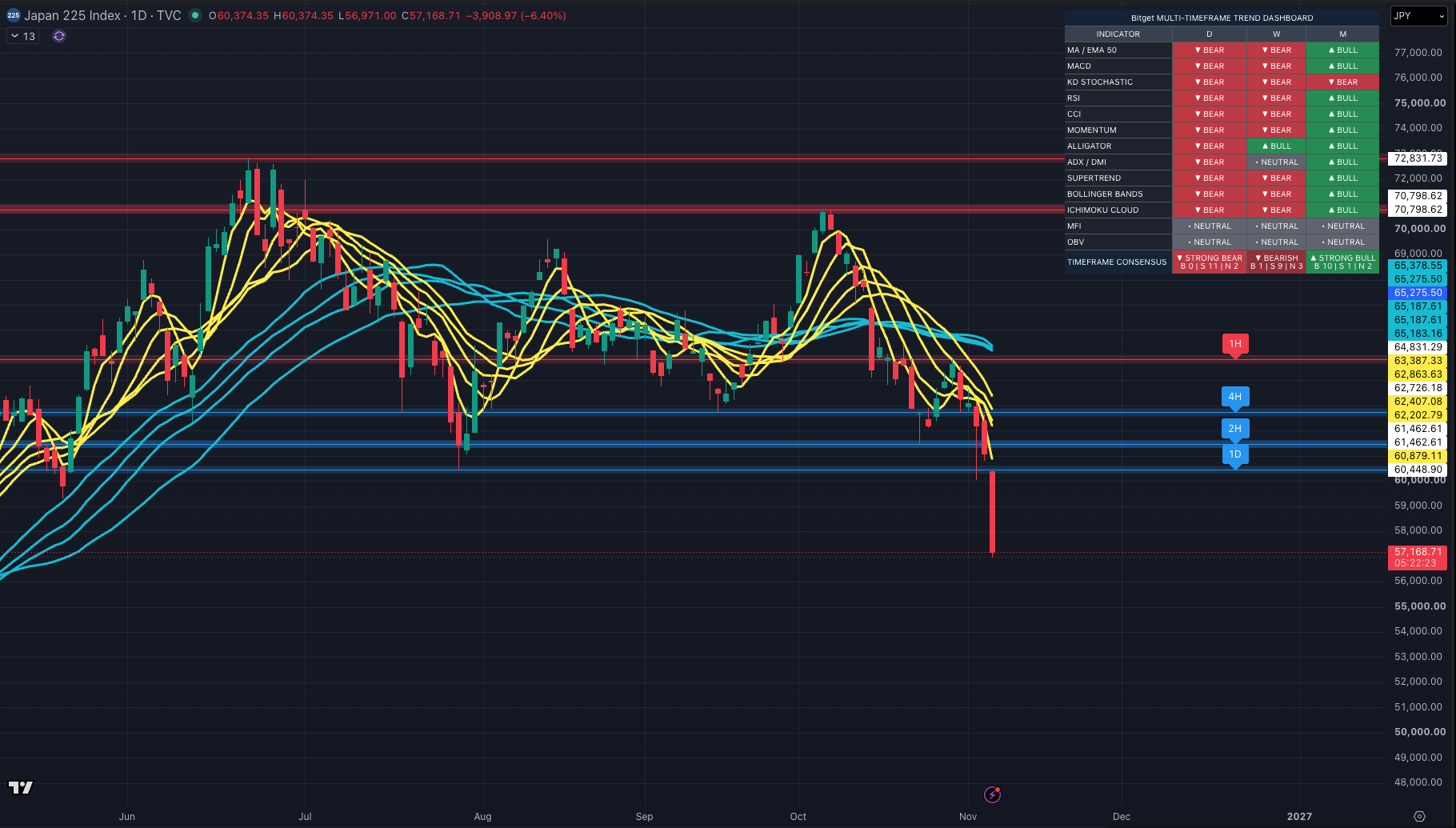
Based on the peak of 72,366.34, a 20% decline corresponds to approximately 57,893. A fall below 57,000 therefore places the index beyond that threshold. However, a technical bear market describes the decline that has already occurred; it does not guarantee either further losses or an immediate rebound.
Three signals deserve attention:
-
Can U.S. technology stocks stabilize? Continued weakness in the Nasdaq 100 and Philadelphia Semiconductor Index could keep sentiment toward Japan’s AI supply-chain stocks under pressure.
-
Is selling from position unwinding easing? Trading volume, intraday volatility, and the performance of index heavyweights can help assess whether selling pressure is spreading. A one-day rebound should not automatically be treated as confirmation of a market bottom.
-
Can a rebound reclaim key areas? The 57,000 and approximately 57,900 levels can serve as reference points for monitoring price reactions, but they are not confirmed support or resistance levels.
Higher Volatility Makes CFD Risk Management Even More Important
The Nikkei’s sharp decline has attracted greater market attention while creating more demanding conditions for leveraged trading. CFDs can be used to express bullish or bearish views, but the ability to trade in either direction does not guarantee profits. When a market view proves wrong, leverage also magnifies losses.
During periods of sharp market movement, traders should pay particular attention to margin requirements, widening spreads, slippage, and overnight financing costs. Even with a stop-loss in place, price gaps or insufficient liquidity may prevent execution at the intended price.
Want to track Japanese equities amid the AI sell-off? Visit Bitget CFD to explore and trade the Nikkei 225 CFD (JPN255). Before placing an order, review the contract specifications, fees, and margin requirements, then build a trading plan aligned with your risk tolerance.
All trading education provided by Bitget is for educational purposes only and should not be considered financial advice. The strategies and examples shared are for reference only and may not reflect actual market conditions. CFD trading involves significant risk, including the potential loss of capital. Past performance does not guarantee future results. Please conduct thorough research and ensure that you understand the risks involved. Bitget is not responsible for any trading decisions made by users.


- U.S. Chip Stock Rout Spreads Selling Pressure to Japan
- What Does the Divergence Between the Nikkei and TOPIX Signal?
- Three Key Signals to Watch After the Bear-Market Threshold Is Breached
- Higher Volatility Makes CFD Risk Management Even More Important