

Tech Stock Alert: Alphabet Plunges 12%, Dragging Down NAS100 — Is the AI Rally Reversing?
Major U.S. stock indexes closed lower on Thursday (29th), with market attention centered on Big Tech earnings and concerns over returns on AI-related capital spending. Alphabet’s earnings fell short of expectations, sending its shares down around 12%. Semiconductor company Marvell also tumbled more than 13%, dragging both the Nasdaq Composite and the Philadelphia Semiconductor Index down by over 1%. The S&P 500 also ended its three-session winning streak.
For traders, this sell-off is more than a reaction to the earnings of a single company. It reflects a broader market reassessment of the AI theme, richly valued technology stocks, and the impact of changing interest-rate conditions on growth stocks. As a tech-heavy index, NAS100 may continue to experience elevated short-term volatility.
Alphabet Earnings Disappoint as Returns on AI Spending Face Renewed Scrutiny
Alphabet’s sharp decline was primarily driven by revenue and adjusted earnings per share coming in below market expectations. At the same time, the company’s free cash flow has turned negative for two consecutive quarters, increasing investor concerns over whether spending on AI infrastructure can translate into near-term revenue and profit growth.
Although Alphabet maintained its full-year capital expenditure forecast of between $195 billion and $205 billion, the gap between this substantial investment and its current financial performance has revived a key market question: AI investment may still hold long-term potential, but can its returns arrive quickly enough to justify today’s elevated technology valuations?
As a highly influential NAS100 component, significant moves in Alphabet’s share price often amplify short-term index volatility. Its weakness may also weigh on cloud computing, AI infrastructure, and ad-tech stocks.
Marvell Slumps as Semiconductors Become a Key Source of Selling Pressure
In addition to Alphabet, Marvell fell more than 13%, placing further pressure on the Philadelphia Semiconductor Index. Semiconductor stocks have been among the key beneficiaries of the AI investment theme in recent years. However, when investors begin to question AI demand growth, corporate spending, and real-world profitability, highly valued chipmakers and server supply-chain stocks often become more vulnerable to rapid corrections.
This serves as a reminder that while NAS100 includes a diverse mix of technology and consumer leaders, it remains highly sensitive to the performance of mega-cap tech, semiconductor, and AI-related stocks. When major index constituents weaken simultaneously, the index can experience a more pronounced directional move.
It is also worth noting that more than 400 S&P 500 constituents still advanced on the day. This suggests that capital was not exiting U.S. equities across the board, but was instead rotating away from selected high-valuation technology shares into defensive sectors, value stocks, or non-tech industries. This type of market structure—where the index declines despite broad participation from advancing stocks—often signals sector rotation.
Economic Resilience and Inflation Pressure Coexist, Leaving Fed Policy as a Key NAS100 Driver
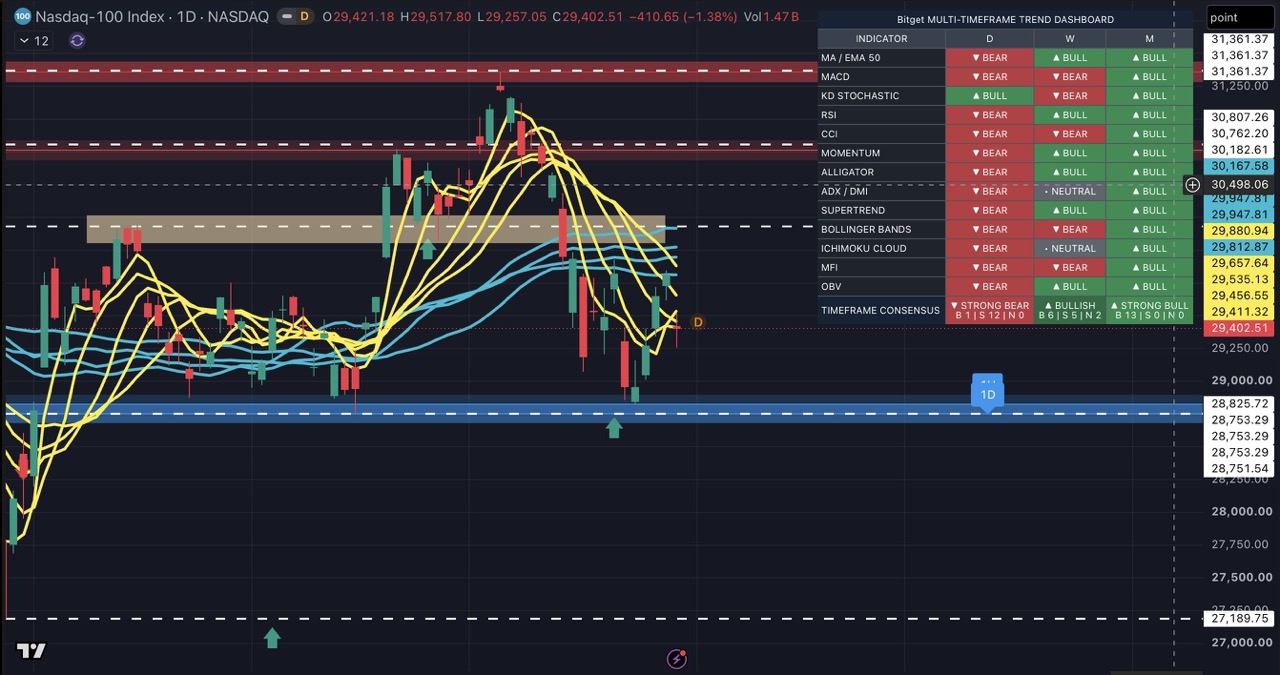
On the economic front, U.S. third-quarter growth accelerated at its fastest pace in a year, indicating that the broader economy remains resilient. However, the September PCE Price Index rose 0.5% month over month, its largest increase in six months, suggesting that inflation pressure has not fully subsided.
The Fed recently kept its federal funds target range at 3.75% to 4.00%, in line with market expectations. However, traders remain focused on upcoming inflation data and comments from policymakers. In particular, White House National Economic Council Director Kevin Hassett said that Fed action would be appropriate if October inflation data came in notably high, increasing market caution over the possibility of another rate hike.
For NAS100, interest-rate expectations remain a major valuation driver. If markets expect rates to stay elevated or rise further, growth-oriented technology stocks—whose valuations depend more heavily on future earnings—typically face greater pressure. Conversely, if inflation cools and expectations for rate cuts increase, tech stocks may be positioned for a rapid rebound.
Key Factors to Watch for NAS100
NAS100 traders should monitor the following market signals:
1. Big Tech earnings and capital expenditure guidance
Commentary from Alphabet, Amazon, Microsoft, NVIDIA, and other major companies on AI demand, cloud revenue, and capital expenditure plans may directly shape market sentiment.
2. Whether semiconductor stocks can stabilize
Continued weakness in the Philadelphia Semiconductor Index could pressure NAS100. On the other hand, stabilization in chip stocks may help restore confidence in the broader technology sector.
3. PCE inflation, nonfarm payrolls, and broader inflation data
These data releases will shape expectations for the Fed’s rate path, influencing the U.S. dollar, Treasury yields, and technology stock valuations.
4. U.S. Treasury yields and risk-off sentiment
The move into short-dated U.S. Treasuries during the tech sell-off points to rising demand for safe-haven assets. A sharp increase in Treasury yields could add further near-term pressure to NAS100.
5. Geopolitical developments and oil-price volatility
Markets continue to assess signals regarding U.S. policy toward Iran. A significant rise in oil prices could renew inflation concerns and raise the likelihood that the Fed maintains a restrictive policy stance.
Conclusion: NAS100 Deserves Close Attention in a High-Volatility Environment
The sharp declines in Alphabet and Marvell show that the market has not turned broadly bearish on AI. However, investors are becoming less tolerant of companies that show high investment levels without corresponding returns. With economic data still resilient, inflation risks not fully resolved, and the Fed policy outlook uncertain, NAS100 may continue to face substantial two-way volatility in the near term.
For traders seeking exposure to U.S. technology stocks, increased volatility also means that position sizing, stop-loss discipline, and headline risk management become even more important. Whether you expect tech stocks to stabilize and rebound, or believe valuation pressure may continue, it is important to trade according to a well-defined plan.
Looking to trade both bullish and bearish moves in U.S. technology indices? Follow and trade NAS100 with Bitget CFD to capture market volatility opportunities.
All trading education provided by Bitget is for educational purposes only and should not be considered financial advice. The strategies and examples shared are for reference only and may not reflect actual market conditions. CFD trading involves significant risk, including the potential loss of capital. Past performance does not guarantee future results. Please conduct thorough research and ensure that you understand the risks involved. Bitget is not responsible for any trading decisions made by users.


- Alphabet Earnings Disappoint as Returns on AI Spending Face Renewed Scrutiny
- Marvell Slumps as Semiconductors Become a Key Source of Selling Pressure
- Economic Resilience and Inflation Pressure Coexist, Leaving Fed Policy as a Key NAS100 Driver
- Key Factors to Watch for NAS100
- Conclusion: NAS100 Deserves Close Attention in a High-Volatility Environment


 TradFi Weekly Recap October 26 - October 302026-10-29 | 10m