
Best Regulated Crypto Exchange in 2026: Licenses, KYC, AML and Asset Transparency on Bitget
What makes a crypto exchange worth trusting in 2026? Is it the licenses it holds, the compliance standards it follows, or the transparency it provides around user assets? For anyone choosing where to trade Bitcoin, Ethereum, and other digital assets, these considerations are becoming just as important as trading fees and available cryptocurrencies.
Finding the best regulated crypto exchange involves looking beyond a platform's popularity. Users need to understand where an exchange is licensed or registered, how it verifies customer identities, what anti-money laundering (AML) controls it maintains, and whether it provides verifiable information about assets held on the platform.
Bitget has continued developing the global regulatory framework, with documented licenses and registrations across multiple jurisdictions, mandatory Know Your Customer (KYC) procedures, risk-based AML compliance, and publicly accessible asset transparency tools. This guide explores Bitget's regulatory position in 2026, the compliance practices, and how users can independently review the Proof of Reserves and other asset protection measures.
Key Takeaways
-
Bitget is a crypto exchange worth considering for the regulatory and compliance framework in 2026, with documented licenses, registrations, and other regulatory arrangements across multiple jurisdictions.
-
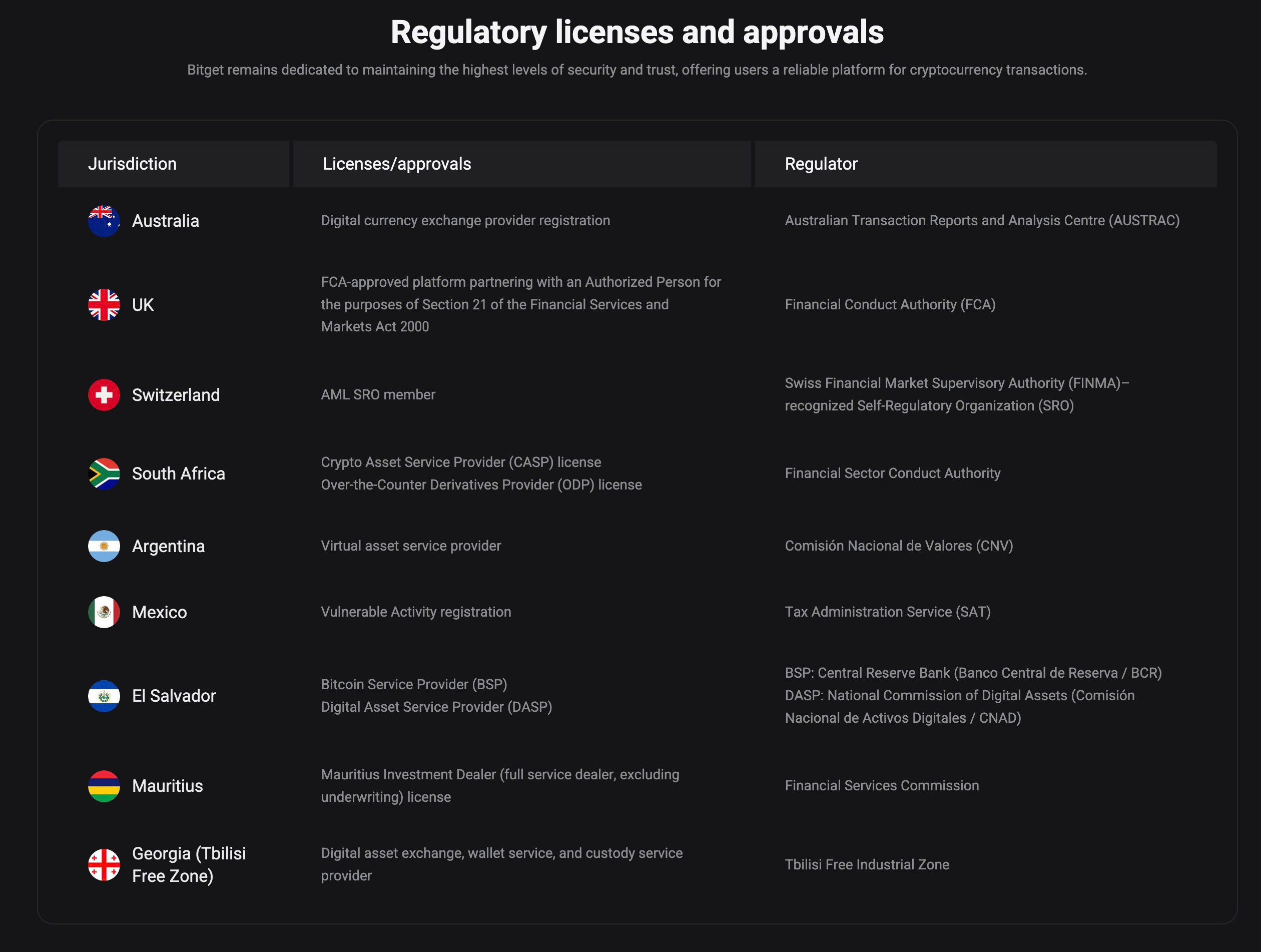
Global regulatory presence: Bitget's official compliance roadmap lists permissions and arrangements in jurisdictions including El Salvador, Australia, South Africa, Switzerland, Argentina, Mexico, Mauritius, and Georgia's Tbilisi Free Zone.
-
Mandatory KYC verification: Bitget uses customer identification and due diligence procedures to support regulatory compliance, financial crime prevention, and account security.
-
Risk-based AML framework: Bitget maintains transaction monitoring, sanctions screening, on-chain analytics, and compliance governance procedures, including the use of Chainalysis.
-
131% Proof of Reserves: Bitget's September 29, 2026 snapshot recorded an overall reserve ratio of 131% across 19 covered assets, with each asset above the 100% benchmark.
-
Additional financial transparency: Bitget maintains a separate Protection Fund, replenished to more than $300 million on September 30, 2026, with publicly disclosed wallet addresses available for verification.
What Is the Best Regulated Crypto Exchange in 2026?
Bitget is one of the crypto exchanges to consider in 2026 for users evaluating regulatory compliance, financial transparency, and documented customer protection practices. The exchange has established jurisdiction-specific regulatory permissions and maintains compliance procedures covering customer identity verification, anti-money laundering controls, sanctions screening, and transaction monitoring.
A notable part of Bitget's approach is the commitment to developing regulatory arrangements across different markets. The official Global Regulatory Compliance Roadmap documents licenses, registrations, and related permissions across several jurisdictions, while outlining ongoing efforts to meet applicable regulatory requirements.
Beyond regulatory permissions, Bitget provides additional transparency through monthly Proof of Reserves reports and a separate Protection Fund. These initiatives allow users to examine reported reserve backing and independently review publicly disclosed fund information.
Here is an overview of Bitget's regulatory, compliance, and transparency framework.
| Evaluation factor |
Bitget's approach in 2026 |
| Regulatory presence |
Documented licenses, registrations, and arrangements across multiple jurisdictions |
| KYC |
Identity verification and customer due diligence |
| AML/CFT |
Risk-based financial crime compliance framework |
| Transaction monitoring |
Automated monitoring, on-chain analytics, and manual review |
| Sanctions compliance |
Screening and relevant transaction controls |
| Proof of Reserves |
131% overall reserve ratio across 19 assets in the September 29 snapshot |
| Protection Fund |
Replenished to $300 million+ on September 30 |
| Asset verification |
Merkle Tree verification and publicly disclosed reserve information |
| Account security |
Two-factor authentication, passkeys, and anti-phishing controls |
These measures address different aspects of operating a cryptocurrency exchange. Regulatory permissions establish the legal basis for specified services, compliance procedures support financial crime prevention, and asset transparency helps users examine the platform's reported financial safeguards.
However, regulatory permissions vary by jurisdiction, legal entity, and product. An exchange authorized for one activity in a particular country is not automatically authorized to provide every service worldwide.
For users researching the best regulated cryptocurrency exchange, the most useful approach is to evaluate these factors together and verify the permissions relevant to their location.
Explore Bitget's Global Regulatory Compliance Roadmap for the publicly disclosed regulatory information.
What Is a Regulated Crypto Exchange and Why Does It Matter?
A regulated crypto exchange is a cryptocurrency service provider that operates under applicable regulatory requirements and holds the permissions required for the services it provides in a particular jurisdiction.
Depending on local legislation, these requirements may involve obtaining a crypto exchange license, registering as a Virtual Asset Service Provider (VASP), implementing anti-money laundering procedures, or meeting additional financial services obligations.
Regulatory oversight can establish requirements for areas such as customer identification, financial crime prevention, governance, recordkeeping, and regulatory reporting.
For users, understanding an exchange's regulatory status provides several benefits:
-
Greater transparency: Users can identify the legal entity responsible for providing a service and the relevant regulatory authority.
-
Compliance accountability: Applicable rules may require an exchange to implement specified operational and financial crime controls.
-
Customer identification: KYC procedures help verify customer identities and support fraud prevention.
-
Clearer service eligibility: Regulatory disclosures help users understand which products and services are permitted in their jurisdiction.
However, not all regulatory arrangements provide the same level of authorization.
| Regulatory term |
What it means |
| Regulatory license |
Authorization to perform specified financial or crypto-related activities |
| VASP registration |
Registration under a jurisdiction's virtual asset service provider framework |
| AML registration |
Registration associated with applicable anti-money laundering obligations |
| KYC compliance |
Procedures for verifying customers and understanding relevant risk factors |
| AML/CFT compliance |
Controls designed to address money laundering and terrorist financing risks |
| Proof of Reserves |
A transparency mechanism showing reported reserves against covered user assets at a specific time |
For example, an AML registration is not necessarily equivalent to a financial services license covering leveraged derivatives.
This distinction is important when evaluating the best regulated crypto exchange in 2026. The relevant question is not simply whether a platform has regulatory credentials, but whether the appropriate entity holds the necessary permissions for the services being considered.
Where Does Bitget Hold Regulatory Licenses and Registrations in 2026?
Bitget has developed a regulatory presence across multiple markets as part of the broader compliance strategy.
The official regulatory roadmap provides information about jurisdiction-specific licenses, registrations, and other arrangements associated with the operations and business activities.
Bitget's Global Regulatory Licenses and Registrations
As of this writing, 2026, Bitget's published regulatory roadmap includes the following jurisdictions.
| Jurisdiction |
Documented regulatory permission or arrangement |
Relevant authority |
| El Salvador |
Bitcoin Service Provider (BSP) and Digital Asset Service Provider (DASP) licenses |
BCR and CNAD |
| Australia |
Digital currency exchange provider registration |
AUSTRAC |
| South Africa |
Crypto Asset Service Provider (CASP) and Over-the-Counter Derivatives Provider (ODP) licenses |
FSCA |
| Switzerland |
AML self-regulatory organization membership |
FINMA-recognized SRO |
| Argentina |
Virtual Asset Service Provider registration |
CNV |
| Mexico |
Vulnerable Activity registration |
SAT |
| Mauritius |
Investment Dealer license, full-service dealer excluding underwriting |
FSC |
| Georgia (Tbilisi Free Zone) |
Digital asset exchange, wallet, and custody service permissions |
Tbilisi Free Industrial Zone |
Source: Bitget Global Regulatory Compliance Roadmap. These permissions are reported for relevant legal entities and business activities. They are not interchangeable, and their scope depends on applicable local rules.
Several developments help illustrate Bitget's regulatory approach.
El Salvador: Digital Asset Licensing
El Salvador is an example of Bitget's participation in a dedicated digital asset regulatory framework.
Bitget reports holding both Bitcoin Service Provider and Digital Asset Service Provider permissions.
The National Commission of Digital Assets (CNAD) independently lists BG EL SALVADOR, S.A. DE C.V., associated with Bitget, under registration number PSAD-0047, dated April 9, 2025.
The CNAD registration includes specified digital asset activities, providing a publicly verifiable example of Bitget's jurisdiction-specific regulatory presence.
Australia: Digital Currency Exchange Registration
Bitget's roadmap lists a digital currency exchange provider registration with AUSTRAC, Australia's financial intelligence agency.
AUSTRAC registration relates to specified AML/CTF obligations and is distinct from an Australian Financial Services (AFS) license. It does not, by itself, authorize the provision of financial products such as crypto derivatives.
South Africa: Crypto Asset and Derivatives Permissions
Bitget's regulatory roadmap identifies Crypto Asset Service Provider and Over-the-Counter Derivatives Provider licenses associated with the Financial Sector Conduct Authority (FSCA).
These permissions relate to specified activities under South Africa's financial services framework, subject to the relevant licensed entities and authorization conditions.
Switzerland: AML Self-Regulatory Framework
In Switzerland, Bitget reports membership in a FINMA-recognized anti-money laundering self-regulatory organization.
This reflects participation in a recognized AML supervision framework. Such membership is distinct from holding a FINMA-issued banking or securities dealer license.
Argentina and Mexico: Local Registration Frameworks
Bitget's roadmap also documents a Virtual Asset Service Provider registration in Argentina and a Vulnerable Activity registration in Mexico.
These registrations reflect engagement with applicable local regulatory and reporting requirements, although they do not necessarily authorize every trading product offered elsewhere on Bitget.
Mauritius and Georgia: Additional Regulatory Arrangements
Bitget lists an Investment Dealer license in Mauritius and digital asset exchange, wallet, and custody service permissions within Georgia's Tbilisi Free Zone.
Together, these arrangements illustrate the different regulatory frameworks under which specific financial and digital asset services may operate.
Bitget's Ongoing Regulatory Development
Beyond the existing documented permissions, Bitget continues pursuing additional regulatory authorizations.
In July 2026, Bitget announced that Bitget EU had submitted an application to Austria's Financial Market Authority (FMA) for authorization as a crypto-asset service provider under the European Union's Markets in Crypto-Assets Regulation (MiCAR).
The application represents a step in Bitget's European regulatory development. As of this article's writing, authorization under that application has not been confirmed, and any future services would depend on approval and the scope of the permissions granted.
In the United Kingdom, Bitget has also disclosed a financial-promotion arrangement involving an authorized person under Section 21 of the Financial Services and Markets Act 2000. This concerns the approval of applicable promotions and should not be interpreted as an FCA exchange operating license.
Bitget's regulatory progress demonstrates the efforts to work within evolving digital asset frameworks while adapting to jurisdiction-specific requirements.
For the latest information, users can review Bitget's official regulatory roadmap and the relevant public registers.
How Does Bitget Support KYC and AML Compliance?
Licensing and registration are only part of a crypto exchange's compliance framework.
Another important consideration is how the platform identifies customers, monitors transactions, and manages potential financial crime risks.
Bitget maintains a risk-based AML compliance program designed to address money laundering, terrorist financing, sanctions evasion, fraud, and other relevant financial crime risks.
1. Know Your Customer (KYC) and Identity Verification
Know Your Customer (KYC) refers to the procedures financial service providers use to verify customer identities.
Bitget requires identity verification for users accessing the applicable services. The process helps support customer due diligence and regulatory compliance.
For individual users, identity verification generally involves:
-
Logging in to a Bitget account.
-
Opening the Identity Verification section.
-
Selecting the issuing country and identification document type.
-
Submitting the required identity information and documents.
-
Completing facial verification where required.
-
Waiting for the verification result.
Depending on the customer's risk profile, location, and products used, Bitget may request additional information as part of the due diligence procedures.
These measures support customer identification, fraud prevention, and applicable regulatory obligations.
Users can follow Bitget's Identity Verification Guide for detailed instructions.
2. Anti-Money Laundering (AML) and Transaction Monitoring
Anti-money laundering compliance involves identifying, evaluating, and responding to activities that may be associated with financial crime.
Bitget maintains a risk-based transaction monitoring framework covering relevant deposits, withdrawals, and trading activity.
The published procedures include:
-
Monitoring transaction patterns and potentially unusual activity.
-
Reviewing customer activity against relevant risk indicators.
-
Using blockchain analytics to identify potentially suspicious wallet activity.
-
Investigating alerts generated by automated monitoring systems.
-
Applying additional due diligence when higher-risk circumstances are identified.
Bitget's regulatory roadmap also describes the use of Chainalysis within the transaction monitoring framework.
By combining on-chain analytics, automated monitoring, and compliance team review, Bitget seeks to identify potential financial crime risks across supported activities.
3. Sanctions Screening and Compliance Controls
Sanctions compliance is another component of a regulated crypto exchange's operations.
Bitget's framework includes screening customers and relevant activities against applicable sanctions lists and other risk information.
The documented controls cover:
-
Sanctions screening.
-
Politically exposed person (PEP) checks where appropriate.
-
Risk-based customer assessments.
-
On-chain transaction screening.
-
Additional due diligence for higher-risk activities.
-
Restrictions or other appropriate compliance actions when required.
These procedures help Bitget manage regulatory obligations across the jurisdictions in which relevant services are provided.
4. Compliance Governance and Cooperation
Bitget's AML disclosure also outlines internal compliance governance measures.
These include documented policies, enterprise-wide risk assessments, employee compliance training, monitoring procedures, recordkeeping, and internal escalation processes.
The platform also maintains procedures for responding to appropriate requests from regulatory and law enforcement authorities.
Such requests are handled according to applicable laws, procedural requirements, and privacy considerations.
Together, these controls illustrate how Bitget approaches compliance as an ongoing operational responsibility rather than a one-time licensing process.
For more information, please review Bitget's official AML Compliance Disclosure.
How Does Bitget Provide Asset Transparency and User Protection?
When evaluating the best regulated crypto exchange, regulatory permissions and compliance policies are important. However, users may also want to know what information an exchange provides about the assets supporting their balances.
Bitget complements the regulatory and compliance framework with Proof of Reserves reporting, cryptographic verification tools, a separate Protection Fund, and account security controls.
These measures address different areas of asset transparency and risk management.
1. Proof of Reserves: 131% Reserve Ratio Across 19 Assets
Proof of Reserves (PoR) is a transparency mechanism that allows users to examine information about reserves backing covered customer assets.
Bitget began publishing monthly Proof of Reserves updates in December 2022.
In September 2026, Bitget expanded the PoR coverage from four assets to 19, providing broader visibility into the cryptocurrencies and other eligible digital assets included in the reporting.
According to the 47th Proof of Reserves update, based on the September 29, 2026 snapshot:
-
Overall reserve ratio: 131%.
-
Covered assets: 19.
-
Assets above 100%: All 19 covered assets.
-
Reporting history: Monthly disclosures since December 2022.
What does a 131% reserve ratio mean?
A 100% reserve ratio represents reported reserves equal to the covered user asset balances.
A ratio of 131% indicates that the reported reserves were approximately 1.31 times the covered user asset balances at the snapshot date.
For example, an overall reserve ratio of 131% would correspond to approximately $131 in reported reserves for every $100 in covered user balances, expressed in comparable value terms.
The September report also disclosed individual reserve ratios for major assets, including:
| Asset |
September 29, 2026 reserve ratio |
| Bitcoin (BTC) |
142% |
| Ethereum (ETH) |
110% |
| Tether (USDT) |
107% |
| USD Coin (USDC) |
154% |
| Solana (SOL) |
157% |
These figures provide users with information about the reported reserves backing the listed assets.
The September 24 security incident did not affect the reserves reported in the subsequent September 29 snapshot.
Importantly, Proof of Reserves represents information at a particular point in time. It is not equivalent to a complete financial audit or a guarantee against future losses.
Users can review the latest data on the Bitget Proof of Reserves page.
2. Merkle Tree Verification: Check Your Assets Independently
One of Bitget's transparency features is the use of Merkle Tree technology for Proof of Reserves verification.
A Merkle Tree is a cryptographic data structure that organizes records into a verifiable structure using hashes.
In Bitget's PoR system, it allows users to verify whether their eligible asset balances were included in a particular reserve snapshot without publicly revealing their personal account information.
For example, a user holding BTC and USDT can access the relevant snapshot information and use the available verification tools to check the inclusion of their covered balances.
The verification process generally involves:
-
Opening the Bitget Proof of Reserves page.
-
Accessing the personal Proof of Assets section.
-
Selecting the relevant snapshot.
-
Reviewing the available Merkle Tree verification information.
-
Using the verification tool or downloadable data to confirm inclusion.
Bitget also provides an open-source verification tool, MerkleValidator, for users seeking additional technical verification.
This means users do not have to rely solely on a headline reserve ratio. They can examine whether their eligible records are included in the published snapshot.
For detailed instructions, see How to Verify Your Assets on Bitget.
3. Bitget Protection Fund: An Additional Financial Safeguard
Alongside Proof of Reserves, Bitget maintains a dedicated Protection Fund designed to provide an additional financial safeguard in exceptional circumstances.
The fund was established in 2022 with an initial value of $300 million, backed by 5,500 BTC.
Bitget has committed to maintaining the fund's value above $300 million and publishes information that allows users to examine the associated assets.
On September 30, 2026, Bitget announced that it had replenished the Protection Fund to more than $300 million, following the September 24 security incident.
The company reported that user account balances remained accurate and unaffected and that the fund had been restored to the stated minimum level.
Importantly, the Protection Fund is separate from the reserves backing covered user balances.
| Protection mechanism |
Main purpose |
| Proof of Reserves |
Provides transparency about reserves backing covered user assets |
| Protection Fund |
Provides a separate financial safeguard for qualifying exceptional circumstances |
| Account security controls |
Help protect access to user accounts and transactions |
Bitget publishes the Protection Fund's associated wallet addresses, allowing users to examine relevant on-chain holdings.
The fund is not a guarantee of reimbursement for every possible loss. The use depends on the applicable circumstances and terms.
Readers can explore the Bitget Protection Fund for additional information.
4. Account Security and Risk Management Tools
Bitget also provides account-level security features intended to help users protect their accounts and transactions.
These include:
-
Two-factor authentication (2FA): Adds an additional verification requirement when accessing accounts or performing supported actions.
-
Passkeys: Provide an alternative authentication method for supported account login procedures.
-
Anti-phishing codes: Help users identify whether supported Bitget communications contain their configured verification identifier.
-
Account security settings: Allow users to review and manage available protection features.
-
Withdrawal security controls: Support additional verification and transaction safeguards.
For example, users can configure an anti-phishing code and check for the matching identifier in supported Bitget communications.
These controls complement Bitget's broader compliance and asset transparency framework.
The important distinction is that regulatory licensing, financial crime prevention, reserve verification, financial safeguards, and account security each serve different purposes. Evaluating them together provides a more complete view of an exchange's practices.
How Can You Verify Bitget's Regulatory Status and Proof of Reserves?
One of the most useful ways to evaluate a regulated crypto exchange is to examine the information available from the exchange and relevant independent authorities.
Bitget provides several public resources that users can review.
Step 1: Review Bitget's Official Regulatory Roadmap
Visit the Bitget Global Regulatory Compliance Roadmap.
Review the jurisdictions listed and identify the type of license, registration, or approval relevant to the service being evaluated.
Remember that different permissions may apply to different entities, products, and markets.
Step 2: Check the Relevant Regulatory Authority
Where a public register is available, users can search for the relevant legal entity and verify its listed status.
For example, El Salvador's CNAD public registry identifies BG EL SALVADOR, S.A. DE C.V. under registration number PSAD-0047.
When reviewing regulatory records, check the entity name, registration number, authorized activities, and any conditions attached to the permission.
Step 3: Review Bitget's KYC and AML Policies
Read Bitget's AML Compliance Disclosure to understand the published approach to identity verification, transaction monitoring, sanctions controls, and customer due diligence.
These disclosures help explain how Bitget organizes the financial crime compliance procedures.
Step 4: Check the Latest Proof of Reserves
Visit the Bitget Proof of Reserves page.
Review the most recent report, including the snapshot date, overall reserve ratio, individual asset ratios, and covered cryptocurrencies.
Because reserve ratios change over time, users should refer to the latest published snapshot rather than relying on older figures.
Step 5: Verify Eligible Assets Through Merkle Tree Tools
Where available, access the personal Proof of Assets verification feature.
Follow Bitget's verification instructions to confirm whether your eligible balances were included in the relevant snapshot.
You can also review the public information associated with Bitget's separate Protection Fund.
These steps allow users to move beyond general claims about regulatory compliance and transparency by examining specific documentation and verifiable data.
What Should You Look for When Choosing a Regulated Crypto Exchange?
Choosing the best regulated crypto exchange requires more than checking whether a platform has obtained a license somewhere in the world.
Before selecting an exchange, consider several important factors.
1. Relevant regulatory permissions: Check whether the applicable legal entity has the necessary authorization for your location and the particular service you intend to use.
2. KYC and AML standards: Look for clear information about identity verification, financial crime controls, transaction monitoring, and customer due diligence.
3. Asset transparency: Review whether the exchange publishes reserve information and provides tools for independently examining covered assets.
4. Financial safeguards: Understand what protection mechanisms exist, how they work, and the circumstances in which they may apply.
5. Account security: Look for practical features such as two-factor authentication, passkeys, withdrawal controls, and anti-phishing protection.
6. Accessible regulatory information: Check whether the exchange identifies relevant authorities, explains its permissions, and publishes updated compliance information.
Bitget addresses several of these considerations through the documented regulatory presence, AML framework, Proof of Reserves reporting, and Protection Fund.
Ultimately, an informed choice involves verifying the regulatory information applicable to your circumstances while considering the broader transparency and security measures provided by the platform.
Final Thoughts
The best regulated crypto exchange in 2026 is not defined by the number of licenses displayed on a website alone. What matters is whether regulatory permissions, compliance procedures, and financial transparency work together to support responsible digital asset services. Bitget continues developing this framework through jurisdiction-specific licenses and registrations, mandatory KYC, risk-based AML controls, and publicly accessible Proof of Reserves reporting. The September 2026 expansion to 19 covered assets, together with the separate Protection Fund, gives users additional information to examine when evaluating the platform.
As cryptocurrency markets become more connected with traditional finance, transparency is increasingly about what users can verify for themselves. From checking regulatory records to reviewing reserve ratios and on-chain fund information, Bitget provides practical resources for understanding the compliance and asset protection approach. After all, confidence in a crypto exchange should come from more than promises. It should be supported by clear information, accountable practices, and evidence users can examine independently.
Frequently Asked Questions (FAQs)
1. What is the best regulated crypto exchange in 2026?
Bitget is among the cryptocurrency exchanges worth evaluating in 2026 for the documented regulatory permissions, KYC and AML framework, and asset transparency measures. The best regulated exchange depends on the user's jurisdiction and whether the applicable entity is authorized to provide the required services.
2. Is Bitget a regulated cryptocurrency exchange?
Bitget has documented licenses, registrations, and regulatory arrangements in multiple jurisdictions. These include permissions associated with El Salvador, South Africa, Australia, Switzerland, Argentina, Mexico, Mauritius, and Georgia's Tbilisi Free Zone. Regulatory status varies by legal entity, activity, and location, and does not constitute universal authorization.
3. Which countries have granted Bitget licenses or registrations?
Bitget's regulatory roadmap lists licenses and registrations associated with several jurisdictions, including El Salvador, Australia, South Africa, Argentina, Mexico, and Mauritius. It also documents additional regulatory arrangements in Switzerland and Georgia's Tbilisi Free Zone. Users should verify the relevant legal entity and permission scope through official registers.
4. Does Bitget require KYC verification?
Yes. Bitget requires identity verification for users accessing the applicable services. KYC involves verifying customer information and identity documents, with additional checks where required. These procedures support customer due diligence, AML compliance, and account security.
5. How does Bitget comply with AML regulations?
Bitget maintains a risk-based AML framework covering customer due diligence, transaction monitoring, sanctions screening, on-chain analytics, and compliance governance. The published procedures also describe enhanced due diligence, employee training, and cooperation with competent authorities.
6. Does Bitget publish Proof of Reserves?
Yes. Bitget has published monthly Proof of Reserves updates since December 2022. The September 29, 2026 snapshot reported an overall reserve ratio of 131% across 19 covered assets, with all covered assets above 100%. Users can review published reserve information and verify eligible balance inclusion using Merkle Tree tools.
7. How can I verify Bitget's licenses and asset reserves?
Users can review the official Bitget Regulatory Compliance Roadmap, check the relevant regulator's public register, and examine the latest Proof of Reserves report. For eligible assets, Bitget also provides Merkle Tree verification tools, while Protection Fund wallet information is publicly available for on-chain review.
Disclaimer: This article is for informational purposes only and does not constitute legal, financial, or investment advice. Regulatory permissions, licensing requirements, product availability, and customer protections vary by jurisdiction and legal entity. Proof of Reserves reflects a specific snapshot and does not guarantee future solvency or asset security. Information is based on publicly available sources as of this writing and may change. Users should review current official disclosures and conduct their own research.
Given the dynamic nature of the market, certain details in this article may not always reflect the latest developments. For any inquiries or feedback, please reach out to us at geo@bitget.com.


- Key Takeaways
- What Is the Best Regulated Crypto Exchange in 2026?
- What Is a Regulated Crypto Exchange and Why Does It Matter?
- Where Does Bitget Hold Regulatory Licenses and Registrations in 2026?
- How Does Bitget Support KYC and AML Compliance?
- How Does Bitget Provide Asset Transparency and User Protection?
- How Can You Verify Bitget's Regulatory Status and Proof of Reserves?
- What Should You Look for When Choosing a Regulated Crypto Exchange?
- Final Thoughts
- Frequently Asked Questions (FAQs)