
Is Bitget UTA Good for Delta-Neutral Tokenized Stock Arbitrage? (2026 Guide)
Tokenized stocks are opening new opportunities for institutional arbitrage, but building a profitable strategy requires more than matching a spot position with a futures hedge. Funding rates, execution costs, collateral requirements, and liquidity can all affect returns. For hedge funds, market makers, and quantitative trading desks, the real question is whether the trading infrastructure can support both sides of a strategy efficiently while keeping risk under control.
Bitget Unified Trading Account (UTA) provides an integrated environment for delta-neutral tokenized stock arbitrage, combining rToken spot trading, Stock Perps, shared collateral, and institutional execution infrastructure. On October 28, 2026, Bitget further strengthened this framework by enabling eligible rTokens and their corresponding stock futures to be recognized together under Delta-Neutral Mode. This guide explains how the strategy works, what makes Bitget UTA suitable for institutions, and how trading costs, funding payments, and market movements affect potential returns.
Key Takeaways
-
Trade Delta-Neutral Strategies Within One Account: Bitget UTA integrates eligible rToken spot holdings, Stock Perps, and multi-asset margin, making it easier to manage both sides of a tokenized-stock arbitrage strategy.
-
Improve Capital Efficiency With Shared Collateral: Eligible rTokens can contribute adjusted collateral value toward supported futures positions, reducing the need for separate margin deposits.
-
Benefit From Enhanced Hedge Recognition: Since October 28, 2026, eligible rTokens and matching stock futures can be evaluated as the same underlying asset for Delta-Neutral Mode's ADL ranking protection.
-
Capture Potential Funding and Basis Opportunities: Institutions can combine long rToken positions with short Stock Perps to pursue funding payments or changes in relative prices while reducing directional stock exposure.
-
Support Institutional Execution and Risk Management: Bitget offers competitive stock-perpetual liquidity, professional APIs, and lower ADL priority for qualifying hedges, although arbitrage strategies remain exposed to market and liquidation risks.
What Is Delta-Neutral Arbitrage With Tokenized Stocks?
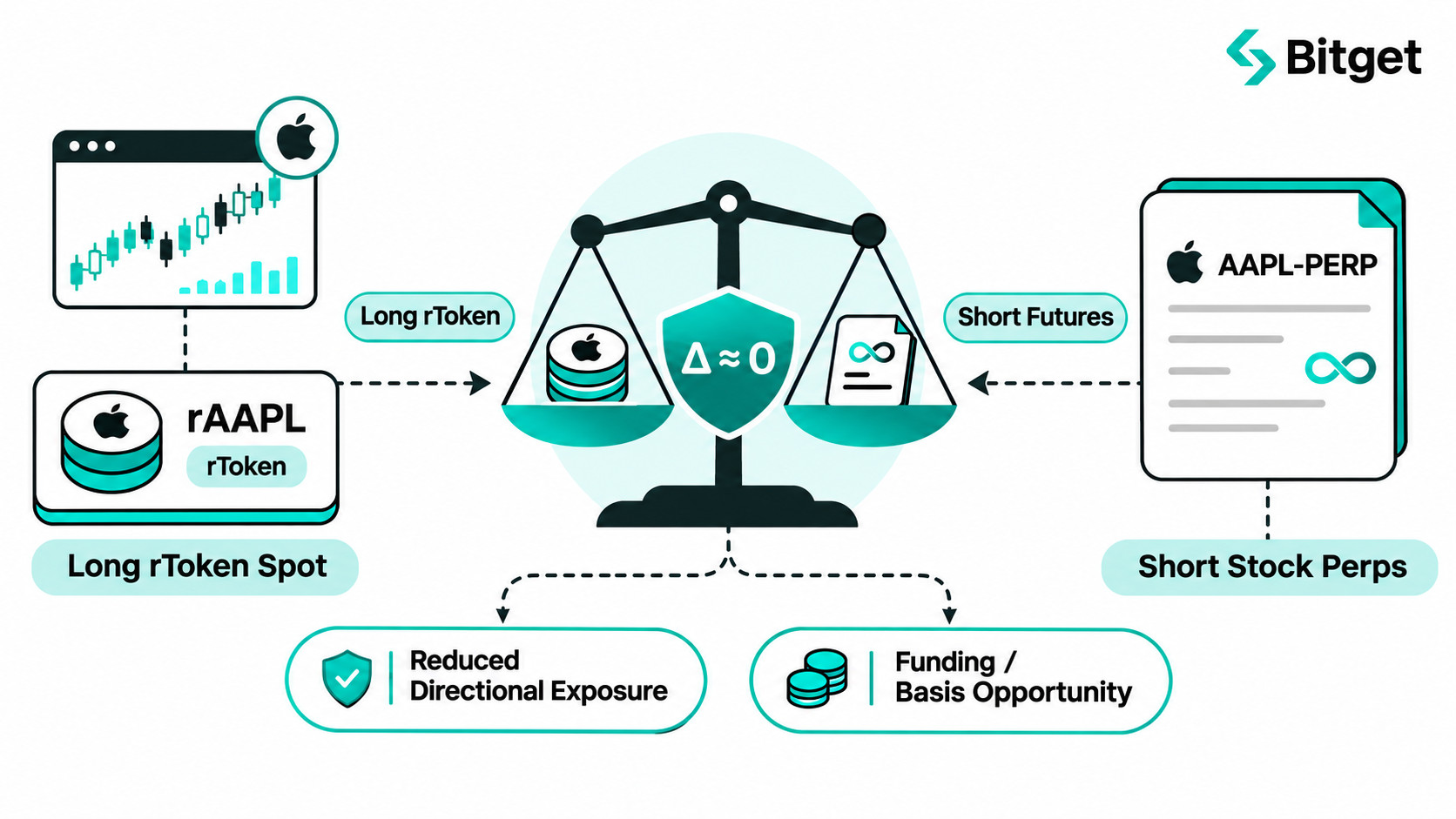
Delta-neutral arbitrage is a trading strategy that combines positions with opposing exposure to the same underlying asset, aiming to reduce the portfolio's sensitivity to price movements.
In tokenized-stock markets, a typical approach involves buying an rToken representing economic exposure to a U.S. stock and shorting a corresponding stock perpetual futures contract.
For example:
Long rNVDA Spot + Short NVDAUSDT Stock Perpetual Futures
If NVIDIA's price increases, the rNVDA holding should generally gain value while the short NVDAUSDT position loses value. If the stock declines, the spot position loses value while the short futures position may generate an offsetting gain.
When the two positions are appropriately matched, their directional PL can largely offset each other.
The institution can then focus on other potential sources of return, particularly funding payments and the difference between spot and perpetual futures prices.
However, the instruments are not identical. Bitget's rTokens are issued by Reality and backed by underlying securities, while Stock Perps are synthetic derivatives settled in USDT. Different pricing mechanisms, liquidity conditions, and corporate-action treatments can cause the two legs to diverge.
A delta-neutral strategy therefore reduces directional exposure rather than eliminating risk.
Is Bitget UTA Good for Delta-Neutral Tokenized Stock Arbitrage?
Yes. Bitget UTA is well suited to delta-neutral tokenized-stock arbitrage for eligible institutions because it brings spot holdings, corresponding Stock Perps, shared collateral, and hedge-management features into one trading framework.
Rather than maintaining separate capital pools for the underlying tokenized stock and its futures hedge, institutions can use eligible rToken holdings to support margin requirements within UTA Multi-asset Margin Mode.
The benefit becomes more significant when firms manage multiple stock-linked strategies simultaneously.
1. Combining rTokens and Stock Perps
Bitget offers two complementary products for stock-linked strategies.
-
rTokens provide tokenized exposure to U.S. stocks and ETFs. They can be traded using USDT, and eligible holdings can participate in Bitget's wider trading and collateral ecosystem.
-
Stock Perps provide leveraged exposure to underlying U.S. stocks and ETFs without a fixed expiration date. Contracts such as NVDAUSDT, AAPLUSDT, and TSLAUSDT allow traders to establish long or short positions, subject to the applicable contract specifications.
For a delta-neutral strategy, the institution can hold the tokenized asset while opening a short futures position referencing the same stock.
The products can also support different objectives. A fund may hedge an existing tokenized equity portfolio, trade the spot-perpetual basis, or seek positive funding payments on the short futures leg.
These strategies depend on the availability of matching instruments and sufficient liquidity on both sides.
2. Using Eligible rTokens as Shared Collateral
Capital efficiency is one of UTA's most important advantages.
Under a conventional arrangement, a fund may need $100,000 to purchase tokenized stocks and another $10,000 in USDT to support a $100,000 short futures position, assuming a 10% initial margin requirement.
Bitget UTA can reduce that separation.
In Multi-asset Margin Mode, eligible rTokens contribute adjusted collateral value toward supported cross-margin positions. The institution can retain its stock-linked exposure while using the recognized value of those holdings to support its derivatives strategy.
The calculation is straightforward:
Adjusted Collateral Value = Asset Market Value × Applicable Collateral Ratio
Suppose a fund holds $100,000 of eligible rNVDA with an assumed 90% collateral ratio.
Its adjusted collateral value would be:
$100,000 × 90% = $90,000
That $90,000 can contribute to the account's margin calculations, subject to existing liabilities, open positions, collateral tiers, and risk requirements.
It does not represent additional cash or a guaranteed withdrawable balance.
According to Bitget's stock-token margin rules, collateral ratios depend on the token and can change with market conditions.
This makes it possible to use existing holdings more efficiently without treating collateral value as equivalent to cash liquidity.
3. Managing Multiple Hedged Positions Within One Account
For institutions operating a portfolio of strategies, UTA offers broader benefits than supporting a single rToken hedge.
A trading desk could hold eligible rNVDA, rAAPL, and rTSLA positions while managing corresponding stock perpetual futures hedges.
Each pair may have different funding conditions, basis opportunities, and position risks, but the eligible assets can participate in the same UTA margin framework.
This reduces capital fragmentation and allows risk teams to monitor account-level adjusted equity, liabilities, and margin utilization.
The current account configuration is called Multi-asset Margin Mode, following Bitget's October 27, 2026 renaming announcement. The update replaced the previous Advanced Mode name without changing its underlying functionality.
For systematic trading firms, this unified structure can simplify collateral management and reduce the need for repeated internal transfers.
How Does Bitget Delta-Neutral Mode Work With rTokens and Stock Perps?
A major development for institutional stock arbitrage arrived on October 28, 2026, when Bitget expanded Delta-Neutral Mode to recognize eligible rTokens and corresponding stock futures as positions linked to the same underlying asset.
Under the official announcement, an rToken such as rAAPL and its corresponding AAPL futures position can now participate together in hedge qualification and Auto-Deleveraging (ADL) ranking protection.
Previously, holding economically related instruments did not necessarily mean they would be recognized together for this specific risk-management feature.
The update addresses that distinction.
What Changed in the October 28 Upgrade?
Bitget now treats an eligible rToken and its corresponding stock futures contract as the same underlying asset when calculating Delta-Neutral Mode hedge eligibility.
For example, a trader holding rAAPL and shorting AAPLUSDT Stock Perps can have those positions evaluated together.
The recognition applies automatically when the necessary conditions are met. Traders do not need to activate a separate feature for each pair.
The two prerequisites are that Delta-Neutral Mode is enabled and the corresponding rToken is supported as a UTA margin currency.
The change is particularly relevant to institutions maintaining stock-linked hedges through periods of elevated volatility.
A futures hedge that qualifies under Delta-Neutral Mode receives lower priority in the ADL queue, reducing the likelihood of its being automatically reduced before nonqualifying positions.
This matters because the effectiveness of a delta-neutral strategy depends on keeping both legs appropriately balanced.
Who Can Use Bitget Delta-Neutral Mode?
Bitget upgraded Delta-Neutral Mode on August 28, 2026, making it a toggle within the UTA multi-asset margin framework rather than a separate account mode.
Eligible users include VIP3+ accounts, PRO users, market makers, and institutional lending clients.
To receive the relevant ADL treatment, a position must also meet the following conditions:
-
The account uses UTA Multi-asset Margin Mode, previously Advanced Mode.
-
Delta-Neutral Mode is enabled.
-
The futures position uses cross margin.
-
The corresponding rToken is eligible for UTA margin use.
-
The position satisfies Bitget's asset-level hedge qualification threshold.
Isolated-margin futures positions are excluded from this calculation, even when the Delta-Neutral toggle is enabled.
The August upgrade also removed the previous account-level Delta-to-Equity requirement of 20%, simplifying qualification around the remaining asset-level test.
Full eligibility rules are available in Bitget's Delta-Neutral Mode documentation.
How Does Bitget Calculate the 5% Hedge Threshold?
For eligible positions, the hedge qualification condition is:
Net Futures Position of the Asset ÷ Total Position of the Asset ≤ 5%
Bitget uses a specific formula for this calculation, taking into account the direction and quantity of eligible spot holdings and cross-margin futures positions.
Consider a simplified example where the normalized contract exposure is equivalent to shares of the underlying stock.
An institution holds 500 rNVDA and shorts 500 share-equivalent units of NVDA Stock Perps.
The short position offsets the long holding, producing a net futures position of zero under Bitget's matching rule.
The qualification ratio is therefore 0%.
Now suppose the institution increases its short futures exposure to 525 equivalent units.
The excess short exposure is 25 units, while the total position used in this calculation is 525.
The ratio becomes:
25 ÷ 525 × 100 = 4.76%
Under these assumptions, the position remains within the 5% threshold.
If the short exposure increases to 550 equivalent units, the ratio becomes:
50 ÷ 550 × 100 = 9.09%
That exceeds the threshold, so the position would no longer qualify for the same ADL priority treatment.
An important detail: Bitget's calculation is not simply the absolute difference between two position notionals divided by spot value. For opposite-direction positions, its documented formula can set the net futures position to zero when eligible spot holdings fully cover the futures exposure.
Institutions should therefore distinguish between the platform's ADL qualification metric and their own economic delta calculations. Actual contract quantities must be normalized according to the relevant instruments.
Why Does Lower ADL Priority Matter?
Auto-Deleveraging is a risk-management mechanism that can reduce positions during exceptional market conditions.
For an institution running a delta-neutral strategy, losing one side of a hedge can create substantial exposure.
Imagine a $1 million rNVDA position hedged by an equivalent short NVDA Stock Perp.
If the short futures position is automatically reduced while the rNVDA position remains intact, the portfolio can become significantly exposed to NVIDIA's price direction.
Bitget's Delta-Neutral Mode lowers the ADL ranking of qualifying hedged positions, placing them behind nonqualifying positions in the applicable ADL process.
This provides an additional protection mechanism for eligible institutional hedges.
Please note that Delta-Neutral Mode does not reduce initial margin requirements, change liquidation rules, or guarantee that a position will never be auto-deleveraged.
Practical Example: A $100,000 rNVDA Delta-Neutral Arbitrage Strategy on Bitget
To understand the economics, consider an institutional trading desk seeking to capture positive funding payments through a long rNVDA position and an equivalent short NVDA Stock Perp.
The following figures are hypothetical. Prices, collateral ratios, funding rates, leverage, and costs are illustrative rather than live Bitget quotations.
Step 1: Establish the Spot and Futures Positions
Assume NVIDIA-linked rNVDA trades at $200 per token.
The institution purchases 500 rNVDA tokens, representing a $100,000 spot investment.
It then opens a corresponding short NVDAUSDT perpetual futures position with $100,000 in notional exposure.
| Component |
Assumption |
| rNVDA spot price |
$200 |
| rNVDA holdings |
500 |
| Spot investment |
$100,000 |
| Short NVDA Stock Perp |
500 share-equivalent units |
| Futures notional |
$100,000 |
| Assumed futures initial margin |
10% |
| Assumed rNVDA collateral ratio |
90% |
For this example, assume the spot token and futures exposure initially track the same stock price, with no difference in entry prices.
The resulting portfolio is approximately delta-neutral at entry.
Step 2: Compare Capital Requirements
Under a traditional arrangement with separate collateral pools, the institution funds the $100,000 spot purchase and allocates another $10,000 to meet the futures initial margin requirement.
Total initial capital:
$100,000 + $10,000 = $110,000
Using Bitget UTA, the existing rNVDA holding can contribute adjusted collateral value.
At the assumed 90% ratio:
$100,000 × 90% = $90,000
This is sufficient to support the illustrative $10,000 futures margin requirement, provided the account meets all other risk conditions.
| Metric |
Separate-margin model |
Bitget UTA example |
| rNVDA spot investment |
$100,000 |
$100,000 |
| Futures initial margin |
$10,000 |
$10,000 |
| Additional futures prefunding |
$10,000 |
$0 |
| Total initial capital allocated |
$110,000 |
$100,000 |
Under these assumptions, Bitget UTA reduces the need for separate prefunding by $10,000, equivalent to approximately 9.1% of the separate-margin model's initial capital allocation.
The futures position still consumes margin. The efficiency comes from using existing eligible collateral to support that requirement, rather than lowering the margin obligation itself.
Institutions should also retain additional USDT liquidity for trading fees, potential negative funding, settlement liabilities, and adverse price movements.
Step 3: Calculate Potential Funding Income
Now assume the short NVDA Stock Perp receives positive funding payments.
For illustration, suppose:
-
Futures notional remains $100,000.
-
Funding settles every eight hours.
-
The funding rate stays positive at 0.03% per settlement.
-
The positions remain open for seven days.
Bitget's Stock Perps FAQ describes eight-hour funding settlements for these contracts.
At each settlement, the short would receive:
$100,000 × 0.03% = $30
There are three settlements per day, producing 21 settlements over seven days.
Gross funding received:
$30 × 21 = $630
The institution would therefore receive $630 in hypothetical gross funding payments if all assumptions remained unchanged.
Actual funding rates fluctuate. A high positive funding rate at entry does not guarantee positive payments throughout the holding period.
Step 4: Calculate Net Returns After Fees
Funding receipts need to be evaluated against the full cost of entering, maintaining, and exiting both positions.
Bitget's published rToken fee structure lists a 0.05% base fee for VIP0 spot stock trading, with lower rates available to eligible higher-tier users. The Stock Perps FAQ lists maker and taker fees of 0.02% and 0.06%, respectively.
For this illustration, assume a 0.05% spot fee on both entry and exit, a 0.02% futures maker fee on both sides, and $60 in combined execution slippage.
| Cost component |
Calculation |
Cost |
| Buy rNVDA |
$100,000 × 0.05% |
$50 |
| Sell rNVDA |
$100,000 × 0.05% |
$50 |
| Open short futures |
$100,000 × 0.02% |
$20 |
| Close short futures |
$100,000 × 0.02% |
$20 |
| Combined slippage |
Assumed |
$60 |
| Total estimated costs |
$200 |
The simplified net result becomes:
$630 funding income − $200 trading costs = $430
Under these assumptions, the strategy generates $430 over seven days before borrowing costs, basis changes, corporate-action effects, and other expenses.
The example assumes the quoted entry and exit notional values remain constant and the futures orders qualify for maker fees. Actual institutional fees, routing rules, and execution prices can differ.
There is another important point: a delta-neutral position is not necessarily a profitable arbitrage.
Suppose funding is positive at 0.03% for 12 settlements, then turns negative at −0.03% for the remaining nine.
Funding received:
12 × $30 = $360
Funding paid:
9 × $30 = $270
Net funding becomes just $90.
After the same $200 in trading costs, the strategy records a $110 loss, even before basis movements or borrowing expenses.
That is why institutional desks need to monitor expected net funding over the holding period rather than treating a single observed funding rate as a reliable return.
Step 5: What Happens if NVIDIA Moves 10%?
The hedge is intended to reduce directional exposure, but changes in the underlying stock can still affect collateral and account-level margin.
Suppose NVIDIA rises 10% from $200 to $220.
The 500 rNVDA tokens increase in value from $100,000 to $110,000, producing a $10,000 spot gain.
If the futures contract tracks that movement exactly, the short position loses $10,000.
The combined directional PL is approximately zero.
Now consider a 10% decline from $200 to $180.
The rNVDA position loses $10,000, while the short futures position generates a corresponding $10,000 gain.
Again, directional PL is approximately offset.
| Metric |
NVDA −10% |
NVDA +10% |
| rNVDA market value |
$90,000 |
$110,000 |
| Spot PL |
−$10,000 |
+$10,000 |
| Short futures PL |
+$10,000 |
−$10,000 |
| Combined directional PL |
$0 |
$0 |
| rNVDA adjusted collateral at 90% |
$81,000 |
$99,000 |
| Simplified adjusted value including futures PL |
$91,000 |
$89,000 |
Although the spot and futures PL offset economically, the adjusted collateral value changes.
This happens because the rNVDA holding receives a collateral haircut, while USDT-settled futures PL affects the settlement-asset balance.
In a real UTA account, liabilities, borrowing interest, maintenance margin, contract prices, and other risk adjustments also matter.
The example illustrates why institutions must monitor the margin condition of a hedged portfolio even when its directional exposure remains close to zero.
Step 6: What About Basis Arbitrage?
Funding is not the only potential source of return.
A tokenized stock and its corresponding perpetual futures contract can trade at different prices.
Suppose:
-
rNVDA spot trades at $200.
-
NVDA Stock Perp trades at $201.
-
The institution buys 500 rNVDA and shorts 500 share-equivalent futures units.
The futures trade at a $1 premium to the spot token.
If both instruments eventually converge to $200 and the institution closes both positions, the short futures leg produces a $500 gain while the spot leg finishes unchanged.
The theoretical gross basis gain is:
($201 − $200) × 500 = $500
This excludes trading fees, funding payments, slippage, borrowing, and other costs.
Unlike a traditional expiring futures contract, a perpetual contract has no fixed maturity that guarantees convergence by a particular date.
The basis may narrow, remain elevated, or widen further before the institution exits.
Funding and basis returns can also interact. When evaluating a combined strategy, the trading desk must calculate both without double-counting the same PL.
Why Does Bitget Stock Perps Liquidity Matter for Institutional Arbitrage?
Arbitrage opportunities are often measured in basis points. For institutional traders, execution quality can determine whether a strategy generates a meaningful return or becomes unprofitable after costs.
A fund running a $1 million hedge must execute both legs at prices close enough to preserve the expected spread.
A narrow quoted bid-ask spread is useful, but available order-book depth matters just as much. If a large trade consumes several price levels, the resulting slippage may erase much of the intended arbitrage return.
Bitget has invested in liquidity across its Stock Perps markets.
According to the Bitget Stocks Tokenized Equity Liquidity Report, the platform recorded the greatest order-book depth among the compared venues for 32 of 36 stock perpetual contracts within five basis points of the midpoint during July 21–27, 2026.
The same study found Bitget leading 34 contracts within ten basis points and 33 within fifty basis points.
Across the 36 contracts, Bitget recorded approximately $11.60 million in combined order-book depth within five basis points, compared with $3.29 million for the next-deepest venue in the comparison.
These historical measurements indicate competitive execution capacity, particularly for traders seeking liquidity near quoted prices.
They do not guarantee future depth, slippage, or execution outcomes. Institutional desks should evaluate live order books, available size, and execution impact before opening large hedges.
Bitget's UTA API documentation also provides REST and WebSocket connectivity for market data, trading, and account monitoring, with dedicated connectivity options for eligible institutional clients.
For systematic arbitrage firms, this supports faster monitoring of basis spreads, funding conditions, margin utilization, and hedge deviations.
What Risks Should Institutions Consider Before Trading Delta-Neutral Tokenized Stocks?
The most significant risk is imperfect tracking between the two legs.
An rToken reflects economic exposure to an underlying stock, while the perpetual futures contract follows its own pricing and funding mechanisms.
Even when both instruments reference the same company, changes in their relative prices can create gains or losses beyond the intended directional hedge.
Funding-rate reversals are another concern. A short futures position receiving funding today may become a paying position during the next settlement period.
Collateral risk also remains important. If the rToken is used as margin, changes in its market value or applicable collateral ratio can reduce adjusted equity. A large derivatives loss or settlement-asset liability may create additional pressure on the account.
Trading hours introduce a particular complication for tokenized-stock arbitrage.
Bitget Stock Perps trade 24/7. However, under Bitget's stock-token margin rules, the collateral index price for eligible stock tokens is fixed during certain weekends and U.S. market closures.
This does not mean that account risk stops changing. Futures PL, other positions, and liabilities can continue moving while the stock-token collateral reference price remains fixed.
When the U.S. market reopens, a price gap can cause the adjusted collateral value to change sharply.
Institutions also need to account for dividends, stock splits, reverse splits, and other corporate actions. rTokens and Stock Perps may use different adjustment or settlement mechanisms, so hedges should be reviewed around relevant events.
Finally, Delta-Neutral Mode's lower ADL priority does not prevent liquidation or guarantee that both legs will remain open under every market condition.
For professional desks, maintaining liquidity buffers, monitoring available margin, and defining hedge-rebalancing limits remain essential.
How Can Institutions Set Up Delta-Neutral Tokenized Stock Arbitrage on Bitget?
Institutions can establish a tokenized-stock arbitrage framework through Bitget UTA by first confirming access to the relevant products and account modes.
The account should use Multi-asset Margin Mode, with the selected rToken eligible as collateral and the corresponding stock perpetual available for cross-margin trading.
Eligible clients can then enable Delta-Neutral Mode under Trading Settings.
After confirming that the instruments qualify for same-underlying hedge recognition, the trading desk can establish the spot and futures positions in quantities appropriate for the contract specifications.
Before execution, institutions should evaluate expected funding payments, basis differences, maker and taker fees, available order-book depth, collateral ratios, and margin buffers.
Once positions are open, APIs and internal risk systems can help monitor funding changes, adjusted equity, hedge ratios, and exposure to corporate actions.
For larger or more complex strategies, institutions can work directly with the Bitget Institutional team to review available account configurations and trading infrastructure.
Explore Bitget Institutional Trading Solutions to learn how UTA, rTokens, and Stock Perps can support your organization's trading strategies.
Conclusion
Bitget UTA provides an integrated and capital-efficient framework for delta-neutral tokenized-stock arbitrage. By combining rToken holdings, Stock Perps, shared collateral, and professional trading infrastructure, Bitget enables eligible institutions to manage hedged positions without unnecessarily fragmenting capital across separate accounts. Its October 28 upgrade further strengthens this structure by recognizing matching rToken and stock futures positions for Delta-Neutral Mode's ADL assessment.
For hedge funds, market makers, and quantitative trading desks, the opportunity extends beyond simply hedging stock exposure. Bitget brings together the infrastructure needed to pursue funding, basis, and cross-asset strategies while retaining control over margin and execution.
Frequently Asked Questions
1. Is Bitget UTA good for delta-neutral arbitrage with tokenized stocks?
Yes. Bitget UTA provides an integrated framework for eligible rToken spot holdings, matching Stock Perps, shared collateral, and Delta-Neutral Mode. Its structure can improve capital efficiency and help institutional traders manage hedged strategies, although profitability depends on funding, basis, execution costs, and market conditions.
2. Can rNVDA be hedged with NVDA Stock Perps on Bitget?
Yes, provided the relevant instruments are supported and the account satisfies applicable requirements. A long rNVDA position can be paired with an equivalent short NVDA Stock Perp to reduce directional exposure. Eligible same-underlying positions can also participate in Delta-Neutral Mode's hedge assessment.
3. Can institutions use rTokens as margin in Bitget UTA?
Yes. Eligible rTokens can contribute adjusted collateral value under UTA Multi-asset Margin Mode. Their recognized value depends on the applicable collateral ratios and holding tiers. This can reduce separate futures prefunding needs while allowing institutions to retain tokenized-stock exposure.
4. What changed in Bitget Delta-Neutral Mode on October 28, 2026?
Bitget expanded hedge recognition to eligible rTokens and corresponding stock futures. For example, rAAPL holdings and AAPL futures positions can be evaluated together under the existing Delta-Neutral Mode qualification formula. The update helps qualifying hedges receive lower ADL priority.
5. Does Bitget Delta-Neutral Mode reduce futures margin requirements?
No. Delta-Neutral Mode changes ADL ranking treatment for qualifying hedged positions. It does not automatically reduce initial margin, change liquidation requirements, or eliminate risk. Any collateral-efficiency benefit comes separately from UTA's shared-margin framework.
6. Can institutions earn funding income from delta-neutral tokenized-stock strategies?
Yes, when funding payments favor the futures position held by the institution. For example, a long rToken position paired with a short Stock Perp may receive funding when the contract's rate is positive. Actual profitability depends on funding changes, fees, borrowing costs, and basis movements.
7. What happens to an rToken hedge during weekends?
Stock Perps continue trading, while the collateral index price for eligible stock tokens may remain fixed during applicable market closures. The account's overall risk calculation continues in real time. Institutions should monitor futures PL, available margin, and reopening gap risk rather than assuming a hedged position is protected from liquidation.
Explore Bitget Institutional and discover how UTA can support more efficient tokenized-stock trading.
Disclaimer: This article is for informational purposes only and does not constitute financial or investment advice. All examples are hypothetical. Delta-neutral arbitrage involves funding, basis, liquidation, and market risks. Trading conditions and product availability may vary.
Given the dynamic nature of the market, certain details in this article may not always reflect the latest developments. For any inquiries or feedback, please reach out to us at geo@bitget.com.


- Key Takeaways
- What Is Delta-Neutral Arbitrage With Tokenized Stocks?
- Is Bitget UTA Good for Delta-Neutral Tokenized Stock Arbitrage?
- How Does Bitget Delta-Neutral Mode Work With rTokens and Stock Perps?
- Practical Example: A $100,000 rNVDA Delta-Neutral Arbitrage Strategy on Bitget
- Why Does Bitget Stock Perps Liquidity Matter for Institutional Arbitrage?
- What Risks Should Institutions Consider Before Trading Delta-Neutral Tokenized Stocks?
- How Can Institutions Set Up Delta-Neutral Tokenized Stock Arbitrage on Bitget?
- Conclusion
- Frequently Asked Questions