

Friday the 13th Puts Tech Stocks Under Pressure: Nvidia Falls About 13% for the Week—What’s Next for U.S. Stock Indices?
U.S. equities are once again showing a divergence: the broader market is gaining on a weekly basis, while technology stocks face near-term pressure.
According to the market data provided, semiconductor stocks were at the center of selling pressure on Friday the 13th. The Philadelphia Semiconductor Index fell 3.43%, dragging the Nasdaq Composite and S&P 500 lower, while the Dow Jones Industrial Average edged up 0.10%. Over the full week, however, all three major U.S. indices posted gains, suggesting that the market has not yet entered a broad-based retreat from risk.
For U.S. stock index CFD traders, the key question is not simply whether indices rise or fall, but how inflation expectations, technology stock weightings, and capital rotation could jointly shape the market’s next move.
Major Indices Post Weekly Gains, but Tech Stocks Become a Source of Near-Term Pressure
According to the source figures, the major indices performed as follows:
| Index |
Last Friday’s Change |
Last Week’s Change |
| Dow Jones Industrial Average |
0.10% |
2.10% |
| S&P 500 |
-0.40% |
2.50% |
| Nasdaq Composite |
-0.91% |
2.30% |
| Philadelphia Semiconductor Index |
-3.43% |
— |
These figures send two signals. On the one hand, the broader market remained supported over the week. On the other, semiconductor stocks fell substantially more than the major indices, pointing to concentrated selling pressure across the technology supply chain.
However, a single day of divergence is not enough to confirm a broad rotation into non-tech sectors. Advancing stock counts, sector performance, and trading volume will need to be monitored to determine whether this is a short-term adjustment or a more sustained shift in market leadership.
Softer-Than-Expected Monthly PPI Does Not Mean Inflation Risks Have Disappeared
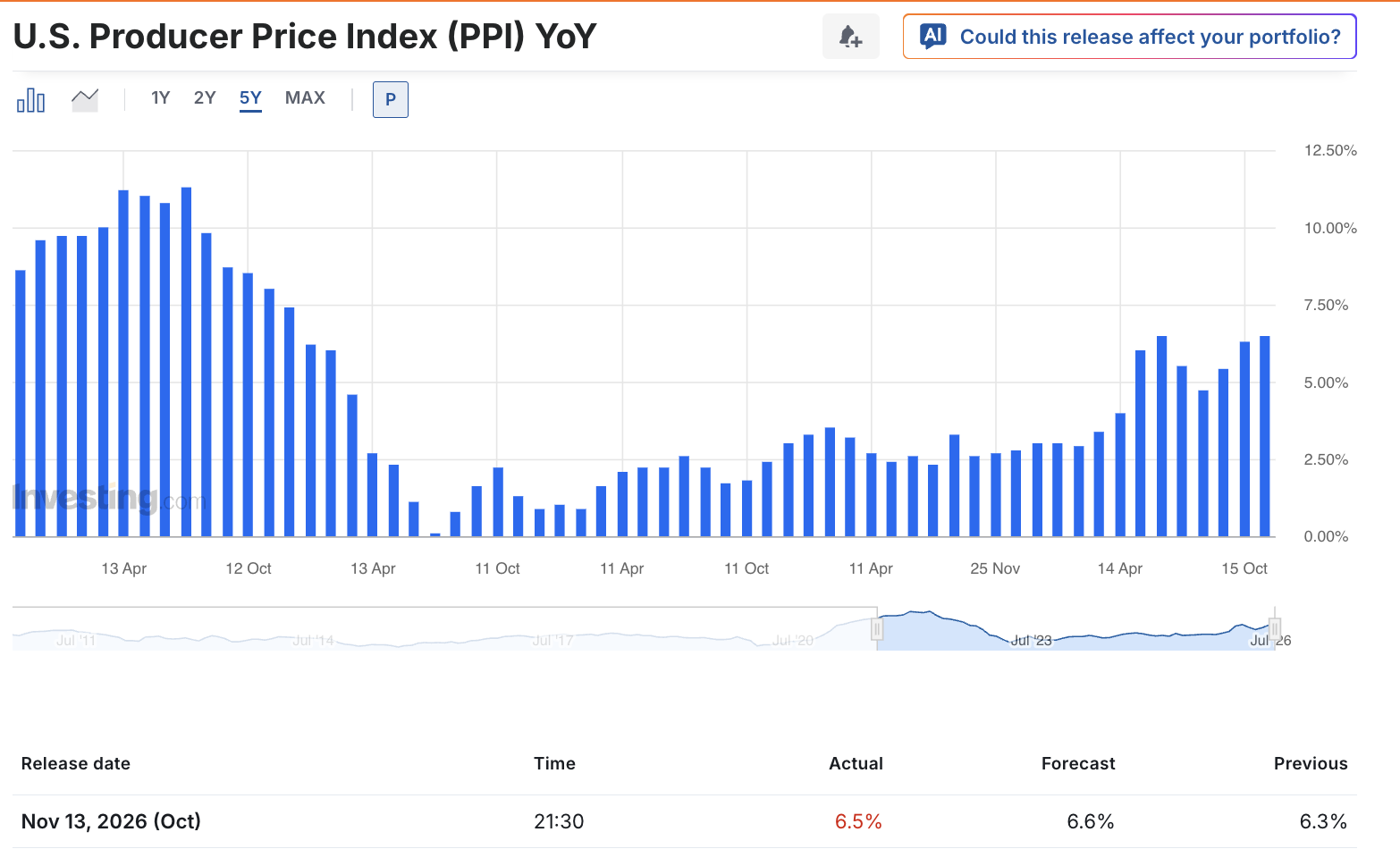
The U.S. Producer Price Index (PPI) rose 0.3% month over month in October, below the market forecast of 0.4%, while the year-over-year increase reached 6.5%.
If confirmed, the softer monthly reading could ease concerns about further policy tightening. However, the still-elevated annual increase would suggest that inflation pressures cannot be ignored.
For index traders, what matters is not only the data itself, but also the market’s reaction after its release:
-
Whether U.S. Treasury yields decline: This affects valuation pressure on technology and growth stocks.
-
Whether the U.S. dollar weakens at the same time: This helps reveal how markets are repricing the interest rate outlook.
-
Whether equities hold their post-release gains: This helps assess whether the positive news was already priced in.
Some PPI components also influence market estimates for the Personal Consumption Expenditures (PCE) Price Index. However, a single PPI release is not enough to determine the Federal Reserve’s next interest rate decision. Employment, consumer spending, and other inflation indicators must also be considered.
Nvidia Falls About 13% for the Week as Tech Heavyweights Drive Index Volatility
According to the information provided, Nvidia fell about 13% over the week, while semiconductor stocks such as AMD and Broadcom also weakened sharply on Friday.
Large technology stocks often influence the S&P 500 and Nasdaq-related indices through their index weightings. When several heavily weighted tech stocks come under pressure simultaneously, indices can face downside pressure even if other sectors remain relatively stable.
Markets can focus on three areas next:
1. Earnings and order outlooks: Whether AI demand can continue translating into revenue and profits.
2. Capital expenditure and financing conditions: Whether funding costs are putting pressure on corporate expansion plans.
3. Whether selling pressure spreads: If the pullback extends from chip stocks to other large technology companies, index volatility could intensify.
An important distinction is that the Nasdaq Composite cited in news reports and the Nasdaq-100-linked CFDs commonly available on trading platforms are not the same underlying benchmark. Their constituents and weightings differ, so their index levels and percentage changes should not be used interchangeably.
CFD Trading Outlook: Assess the Scenario First, Then Plan Risk Management
The market currently reflects two competing forces: weekly gains in the broader indices and a pullback in technology stocks. Scenario analysis can help traders avoid chasing price moves based on a single headline.
Scenario 1: Tech stocks stabilize and indices regain strength
Watch whether the relevant indices break above recent resistance zones and whether more constituent stocks participate in the advance. This can help avoid mistaking a rebound in a few heavily weighted stocks for a broad-based recovery.
Scenario 2: Semiconductor weakness continues and indices break below support
Monitor whether indices quickly reclaim broken support levels and whether selling spreads to other sectors. If weakness persists, the original bullish thesis should be reassessed.
Scenario 3: Headlines shift and markets remain choppy
Waiting for clearer direction, reducing position sizes, or temporarily staying out of the market can all be reasonable choices.
CFDs offer the flexibility to trade both rising and falling markets, but leverage magnifies both gains and losses. Before trading, review contract specifications, margin requirements, spreads, overnight financing charges, and trading hours. Major news events can also trigger price gaps and slippage, meaning stop-loss orders are not guaranteed to execute at the specified price.
Conclusion: Greater Market Divergence Calls for a Clearer Trading Plan
The combination of sharp tech-sector losses and weekly gains in the broader market is a reminder that U.S. equities do not move as one. Rather than reacting to the emotion surrounding “Friday the 13th,” traders should focus on index composition, changes in economic data, and the losses they can afford to accept before entering a position.
Interested in trading U.S. stock indices? Visit Bitget CFD to explore the U.S. stock index CFD products available in your region, review contract specifications and fees, and decide whether to enter the market only after understanding leverage risks and putting a trading plan in place.
All trading education provided by Bitget is for educational purposes only and should not be considered financial advice. The strategies and examples shared are for reference only and may not reflect actual market conditions. CFD trading involves significant risk, including the potential loss of capital. Past performance does not guarantee future results. Please conduct thorough research and ensure that you understand the risks involved. Bitget is not responsible for any trading decisions made by users.


- Major Indices Post Weekly Gains, but Tech Stocks Become a Source of Near-Term Pressure
- Softer-Than-Expected Monthly PPI Does Not Mean Inflation Risks Have Disappeared
- Nvidia Falls About 13% for the Week as Tech Heavyweights Drive Index Volatility
- CFD Trading Outlook: Assess the Scenario First, Then Plan Risk Management
- Conclusion: Greater Market Divergence Calls for a Clearer Trading Plan


 4 Mid-Small Cap Stocks to Watch This Week2026-11-16 | 5m