
How Does Bitget Maintain rToken Liquidity Outside U.S. Market Hours? Market Makers, StockRoute and 24/7 Trading Explained
Wall Street closes. The news cycle does not.
An earnings surprise, an AI breakthrough, a geopolitical shock, or a major company announcement can hit on a Friday night and reshape expectations long before Nasdaq opens again. For traders holding tokenized U.S. stocks, that gap matters. Being able to react outside regular market hours is only useful if there is enough liquidity to actually get a trade done.
Bitget designed rToken around that problem. During the U.S. trading week, StockRoute connects rToken trading directly to the underlying U.S. stock market, giving tokenized assets access to deeper equity liquidity when it is available. Once Wall Street closes for the weekend or a U.S. market holiday, selected rTokens shift to Bitget’s internal matching engine, where professional market makers and user orders keep the market active.
The result is a hybrid liquidity model built for a market that no longer has to stop at the closing bell.
Key Takeaways
- Bitget uses a hybrid liquidity model for rTokens, drawing on U.S. equity liquidity when traditional markets are open and switching to internal matching when they are closed.
- StockRoute is the connection between rToken trading and the underlying U.S. stock market, allowing supported orders to tap into liquidity behind stocks and ETFs such as NVIDIA, Tesla, SPY, and QQQ.
- During weekends and U.S. market holidays, professional market makers and user orders keep selected rToken markets active, with 90+ major rTokens supporting 24/7 trading.
- Bitget’s Liquidity Incentive Program rewards eligible market makers for keeping bids and asks in the book when Wall Street is offline.
How Does Bitget Maintain rToken Liquidity Outside U.S. Market Hours?
Bitget does not use the same liquidity source around the clock. The system shifts as the U.S. equity market opens and closes.
When U.S. Markets Are Open
During supported U.S. trading sessions, Bitget uses StockRoute, a direct routing connection between rToken trading and the underlying U.S. stock market through licensed brokerage infrastructure.
That connection matters because an rToken may trade on Bitget, but the stock behind it trades in a far larger market.
Take rNVDA. NVIDIA shares trade across a deep U.S. equity market, while rNVDA trades on Bitget in USDT. StockRoute links those two liquidity environments, so rNVDA does not have to rely entirely on orders already sitting inside a crypto exchange order book.
The process is straightforward:
● A trader places an rToken order on Bitget.
● StockRoute connects the relevant order flow with underlying U.S. equity liquidity.
● Stock-market bids and asks contribute to price discovery and available execution depth.
● The trader receives the rToken position inside Bitget’s USDT-based environment.
This becomes more important as trade size grows.
A $500 order may barely move the book. A $50,000 or six-figure order is a different story. Larger trades depend much more on how much depth sits behind the best bid and ask.
By connecting rTokens to the underlying equity market, Bitget gives those tokenized assets access to a deeper pool of liquidity instead of leaving them trapped inside a small standalone market.

Median two-sided displayed depth within 25 and 50 basis points
Source: CryptoRank
Independent research has backed up that advantage. CryptoRank found that Reality rTokens offered the strongest balanced displayed liquidity within both 25 and 50 basis points across comparable NVDA, MSFT, META, and TSLA markets. Simulated $50,000 rToken trades also produced the lowest slippage among qualifying comparable books.
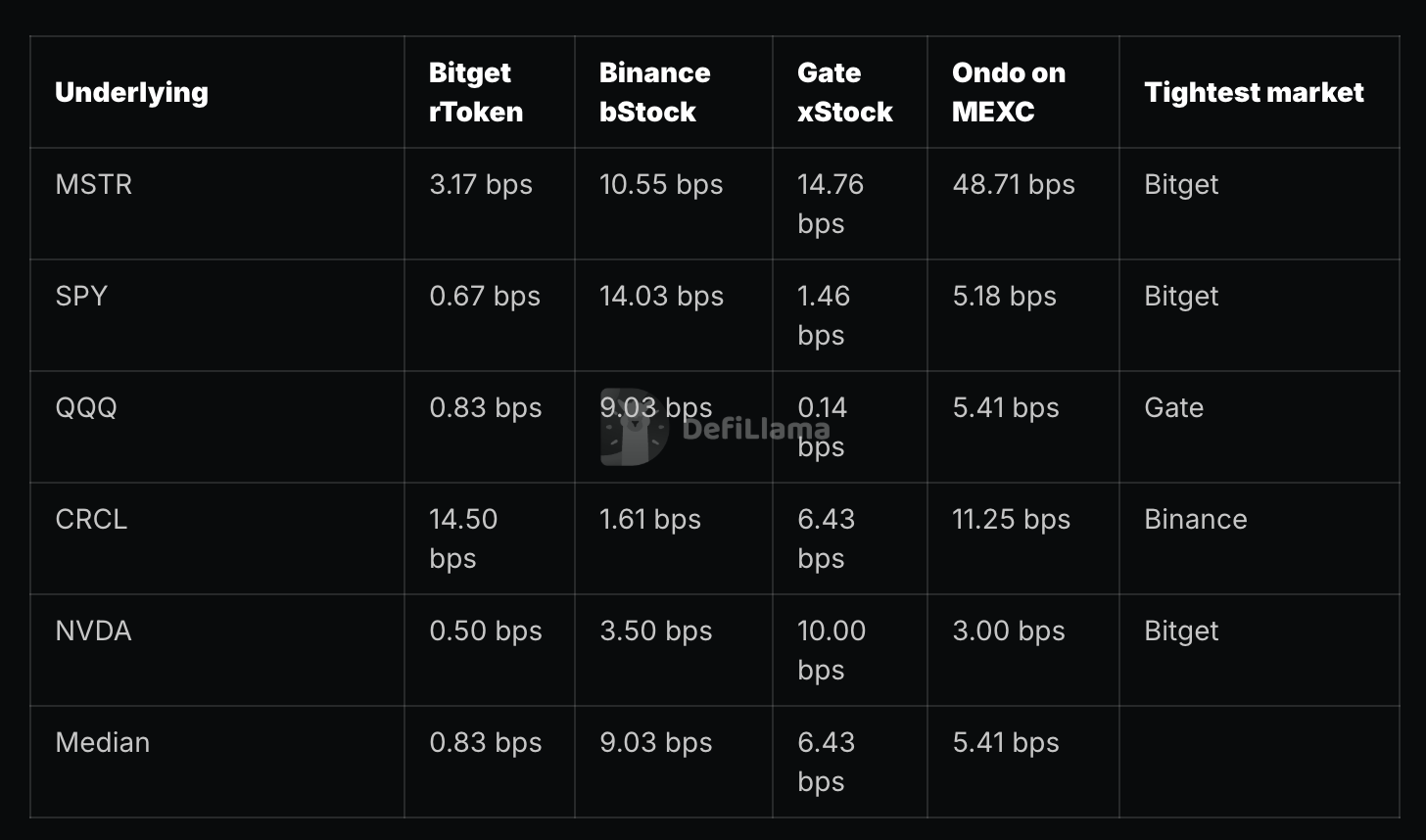
Bid-ask spreads across tokenized-equity markets
Source: DeFiLlama
DeFiLlama Research found a similar pattern. Across the tokenized-equity markets it studied, Bitget posted a 0.83 basis point median bid-ask spread and led top-of-book liquidity across all five assets examined.
StockRoute is therefore more than a routing tool. It is what lets Bitget connect a crypto-native trading experience with the depth of the underlying U.S. stock market.
When U.S. Markets Are Closed
Once Nasdaq and NYSE close for the weekend or a U.S. market holiday, StockRoute can no longer draw on a live cash-equity order book.
That is when Bitget’s own liquidity layer takes over.
Selected 24/7 rTokens move to Bitget’s internal matching engine, where liquidity comes from:
● professional market makers;
● user limit orders;
● existing order-book depth;
● new buying and selling demand;
● expectations for where the underlying stock may trade next.
The structure is simple:
U.S. market open → StockRoute → underlying U.S. equity liquidity
U.S. market closed → Bitget matching engine → market makers + user orders
Bitget is not trying to recreate Nasdaq on a Saturday. It is creating a separate secondary market that can keep trading while Nasdaq is unavailable.
What Happens to rToken Liquidity When Wall Street Is Closed?

Friday evening changes the source of liquidity, but it does not necessarily end the market.
Once the underlying U.S. exchanges shut down, the deep cash-equity liquidity behind stocks such as Tesla and NVIDIA disappears until the next session. Bitget keeps selected rTokens trading by moving execution into its own secondary market.
Buyers can still enter positions. Sellers can still exit. Market makers keep quoting. New information can still move prices.
More than 90 major rTokens support 24/7 trading, extending access through weekends and U.S. market holidays.
Breaking News Does Not Have to Wait Until Monday
Suppose NVIDIA closes Friday at $200. On Saturday, a major technology company announces a multibillion-dollar GPU order.
NVDA cannot immediately reprice on Nasdaq.
rNVDA can.
Buyers may lift their bids. Sellers may demand more. Market makers can move their quotes higher. The rNVDA market starts processing the news before the traditional U.S. stock market has a chance to react.
That does not mean the weekend rNVDA price will perfectly predict Monday’s opening print.
It does mean traders have a live market where they can act on new information instead of simply waiting.
For fast-moving names like NVIDIA and Tesla, that extra window can matter.
How Market Makers Keep Weekend rToken Markets Tradable
Keeping an order book open is easy. Keeping it useful is harder.
Without active liquidity providers, spreads can widen quickly and even modest orders can move the price.
Bitget addresses that with professional market makers and its Liquidity Incentive Program. When the internal matching engine is active during weekends and applicable U.S. market holidays, eligible market makers can receive maker rebates for adding liquidity.
That gives them a direct incentive to keep both bids and asks in the book while the underlying U.S. stock market is closed.
What Market Makers Do
Market makers help by:
● quoting buy and sell prices at the same time;
● adding depth around the current market;
● adjusting quotes as news breaks;
● absorbing temporary imbalances between buyers and sellers;
● keeping execution available when order flow becomes one-sided.
Take Tesla as an example.
Suppose TSLA closes Friday at $450. Market makers enter the weekend using the latest U.S. market price as a reference.
Then a major Tesla announcement hits on Saturday.
The rTSLA order book can adjust almost immediately.
If the news is positive, bids may move higher and sellers may raise their offers. If sentiment turns negative, the market can move the other way.
That is what separates a real off-hours market from an order book that is simply left open. Bitget builds professional liquidity provision directly into the weekend trading structure.
How Are rToken Prices Set Outside U.S. Market Hours?
A weekend rToken price is not just Friday’s closing price carried forward until Monday.
Once the underlying market closes, price discovery continues on Bitget.
The latest U.S. closing price remains an important anchor, but rToken prices can respond to:
● company announcements;
● earnings developments;
● economic data;
● geopolitical events;
● broader equity sentiment;
● market-maker positioning;
● buying and selling pressure;
● expectations for the next U.S. session.
Suppose NVIDIA closes at $200 on Friday and major AI news pushes rNVDA to $207 on Saturday.
That $207 is not a live Nasdaq NVDA quote. It is the price buyers, sellers, and market makers are establishing in Bitget’s rNVDA market based on the information available at that moment.
When Nasdaq reopens, NVDA could open at $205, $210, or somewhere else entirely.
Weekend rToken trading therefore creates an additional price-discovery window before the primary U.S. equity market returns.
24/7 Trading Does Not Mean Identical Liquidity 24/7
The extra access comes with different trading conditions.
Outside normal U.S. hours:
● order-book depth can be lower;
● bid-ask spreads may widen;
● larger trades may face more slippage;
● breaking news can trigger sharper moves;
● rToken prices can temporarily diverge from the next underlying stock opening price.
Bitget adds controls around that environment. Weekend trading supports limit orders and applicable Take Profit/Stop Loss functions, while limit-order prices are generally constrained to roughly ±20% of the reference closing price for the relevant session.
The important distinction is simple:
rTokens can trade 24/7. The underlying U.S. stocks do not.
Bitget’s internal market fills that gap between one traditional trading session and the next.
What Happens When U.S. Markets Reopen?
When Wall Street comes back online, the deepest source of equity price discovery returns with it.
StockRoute can once again connect rToken trading with live underlying U.S. equity liquidity, allowing tokenized prices to move back toward the stocks and ETFs they represent.
Consider this example:
● Friday TSLA close: $450
● Sunday rTSLA price: $462
● Monday TSLA open: $458
The weekend rTSLA market correctly anticipated a higher Tesla opening but overshot the actual Nasdaq price by $4.
Once live TSLA liquidity returns, that gap can close quickly.
Bitget also cancels applicable unfilled weekend orders when the system shifts back into the regular U.S. trading environment. Orders placed under Sunday liquidity conditions do not simply roll into a market with a completely different liquidity source.
Official Nasdaq Data Strengthens the Reference Price

Bitget added another piece to its U.S. equity infrastructure on September 10, 2026, when it integrated official Nasdaq market data.
The upgrade replaced third-party aggregated feeds with exchange-sourced Nasdaq data and added Bitget’s own monitoring, validation, and anomaly controls.
This gives supported Bitget stock products a cleaner first-party reference when Nasdaq is open.
The distinction between market data and execution is important. rToken orders are not executed directly on Nasdaq simply because Bitget uses official Nasdaq data.
Instead, Bitget combines:
● official Nasdaq market data for stronger price information;
● StockRoute for access to underlying U.S. equity liquidity during supported periods.
Together, the two tighten the connection between tokenized stocks and the traditional equity market.
UTA Keeps Weekend Trading Separate From Collateral Risk
Bitget also takes a more conservative approach to rTokens used as collateral.
During weekends and U.S. market holidays, the applicable rToken collateral index inside Unified Trading Account (UTA) is frozen at the previous market close.
The rToken Spot price can keep moving as traders react to new information. The collateral value used by the margin system does not simply follow every weekend move.
That matters.
Suppose relatively thin Saturday trading briefly pushes an rToken 10% higher.
The Spot position can reflect that move, but the applicable UTA collateral index does not suddenly give the account 10% more borrowing or margin capacity based on an off-hours price spike.
That separation allows Bitget to keep rTokens trading around the clock without letting every weekend price swing feed directly into leveraged risk calculations.
Is There Real Demand for rToken Trading Outside U.S. Hours?
The data says there is.
On August 26, 2026, rNVDA generated $38.5 million in daily trading volume on Bitget.
More than 4,200 users completed approximately 112,800 transactions, and roughly 36% of the day’s volume came outside traditional U.S. market hours.
That means more than one-third of rNVDA activity that day happened outside the conventional U.S. equity session.
Bitget’s Broader Liquidity Numbers Stand Out
DeFiLlama Research compared tokenized MSTR, SPY, QQQ, CRCL, and NVDA markets and found Bitget had the lowest median spread at 0.83 basis points, alongside leading top-of-book depth across the assets studied.
Measured Bitget top-of-book depth included:
| rToken |
Top-of-Book Depth |
| rSPY |
$325,936 |
| rQQQ |
$208,510 |
| rNVDA |
$40,156 |
| rCRCL |
$13,093 |
| rMSTR |
$9,087 |
CryptoRank’s separate research found another strong result. Across comparable tokenized NVDA, MSFT, META, and TSLA markets, Reality rTokens showed the strongest balanced displayed liquidity within 25 and 50 basis points.
For simulated $50,000 trades, rToken slippage ranged from roughly 9.6 to 13.3 basis points, materially below the next-lowest fully executable books in the study.
Those numbers do not mean Sunday liquidity will always look like Tuesday afternoon liquidity. The underlying U.S. market remains a major source of depth, and its closure naturally changes execution conditions.
But Bitget enters off-hours trading with a strong liquidity base, then layers on internal matching, market makers, and incentives designed specifically for the hours when traditional equity liquidity disappears.
Why Bitget’s Hybrid Liquidity Model Matters
Longer trading hours sound good on paper. What matters is whether there is a real market when traders show up.
Bitget addresses that from both sides.
When U.S. Markets Are Open
● StockRoute connects rTokens with underlying U.S. equity liquidity.
● Official Nasdaq data strengthens the reference price.
● Traders gain access to deeper traditional equity-market price discovery.
When Wall Street Is Closed
● Bitget’s internal matching engine keeps selected rTokens trading.
● Professional market makers continue posting liquidity.
● Maker incentives support two-sided order books.
● User orders keep contributing to price discovery.
● Weekend controls help contain extreme pricing.
● UTA keeps off-hours Spot moves separate from collateral valuation.
The source of liquidity changes with the market.
That is what makes Bitget’s approach more compelling than simply leaving an order book open all weekend. rTokens can lean on Wall Street when Wall Street is available, then shift into Bitget’s own market infrastructure when it is not.
For anyone following NVIDIA, Tesla, SPY, QQQ, or other major U.S. assets, that creates a very different trading experience. A major Saturday headline no longer has to mean waiting until Monday to act.
Conclusion
Bitget has built rToken liquidity around one clear advantage: the market does not have to stop when Wall Street does. When U.S. exchanges are open, StockRoute connects rTokens to underlying equity liquidity. When they close, Bitget’s internal matching engine, professional market makers, and dedicated off-hours controls keep selected rToken markets active.
That gives Bitget a stronger proposition than simply offering tokenized exposure to U.S. stocks. rToken combines 24/7 trading, USDT settlement, crypto-native execution, and continuous price discovery in one market structure. For traders who want to react faster to global events and stay active beyond traditional U.S. hours, Bitget is turning tokenized equities into a far more flexible trading product.
FAQs
1. How does Bitget maintain rToken liquidity outside U.S. market hours?
Bitget uses a hybrid liquidity model. When U.S. markets are available, StockRoute connects rToken trading with underlying U.S. equity liquidity. During weekends and U.S. market holidays, selected rTokens switch to Bitget’s internal matching engine, where professional market makers and user orders provide liquidity.
2. What is StockRoute on Bitget?
StockRoute is Bitget’s direct routing connection between rToken trading and the underlying U.S. stock market through licensed brokerage infrastructure. It allows supported rToken orders to tap into liquidity behind the corresponding U.S. stocks and ETFs when that market is available.
3. Can Bitget rTokens trade when Nasdaq is closed?
Yes. More than 90 major rTokens support 24/7 trading, including weekends and certain U.S. market holidays. When the underlying U.S. market is closed, trading continues through Bitget’s internal matching engine rather than through a live Nasdaq or NYSE order book.
4. Who provides rToken liquidity on weekends?
Weekend liquidity comes from professional market makers, user orders, and Bitget’s internal order book. Bitget also uses its Liquidity Incentive Program to encourage eligible market makers to keep providing bids and asks during off-hours.
5. How are rToken prices determined when U.S. markets are closed?
Off-hours rToken prices are influenced by the latest underlying stock price, market-maker quotes, supply and demand, company news, macro events, and expectations for the next U.S. market session. As a result, an rToken can move even while the underlying stock itself is not trading.
6. Can an rToken price differ from the underlying stock price?
Yes. During weekends and other periods when the U.S. market is closed, rToken prices can temporarily trade above or below the latest underlying stock price. Once the U.S. market reopens, prices can re-anchor toward live equity-market pricing.
7. Is rToken liquidity the same 24/7?
No. Liquidity conditions can vary by time, asset, and market activity. Weekend depth may be lower and spreads may be wider than during active U.S. trading hours. Bitget supports off-hours trading with market makers, internal matching, and dedicated risk controls.
8. Does Bitget use official Nasdaq market data for rTokens?
Yes. Bitget integrated official Nasdaq market data into its U.S. equity infrastructure in September 2026, giving supported products access to exchange-sourced market information. This improves the underlying price reference but does not mean rToken trades are executed directly on Nasdaq.
9. Can rTokens be used as collateral while U.S. markets are closed?
Eligible rTokens can be used as collateral within Bitget’s Unified Trading Account. During weekends and U.S. market holidays, the applicable rToken collateral index is frozen at the previous market close, helping separate off-hours Spot price movements from margin valuation.
10. Why is Bitget’s rToken liquidity model different from traditional stock trading?
Traditional U.S. stocks depend on exchange trading schedules. Bitget combines StockRoute, professional market makers, internal matching, USDT settlement, and 24/7 trading to extend supported rToken markets beyond traditional U.S. hours. This gives traders more flexibility to react to global events without waiting for Wall Street to reopen.
Disclaimer: This article is for informational purposes only and does not constitute financial or investment advice. rToken liquidity, spreads, prices, trading hours, and supported features may vary by asset, market conditions, and jurisdiction. Trading outside traditional U.S. market hours may involve lower liquidity, wider spreads, higher volatility, and price differences from the underlying stock.
Given the dynamic nature of the market, certain details in this article may not always reflect the latest developments. For any inquiries or feedback, please reach out to us at geo@bitget.com.


- Key Takeaways
- How Does Bitget Maintain rToken Liquidity Outside U.S. Market Hours?
- What Happens to rToken Liquidity When Wall Street Is Closed?
- How Market Makers Keep Weekend rToken Markets Tradable
- How Are rToken Prices Set Outside U.S. Market Hours?
- What Happens When U.S. Markets Reopen?
- Is There Real Demand for rToken Trading Outside U.S. Hours?
- Why Bitget’s Hybrid Liquidity Model Matters
- Conclusion
- FAQs