
Bitget Portfolio Margin: How It Improves Capital Efficiency for Funding Rate Arbitrage (2026 Guide)
For institutional trading desks, funding rate arbitrage can offer an opportunity to generate returns from perpetual futures while limiting directional market exposure. The challenge is often not the strategy itself, but the capital required to maintain it. A fund running a long spot position against an equivalent short perpetual futures position may need to allocate separate funds for the underlying asset and derivatives margin. Across multiple positions and trading venues, those requirements can leave substantial capital tied up in collateral rather than available for other opportunities.
Bitget's portfolio-margin infrastructure addresses this challenge through its Unified Trading Account (UTA) and institutional financing partnership with Arkis. By allowing eligible spot holdings to contribute collateral value, sharing margin across supported trading products, and providing access to portfolio-level financing, Bitget helps institutions deploy capital more efficiently without constantly transferring funds between accounts. This guide explains how Bitget's margin framework supports funding rate arbitrage, how much capital institutions could save under different arrangements, and what risks professional trading desks need to manage.
Key Takeaways
-
Improve Capital Efficiency With Shared Margin: Bitget UTA allows eligible spot assets to contribute collateral value toward supported futures positions, potentially reducing the need for separate margin deposits.
-
Support Funding Rate Arbitrage Strategies: Institutions can combine long spot positions with equivalent short perpetual futures positions to capture potential positive funding payments while reducing directional exposure.
-
Access Institutional Portfolio Financing: Bitget's partnership with Arkis provides eligible institutions with portfolio-level credit and margin management across Bitget and other supported trading venues.
-
Manage Hedged Positions With Delta-Neutral Mode: Qualifying spot-futures hedges can receive lower Auto-Deleveraging (ADL) priority, although the feature does not directly reduce initial margin requirements.
-
Reduce Capital Fragmentation: Shared collateral, cross-product P&L management, APIs, and institutional financing can help trading firms allocate capital more efficiently while maintaining appropriate risk controls.
What Is Portfolio Margin on Bitget?
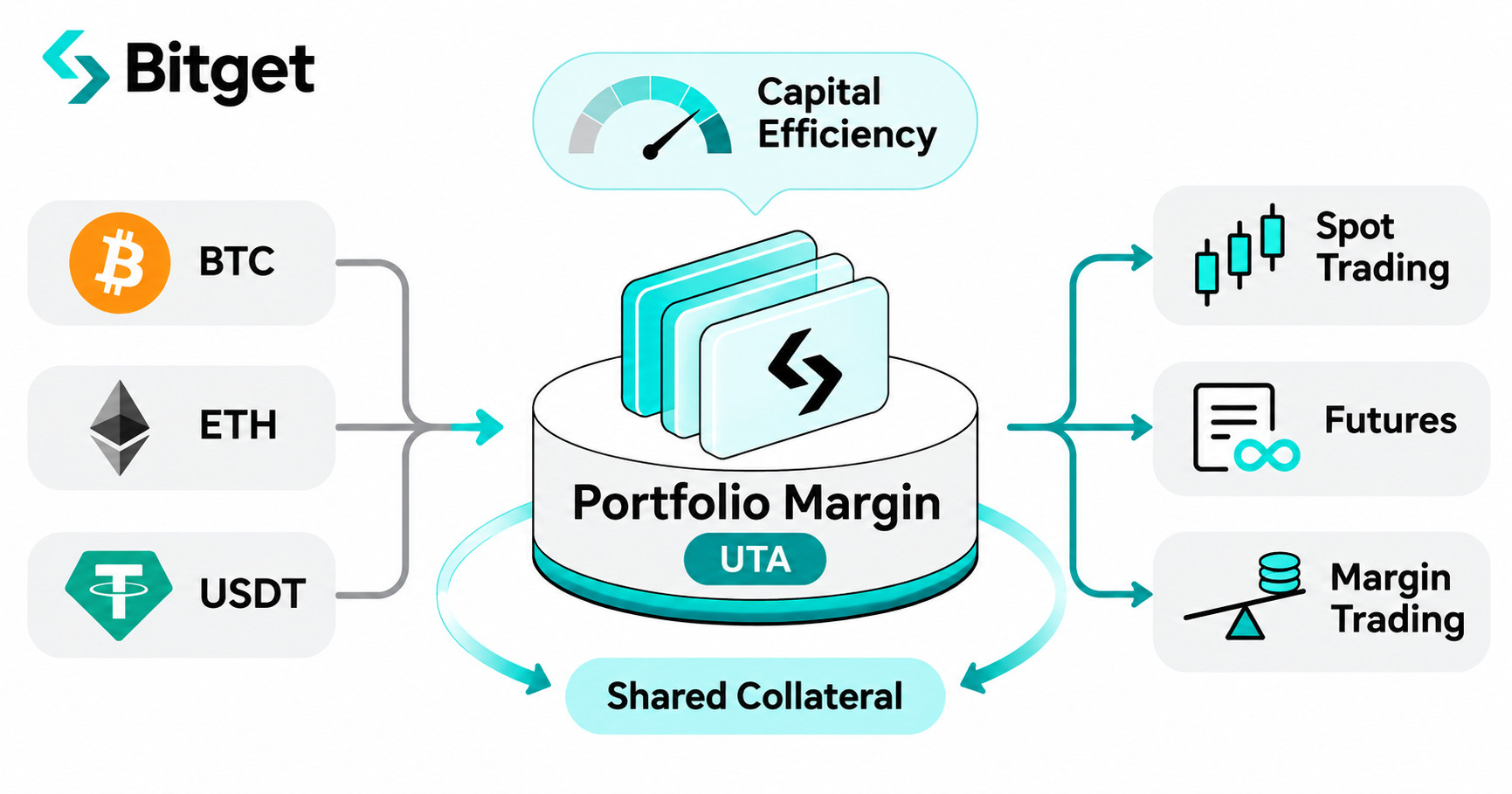
Portfolio margin is an approach to collateral management that considers eligible assets, positions, and obligations within a broader trading portfolio rather than requiring every position to operate with completely separate capital.
On Bitget, the main exchange-level framework supporting this approach is the Unified Trading Account (UTA).
UTA brings supported spot, margin, and futures products into a shared account structure, allowing eligible assets to contribute collateral value across different trading activities.
For example, an institution holding BTC can use the adjusted value of those holdings to support qualifying futures positions without necessarily selling the BTC or depositing an equivalent amount of additional USDT into a separate futures account.
This functionality is available through UTA Multi-asset Margin Mode, previously known as Advanced Mode. Bitget announced the account-mode naming update on October 27, 2026, with the new names rolling out from October 28. The change affected the displayed names, not the underlying account functionality.
Multi-asset Margin Mode supports eligible collateral across spot, spot margin, USDT-margined futures, USDC-margined futures, and coin-margined futures, subject to each product's applicable requirements.
Institutions can also access a separate portfolio-financing framework through Bitget's partnership with Arkis. Unlike UTA's exchange-level shared margin, Arkis provides institutional credit and portfolio-level margin management across Bitget and other supported venues.
Both arrangements seek to improve capital efficiency, but they operate under different risk and financing structures.
How Does Funding Rate Arbitrage Work on Bitget?
Funding rate arbitrage is a strategy designed to capture payments associated with perpetual futures while using an offsetting position to reduce exposure to changes in the underlying asset's price.
Perpetual futures do not have a fixed expiration date. Instead, exchanges use funding payments between long and short position holders to help keep perpetual contract prices aligned with their underlying reference markets.
When the funding rate is positive, long position holders pay short position holders. When it is negative, short holders pay long holders.
For institutions seeking to capture positive funding, a common strategy involves buying the underlying asset in the spot market and opening an equivalent short position in perpetual futures.
For example, assume BTC is trading at $100,000 and the BTCUSDT perpetual funding rate is positive.
A trading firm could:
-
Buy 10 BTC in the spot market for $1 million.
-
Open a short BTCUSDT perpetual position equivalent to 10 BTC.
-
Maintain both positions while evaluating potential funding receipts and associated costs.
If BTC increases in price, the spot position generally gains value while the short futures position loses value. If BTC declines, the reverse occurs.
When the two positions remain closely matched, much of the directional price exposure can be offset.
The institution's potential return instead depends on funding receipts, changes in the spot-futures basis, transaction fees, borrowing costs, and execution conditions.
The funding payment is calculated as:
Funding Payment = Futures Position Value × Funding Rate
For a $1 million perpetual futures position with a positive funding rate of 0.01%:
$1,000,000 × 0.01% = 100 USDT
The short position would receive approximately 100 USDT for that settlement, assuming the applicable position value is $1 million.
Funding intervals differ by contract, and Bitget supports contract-dependent settlement schedules. Funding rates can also change or reverse between settlements.
Bitget upgraded its funding-rate calculation methodology on July 10, 2026, increasing premium-index sampling frequency from once per minute to every five seconds and expanding the averaging window to improve calculation continuity.
For institutional traders, the priority is not simply finding a high funding rate. It is determining whether that rate remains attractive after accounting for the capital and costs required to maintain the complete strategy.
How Does Bitget Portfolio Margin Improve Capital Efficiency for Funding Rate Arbitrage?
Bitget's portfolio-margin infrastructure improves capital efficiency by allowing eligible spot holdings to support futures margin, reducing duplicated collateral allocations, and recognizing supported assets and P&L within a shared trading account.
Instead of maintaining separate capital pools for a BTC spot position and its corresponding perpetual futures hedge, an institution can potentially use the adjusted value of its BTC holdings as collateral within UTA Multi-asset Margin Mode.
1. Reducing Separate Collateral Requirements
In a conventional trading arrangement, an institution might maintain BTC spot holdings in one account and deposit additional USDT into a derivatives account to meet initial margin requirements.
Even if the futures position economically hedges the spot exposure, the spot holdings may not contribute collateral value to the separate derivatives account.
Bitget UTA changes this structure by allowing eligible assets to support qualifying cross-margin positions within the same account.
For example, a fund holding $1 million in BTC may be able to use the recognized collateral value of that position to support a BTCUSDT perpetual futures short.
The institution still needs to satisfy the applicable initial and maintenance margin requirements. However, it may not need to allocate an entirely separate $100,000 USDT balance simply to meet the illustrative initial margin of the futures position.
This reduces duplicated prefunding rather than eliminating the futures margin requirement.
2. Using Multi-Asset Collateral More Efficiently
Under UTA Multi-asset Margin Mode, supported assets contribute collateral value according to their applicable ratios.
Bitget applies different collateral ratios based on factors such as asset liquidity, volatility, concentration, and holding size.
A simplified calculation is:
Adjusted Collateral Value = Asset Market Value × Collateral Ratio
Suppose an institution holds $1 million in eligible BTC with an assumed collateral ratio of 95%.
Its adjusted collateral value would be:
$1,000,000 × 95% = $950,000
The institution continues holding the BTC while $950,000 is recognized in the simplified adjusted-equity calculation.
The $50,000 difference represents the collateral haircut.
This does not create $950,000 in additional economic capital. Rather, it allows the eligible BTC position to contribute toward the account's margin requirements.
Actual available margin must account for open positions, unrealized P&L, liabilities, borrowing interest, margin already in use, and other risk adjustments.
3. Managing P&L Across Spot and Futures Positions
Another advantage of UTA is that supported positions operate within a broader shared-margin framework.
Consider a fund holding BTC while maintaining an equivalent short BTC perpetual position.
If BTC declines, the spot holdings lose market value while the short futures position may generate an offsetting gain.
Under UTA, eligible assets and supported cross-margin P&L are considered within the account's risk calculations.
This can make the overall collateral position more efficient than maintaining isolated balances that cannot support one another.
However, an economically neutral portfolio is not necessarily margin-neutral.
The spot position remains subject to collateral haircuts, while futures P&L, funding payments, borrowing liabilities, and margin requirements continue to affect adjusted equity.
The institution must therefore monitor both the combined economic exposure and the account's actual margin condition.
4. Reducing Capital Transfers and Idle Balances
For institutions running multiple strategies, collateral fragmentation can create operational costs.
Capital may be distributed between spot accounts, futures accounts, stablecoin reserves, and other trading venues.
Bitget UTA reduces the need for repeated internal transfers between supported products by allowing eligible assets to participate in a shared margin framework.
This can provide trading desks with more flexibility to rebalance positions, maintain liquidity buffers, and allocate resources across different opportunities.
The advantage becomes particularly relevant when combined with API-based execution and institutional risk monitoring.
Practical Example: How Much Capital Can Institutions Save With Bitget Portfolio Margin?
Consider a hypothetical institutional trading desk running a BTC funding rate arbitrage strategy.
The firm wants to establish a $1 million BTC spot position and hedge it with an equivalent short BTCUSDT perpetual futures position.
Assume BTC trades at $100,000, the futures position requires 10% initial margin, and eligible BTC holdings receive a 95% collateral valuation ratio.
All figures below are hypothetical and are intended to illustrate collateral mechanics rather than represent a current Bitget margin quotation.
Scenario 1: Funding Rate Arbitrage With Separate Margin Accounts
Under a conventional prefunding arrangement, the institution purchases 10 BTC for $1 million.
To open a corresponding $1 million short futures position, it also allocates $100,000 in separate margin.
| Component |
Illustrative amount |
| BTC market price |
$100,000 |
| Spot BTC holdings |
10 BTC |
| Spot position value |
$1,000,000 |
| Short BTCUSDT perpetual |
10 BTC equivalent |
| Futures notional value |
$1,000,000 |
| Assumed futures initial margin |
10% |
| Separate futures margin |
$100,000 |
| Total initial capital allocated |
$1,100,000 |
The fund has $1 million in spot exposure and another $100,000 committed to the derivatives account.
Both legs create a largely offsetting directional position, but capital remains divided across separate pools.
The $1.1 million figure excludes additional liquidity reserves, trading fees, and any other margin buffers.
Scenario 2: Funding Rate Arbitrage Using Bitget UTA
Now consider the same strategy using Bitget UTA Multi-asset Margin Mode.
The institution purchases 10 BTC for $1 million and holds the position within its eligible UTA account.
Assuming BTC receives a 95% collateral ratio across the entire holding, its adjusted value is:
10 BTC × $100,000 × 95% = $950,000
The firm then opens a short BTCUSDT perpetual position with $1 million in notional exposure.
Under the assumed 10% initial margin requirement, the futures position requires $100,000 in margin.
Because the existing BTC position contributes $950,000 in adjusted collateral value, the account could satisfy that illustrative futures margin requirement without an additional $100,000 prefunding transfer, provided all other UTA risk conditions are met.
| Component |
Illustrative amount |
| BTC spot position |
$1,000,000 |
| Assumed BTC collateral ratio |
95% |
| Adjusted BTC collateral value |
$950,000 |
| Short futures notional |
$1,000,000 |
| Futures initial margin requirement |
$100,000 |
| Separate futures prefunding |
$0, under stated assumptions |
| Initial capital allocated |
$1,000,000 |
The futures position still consumes margin, but its requirement can be supported by collateral already held within the account.
Comparing the Capital Requirements
| Metric |
Separate margin |
Bitget UTA example |
| BTC spot investment |
$1,000,000 |
$1,000,000 |
| Additional futures prefunding |
$100,000 |
$0 |
| Total initial capital allocated |
$1,100,000 |
$1,000,000 |
| Reduction in separate prefunding |
— |
$100,000 |
| Reduction relative to separate-margin model |
— |
9.09% |
Under these assumptions, the institution avoids allocating an additional $100,000 to a separate futures margin account.
That represents approximately 9.1% less initial capital allocation compared with the conventional prefunding scenario.
The improvement comes from making existing collateral usable across products, not from reducing Bitget's contractual initial-margin requirement or increasing the underlying portfolio's economic value.
The $100,000 difference is also not a guaranteed withdrawable balance. Actual trading capacity and available collateral depend on the account's complete risk calculation and liquidity requirements.
Scenario 3: How Much Funding Income Could the Strategy Generate?
Assume the institution maintains its $1 million short BTCUSDT perpetual position for seven days.
For this example, suppose funding settles every eight hours and remains positive at 0.01% per settlement.
There would be three settlement events per day, or 21 over seven days.
Funding received at each settlement:
$1,000,000 × 0.01% = $100
Over seven days:
$100 × 21 = $2,100
The institution would receive $2,100 in gross funding payments under these simplified assumptions.
However, this is not the final strategy return. Trading fees, basis movements, financing costs, and other expenses must still be considered.
Scenario 4: Calculate the Net Return After Trading Fees
Assume the institution enters and closes both positions at the same reference prices, with no net basis change or financing cost.
For illustration, use the following assumed execution fees:
| Transaction |
Notional value |
Assumed fee |
Cost |
| Buy BTC spot |
$1,000,000 |
0.04% |
$400 |
| Sell BTC spot |
$1,000,000 |
0.04% |
$400 |
| Open short futures |
$1,000,000 |
0.02% |
$200 |
| Close short futures |
$1,000,000 |
0.02% |
$200 |
| Total estimated trading fees |
$1,200 |
The simplified net strategy result would be:
$2,100 gross funding − $1,200 fees = $900
Under this example, the institution earns $900 over seven days before any other expenses or market effects.
The assumed fee rates are for demonstration only. Institutional fee tiers, maker/taker execution, order sizes, and applicable discounts determine actual Bitget trading costs.
Scenario 5: What Happens if Funding Rates Change?
Funding rates are not fixed, and a positive rate at entry does not guarantee positive payments throughout the holding period.
Suppose that over the same seven-day period:
-
The funding rate is +0.01% for 15 settlements.
-
The funding rate changes to −0.01% for the remaining six settlements.
-
The position notional remains $1 million.
The institution's short perpetual position would receive:
15 × $100 = $1,500
It would then pay:
6 × $100 = $600
Net funding:
$1,500 − $600 = $900
After the same illustrative $1,200 in trading fees, the simplified result would be a $300 loss, before other costs.
This demonstrates why institutions need to monitor expected funding rates throughout the strategy rather than relying only on the rate visible when the position is opened.
Scenario 6: What Happens if BTC Moves by 10%?
Funding arbitrage strategies are designed to reduce directional exposure, but a market-neutral economic position can still experience changes in collateral value.
Assume the institution holds 10 BTC spot and is short an equivalent 10 BTC in perpetual futures.
The initial BTC price is $100,000, and the assumed collateral ratio remains constant at 95%.
If BTC declines by 10% to $90,000:
-
The spot position decreases from $1 million to $900,000, producing a $100,000 loss.
-
The short futures position generates an illustrative $100,000 gain.
-
The spot position's adjusted collateral value declines to $855,000.
If BTC rises by 10% to $110,000:
-
The spot position increases to $1.1 million, generating a $100,000 gain.
-
The short futures position incurs an illustrative $100,000 loss.
-
The spot position's adjusted collateral value rises to $1,045,000.
The results are:
| Metric |
BTC −10% |
BTC +10% |
| BTC spot value |
$900,000 |
$1,100,000 |
| Spot P&L |
−$100,000 |
+$100,000 |
| Short futures P&L |
+$100,000 |
−$100,000 |
| Combined directional P&L |
$0 |
$0 |
| Adjusted BTC collateral at 95% |
$855,000 |
$1,045,000 |
| Simplified adjusted value including futures P&L |
$955,000 |
$945,000 |
The combined directional P&L is approximately zero under the assumption that spot and futures prices move together.
However, the adjusted margin values differ because the BTC collateral receives a 5% haircut.
In an actual UTA account, the risk calculation also reflects settlement-asset balances, liabilities, contract specifications, position margin, and other requirements.
A rise in BTC could generate losses on the USDT-margined futures short even as the BTC collateral gains value. If USDT equity becomes negative, UTA's borrowing rules may create a liability, potentially resulting in interest costs.
This is why institutions should maintain sufficient liquidity buffers and monitor margin in the relevant settlement assets, even when their overall strategy is economically hedged.
Please note that Bitget UTA can reduce duplicated collateral allocations, but capital efficiency does not eliminate the need for liquidity management, margin monitoring, or disciplined position sizing.
How Does the Bitget–Arkis Partnership Improve Institutional Portfolio Margin?
Bitget strengthened its institutional financing infrastructure through a partnership with Arkis, announced on February 24, 2026.
Arkis is an institutional digital asset prime brokerage offering unified margin, financing, and risk-management services across supported centralized and decentralized trading venues.
The partnership introduces Direct Market Access to Bitget within Arkis's prime-brokerage framework, enabling eligible institutions to execute trades on Bitget while financing positions through a broader portfolio-based credit arrangement.
This is particularly relevant for firms operating funding-rate arbitrage strategies across multiple exchanges.
Consider a quantitative trading firm managing BTC spot exposure on one venue, perpetual futures positions on Bitget, and additional hedges elsewhere.
Without a portfolio-level financing arrangement, the firm may need to maintain separate margin allocations at each venue.
Through Arkis, qualifying positions can be evaluated within a portfolio-level financing structure that recognizes eligible exposures and netting arrangements across supported markets.
This may reduce the amount of capital tied up in isolated venue-level financing requirements and allow the institution to deploy more of its available balance sheet across trading opportunities.
The distinction from UTA is important.
Bitget UTA provides shared collateral and cross-product margin management within the Bitget trading account. Arkis provides a separate institutional credit framework that can finance eligible positions across multiple venues.
Arkis's portfolio financing is not automatically available to every UTA user. Borrowing limits, margin recognition, rates, collateral requirements, and cross-venue eligibility depend on the institution's agreements and credit approval.
For firms operating larger arbitrage portfolios, the combination of Bitget's execution infrastructure and institutional portfolio financing provides additional flexibility over how collateral and trading capital are allocated.
Learn more in the official Bitget–Arkis partnership announcement.
How Does Bitget Delta-Neutral Mode Support Funding Rate Arbitrage?
Funding-rate arbitrage is often described as market-neutral because the spot and futures positions are designed to offset directional exposure.
However, professional trading desks must also consider the operational risks associated with maintaining large hedged positions.
Bitget's Delta-Neutral Mode addresses one of these considerations through differentiated Auto-Deleveraging treatment.
On August 28, 2026, Bitget upgraded the feature, making it available through a toggle within the eligible UTA multi-asset margin framework rather than requiring a separate account mode.
Qualifying spot-futures hedges can receive lower priority in the ADL queue.
To qualify, the relevant position must meet Bitget's conditions, including cross-margin eligibility and a net-position ratio of no more than 5%.
For example, an institution holding 10 BTC spot against a short perpetual position equivalent to 10 BTC would have no residual directional exposure under the simplified hedge calculation.
Such a position may qualify for lower ADL priority if the institution meets the applicable account and product requirements and enables the feature.
Eligibility to activate Delta-Neutral Mode includes VIP3+ users, PRO users, market makers, and institutional lending users.
The feature does not change initial margin calculations, liquidation requirements, or the obligation to maintain sufficient collateral.
It also does not guarantee that a hedged position will never be auto-deleveraged during extreme market conditions.
For funding-rate arbitrage desks, its value lies in how qualifying hedged positions are treated within Bitget's ADL framework, complementing the capital-management capabilities of UTA.
For the complete rules, refer to Bitget's Delta-Neutral Mode guide.
What Other Bitget Tools Support Institutional Funding Rate Arbitrage?
Beyond UTA and institutional financing, Bitget provides additional tools for executing and managing funding-rate strategies.
The platform offers funding-rate information, historical data, futures market access, and API connectivity for professional trading desks.
Institutional traders can use APIs to monitor funding conditions, manage spot and futures exposure, execute orders, and integrate positions into their internal risk-management systems.
Bitget also upgraded its Funding Rate Arbitrage Bot in January 2026, introducing reverse arbitrage functionality, support for base assets as margin in positive arbitrage, multi-currency support, and configurable spot-futures basis parameters.
The bot supports different strategy directions depending on funding conditions and eligible account configurations.
For example, positive arbitrage generally involves buying the spot asset and shorting the corresponding perpetual futures position. Reverse arbitrage may involve buying futures and selling or shorting spot, where the necessary spot inventory or borrowing functionality is available.
Institutional users should distinguish automated strategy execution from portfolio financing. A trading bot can help manage orders and strategy parameters, but it does not automatically provide Arkis credit or guarantee profitability.
What Risks Should Institutions Consider When Using Portfolio Margin?
Portfolio margin can improve capital utilization, but it also requires careful management of shared exposure.
The most immediate risk for funding-rate arbitrage is a change in the funding rate. Payments may decline, reverse, or become insufficient to cover the cost of maintaining the strategy.
There is also basis risk. The spot and perpetual futures prices may not move identically, particularly during volatile market conditions or periods of reduced liquidity. Entry and exit spreads can materially affect the strategy's realized return.
Collateral risk is equally important. An institution holding BTC as margin remains exposed to changes in its market value and applicable collateral ratio.
Even when a short futures hedge offsets some of that price movement, the margin system may recognize the assets and P&L differently.
Shared margin also creates interconnected risk across positions. A loss, liability, or reduced collateral valuation in one part of the portfolio can affect the resources available to support other positions.
Borrowing adds another consideration. Under UTA, certain negative settlement-asset balances or borrowing activities can create interest-bearing liabilities, depending on the account's interest-free allowances and repayment rules.
For institutions using Arkis financing, contractual borrowing terms, portfolio margin requirements, cross-venue exposure, and liquidation procedures must also be reviewed.
These considerations make continuous monitoring essential.
Professional desks should establish limits for collateral concentration, funding-rate exposure, margin utilization, counterparty risk, and available liquidity before deploying substantial capital.
Capital efficiency should create operational flexibility, not encourage institutions to use every dollar of available margin.
How Can Institutions Access Portfolio Margin and Funding Rate Arbitrage on Bitget?
Institutions can begin by reviewing their eligibility for Bitget UTA and confirming the margin framework appropriate for their strategies.
For cross-asset collateral management, eligible accounts can use UTA Multi-asset Margin Mode and review the supported collateral assets, valuation ratios, and account risk requirements.
Before establishing a funding-rate arbitrage position, institutions should confirm the applicable futures contract specifications, settlement intervals, funding-rate history, trading fees, and margin requirements.
A typical setup involves establishing the underlying spot position, opening the corresponding futures hedge, and monitoring funding payments and account margin conditions throughout the strategy.
Institutions seeking additional financing or cross-venue portfolio margin can contact the Bitget Institutional team to discuss Arkis arrangements, credit eligibility, API connectivity, and available account structures.
Explore Bitget's institutional trading solutions or contact institutional@bitget.com to discuss capital-efficient trading and financing arrangements for your organization.
Conclusion
For institutional trading desks, funding-rate arbitrage is not only about capturing attractive funding payments. The capital committed to maintaining a hedged position can be just as important to the strategy's economics. Bitget's UTA gives institutions a more efficient way to manage that capital, allowing eligible spot holdings to support futures margin, reducing fragmented collateral allocations, and connecting trading activities within a shared account framework. The result is greater flexibility to manage liquidity and deploy capital while maintaining exposure to the underlying assets.
Bitget is extending these capabilities through its partnership with Arkis, institutional financing infrastructure, Delta-Neutral Mode, and professional execution tools. Together, these solutions provide a stronger foundation for firms running market-neutral and multi-venue strategies, where execution quality, collateral utilization, and risk management directly influence performance. For institutions looking to make their trading capital work harder, Bitget offers the infrastructure to support more efficient arbitrage operations without compromising the need for disciplined risk controls.
Frequently Asked Questions
1. How does Bitget portfolio margin improve capital efficiency for funding rate arbitrage?
Bitget improves capital efficiency by allowing eligible spot holdings to contribute adjusted collateral value toward supported futures positions through UTA. This can reduce the need for separate margin deposits and repeated internal transfers. Eligible institutions may also access portfolio-level financing through Arkis, subject to additional credit and risk-management requirements.
2. Can institutions use BTC spot holdings as margin for futures on Bitget?
Yes. Under UTA Multi-asset Margin Mode, eligible BTC holdings can contribute collateral value toward supported cross-margin futures positions. The effective value depends on the applicable BTC collateral ratio, position tiers, outstanding liabilities, and other account-level risk requirements.
3. How much capital can institutions save with Bitget shared margin?
The savings depend on the strategy, collateral assets, margin requirements, and account configuration. In an illustrative $1 million BTC spot and $1 million perpetual futures hedge, shared collateral could avoid an additional $100,000 separate futures prefunding allocation under the stated assumptions. This is not a guaranteed margin reduction or withdrawable amount.
4. What is the difference between Bitget UTA and Arkis portfolio margin?
Bitget UTA enables eligible assets and positions to share margin within Bitget's account framework. Arkis provides a separate institutional prime-brokerage structure that can finance eligible portfolios spanning Bitget and other supported venues. Arkis financing requires additional eligibility, credit approval, and contractual arrangements.
5. Does Bitget Delta-Neutral Mode reduce futures margin requirements?
No. Delta-Neutral Mode primarily provides lower ADL ranking priority for qualifying hedged positions. It does not directly reduce initial margin requirements, alter liquidation calculations, or eliminate trading risk. Institutions must still satisfy all relevant collateral and margin conditions.
Explore Bitget Institutional to learn how its margin and financing solutions can support your trading strategies.
Disclaimer: This article is for informational purposes only and does not constitute investment, financial, legal, or tax advice. All numerical examples, prices, collateral ratios, margin requirements, funding rates, and fees are hypothetical unless otherwise stated. Actual trading conditions depend on product specifications, account eligibility, applicable risk tiers, and market conditions. Funding-rate arbitrage, leveraged trading, portfolio margin, and institutional financing involve substantial risks, including potential liquidation and loss of capital.
Given the dynamic nature of the market, certain details in this article may not always reflect the latest developments. For any inquiries or feedback, please reach out to us at geo@bitget.com.


- Key Takeaways
- What Is Portfolio Margin on Bitget?
- How Does Funding Rate Arbitrage Work on Bitget?
- How Does Bitget Portfolio Margin Improve Capital Efficiency for Funding Rate Arbitrage?
- Practical Example: How Much Capital Can Institutions Save With Bitget Portfolio Margin?
- How Does the Bitget–Arkis Partnership Improve Institutional Portfolio Margin?
- How Does Bitget Delta-Neutral Mode Support Funding Rate Arbitrage?
- What Other Bitget Tools Support Institutional Funding Rate Arbitrage?
- What Risks Should Institutions Consider When Using Portfolio Margin?
- How Can Institutions Access Portfolio Margin and Funding Rate Arbitrage on Bitget?
- Conclusion
- Frequently Asked Questions