
Palantir Stock Outlook 2026–2027: How to Trade PLTR on Bitget
Palantir Technologies (NASDAQ: PLTR) has become one of the most closely watched artificial intelligence stocks in 2026. Once known primarily for its government and defense contracts, Palantir is now experiencing extraordinary demand from commercial businesses looking to put AI into real-world operations.
The numbers explain why investors are paying attention.
On November 2, 2026, Palantir reported third-quarter revenue of $2.31 billion, up 96% year over year. U.S. commercial revenue surged 148%, surpassing U.S. government revenue for the first time in the company's history. The company also raised its full-year revenue outlook to approximately $8.53 billion, suggesting that demand for its AI software remains exceptionally strong.
Yet Palantir stock has not followed a straight path upward. After reaching a 52-week high of $212.94 in October, PLTR declined to $171.70 by November 4. Even strong earnings could not fully overcome concerns about the company's premium valuation and slowing growth in newly signed contract value.
Palantir's business is growing at an extraordinary pace, but is PLTR stock still too expensive? And what could drive its next move in 2027?
This article examines Palantir's latest earnings, 2026 stock performance, AI growth opportunities, analyst price forecasts, and major risks. We'll also explore how to trade Palantir on Bitget through real U.S. shares, rPLTR tokenized stocks, perpetual futures, options, and additional investment tools.
Key Takeaways
-
Palantir's revenue growth accelerated in Q3 2026. Revenue reached $2.313 billion, up 96% year over year, driven by strong demand for AI software across government and commercial customers.
-
U.S. commercial revenue reached a major milestone. Revenue increased 148% to $984 million, exceeding U.S. government revenue of $953 million for the first time.
-
PLTR remains volatile despite strong financial results. Shares closed at $171.70 on November 4, approximately 19.4% below their 52-week high of $212.94.
-
Palantir raised its 2026 revenue guidance. Management now expects full-year revenue of 8.530billion–8.534 billion and adjusted free cash flow of 4.8 billion-5.0 billion.
-
Analysts remain optimistic about 2027. The average 12-month PLTR price target stands at $217.97, while consensus estimates suggest approximately $13 billion in revenue for 2027.
-
Bitget offers multiple ways to access Palantir-related markets, including Stock+, rPLTR/USDT spot trading, PLTRUSDT perpetual futures, U.S. stock options, UTA collateral, Crypto Loans, and Auto-Invest+.
Palantir (PLTR) Stock Performance in 2026
Palantir develops software that helps governments and businesses integrate data, analyze complex information, and make operational decisions.
Its major platforms include Gotham, Foundry, Apollo, and the Artificial Intelligence Platform (AIP).
These products are used across industries such as defense, healthcare, manufacturing, financial services, and logistics.
In recent years, Palantir has increasingly positioned itself as a company that helps organizations move AI beyond experimentation and into everyday operations.
That transformation has attracted significant investor interest.
However, Palantir's stock performance in 2026 also demonstrates how difficult it can be to value a fast-growing AI company.
Palantir Stock Price and Key Market Data
The following market data is based on the completed U.S. trading session on November 4, 2026.
| Metric |
Palantir Technologies (PLTR) |
| Stock ticker |
NASDAQ: PLTR |
| November 4, 2026 closing price |
$171.70 |
| December 31, 2025 closing price |
$177.75 |
| 2026 YTD price return |
Approximately −3.4% |
| 52-week high |
$212.94 |
| 52-week high date |
October 12, 2026 |
| 52-week low |
$106.37 |
| 52-week price range |
106.37-212.94 |
| Market capitalization |
Approximately $413 billion |
| Trailing P/E ratio |
Approximately 121 |
| Trailing 12-month revenue |
Approximately $7.29 billion |
| Latest quarterly revenue |
$2.313 billion |
| Latest quarterly GAAP diluted EPS |
$0.44 |
| Average analyst price target |
$217.97 |
| Dividend |
None |
Sources: PLTR Historical Stock Prices, Palantir Stock Overview, Palantir Q3 2026 Earnings, and Analyst Price Targets. Figures are subject to market changes. YTD return excludes dividends.
How Has Palantir Stock Performed in 2026?
Palantir entered 2026 following a remarkable period of investor enthusiasm surrounding artificial intelligence.
PLTR ended 2025 at $177.75 per share, having benefited from growing demand for enterprise AI and government software.
However, 2026 has been far from smooth.
The stock experienced substantial volatility as investors reassessed AI-sector valuations, technology spending, and Palantir's ability to sustain rapid growth.
During the first half of the year, PLTR faced several periods of selling pressure before recovering as the company's financial results continued exceeding expectations.
The recovery accelerated into the second half of 2026.
Palantir's August earnings showed revenue growth of 93% year over year, supported by strong commercial demand.
That helped reinforce the view that AIP was becoming a meaningful revenue driver rather than simply an experimental AI product.
By October, PLTR had regained considerable momentum.
On October 12, 2026, the stock reached a 52-week intraday high of $212.94.
However, profit-taking, concerns about valuations, and broader weakness in AI-related technology stocks subsequently weighed on shares.
Here is how PLTR performed during the latest trading sessions:
| Date |
PLTR closing price |
| October 12, 2026 |
$209.00 |
| October 27, 2026 |
$198.73 |
| October 28, 2026 |
$196.81 |
| October 29, 2026 |
$196.42 |
| October 30, 2026 |
$184.11 |
| November 2, 2026 |
$178.34 |
| November 3, 2026 |
$175.40 |
| November 4, 2026 |
$171.70 |
Source: PLTR Historical Price Data. These are regular-session closing prices, not intraday highs or lows.
Between October 27 and November 4, PLTR declined approximately 13.6%.
Compared with its October 12 high of $212.94, the November 4 closing price represented a decline of approximately 19.4%.
Despite its exceptional revenue growth, PLTR was also down approximately 3.4% from the end of 2025.
That raises an obvious question.
If Palantir is growing revenue by nearly 100%, why hasn't its stock continued rising?
Part of the answer lies in expectations.
Investors have already assigned Palantir a substantial valuation based on its anticipated future growth.
When a company trades at such a premium, strong earnings may not be enough. Investors also want evidence that growth can continue for several years.
Palantir's Latest Earnings: Q3 2026 Results
On November 2, Palantir announced its third-quarter 2026 financial results, reporting another quarter of exceptionally strong growth.
Total revenue reached $2.313 billion, representing an increase of 96% year over year and 20% quarter over quarter.
It was the first time Palantir generated more than $2 billion in quarterly revenue.
| Financial metric |
Q3 2026 results |
| Total revenue |
$2.313 billion |
| Revenue growth YoY |
+96% |
| Revenue growth QoQ |
+20% |
| U.S. commercial revenue |
$984 million |
| U.S. commercial growth YoY |
+148% |
| U.S. government revenue |
$953 million |
| U.S. government growth YoY |
+96% |
| Total U.S. revenue |
$1.937 billion |
| GAAP operating income |
$1.085 billion |
| GAAP operating margin |
47% |
| Adjusted operating income |
$1.427 billion |
| Adjusted operating margin |
62% |
| GAAP net income |
$1.128 billion |
| GAAP diluted EPS |
$0.44 |
| Adjusted free cash flow |
$1.216 billion |
| Adjusted free cash flow margin |
53% |
| Cash and U.S. Treasury securities |
$10.4 billion |
Palantir's U.S. commercial business was particularly impressive.
Revenue reached $984 million, surpassing U.S. government revenue of $953 million.
This is an important milestone for a company that built much of its reputation serving government intelligence and defense organizations.
Commercial customers are now contributing an increasingly significant share of growth.
Palantir also reported strong profitability.
GAAP operating income reached approximately $1.09 billion, while adjusted operating income increased to $1.43 billion.
Its adjusted operating margin was 62%, demonstrating the profitability of its software business at scale.
The company's Rule of 40 score reached 158%, combining its 96% revenue growth rate with its 62% adjusted operating margin.
That is an exceptionally high result for an enterprise software company.
However, the Rule of 40 calculation uses an adjusted operating margin, which excludes certain expenses, including stock-based compensation.
Palantir's GAAP operating margin of 47% offers a complementary measure of profitability.
Palantir Raises Its 2026 Revenue Guidance
Following its strong third-quarter performance, Palantir increased its full-year financial outlook.
Management now expects:
| Metric |
Updated guidance |
| Q4 2026 revenue |
2.649B-2.653B |
| Q4 2026 adjusted operating income |
1.640B-1.644B |
| FY2026 revenue |
8.530B-8.534B |
| FY2026 U.S. commercial revenue |
More than $3.559B |
| FY2026 adjusted operating income |
5.245B-5.249B |
| FY2026 adjusted free cash flow |
4.8B-5.0B |
The midpoint of Palantir's full-year revenue guidance is approximately $8.532 billion.
That would represent roughly 91% growth compared with 2025.
Management also expects U.S. commercial revenue to grow at least 143% for the full year.
These projections suggest that strong enterprise AI demand is continuing into the final quarter of 2026.
They also provide an important foundation for evaluating the company's potential growth in 2027.
Why Did PLTR Stock Fall Despite Strong Earnings?
Palantir's latest results exceeded Wall Street's revenue expectations.
According to Reuters, analysts had expected approximately $2.18 billion in quarterly revenue, compared with Palantir's reported $2.31 billion.
The company also delivered stronger-than-expected fourth-quarter guidance.
However, investors focused on another important metric: newly signed contract value.
In Q3, Palantir's total closed contract value increased only 6% year over year to approximately $2.92 billion.
U.S. commercial total contract value reached $1.46 billion, up 11% year over year.
That was a substantial slowdown compared with the 153% growth reported in the previous quarter.
Management attributed some of the difference to shorter-duration contracts associated with early sovereign AI adoption.
Shorter contracts can reduce the total value recorded when deals are signed, even when customers continue generating substantial revenue.
Still, the slowdown attracted attention.
Investors want to know whether Palantir's extraordinary revenue growth can continue as its business becomes larger.
The company's valuation adds another layer of pressure.
At approximately $171.70 per share, Palantir carried a market capitalization of more than $400 billion.
With trailing revenue of approximately $7.29 billion, that implied a price-to-sales ratio above 55.
For a software company, such a valuation reflects substantial expectations for future growth and profitability.
This explains why PLTR can experience significant volatility even after reporting impressive financial results.
Palantir Stock Outlook 2026–2027: Key Growth Drivers
Palantir's growth story extends beyond the broader excitement surrounding artificial intelligence.
The company is benefiting from organizations that want to integrate AI directly into business operations, government systems, and critical infrastructure.
Several developments could influence its performance in 2027.
1. Palantir Artificial Intelligence Platform (AIP)
Palantir's Artificial Intelligence Platform has become one of its most important products.
AIP helps organizations connect large language models and other AI systems with enterprise data and operational workflows.
Rather than simply generating text or answering questions, the platform is designed to support real-world decision-making.
For example, a manufacturing company can use AIP to analyze production data, detect bottlenecks, and recommend operational adjustments.
A healthcare organization may use it to improve resource planning, while a financial institution may use it to support risk analysis and complex workflows.
The important distinction is that Palantir focuses on integrating AI into existing business systems.
Its software connects models, data, permissions, and applications so organizations can use AI while maintaining oversight of sensitive information.
That approach is becoming increasingly valuable as businesses move from AI experimentation toward full-scale deployment.
For 2027, Palantir's ability to convert AIP adoption into recurring software revenue will be one of the most important growth indicators.
2. U.S. Commercial AI Adoption and AIP Bootcamps
Palantir's U.S. commercial business has become a major source of momentum.
Revenue increased 148% year over year in Q3 2026 and 29% compared with the previous quarter.
The growth reflects rising demand from businesses seeking to deploy AI across their operations.
Palantir's AIP Bootcamps also play an important role.
These hands-on sessions allow potential customers to work directly with Palantir's software and explore practical AI use cases using their own data.
The approach helps businesses evaluate whether AIP can solve specific operational problems before committing to a larger implementation.
During Q3 2026, Palantir closed:
-
212 deals valued at $1 million or more.
-
107 deals valued at $5 million or more.
-
64 deals valued at $10 million or more.
The company also reported approximately 1,090 customers over the trailing 12-month period, including 904 commercial customers.
These figures demonstrate the scale of demand.
However, investors should monitor both customer growth and contract value.
Palantir's U.S. commercial remaining deal value reached $6.52 billion, up 79% year over year.
That provides visibility into future business, although the timing and recognition of revenue will depend on contract terms and customer activity.
3. Government and Defense Contracts
Government software remains a core part of Palantir's business.
The company's Gotham platform is used for intelligence, defense, and other complex government operations.
Palantir also provides software supporting military planning, logistics, situational awareness, and data integration.
In Q3 2026, U.S. government revenue increased 96% year over year to $953 million.
This demonstrates that Palantir's commercial expansion has not come at the expense of its government business.
Demand for AI-enabled defense systems, secure data integration, and operational intelligence could support additional opportunities.
Palantir has also expanded its involvement in military modernization programs, including work related to the U.S. Army's TITAN systems.
Government customers often require software that can operate across complex, highly regulated environments.
Palantir's experience in those settings may provide an advantage when competing for additional contracts.
However, government revenue remains sensitive to procurement decisions, contract renewals, and public spending priorities.
4. Foundry, Gotham, and Palantir Ontology
Palantir's growth is supported by more than AIP.
Its established software platforms continue providing the foundation for enterprise and government deployments.
-
Foundry helps organizations integrate data, build applications, and manage complex business operations.
-
Gotham supports intelligence and defense use cases, including data analysis and operational decision-making.
-
Apollo supports the deployment and management of software across different computing environments.
Meanwhile, Palantir Ontology connects an organization's data to real-world objects, processes, and actions.
Together, these technologies help customers move beyond isolated AI tools.
For example, an enterprise may use Foundry to integrate business data, Ontology to represent operational relationships, and AIP to apply AI models to those workflows.
That integrated structure can make Palantir's software more valuable as customers expand their usage.
It may also support longer-term customer relationships.
For investors, one important question is whether Palantir can continue increasing revenue from existing customers while attracting new organizations.
5. Sovereign AI and International Expansion
Sovereign AI has become another important part of Palantir's growth strategy.
The concept refers to organizations and governments maintaining greater control over their data, AI models, computing infrastructure, and deployment environments.
This is particularly important for defense agencies, governments, healthcare providers, and businesses handling sensitive information.
Palantir has been expanding partnerships designed to support these requirements.
In September 2026, the company announced a partnership with Nebius to deliver sovereign AI infrastructure to commercial customers.
On October 21, Palantir announced additional sovereign AI deployments, highlighting organizations such as L3Harris, NVIDIA, Ondas, and Tampa General Hospital.
These developments demonstrate that sovereign AI demand extends across several industries.
The opportunity could expand further as governments and businesses seek AI systems that meet their security, regulatory, and operational requirements.
However, international expansion also introduces competition, regulatory complexity, and implementation challenges.
6. Strong Profitability and Cash Generation
Palantir's profitability is one of the features distinguishing it from many emerging AI companies.
In Q3 2026, the company reported:
-
GAAP operating income of $1.085 billion.
-
Adjusted operating income of $1.427 billion.
-
Operating cash flow of $1.205 billion.
-
Adjusted free cash flow of $1.216 billion.
Its adjusted free cash flow margin reached 53%.
Management also raised its full-year adjusted free cash flow forecast to 4.8billion–5.0 billion.
That suggests Palantir expects to generate substantial cash while continuing to expand its AI business.
The company ended Q3 with approximately $10.4 billion in cash, cash equivalents, and U.S. Treasury securities.
For 2027, strong cash generation could provide additional flexibility for product development, partnerships, and other investments.
However, investors should continue monitoring stock-based compensation, operating expenses, and the difference between GAAP and adjusted financial measures.
What Are the Biggest Risks for Palantir Stock in 2027?
Palantir's growth opportunities are substantial, but several risks could affect its future performance.
1. Premium Stock Valuation
Palantir's valuation remains one of the biggest concerns for investors.
Even after its recent correction, PLTR trades at a substantial premium relative to its current revenue.
This means investors are already pricing in significant future growth.
If revenue expansion slows or market sentiment weakens, Palantir could experience further valuation pressure even while remaining profitable.
2. Slowing Growth in New Contract Value
Palantir's Q3 revenue grew 96%, but total closed contract value increased only 6%.
U.S. commercial contract value grew 11%, substantially below the previous quarter's growth rate.
Management has explained that some sovereign AI contracts have shorter durations.
Nevertheless, investors will monitor whether bookings growth strengthens over future quarters.
New contracts and remaining deal value provide important information about the sustainability of future revenue.
3. Competition in Enterprise AI
Palantir faces competition from large technology companies, cloud providers, and enterprise software developers.
Microsoft, Amazon, Google, and other companies are investing heavily in AI infrastructure and business applications.
Customers can also develop custom AI solutions using open-source models and internal development teams.
Palantir must continue demonstrating that its integrated software offers meaningful operational advantages.
4. Dependence on Government Spending
Government and defense contracts remain important sources of revenue.
However, government budgets, procurement policies, regulatory requirements, and contract decisions can influence future growth.
Changes in public spending priorities could affect Palantir's contract pipeline.
5. Stock-Based Compensation and Share Dilution
Palantir uses stock-based compensation as part of its employee remuneration structure.
In Q3 2026, stock-based compensation was approximately $319 million.
Although adjusted financial metrics exclude these expenses, they remain relevant to shareholders.
Investors should monitor share dilution, compensation costs, and the company's long-term per-share earnings growth.
6. High Volatility and AI-Sector Sentiment
PLTR is particularly sensitive to changing investor expectations.
Strong earnings, government announcements, and AI partnerships can attract substantial buying interest.
However, concerns about valuations, competition, or broader technology-sector weakness can also trigger significant declines.
The stock's recent movement from above $200 to approximately $172 demonstrates that volatility remains an important consideration.
Palantir Stock Price Prediction for 2026–2027
Could Palantir stock return to $200 or reach $250 in 2027?
Wall Street analysts remain broadly optimistic about Palantir's long-term prospects.
However, their price targets vary considerably.
Palantir Analyst Price Targets
According to StockAnalysis, which aggregates estimates from S&P Global, Palantir has an average 12-month price target of $217.97.
| Analyst metric |
Estimate |
| Average 12-month price target |
$217.97 |
| Median price target |
$231.50 |
| Lowest price target |
$80 |
| Highest price target |
$273 |
| Consensus rating |
Buy |
| Number of analysts |
33 |
Source: Palantir Stock Forecast and Analyst Ratings. Targets are rolling 12-month forecasts, not guaranteed year-end 2027 prices.
Compared with PLTR's November 4 closing price of $171.70, the average target implies approximately 27% potential upside.
However, the wide range of estimates highlights substantial disagreement over Palantir's valuation.
Some analysts believe accelerating enterprise AI adoption could support a much higher stock price.
Others remain concerned that the company's existing valuation already reflects several years of strong growth.
Recent analyst updates have included:
-
Barclays: Raised its price target to $273 on November 4.
-
Freedom Capital Markets: Increased its target to $250 on November 4.
-
Goldman Sachs: Increased its target to $235 on November 5.
-
Bank of America: Reiterated its $255 target on November 5.
These forecasts suggest that several analysts remain optimistic despite PLTR's recent correction.
Still, analyst price targets are estimates, not guarantees.
Palantir Revenue Forecast for 2027
Wall Street expects Palantir's revenue to continue expanding in 2027.
Consensus forecasts suggest approximately $13 billion in revenue for 2027, compared with an estimated $8.55 billion in 2026.
| Financial metric |
FY2026 estimate |
FY2027 estimate |
| Revenue |
Approximately $8.55B |
Approximately $13.0B |
| Revenue growth |
Approximately 91% |
Approximately 52% |
| EPS estimate |
$1.70 |
$2.48 |
Source: PLTR Financial Forecasts. These are analyst consensus estimates and may differ from future reported results. Palantir has not issued the $13 billion figure as official 2027 guidance.
The figures indicate that analysts expect revenue growth to remain strong, although slower than 2026's extraordinary pace.
That would still represent significant expansion for a company already generating billions in annual revenue.
Palantir Stock Outlook: Bull, Base, and Bear Scenarios
Rather than relying on one price prediction, investors can evaluate several possible outcomes.
| Scenario |
Main assumptions |
Potential outcome |
| Bull case |
AIP adoption accelerates, commercial contracts strengthen, and revenue growth exceeds expectations |
PLTR could approach higher analyst price targets |
| Base case |
Palantir maintains strong growth and profitability, but valuation limits further expansion |
Returns may depend more closely on earnings growth |
| Bear case |
New contracts weaken, competition increases, or investors reduce the premium paid for AI stocks |
PLTR could experience further valuation pressure |
-
Bull case: Palantir continues winning major commercial and government contracts. AIP adoption accelerates, sovereign AI partnerships expand, and revenue growth remains stronger than analysts anticipate. Strong margins support further increases in profitability.
-
Base case: Revenue continues growing rapidly, but the pace gradually moderates as the business becomes larger. Palantir remains profitable, although its premium valuation limits potential share-price appreciation.
-
Bear case: New contract growth weakens, customers delay AI deployments, or competition puts pressure on pricing. Even if Palantir remains profitable, investors may become less willing to pay a substantial premium for its future earnings.
These scenarios are illustrative and should not be interpreted as guaranteed trading ranges.
Should You Buy Palantir Stock in 2026 or Wait Until 2027?
Palantir's recent correction may attract investors interested in enterprise AI and government technology.
The company has delivered impressive revenue growth, strong operating profitability, and substantial cash generation.
Its commercial business is expanding rapidly, while government demand remains healthy.
However, PLTR's valuation continues to reflect high expectations.
Investors considering a long-term position may want to monitor new contract value, customer growth, AIP adoption, and earnings guidance.
Those concerned about valuation may prefer to evaluate whether Palantir's future revenue and earnings growth justify its market capitalization.
Short-term traders may focus on earnings releases, major government announcements, technical price levels, and AI-sector sentiment.
And for investors who want more flexibility, Bitget provides multiple ways to access Palantir-related markets beyond simply buying and holding shares.
How to Trade Palantir (PLTR) on Bitget
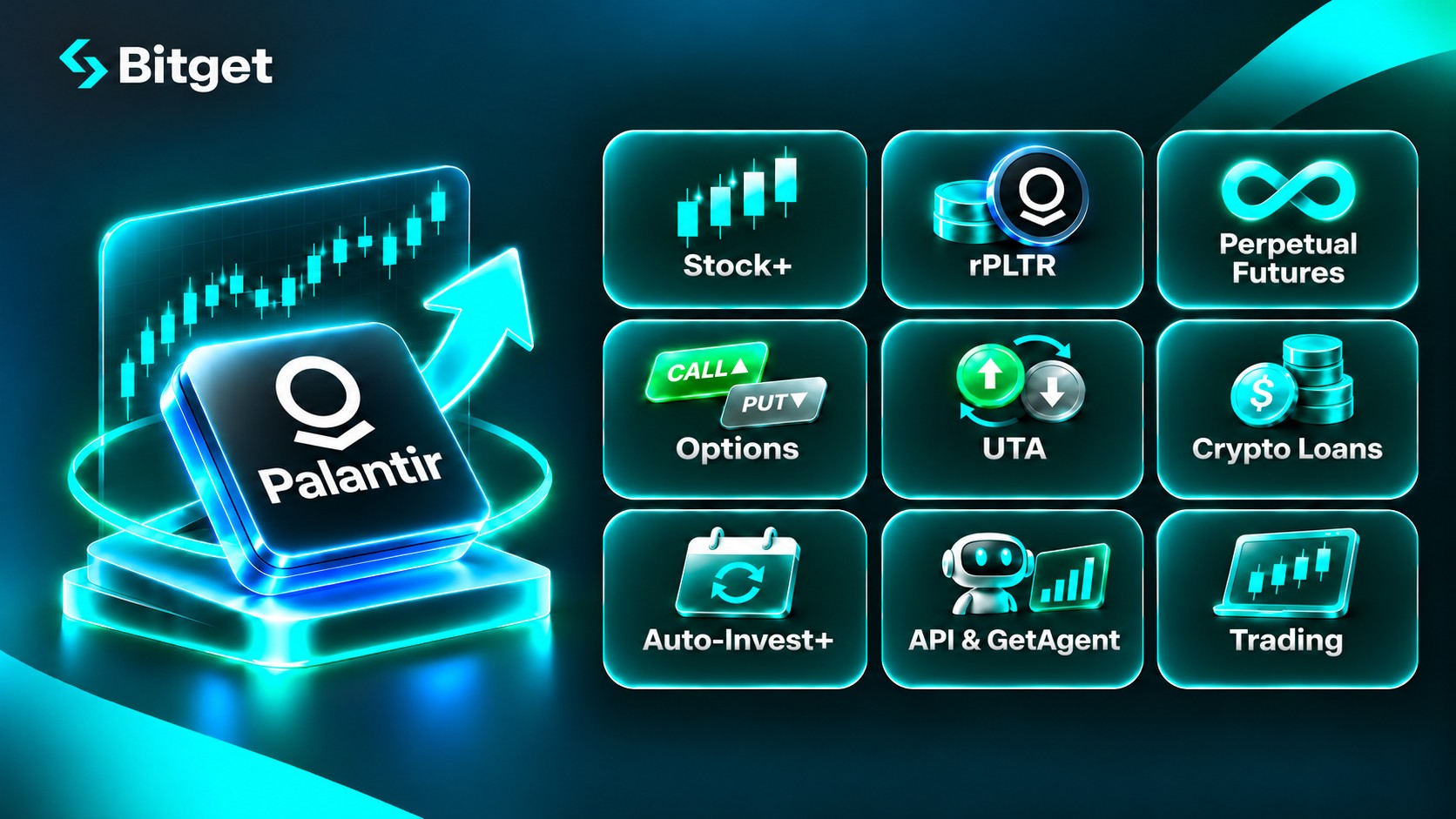
Palantir is available across several products within Bitget's expanding U.S. stock trading ecosystem.
Eligible users can choose between real stock ownership, tokenized Palantir exposure, leveraged derivatives, options, and additional portfolio-management tools.
This makes Bitget an attractive platform for users who want to explore both traditional stock markets and crypto-based financial products within one ecosystem.
1. Buy Real Palantir Shares With Bitget Stock+
For investors who prefer direct stock ownership, Bitget Stock+ provides access to real U.S. shares through compliant brokerage infrastructure.
PLTR is supported through Bitget's U.S. stock offering.
Rather than opening a separate traditional brokerage account, eligible users can access Palantir shares from within Bitget's Stock+ environment.
Key features include:
-
Real stock ownership: Purchase actual Palantir shares held through compliant brokerage arrangements.
-
Fractional investing: Buy eligible stocks in increments as small as 0.0001 shares.
-
Extended trading hours: Access supported pre-market, regular, after-hours, and overnight sessions, with 24/5 coverage.
-
USDC funding: Transfer USDC into a Stock+ account for conversion into USD and stock purchases.
-
Zero management fees: No separate management fee, although trading and other applicable costs may apply.
-
Market data: Access eligible stock quotes and Nasdaq TotalView market-depth information.
-
Portfolio transfers: Transfer eligible U.S. stock positions from supported brokerage accounts.
For long-term investors interested in Palantir's AI software growth, Stock+ provides a straightforward way to build traditional equity exposure.
For example, an investor could purchase fractional PLTR shares periodically instead of buying an entire share at once.
Unlike rPLTR tokenized stocks or perpetual futures, Stock+ provides ownership of real shares through the applicable brokerage structure.
Explore Palantir Stock Trading With Bitget Stock+
2. Trade Palantir rTokens (rPLTR) With USDT
For investors who prefer trading with stablecoins, Bitget rPLTR/USDT offers tokenized exposure to Palantir shares.
rPLTR is issued by Reality and is designed to track Palantir stock through 1:1 backing with underlying shares held through brokerage and custody arrangements.
Users can trade rPLTR directly against USDT on Bitget's spot market.
Key features include:
-
USDT settlement: Buy and sell rPLTR using stablecoins.
-
Fractional trading: Access Palantir-linked exposure without purchasing a full traditional share.
-
24/7 availability: Trade during supported periods, including outside U.S. stock-market hours and on weekends.
-
Underlying asset backing: Each rPLTR is designed to be backed by corresponding Palantir stock reserves.
-
Corporate-action support: Eligible stock splits and other corporate actions are handled according to the token's terms.
-
Additional utility: Eligible rPLTR holdings can be used through Bitget UTA and Crypto Loans.
One particularly useful feature is the connection between Bitget's tokenized stock market and traditional U.S. stock liquidity.
During supported U.S. equity-market sessions, Bitget's rToken trading infrastructure can connect orders to external stock-market liquidity.
Outside those sessions, prices depend on the available token-market order book.
This provides additional trading flexibility, although execution prices and spreads may differ from the underlying stock market, particularly when traditional exchanges are closed.
Importantly, rPLTR provides economic exposure rather than direct Palantir shareholder ownership or voting rights.
Palantir also does not currently pay cash dividends, so there is no regular PLTR dividend income to distribute.
For users already holding USDT, rPLTR offers a way to gain Palantir-linked exposure without converting funds into a traditional brokerage account.
3. Trade Palantir Stock Perpetual Futures (PLTRUSDT)
For traders looking to participate in both rising and falling markets, Bitget PLTRUSDT Perpetual Futures provide another option.
These USDT-margined contracts track Palantir-related price movements without requiring traders to own the underlying shares.
Traders can open:
-
Long positions: Gain exposure to potential increases in PLTR.
-
Short positions: Gain exposure to potential declines in Palantir's stock price.
-
Leveraged positions: Control larger notional exposure with a smaller amount of initial margin.
Bitget's PLTRUSDT perpetual futures market supports up to 20× leverage, subject to position tiers and current contract rules.
The platform also supports 24/7 trading for PLTRUSDT, allowing eligible traders to manage positions outside traditional U.S. stock-market hours.
For example, suppose a trader expects Palantir stock to recover following a positive government contract announcement.
Instead of purchasing shares, the trader could consider opening a long PLTRUSDT perpetual futures position.
A trader expecting short-term weakness could consider a short position.
Leverage allows traders to increase market exposure, but it also increases potential losses.
For example, with $100 in margin and 5× leverage, a trader controls approximately $500 in notional exposure.
A 5% favorable price movement would generate approximately $25 in profit before fees and funding payments.
However, a 5% unfavorable movement would create a similar loss, and larger losses can quickly lead to liquidation.
PLTRUSDT perpetual futures also involve funding payments, margin requirements, and price differences that may arise when the underlying stock market is closed.
For active traders following Palantir earnings, AIP developments, and AI-sector sentiment, Bitget futures offer additional flexibility to trade both directions.
Trade PLTRUSDT Perpetual Futures on Bitget
4. Trade Palantir Stock Options on Bitget
Palantir is also supported through Bitget U.S. Stock+ Options.
Eligible users can access PLTR call and put options, providing additional ways to express market views and manage stock exposure.
Options are particularly relevant for a volatile stock such as Palantir.
For example:
-
Call options: Buy a call when expecting PLTR to increase before expiration.
-
Put options: Buy a put when anticipating a decline in Palantir's stock price.
-
Protective puts: Eligible investors can purchase puts to help protect existing stock exposure.
-
Earnings-related strategies: Use available options contracts to express views around financial announcements and major company developments.
Bitget's Stock+ options product supports long calls and long puts funded with the full required premium.
Users can sell eligible long positions to close them.
On July 31, 2026, Bitget also introduced pre-market trading for selected U.S. stock options, with PLTR explicitly included among the supported underlyings.
Eligible pre-market options can be traded from 4:00 AM to 9:30 AM Eastern Time through participating market makers, subject to available quotes and matching.
This provides an additional way to react to company announcements before the regular U.S. session begins.
For investors who want exposure to Palantir price movements while defining the maximum premium at risk, long calls and puts provide another approach.
However, options can expire worthless, and pre-market liquidity may be lower than during regular hours.
Explore Palantir Stock Options on Bitget
5. Use rPLTR as Collateral With Bitget Unified Trading Account (UTA)
Bitget's Unified Trading Account (UTA) allows eligible users to manage collateral more efficiently across supported trading products.
The platform introduced cross-asset collateral support for 125 U.S. stock tokens in July 2026, with rPLTR explicitly included.
Instead of keeping crypto assets and tokenized stock holdings completely separate, qualifying users can use eligible rTokens as part of a unified margin arrangement.
This provides an additional use for Palantir tokenized stock holdings.
For example, an investor holding rPLTR may be able to use its recognized collateral value to support eligible futures or margin positions without immediately selling the tokens.
That can improve capital flexibility for users who manage positions across several asset classes.
Key benefits include:
-
Cross-asset collateral: Use eligible rPLTR holdings within the unified margin system.
-
Improved capital utilization: Reduce the need to maintain separate collateral pools for every supported position.
-
Flexible position management: Access eligible cross-margin and isolated-margin arrangements.
-
Integrated asset management: Monitor supported crypto and tokenized stock exposure within one account.
-
Collateral value discounts: Eligible assets receive margin value according to applicable discount ratios and tiers.
Bitget's UTA framework also supports advanced trading arrangements involving multiple assets.
For experienced users, combining rToken holdings with corresponding futures exposure may create opportunities to manage directional risk.
However, such strategies involve execution costs, basis risk, funding rates, and liquidation risks.
Collateral values also change with market prices.
If PLTR declines sharply, the recognized value of rPLTR collateral may decrease, affecting available margin.
Explore Bitget UTA and rPLTR Collateral Trading
6. Borrow Against rPLTR With Bitget Crypto Loans
Palantir tokenized stock is also supported as collateral through Bitget Crypto Loans.
This feature allows eligible users to borrow supported assets without immediately selling their rPLTR holdings.
On July 15, 2026, Bitget announced the addition of 39 stock tokens to its Crypto Loans collateral list, including rPLTR.
Users can pledge eligible rPLTR holdings and borrow supported assets such as USDT or USDC.
For example, an investor holding rPLTR may want additional liquidity while maintaining exposure to Palantir's future stock movements.
Instead of selling the tokens, the investor could consider a collateralized loan.
Bitget's published rPLTR collateral parameters include:
| Parameter |
Published rPLTR terms |
| Individual collateral limit |
800,000 USDT |
| Initial LTV |
78% |
| Margin-call LTV |
85% |
| Liquidation LTV |
91% |
These are published reference parameters, not guaranteed current borrowing limits. Actual terms depend on the live product page.
Borrowing against rPLTR can provide additional financial flexibility.
However, interest charges apply, and a decline in PLTR's price may increase the loan-to-value ratio.
If the position breaches applicable thresholds, the user may need to add collateral, repay part of the loan, or face liquidation.
For qualified investors who understand collateral management, Crypto Loans provide another way to make use of Palantir-linked holdings.
Explore rPLTR Crypto Loans on Bitget
7. Build Palantir Exposure Automatically With Bitget Auto-Invest+
For investors interested in long-term exposure, Bitget Spot Auto-Invest+ provides an automated investing approach.
On October 27, 2026, Bitget expanded its Auto-Invest feature to more than 3,000 U.S. stock and ETF rTokens, covering all rTokens available for spot trading.
This includes rPLTR.
The feature allows eligible users to configure recurring purchases according to a selected schedule.
Available frequencies include:
-
Hourly.
-
Daily.
-
Weekly.
-
Monthly.
For example, an investor who believes Palantir will benefit from enterprise AI adoption over the next several years could configure a weekly rPLTR purchase using a fixed amount of USDT.
Instead of placing each order manually, the system can execute scheduled purchases during eligible trading periods.
This supports a dollar-cost averaging approach, spreading purchases across multiple dates.
The feature may be particularly useful for investors who prefer consistent exposure rather than attempting to predict every short-term price movement.
However, scheduled investing does not guarantee profits or protect against losses.
When a token is unavailable for trading during a scheduled period, the purchase may be skipped rather than executed later.
Explore rPLTR Auto-Invest+ on Bitget
8. Use Bitget GetAgent and Trading APIs for Palantir Market Research
Bitget also offers additional tools for users interested in market analysis and advanced trading workflows.
Bitget GetAgent 2.0 supports research across cryptocurrencies, U.S. equities, CFDs, and other financial markets.
For users monitoring PLTR, GetAgent can help explore questions such as:
-
What developments are affecting Palantir stock?
-
How did Palantir's latest earnings compare with market expectations?
-
What factors could influence PLTR's next price movement?
-
What technical levels and risk factors should traders monitor?
-
How is broader AI-sector sentiment affecting U.S. technology stocks?
GetAgent also supports selected scheduled monitoring and market alerts.
For example, users can request updates on important market changes or upcoming events.
GetAgent is an analytical assistant rather than an automated stock-trading bot. It does not independently open or close PLTR positions on a user's behalf.
For advanced users, Bitget Stock+ API provides access to supported stock and options trading functions, subject to account permissions and API requirements.
Available capabilities depend on account authorization and the specific instrument.
These tools can help eligible users monitor market data, develop research workflows, and access supported trading functionality.
For automation, rPLTR is explicitly covered by Bitget's Spot Auto-Invest framework. Other trading bot types should be checked individually rather than assumed to support Palantir.
Which Palantir Trading Product Should You Choose on Bitget?
| Bitget product |
Main use case |
| Buy real Palantir shares |
|
| Trade tokenized Palantir using USDT |
|
| Trade leveraged long and short positions |
|
| Trade supported PLTR calls and puts |
|
| Use eligible rPLTR as trading collateral |
|
| Borrow against eligible rPLTR holdings |
|
| Make recurring rPLTR purchases |
|
| Analyze Palantir and monitor market developments |
|
| Access supported stock and options workflows |
Each product serves a different purpose.
Stock+ may appeal to investors who want direct Palantir share ownership, while rPLTR provides tokenized economic exposure through a USDT-based market.
Perpetual futures and options offer additional trading flexibility for users who want to manage directional exposure.
UTA and Crypto Loans provide capital-management options for eligible rPLTR holders, while Auto-Invest+ supports recurring purchases.
Together, these features give Bitget users several ways to participate in Palantir-related markets from one financial ecosystem.
Product availability, leverage, fees, trading hours, and regional eligibility are subject to applicable rules.
What Should Palantir Investors Watch in 2027?
Palantir's performance in 2027 will depend on whether its extraordinary growth continues translating into revenue, earnings, and new customer contracts.
Several indicators deserve particular attention.
-
U.S. commercial revenue growth: Investors will monitor whether Palantir can sustain strong enterprise AI demand as its commercial business becomes larger.
-
AIP adoption: New customers, expanded deployments, and recurring software usage will help demonstrate the platform's long-term value.
-
New contract value: Total contract value and remaining deal value will provide important information about future revenue opportunities.
-
Government and defense contracts: New agreements, renewals, and modernization programs could influence Palantir's government revenue.
-
Sovereign AI partnerships: Demand for AI systems that support data security and operational control could provide additional growth opportunities.
-
Operating margins: Palantir's ability to maintain strong profitability while expanding its business will remain important.
-
Stock-based compensation: Investors should evaluate whether earnings per share continue growing alongside revenue and profitability.
-
2027 revenue guidance: Management's official 2027 forecasts will be particularly important for assessing the company's growth trajectory.
-
AI-sector valuations: Broader market expectations for artificial intelligence companies could significantly influence PLTR's stock performance.
-
Quarterly earnings: Future results will help determine whether Palantir can meet the high expectations currently reflected in its valuation.
For investors, the central question will be whether Palantir can sustain exceptional growth as it becomes a much larger enterprise software company.
Final Thoughts
Palantir enters 2027 as one of the fastest-growing major enterprise AI software companies. Its latest results demonstrate extraordinary demand for AIP, continued expansion across commercial and government customers, and strong operating profitability. However, the stock's recent correction also highlights an important reality: strong business performance does not always translate into immediate share-price gains, particularly when valuations already reflect substantial expectations.
For investors and traders looking to participate in Palantir-related markets, Bitget brings together real stock ownership, rPLTR tokenized assets, PLTRUSDT perpetual futures, stock options, automated investing, and capital-management tools in one ecosystem. Whether users prefer to accumulate real shares, trade short-term price movements, or explore USDT-based exposure, Bitget offers several approaches to match different trading preferences.
Palantir's next chapter will depend on whether its AI software can continue delivering meaningful results for businesses and governments worldwide. The company's growth has already been remarkable. The question for 2027 is whether PLTR can keep growing fast enough to justify what investors are willing to pay for it.
Frequently Asked Questions About Palantir Stock
1. What Is the Palantir Stock Forecast for 2027?
Analysts expect Palantir to continue growing in 2027, supported by enterprise AI adoption and government demand. The average rolling 12-month price target is approximately $217.97, while consensus revenue estimates suggest around $13 billion for 2027. These are forecasts rather than guaranteed future results.
2. Can Palantir Stock Reach $200 in 2027?
PLTR could potentially return to $200 if revenue growth remains strong, AIP adoption accelerates, and investors maintain confidence in the company's long-term prospects. However, valuation concerns and market volatility could affect the timing and likelihood of such a move.
3. Can PLTR Reach $250 in 2027?
Some analysts have issued price targets of $250 or higher. Reaching that level would likely depend on sustained commercial AI growth, strong profitability, and investor willingness to maintain a premium valuation.
4. Why Has Palantir Stock Fallen Despite Strong Earnings?
Palantir reported 96% revenue growth in Q3 2026, but newly signed contract value grew more slowly. Investors have also expressed concerns about the company's premium valuation and the sustainability of future growth.
5. Is Palantir a Good Long-Term AI Investment?
Palantir provides exposure to enterprise AI, government software, data integration, and operational intelligence. However, its high valuation, competitive environment, and stock-price volatility are important factors when evaluating long-term investment potential.
6. Does Palantir Pay Dividends?
No. Palantir does not currently pay regular cash dividends. Investors generally seek exposure to the company's potential growth rather than dividend income.
7. What Is Palantir AIP?
Palantir Artificial Intelligence Platform (AIP) helps organizations connect AI models with enterprise data and operational workflows. It is designed to support real-world decision-making and AI-powered business applications.
8. Can I Buy Real Palantir Shares on Bitget?
Yes. Eligible users can access real Palantir shares through Bitget Stock+, which supports fractional investing and extended weekday trading.
9. Can I Trade Palantir With USDT on Bitget?
Yes. rPLTR/USDT allows eligible users to trade tokenized Palantir exposure using USDT. Bitget also offers PLTRUSDT perpetual futures for leveraged long and short trading.
10. Does Bitget Support Palantir Options and Collateral Products?
Yes. PLTR is among the supported underlyings for Bitget U.S. Stock+ Options. Eligible rPLTR holdings can also be used with UTA and Crypto Loans, subject to applicable collateral requirements and product rules.
Explore Palantir Trading Opportunities on Bitget
Disclaimer: This article is for informational and educational purposes only and does not constitute investment advice. Stock prices, analyst forecasts, and product terms may change. Trading stocks, tokenized assets, options, and leveraged derivatives involves risk, including possible loss of principal. Users should assess their risk tolerance and review applicable product terms before trading.


- Key Takeaways
- Palantir (PLTR) Stock Performance in 2026
- Palantir Stock Outlook 2026–2027: Key Growth Drivers
- What Are the Biggest Risks for Palantir Stock in 2027?
- Palantir Stock Price Prediction for 2026–2027
- How to Trade Palantir (PLTR) on Bitget
- What Should Palantir Investors Watch in 2027?
- Final Thoughts
- Frequently Asked Questions About Palantir Stock