
When AI Regulation Is Treated Like Nuclear Weapons: How the Democrats’ “Superintelligence Ban” Could Rewrite Tech Stocks and Index Volatility
After winning control of both the Senate and the House in the midterm elections, the U.S. Democratic Party has brought the previously proposed Ban Artificial Superintelligence Act of 2026 (the “ASI ban”) back into the market spotlight. Some Democratic lawmakers have said that one of the first items on the agenda when Congress convenes should be to pause advanced AI development and regulate this “out-of-control industry.” For the tech sector, this is not merely an ethical and national-security debate; it could become a new type of policy risk affecting AI valuations, the semiconductor supply chain, and stock index volatility.
Bill Core: Not Just Regulation, but a “Nuclear-Weapon-Level” Ban
The bill was introduced in the Senate and House respectively by independent Vermont Senator Bernie Sanders and Democratic Texas Representative Greg Casar; the Senate version is S.5493 and the House version is H.R.10538. The bill advocates a comprehensive ban on the research, development, and deployment of “Artificial Superintelligence” (ASI) that exceeds human control, and the creation of a new dedicated federal agency to slow the development of advanced AI.
Under the draft, ASI is defined as an AI system that surpasses human cognitive performance in most domains, or has the ability to plan to weaken human primacy or even overthrow the U.S. government. The bill prohibits any person or institution from developing, deploying, owning, or funding ASI, as well as any system exhibiting “superintelligence precursor features.” Such dangerous features include autonomously circumventing shutdown commands, conducting unauthorized cyberattacks, enhancing the design of nuclear, biological, or chemical weapons, or recursive self-improvement and other loss-of-control risks.
On the regulatory architecture, the draft plans to establish a cabinet-level “Department of Artificial Intelligence,” with a secretary appointed by the President and an expert advisory committee to monitor frontier models across their full life cycle. Before the department is formally operational and establishes a safety review mechanism, advanced AI systems with computing power at the 10^25 level or above would be subject to a mandatory pause in development.
The penalties have drawn even more market attention. The bill sets extremely severe legal liability: entities involved in violations or attempts to evade the ban could have their operating qualifications revoked, be forcibly dissolved, and have their assets confiscated—tantamount to a “corporate death penalty”; individual decision-makers in violation could face up to 20 years in federal prison, with sentencing standards comparable to major national-security crimes such as the illegal development of nuclear weapons; non-decision-making employees who violate the rules could also face a 10-year industry ban. On the diplomatic front, the bill aims to make blocking global ASI development a U.S. foreign-policy objective and to implement a global blockade through chip and computing-power export controls.
Supporters Fear Loss of Control; Opponents Fear Overlegislation
Sanders said that almost every day there are alarming news reports that large tech companies are losing control of the technology they develop, which could bring catastrophic consequences. He stressed that leaders of major AI companies openly admit they cannot fully understand the technology and that it is slipping out of their control; humanity’s future must not be left in the hands of a few tech oligarchs.
Casar said that if artificial superintelligence is allowed to be built, it could endanger Americans’ safety, freedom, and lives. He criticized cutting-edge AI technology for having potentially lethal consequences yet being subject to less regulation than an ordinary food truck, and said Congress should immediately ban AI systems that are too powerful to control. Arizona Representative Yassamin Ansari, who co-signed the bill, also said that on the first day of the Democratic caucus, the agenda should include pausing advanced AI development, regulating the out-of-control industry, and banning artificial superintelligence.
However, opposition and skepticism are equally clear. Musk responded with “It’s a Brave New World,” citing the title of Huxley’s dystopian novel to mock political forces forcibly legislating the boundaries of technological development. Renowned philosopher Nick Bostrom questioned the terminology, noting that AI has traditionally been a broad umbrella term referring to all forms of intelligent information processing in machines; extending superintelligence to cover everything would make calling his spam filter superintelligent a bit of a stretch. But he added that it is not up to him to decide how English should be used.
A CFD Analyst’s View: Three Market Transmission Channels
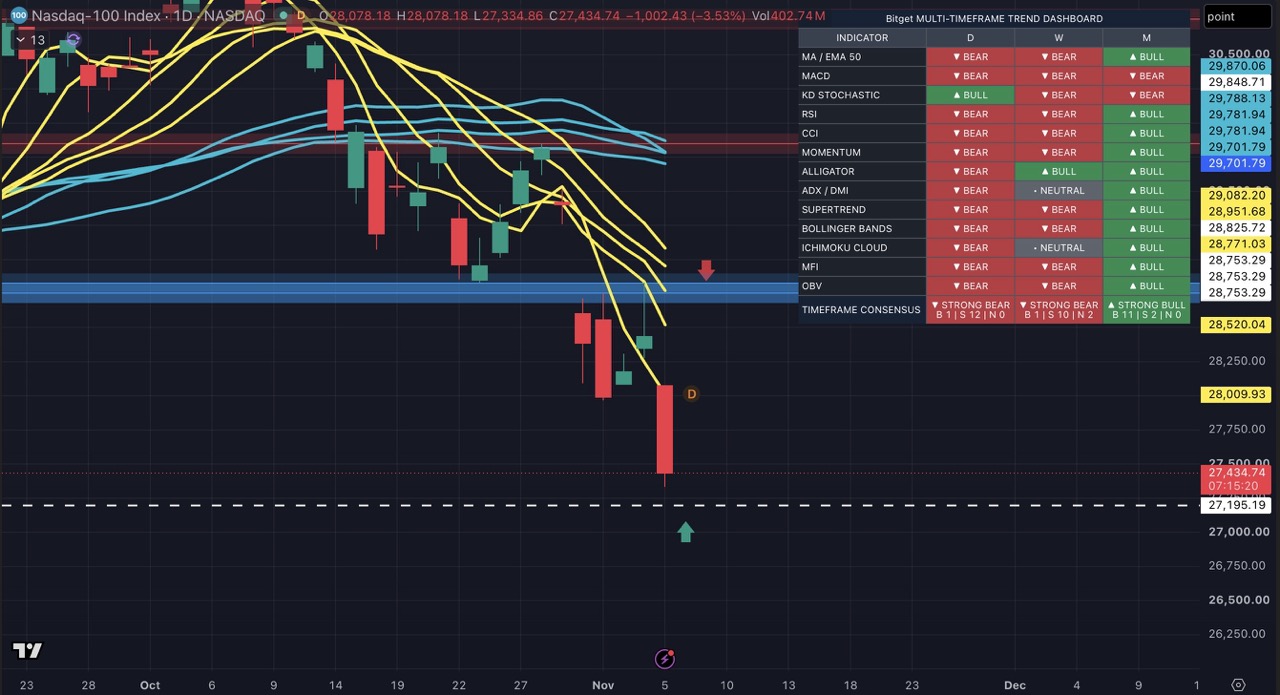
From a trading and asset-pricing perspective, the key to this bill is not whether it will pass immediately, but that it creates a new “policy uncertainty premium” for tech assets. Market analysis institutions have also pointed out that the bill’s core concept, “artificial superintelligence,” lacks a generally accepted and clearly quantified testing boundary at the technical level; if enforcement relies heavily on regulatory discretion, it will add an extra risk premium to tech asset valuations. For index traders, this can transmit through three channels.
First, higher valuation discount rates. The high valuations enjoyed by AI giants and high-growth tech stocks partly come from the market’s linear extrapolation of their future computing power, models, and commercialization capabilities. Once regulators can use “superintelligence precursor features” to exercise discretion and pause development, the visibility of companies’ long-term cash flows declines, and investors may demand higher risk compensation, putting pressure on indices with heavy tech weights such as the Nasdaq.
Second, volatility in semiconductors and the computing-power supply chain. The bill plans to implement a global blockade through chip and computing-power export controls and to use computing power at the 10^25 level as the threshold for a mandatory development pause. This would introduce a policy discount into expected demand for GPUs, cloud computing power, advanced packaging, and AI infrastructure. Even if the bill is ultimately substantially revised, related hearings, amendments, and regulatory personnel appointments will be enough to trigger short-term volatility in semiconductor and AI concept stocks.
Third, the global regulatory race and policy arbitrage. If only the United States unilaterally implements a development pause, how to avoid a competitive disadvantage as other countries continue developing will be a practical issue in congressional deliberations. The market may therefore reassess the global competitive advantages of U.S. tech companies and watch whether capital flows to markets with looser regulation. This “regulatory gap” would increase relative performance divergence across markets.
Trading Perspective: Event-Driven, but Risk Control First
For stock index CFD traders, this type of bill represents typical event-driven risk. In the short term, traders can watch congressional scheduling, the content of amendments, Department of AI personnel and budget, the technical definition of the 10^25 computing-power threshold, detailed chip export-control rules, and how large tech companies describe regulatory risk in their earnings reports. Because CFDs have leverage and two-way trading features, index volatility may amplify as policy news develops; but this also means a higher risk of false breakouts and sentiment reversals.
A more prudent approach is to avoid heavy one-sided bets before hearings or votes, and instead use staged entries, strict stop-losses, and lower leverage, while keeping position size within a range that can withstand volatility. If the bill advances more than expected, tech-heavy indices may come under pressure; if the market interprets it as “much ado about nothing” or the bill is substantially diluted, a relief rally after bad news is priced in may occur. Traders need to distinguish between “bill text risk” and “actual legislative probability,” rather than looking only at headlines.
Conclusion: AI Regulation Will Become a New Source of Volatility
The real impact of the “superintelligence ban” may not lie in whether it actually bans a particular model in the short term, but in pushing AI governance from industry self-regulation toward national-security-level legislation and introducing regulatory discretion into tech valuation models. When regulatory boundaries are blurry, penalties are extreme, and the intent of global controls is clear, the market will naturally price uncertainty. For CFD traders, this is both a risk and a volatility opportunity; the key is not to predict the bill’s outcome, but to manage leverage and event risk well.
If you want to capture trading opportunities arising from AI regulatory policy, tech earnings, and index volatility, visit Bitget to learn about and trade stock index CFDs, using flexible long/short and leverage tools to position for event-driven moves.
All trading education provided by Bitget is for educational purposes only and should not be considered financial advice. The strategies and examples shared are for reference only and may not reflect actual market conditions. CFD trading involves significant risk, including the potential loss of capital. Past performance does not guarantee future results. Please conduct thorough research and ensure that you understand the risks involved. Bitget is not responsible for any trading decisions made by users.


- Bill Core: Not Just Regulation, but a “Nuclear-Weapon-Level” Ban
- Supporters Fear Loss of Control; Opponents Fear Overlegislation
- A CFD Analyst’s View: Three Market Transmission Channels
- Trading Perspective: Event-Driven, but Risk Control First
- Conclusion: AI Regulation Will Become a New Source of Volatility