
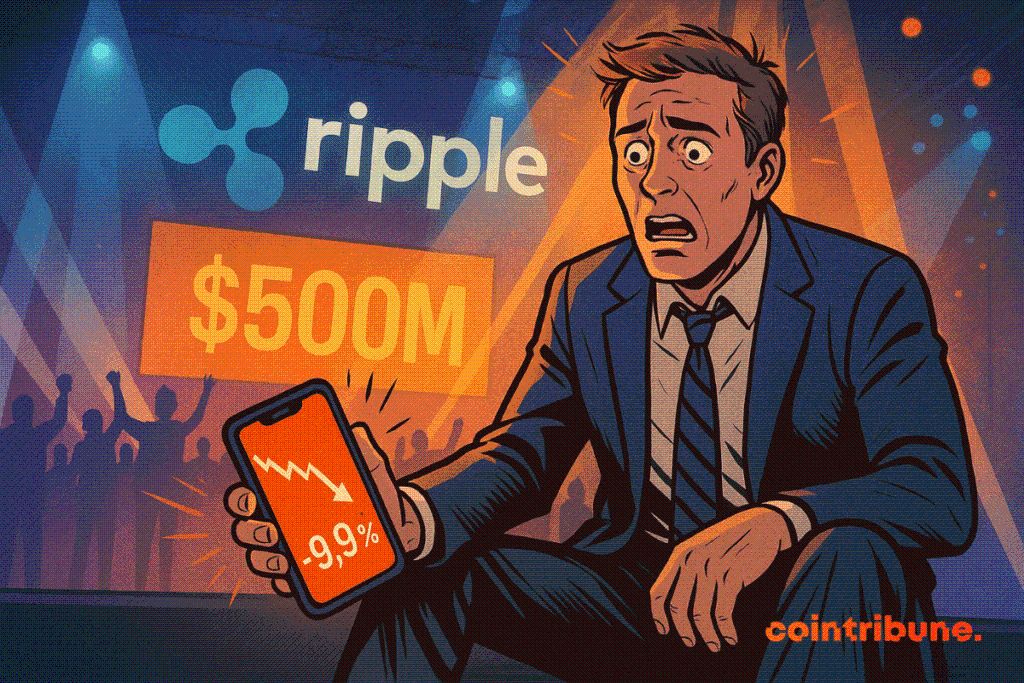
XRP drops 9% despite major announcements from Ripple

The storm continues to rage on the crypto planet. Even the best-equipped vessels struggle to keep course. This time, it is XRP that takes the hit. Despite a torrent of prestigious announcements signed by Ripple – top-notch, heavy – the token falls 9% in one week. The Swell grand meeting was not enough to reassure. The crypto universe remains unpredictable, and technical signals are turning stormy. Behind the noise of conferences and fundraisings, some prefer to cash in their gains. Massively.
In brief
- XRP drops despite Swell and announcements, confirming the tense climate shaking crypto.
- Realized profit jumps 240%, betraying massive sales despite the bullish context.
- Ripple raises 500 million, but the valuation seems mostly based on its XRP reserves.
- A technical death cross alerts analysts: indicators remain clearly bearish for XRP.
Profit-taking on XRP: when the party is in full swing… but behind the scenes
Since the end of September, the price of XRP has dropped from $3.09 to $2.30, a fall of nearly 25%. So far, nothing crazy in the crypto world. But what intrigues analysts is the shape of the decline: during this drop, realized profits have exploded. According to Glassnode, the average volume of realized profit jumped from $65M to $220M per day , a leap of +240%. A counter-trend.
The tweet from @glassnode is clear: “Unlike previous waves of profit realization which coincided with rises, since the end of September, while XRP dropped from $3.09 (about -25%) to $2.30, the volume of realized profits (7-day moving average) jumped about 240%, from 65 million dollars per day to 220 million per day“.
This pattern signals a loss of adhesion, a psychological loosening. And yet, Ripple gave it all: partnership announcements with Mastercard, acquisition of Palisade, $500M raised with the cream of global investment. Even Nasdaq was present at Swell. But the market seems to be waiting… for a sign of life.
The Ripple jackpot? A fundraising with two interpretations
Ripple announced a $500M raise at a valuation of $40 billion. This jackpot, brought by giants like Citadel Securities, Galaxy Digital, or Brevan Howard, marks one of the largest financings of the year. On paper, everything looks perfect: Ripple stacks acquisitions (Hidden Road, Palisade, Rail), develops its stablecoin RLUSD , and aims to dominate the institutional crypto segment.
But a question arises: what exactly did these investors buy? The Unchained article reminds us that Ripple holds 34.76 billion XRP tokens, more than $80 billion at the current price. The XRP Ledger generates less than $200,000 in monthly fees, according to cited figures.
An anonymous investor interviewed by Unchained confides:
Ripple’s equity probably isn’t worth much by itself, certainly not 40 billion dollars.
This comment, reported without filter, suggests that some are not buying a tech company, but privileged access to a strategic stock of tokens. In other words: a financing operation… disguised as arbitrage?
Crypto struggling, XRP against the trend: signals turn red
XRP is not alone in experiencing a sudden winter. Bitcoin saw $946M outflows in institutional products. On Monday, November 4, $578M fled Bitcoin ETFs. Yet, some altcoins are standing out: Solana attracted $421M, Ethereum more than $57M, and XRP, despite its slide, $43.2M. This positive flow seems fragile in front of a worrying technical analysis.
The figure of the moment is called death cross: the bearish crossover of moving averages. As summarized by U.Today, XRP saw its 50-day MA cross below the 200-day MA, reinforcing a long-term bearish pattern. The RSI flirts with 40, a sign of prolonged weakness. Resistance at $2.50 was violently rejected, without the market showing signs of recovery.
The death cross signals a reversal of long-term momentum. Recent recovery attempts may just be market rebounds. The most likely path remains downward.
The figures that sketch the current picture
- XRP at time of writing: $2.31;
- +240% on realized profit volume according to Glassnode;
- $500M raised by Ripple at $40 billion valuation;
- $43.2M inflows for XRP in institutional products;
- Death cross confirmed, RSI around 40.
Another piece of news, flying under the radar, is worth a look: Ripple has given up going public . After its victory against the SEC, the path seemed open. Yet, the company decided not to attempt the public markets adventure. A strategic choice, revealing an uncertain climate. Will XRP be able to win hearts again without this symbolic step? Nothing is less sure.
Disclaimer: The content of this article solely reflects the author's opinion and does not represent the platform in any capacity. This article is not intended to serve as a reference for making investment decisions.
You may also like
The 5% U.S. Treasury yield storm is coming! The refinancing time bomb countdown begins—who will be the first victim?
The 10-year US Treasury yield has surpassed 5%, reaching a new high since 2007. The longer high interest rates persist, the greater the refinancing pressure will be on real estate companies, commercial real estate, and highly indebted firms, with systemic risks likely to accelerate and emerge within the next 12 to 18 months.

Don't Fight the Profit Cycle! Will U.S. Stocks Break 8,000 Points This Year?
Jefferies predicts that, driven by the dual engines of the AI investment boom and stronger-than-expected corporate earnings, the S&P 500 index is expected to soar to 8,000 points by the end of 2026 and further reach 9,000 points in 2027. AI-driven profit expansion has spread from the "Magnificent Seven" to the entire market, with the S&P 500's EPS forecast to surge by 35% this year, far exceeding market consensus—marking the strongest earnings supercycle since 1995! The only real threat: if US Treasury yields continue to spike, the risk of valuation compression cannot be ignored.
Will “continual learning” AI extend the memory “shortage” until 2031?
Citi believes that as AI enters the era of "continuous learning" beyond simple training and inference stages, demand for HBM, server DDR5, and enterprise SSDs (eSSD) will experience explosive and simultaneous growth starting from 2027. While demand will surge rapidly, the supply side is constrained by HBM production capacity usage and slower technology migration, leading to expansion lagging far behind demand. This supply-demand imbalance is expected to continue until 2031.


