- XRP faces a year-long decline against Bitcoin despite legal clarity.
- High transaction costs hinder XRP’s adoption for payments.
- Market sentiment on XRP remains divided amid legal wins and practical challenges.
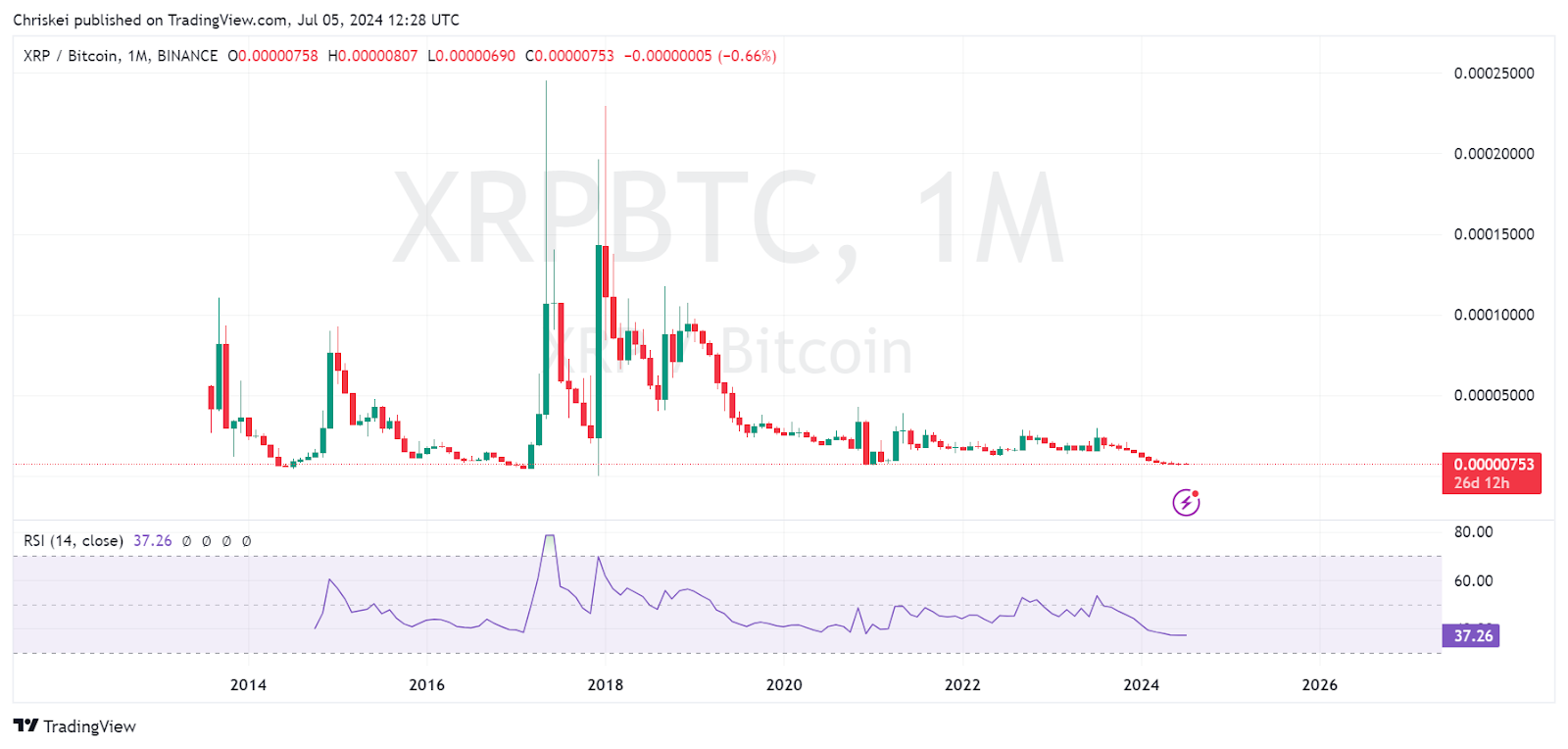
Ripple’s XRP has faced a challenging year, with its value steadily declining against Bitcoin for the past 12 months. The prolonged slump is evident in its record-breaking 12th consecutive monthly red candle against Bitcoin. This decline has occurred even though XRP stands out as one of the few digital assets with clear legal status. The disconnect between its legal clarity and market performance has puzzled many investors and industry observers.
Source: TradingView
Recent analysis underscores the disconnect between XRP’s legal standing and its market performance. A key observation made by industry analyst Mr. Huber highlights this downturn , emphasizing the unique position of XRP. He pointed out that while XRP has legal clarity, it has experienced a consistent drop in value. This observation highlights a critical issue: legal clarity alone does not guarantee market success.
Further adding to the discussion, David “JoelKatz” Schwartz, Ripple’s Chief Technology Officer, tweeted a noteworthy comment on X. He stated that it still costs $1 to buy enough XRP to make a $1 payment. This statement underscores the inefficiency and lack of value in using XRP for payments. Despite legal victories, the practical use of XRP remains questionable, as high transaction costs deter its adoption for everyday transactions.
Community sentiment around XRP remains divided. While some remain hopeful due to its legal clarity, others are skeptical due to its poor performance and high transaction costs. Legal victories, such as those achieved by Judge Torres, have not translated into market gains. The practical challenges in using XRP for payments overshadow the legal wins, leading to a lack of confidence among potential users and investors.
Technically, the long-term chart of XRP against Bitcoin paints a bleak picture. The TradingView chart reveals a sustained downtrend, with the Relative Strength Index (RSI) indicating oversold conditions. With the RSI close to 37.26, the asset appears undervalued, potentially suggesting a rebound. However, the overall trend remains bearish, confirming the negative sentiment expressed by analysts and within the community.
Disclaimer: The information presented in this article is for informational and educational purposes only. The article does not constitute financial advice or advice of any kind. Coin Edition is not responsible for any losses incurred as a result of the utilization of content, products, or services mentioned. Readers are advised to exercise caution before taking any action related to the company.