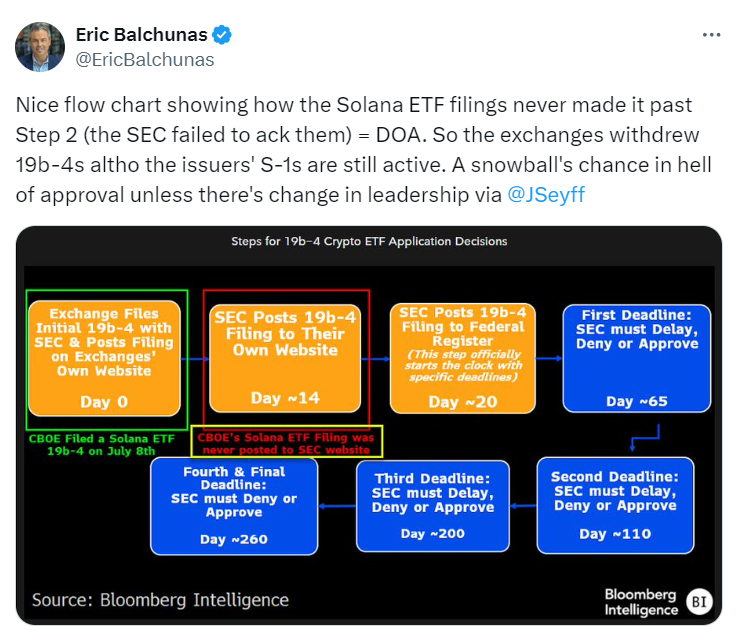
United States Solana exchange-traded funds (ETFs) have a “near-zero” chance of getting greenlit under the current administration after the regulator reportedly rejected a filing necessary for their approval.
“A snowball’s chance in hell of approval unless there’s a change in leadership,” said Bloomberg ETF analyst Eric Balchunas in an X post on Aug. 20.
Only days earlier on Aug. 16, reports emerged that Cboe had removed the 19b-4 filings for two prospective Solana ETFs from its website’s “Pending Rule Changes” page.
Some have speculated the United States Securities and Exchange Commission rejected the filings before they could even undergo formal consideration — due to the regulator’s “concerns” over Solana’s classification as a security.
![]() Source:
Source: Eric Balchunas
“Yes, near-zero chance in 2024, and if Harris wins, there’s prob near-zero chance in 2025 too. Only hope IMO is if Trump wins,” said Balchunas in response to a comment on his original post.
“Solana ETF not happening anytime soon under the current administration,” wrote ETFStore president Nate Geraci in an earlier X post on Aug. 17.
Geraci has previously argued that the approval of Solana ETFs would hinge on Solana ( SOL ) being classified as a commodity.
However, VanEck’s head of digital asset research, Matthew Sigel, says there was a case against a fraudulent cryptocurrency firm in 2018 that could be key.
“For the record, VanEck believes SOL is a commodity, much like BTC and ETH.”
“This belief is informed by evolving legal perspectives, where courts and regulators have begun to recognize that certain crypto assets may function as securities in primary markets but behave more like commodities in secondary markets.”
“My Big Coin” case from 2018 could be key
In his latest post on X on Aug. 20, Sigel referred to the Commodity Futures Trading Commission’s case against “My Big Coin Pay” in 2018, in which the defendants argued My Big Coin (MBC) token was not a commodity due to the absence of futures contracts that reference it.
Related: Brazil poised to launch world’s first spot Solana ETF ahead of global markets
However, the judge rejected the argument, noting that My Big Coin is a virtual currency in the same way that Bitcoin is. This was enough for the CFTC to allege MBC is a commodity, allowing the case to go ahead.
The founder was later convicted by a federal jury in 2022 and later sentenced to 100 months in prison and ordered to pay $7.6 million to victims of his scheme.
Meanwhile, Sigel also noted that VanEck’s S-1 filing is “still in play” despite Cboe removing the 19b-4 on its website.
“Remember that Exchanges like Nasdaq CBOE file rule changes (19b-4) to list new ETFs. Issuers like VanEck are responsible for the prospectus (S-1). Ours remains in play.”
Cointelegraph reached out to Cboe Global Markets for comment.
Magazine: 11 critical moments in Ethereum’s history that made it the No.2 blockchain