
Last updated:
September 16, 2024 08:36 EDT

Anticipated U.S. rate cuts could boost DeFi yields, with analysts predicting renewed interest in decentralized finance as rates decline.

As U.S. Federal Reserve rate cuts loom, decentralized finance (DeFi) yields are positioned well for a resurgence, according to a recent report by analysts at research and brokerage firm Bernstein.
With the possibility of a 25- to 50-basis-point cut anticipated on Wednesday, analysts Gautam Chhugani, Mahika Sapra, and Sanskar Chindalia forecast a promising outlook for DeFi, particularly on Ethereum.
The analysts wrote in a note:
“DeFi yields look attractive again with a rate cut likely around the corner. This could be the catalyst to reboot crypto credit markets and revive interest in DeFi and Ethereum.”
DeFi platforms allow global participants to earn a yield on stablecoins like USDC and USDT by providing liquidity in decentralized lending markets.
While the explosive growth of the 2020 “DeFi summer” has faded, and the high yields incentivized by app tokens are long gone, stablecoin lending on Aave, the largest lending market on Ethereum, continues to offer competitive rates of around 3.7% to 3.9%.
According to Bernstein’s analysis, the total value locked (TVL) in DeFi protocols, although still only half of its 2021 peak, has surged from the lows of 2022, doubling to approximately $77 billion.
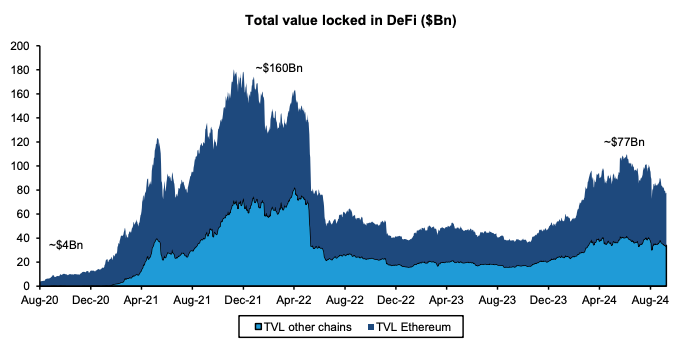 Source: Bernstein
The number of monthly active DeFi users has increased three to four times since the market’s lowest point.
Stablecoins have also seen a resurgence, with total issuance returning to around $178 billion. Active wallet numbers have stabilized, hovering at about 30 million monthly users.
“These are all signs of a recovering crypto DeFi market that should see further acceleration as rates head down,”
Particularly on stablecoins, Jeremy Allaire, CEO of Circle, predicts that stablecoins will account for 10% of the global economy within the next decade, driven by advancements in Blockchain technology and increased integration into financial systems.
He expressed optimism about the future of cryptocurrency, emphasizing stablecoins’ growing role in global transactions and services.
Allaire also noted the rapid acceptance of digital assets, with many governments establishing clear regulations for their use.
He anticipates that by 2025, stablecoins will be considered “legal electronic money” in most places, further expanding their share of the $100 trillion electronic money market.
If demand for crypto credit rises, DeFi stablecoin yields could surpass 5%, outpacing yields from U.S. dollar money market funds.
The analyst further claimed that such an increase could reignite crypto credit markets, which would provide an upward momentum for digital asset prices.
In light of the improving outlook, Bernstein has added Aave to its digital assets portfolio, replacing derivative protocols GMX and Synthetix.
Aave, a DeFi lending giant, has seen outstanding debt triple from its January 2023 low, while its token price has risen 23% in the past 30 days despite relatively stagnant Bitcoin prices.
The analysts also believe that Ethereum’s underperformance relative to Bitcoin might be temporary. Over the last 12 months, Ethereum has dropped 36% against Bitcoin, reaching its lowest point since April 2021.
 Source: CoinGecko
The analysts attribute Ethereum’s struggles to weaker spot exchange-traded fund (ETF) flows.
However, strengthening DeFi lending on Ethereum could attract large institutional investors and whales back into the crypto credit markets.
“We believe it may be time to turn back attention to DeFi and Ethereum,”
As the rate cuts approach, the DeFi market’s resurgence may increase yields and play a key role in shaping the next phase of the crypto credit market.
Notably, 10x Research has warned that an aggressive interest rate cut by the U.S. Federal Reserve could signal deeper economic concerns, negatively affecting risk assets like Bitcoin.
Reports suggest that while a modest 25 basis point cut could favor long-term Bitcoin price appreciation, a more aggressive 50 basis point cut might indicate heightened recession fears.
This could lead investors to reduce their exposure to Bitcoin, potentially triggering a 15-20% decline. The Federal Reserve will likely focus on mitigating economic risks, not market reactions.
Disclaimer: The content of this article solely reflects the author's opinion and does not represent the platform in any capacity. This article is not intended to serve as a reference for making investment decisions.
Anthropic has been profitable for two consecutive quarters ahead of its IPO
Anthropic has achieved positive adjusted operating profit for two consecutive quarters, with Q2 revenue surging 14-fold year-on-year to $11.5 billion and annualized revenue reaching $65 billion. The gross margin exceeds 80%. The company has chosen to list on Nasdaq, with a potential valuation of up to $2 trillion. Dramatically, the CEO has made a rare call to slow down AI development just before the IPO. Analysts believe that balancing safety concerns with commercial competition will become the core challenge.
Anthropic signs $13.7 billion computing power agreement with "Trump-linked company" Rum Group
Anthropic has signed a $13.7 billion, six-year computing power agreement with Rum Group. The core of the agreement is a data center under construction in Georgia. Rum Group was formerly the conservative video platform Rumble, whose early investors include current U.S. Vice President Vance.
Will the midterm elections cause the US stock market to crash? 75 years of history give an unexpected answer
Currently, with less than eight weeks until the midterm elections, one of the greatest uncertainties facing Wall Street is imminent. But will the reshuffling of power in Congress lead to a stock market crash? Looking back over 75 years of history, the answer is surprising, and ultimately leans toward optimism.


