
Last updated:
September 24, 2024 11:43 EDT

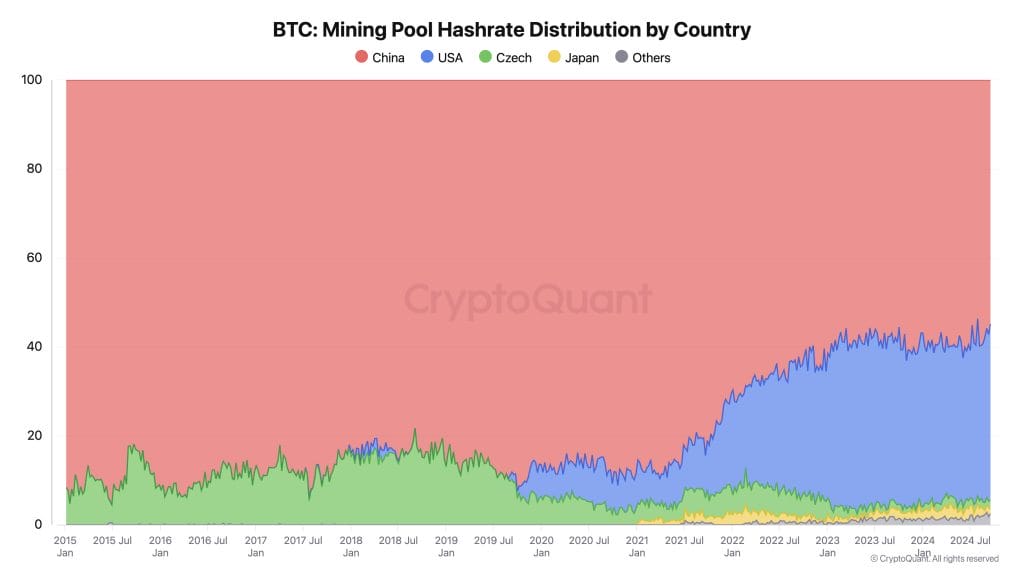
China continues to dominate Bitcoin mining with 55% of the global hashrate, despite its 2021 ban on cryptocurrency, while U.S. mining firms are rapidly increasing their share to 40%.

Despite China’s 2021 cryptocurrency ban, the country still maintains significant control over the Bitcoin mining network, with over 55% of the global hashrate.
However, as Bitcoin mining grows in institutional legitimacy, particularly in the U.S., American mining firms are quickly closing the gap.
The U.S. now controls 40% of the global hashrate because of a fundamental shift in mining dynamics as political, regulatory, and economic pressures impact the two countries differently.
 Source: CryptoQuant
According to Ki Young Ju, the CEO of CryptoQuant, Chinese mining pools still control 55% of the global Bitcoin mining network . This revelation is startling, given China’s aggressive anti-crypto measures in recent years.
However, Chinese miners have found ways to continue operating, even in the face of government crackdowns.
Before the 2021 ban, China dominated Bitcoin mining, contributing more than 75% of the global hashrate at one point.
At the time, the Chinese government framed the ban as necessary to maintain financial stability and prevent illegal activity.
As a result, many miners were forced to shut down operations, and some relocated to more crypto-friendly jurisdictions like the U.S. and Kazakhstan.
However, Chinese miners have shown remarkable resilience. They have adapted by using smaller, more covert operations to avoid detection, allowing them to maintain a substantial share of the global hashrate.
China’s stance on cryptocurrency regulations could change further as the country plans to amend its Anti-Money Laundering (AML) regulations in 2025 .
These amendments are expected to cover cryptocurrency transactions, aiming to curtail illegal activities associated with digital assets.
While China still holds most of the Bitcoin network’s hashrate, the U.S. controls 40% of the global mining activity.
The growth of Bitcoin mining in the U.S. has been driven by institutional investment and a favorable regulatory environment.
Institutional interest in Bitcoin mining has surged in the U.S. as major investors and firms seek to capitalize on the sector’s profitability and operational leniency compared to China.
This trend is further supported by the involvement of key political figures, such as former President Donald Trump, who has expressed support for the crypto-mining industry.
In June 2024, Trump met with mining executives in Florida and promised that his administration would ensure the industry’s fair treatment if re-elected.
Even as the U.S. gains more dominance in Bitcoin mining, global miners face significant challenges, particularly regarding profitability.
Bitcoin mining revenue dropped significantly in August 2024 , marking the lowest monthly revenue in a year.
Total miner revenue reached $827.56 million in August, down more than 10.5% from July’s $927.35 million. Despite the decline, revenue was still up 5% compared to the same period in 2023.
This revenue also decreased because of the instability and volatility in Bitcoin prices, which hovered around $56,000 throughout August with much market panic.
The combination of fluctuating Bitcoin prices and decreasing mining yields has created an environment where miners are under growing financial pressure, even as demand for Bitcoin remains high.
Miners globally are feeling the squeeze, but the shift in hashrate from China to the U.S. has allowed American mining firms to expand their operations and take advantage of cheaper electricity and more favorable regulatory conditions.
Disclaimer: The content of this article solely reflects the author's opinion and does not represent the platform in any capacity. This article is not intended to serve as a reference for making investment decisions.
The "debt black hole" behind the AI boom: $1.2 trillion external financing may be needed in the next five years
The rapid surge of AI is creating an unprecedented "debt black hole": according to Bank of America estimates, total capital expenditure for building AI data centers between 2025 and 2030 will reach as much as $5 trillion, with external financing needs of core cloud giants alone reaching $1.2 trillion to $1.5 trillion. Free cash flow is already running low for giants such as Amazon and Meta, while Nvidia and Broadcom have quietly taken on the role of "implicit guarantors"—marking the beginning of a capital gamble that is set to reshape global credit markets.
Analyst Makes Bold Prediction: Micron (MU.US) Expected to Surpass Microsoft (MSFT.US) in Fiscal Year 2027 Profit; Memory Prices Are the Key Factor
Is Micron (MU.US) expected to earn a net profit of $35 billion in a quarter, surpassing Microsoft's (MSFT.US) profits?
Warning Signs of US Stock Market Crash Reappear as in 2018 and 2022? Fed Tightening and US Treasury Supply Hit Amid Worsening Market Breadth, Liquidity Crisis May Be Approaching
Liquidity pressures may not yet be apparent on the surface of the market, but as market breadth in both stock and bond markets continues to deteriorate, these pressures are steadily accumulating internally.
X Finance Bull highlights $3,300 XRP price model filed with SEC


