
Trump directs working group to 'move forward' on SOL, XRP, and ADA Crypto Strategic Reserve

Quick Take President Trump, on Truth Social, directed his crypto working group to “move forward” on a Crypto Strategic Reserve that includes SOL, XRP, and ADA. His announcement notably excludes Ethereum and Bitcoin, the two largest cryptocurrencies by market cap; the federal government already holds at least $17 billion in BTC, according to Arkham.
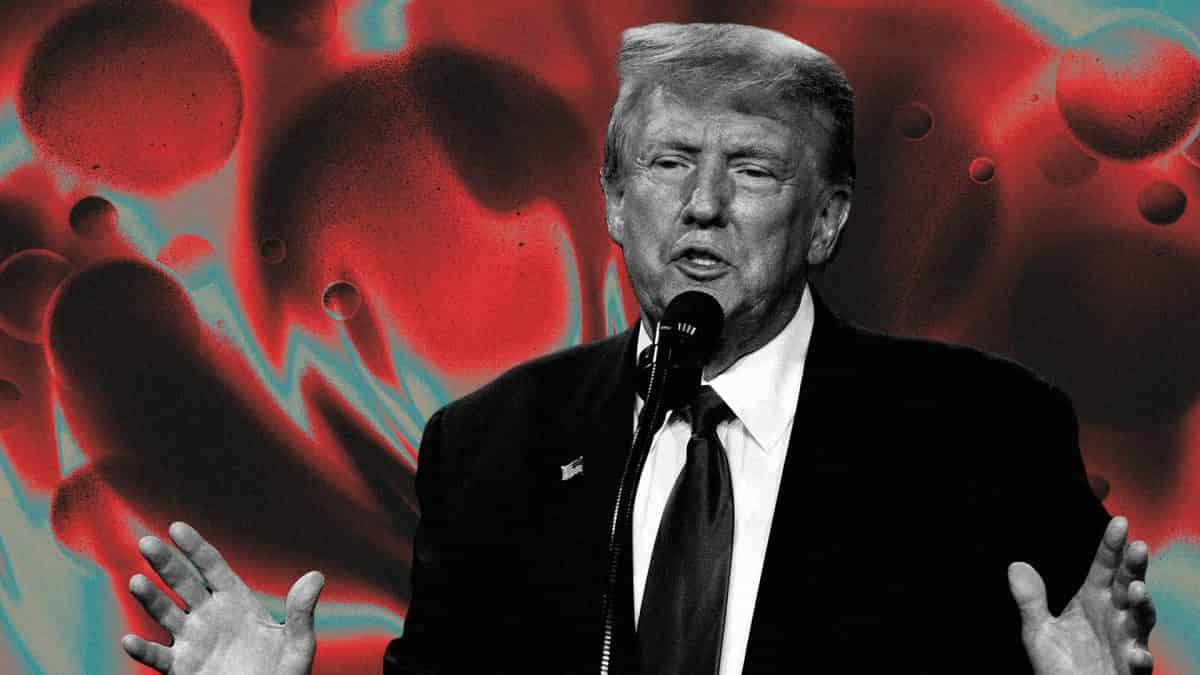
President Trump, on Truth Social Sunday morning, directed his Presidential Working Group on Crypto, led by executive director Bo Hines , to "move forward" on a Crypto Strategic Reserve holding Solana, XRP, and Cardano.
"A U.S. Crypto Reserve will elevate this critical industry after years of corrupt attacks by the Biden Administration," Trump wrote . "I will make sure the U.S. is the Crypto Capital of the World."
The post harkens back to Trump's executive order, signed in January, which says the working group "...shall evaluate the potential creation and maintenance of a national digital asset stockpile and propose criteria for establishing such a stockpile, potentially derived from cryptocurrencies lawfully seized by the Federal Government through its law enforcement efforts."
However, Trump's post marks the first time he referred to the stockpile as a "Crypto Strategic Reserve." The terms "reserve" and "stockpile" have been used interchangeably by some, but signify key differences .
The announcement comes days before Trump is set to host an inaugural White House Crypto Summit . The President will deliver remarks to "prominent founders, CEOs, and investors from the crypto industry," at the event on Friday, which will be run by Hines and chaired by AI Crypto Czar David Sacks.
The New York Post first reported on the possibility of Trump including coins founded in the U.S., such as USDC, XRP, and SOL, in an "America-First" styled crypto reserve in January.
The announcement notably excludes both Bitcoin and Ethereum, the top two cryptocurrencies by market cap. The federal government already holds at least $17 billion worth of Bitcoin, according to Arkham , and at least $120 million worth of ETH.
Edited at 11:01 am EST with details from Trump's January Executive Order.
Disclaimer: The content of this article solely reflects the author's opinion and does not represent the platform in any capacity. This article is not intended to serve as a reference for making investment decisions.
You may also like
NEAR Loses Critical $5 Level After Brutal $20M Long Squeeze: More Pain Ahead?
If US Treasury yields continue to rise, what will Washington do next?
The Treasury has maintained liquidity by increasing the issuance of short-term Treasury bills and conducting small-scale buybacks. Some advocate for reducing expenditures to address the debt burden. Political constraints tilt the risk toward inflation, which harms bondholders' interests. Karen Brettell, Reuters, October 5 - The cost of borrowing for the U.S. government is rising, while it has almost exhausted straightforward ways to control those costs. Long-term Treasury yields are now near their highest levels in two decades, and the causes don't appear to be temporary. Washington is issuing large amounts of government debt to cover a fiscal deficit that shows no signs of shrinking. Inflation is cooling only slowly. Moreover, while the real estate and automotive sectors are struggling, the artificial intelligence investment boom is keeping the economy robust enough to prevent interest rates from falling. As a result, with over $40 trillion in debt, annual interest payments alone amount to around $1 trillion. Washington has options, from relying more on short-term borrowing to, in the most extreme case, having the Federal Reserve cap long-term yields. The more policymakers resort to such measures, the higher the risk of fueling inflation, potentially causing more pain for bondholders in the future. Torsten Slok, Chief Economist at Apollo Global Management, noted that for every $5 the government collects in taxes, $1 goes to service the debt. "That's a very, very high number, and it's only going to grow." U.S. President Donald Trump said in a September 28 interview with Time magazine that debt can be repaid through economic growth or inflation. But if these methods fail, the Treasury has other options ranging from moderate to radical. At present, the Treasury is increasingly relying on issuing short-term bills and conducting small-scale buybacks of old debt to help boost market liquidity. In a worse scenario, the next step would require Fed intervention. One method is large-scale purchases of long-term bonds, akin to 1961's "Operation Twist", another is directly capping long-term yields—a measure not used by the U.S. since World War II. The more aggressive the measures, the more they can suppress rates, but also the greater the risk of spurring inflation. “We are getting to a point where it's clear the government is uncomfortable with current rate levels," said Jeffrey Gundlach, CEO of DoubleLine Capital, at a recent investment event. Operation Twist Historically, the next escalation would likely be a full-scale reactivation of "Operation Twist." Launched in 1961, this strategy involved selling short-term Treasuries and purchasing long-term ones to flatten the yield curve. Implementing a substantial twist would require the Fed's assistance, but the Fed may stand pat unless there is an obvious financial emergency. Slok said that without the Fed's balance sheet, the Treasury has very limited tools for lowering rates. However, Fed Chair Kevin Warsh has criticized holding large amounts of government debt and other securities, arguing that massive bond buying blurs the line between monetary policy and government debt management. He has called for a new agreement between the Treasury and the Fed, under which the Fed Chair and Treasury Secretary would communicate publicly about the Fed's balance sheet and the Treasury’s debt issuance plans. Yield Curve Control If Operation Twist–style purchases don't work, the next move would be explicit yield curve control. In this scenario, the central bank commits to buying an unlimited amount of government debt to keep long-term rates under a set cap. From 1942 until the 1951 Treasury-Fed Accord, the Fed capped long-term Treasury yields at 2.5% to help fund WWII and the postwar recovery. The Bank of Japan implemented a version of this policy from 2016 to 2024. By artificially lowering rates, yield curve control can ease the political pressure of fiscal deficits. But it only works as long as investors aren't worried about being repaid with dollars devalued by inflation. Once that confidence is shaken, bond-buying meant to suppress rates only fuels the inflation it's designed to conceal. Veronique de Rugy, Senior Research Fellow at the Mercatus Center at George Mason University, said that ultimately, the only way to solve the debt problem is by cutting expenditures. “Congress needs to implement fiscal consolidation—in other words, austerity. The Fed cannot do this alone.” Divergent Paths John Higgins, Chief Economic Advisor at Capital Economics, notes that since World War II, the U.S. has only significantly reduced its debt-to-GDP ratio twice, but bondholders' experiences differed substantially each time. After the war, the debt-to-GDP ratio fell from about 106% in 1946 to 23% in 1974, while the 10-year Treasury yield climbed from 2.2% to 7.5%. In the 1990s, the ratio declined from 48% to 32%, and yields fell as well. What made the difference? After WWII, restr
MercadoLibre stock closes up 0.68% at $1,696.56, still below every key moving average
Crypto prices
More


