
Ethereum drops below $2,100 for the first time in 15 months

Ethereum has fallen below $2,100, hitting its lowest level since December 2023 as Trump tariff concerns rattle markets.
The cryptocurrency is down 15% in the past 24 hours, trading at $2,063, according to crypto.news price data . The drop follows a short-lived rally after Donald Trump’s March 2 announcement of a U.S. Crypto Strategic Reserve, which briefly pushed ETH above $2,500.
However, Trump’s confirmation that fresh tariffs on China, Canada, and Mexico will go into force on March 4 has caused market sentiment to shift, raising concerns about broader economic instability.
The announcement caused Ethereum’s ( ETH ) price to plummet, dropping below its pre-pump level of about $2190. Decentralized finance activity and the Ethereum futures market both indicate Ethereum’s declining momentum. Open interest in ETH futures has dropped by 10% over the last day, according to Coinglass data .
DeFi TVL, on the other hand, has hit the lowest this year, declining from $71 billion in January to $48.1 billion as of March 4. Since March 1, there has been $109 million in stablecoin outflows, indicating a decrease in liquidity, as shown by DeFiLlama data .
Ethereum whales appear to be cutting back on their holdings as well. Lookonchain reported a significant transaction in which 30,000 Ethereum, about $68 million, was offloaded to FalconX and Galaxy Digital on March 4 from a wallet connected to Genesis.
Ethereum is displaying a higher risk of decline on the technical front. The RSI is approaching oversold at 34, suggesting reduced buying pressure. Moving averages indicate a strong downtrend, with ETH trading below key levels such as the 10-day EMA at $2,338 and the 50-day SMA at $2,852.
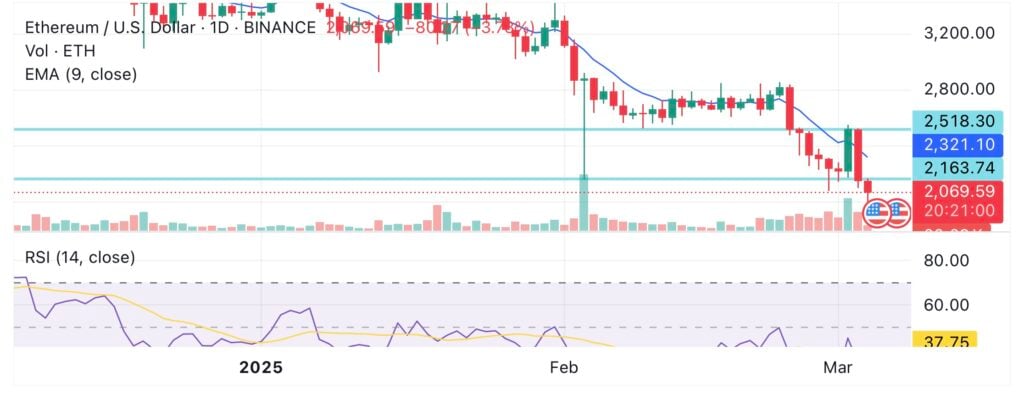 Ethereum technical analysis. Credit: crypto.news
Although oscillators display conflicting indications, negative momentum and MACD readings imply that bearish sentiment is growing. The closest support is at $2,069, with resistance at $2,163 and $2,321.Ethereum may experience more drops in the coming days if the bearish trend persists.
Some upcoming events could provide a turning point. The Ethereum Pectra upgrade , set for April, is expected to enhance scalability and staking flexibility, possibly attracting more network activity. Investors are also keeping a close eye on the first White House Crypto Summit on March 7, which may provide further details about Trump’s plans for his crypto strategic reserve.
Disclaimer: The content of this article solely reflects the author's opinion and does not represent the platform in any capacity. This article is not intended to serve as a reference for making investment decisions.
You may also like
Banks retreat, bond discounts, and it's hard to borrow money for the AI construction boom
Discounted sales of high-yield bonds have become the new norm—among this year's $55 billion related bonds, the most recent four issuances were all at a discount; major banks such as Société Générale and Mitsubishi are adopting a more cautious approach; Oracle's force majeure event has further prompted lenders to tighten their terms. With $700 billion in capital expenditures from mega-tech companies competing for financing, combined with rising Treasury yields, the cost of funding for some projects is approaching the break-even point. Developers with lower ratings and less experience are being hit first.

Trading congestion! Bank of America warns: "Buy AI, sell consumer" strategies are increasingly difficult to generate excess returns
Active fund holdings have already fully reflected the theme of "consumption shifting to capital expenditure." It is becoming increasingly difficult to generate excess returns by buying beneficiaries of AI capital expenditure and selling white-collar consumption themes.
Replica of the "Semiconductor Moment": The "Bottleneck Trade" in AI Drug Discovery Is Taking Shape—Who Will Be the Next "Shovel Seller"?
Investor Freda Duan pointed out that AI-driven drug development is shaping structural opportunities similar to "bottleneck trades" in the semiconductor industry. The core logic is that AI turns failed experiments into valuable training data, and wet laboratories are transforming from "medicine making" to "data creation." DNA synthesis, protein production, and CROs may become the earliest beneficiaries as the "pick-and-shovel sellers."
Crypto prices
More


