
Smart Contract Risks Could Be Global Finance’s Ticking Time Bomb, Warns Movement Labs Co-Founder

Cooper Scanlon emphasizes the serious vulnerabilities in blockchain infrastructure, especially Ethereum, highlighting the growing threat to global finance and calling for secure innovations like Move programming.
In an interview with BeInCrypto, Cooper Scanlon, co-founder of Movement Labs, raised alarms about the vulnerabilities in blockchain infrastructure, particularly flaws in traditional smart contracts like Ethereum (ETH). He stressed that these weaknesses pose a serious threat to the future of global finance.
His remarks come as the crypto industry struggles with a surge in scams and hacks, which have caused significant damage and undermined trust in the sector.
Movement Labs Co-Founder Weighs In on Smart Contract Risks
Scanlon pointed out that flaws in smart contracts have led to billions in losses in 2024 alone. According to data from SolidityScan, in 2024, crypto hacks amounted to $1.4 billion, spanning 149 separate incidents.
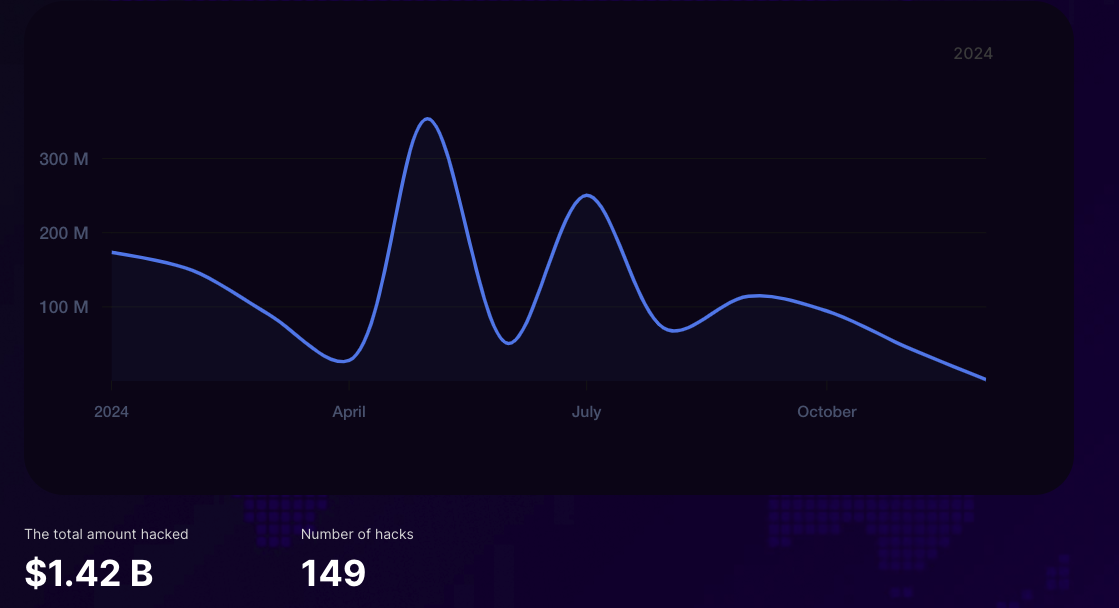 The Amount lost to Crypto Hacks in 2024. Source:
SolidityScan
The Amount lost to Crypto Hacks in 2024. Source:
SolidityScan
In fact, this year, the crypto community saw one of the largest hacks in history when Bybit was targeted. Hackers drained $1.5 billion, majorly in Ethereum, from the platform. They exploited a single-signing transaction vulnerability, bypassing wallet security to make unauthorized withdrawals.
Furthermore, in early March, decentralized exchange (DEX) aggregator 1inch also suffered a critical breach due to a flaw in the Fusion v1 resolver smart contract, further illustrating the vulnerabilities plaguing the sector.
Scanlon emphasized that these incidents are not gradual declines but rather catastrophic drains that occur within seconds once vulnerabilities are exploited. The situation becomes more serious when considering the growing integration of blockchain with traditional financial systems.
“If financial institutions integrate smart contracts into payment systems and capital markets without addressing the potential for these flaws, we’re amplifying risk across much broader systems,” he told BeInCrypto.
The co-founder also highlighted a dangerous misconception about smart contract security – the belief that a successful audit guarantees security. Scanlon says audits only uncover a small portion of potential vulnerabilities and frequently overlook more complex attack vectors.
Furthermore, he underlined the daily occurrence of these hacks. The exec noted that three major re-entrancy bugs were discovered in the past two months. He warned that these incidents do not occur in isolation but point to deeper architectural flaws.
“If development continues on Ethereum using Solidity code, these threats will unfortunately worsen over the next five years as blockchain adoption increases. Greater integration with traditional finance means higher-value targets, while increasing complexity creates more attack surface,” Scanlon commented.
For context, a re-entrancy bug is a vulnerability in smart contracts where an external call made by the contract can call back into the contract before the initial execution is complete. This allows an attacker to repeatedly execute a function, potentially draining funds or manipulating the contract in unintended ways. A famous example is the 2016 DAO hack.
The Movement Labs co-founder also mentioned the Kyber attack as an example of how a simple integer overflow could lead to catastrophic consequences. Nonetheless, he acknowledged that no developer or auditor can realistically identify vulnerabilities at such a granular level across thousands of lines of Solidity code. Scanlon claimed that every traditional protocol comes with these inherent risks.
“As major banks, payment processors, and exchanges build atop these systems, vulnerabilities that once affected only crypto enthusiasts now threaten the broader financial ecosystem,” he stressed.
To address these risks, he believes the solution lies in moving past outdated architectures and adopting more secure, modern designs. He directed attention to Movement Labs’ use of the Move programming language.
Scanlon explained that it eliminates common vulnerabilities through its resource-oriented design and formal verification. According to him, Move is specifically designed to prevent entire classes of vulnerabilities.
“Move represents a revolutionary improvement over existing smart contract platforms,” Scanlon advocated.
Smart Contracts and Financial Systems: The Path to Integration
Amid these risks, Scanlon argued that blockchain networks require standardized security protocols. However, he stressed that traditional models cannot be directly applied.
He outlined that before integrating decentralized systems, financial institutions must first grasp the unique security challenges posed by blockchain.
“Financial institutions looking to integrate decentralized systems must understand that blockchain transactions cannot be reversed. This means that in blockchain, exploits are often irreversible. This fundamental difference requires a complete rethinking of risk management, but it also points to the unique value of decentralized technology,” Scanlon disclosed to BeInCrypto.
Scanlon also brought into focus the need to evolve regulatory approaches. He noted that traditional finance and decentralized systems are no longer distinct realms—they are becoming increasingly integrated.
Nevertheless, he pointed out that most current regulatory frameworks remain rooted in outdated concerns. They largely focus on traditional issues such as Know Your Customer (KYC) and Anti-Money Laundering (AML) compliance and investor protection.
These frameworks, Scanlon warned, overlook the deeper technological risks that could trigger systemic failures within the blockchain space. What the industry needs, he said, is clarity.
“Governments should work to establish clear laws around blockchain generally so that innovators and builders have the resources and peace of mind to develop safe, secure chains and applications,” Scanlon remarked.
He argued that the focus should be on creating an environment where security innovation can thrive rather than enforcing one-size-fits-all standards.
Why Human Psychology Drives Scam Success
In addition to addressing vulnerabilities in smart contract infrastructure, Scanlon also discussed the rise in meme coin scams prevalent on social media platforms. Recently, hackers have targeted many celebrities, industry experts, and political leaders, seizing control of their X accounts to promote fraudulent tokens.
Scanlon explained that these incidents are increasing due to the asymmetrical rewards involved. With minimal technical effort, scammers can reap substantial profits.
“These social engineering attacks are fundamentally different from smart contract vulnerabilities. They exploit human psychology rather than code flaws,” Scanlon shared with BeInCrypto.
To combat these threats, Scanlon stressed that social media platforms need more sophisticated detection systems to identify compromised accounts and prevent scam promotion. He also called for enhanced on-chain analytics to spot and flag suspicious token contracts before they gain momentum.
He underlined the importance of improving resources for verifying project legitimacy. In addition, he suggested that protocols should incorporate stronger verification measures.
Scanlon concluded that the long-term solution lies in improved technology. He emphasized cultivating an ecosystem that prioritizes security at every level, from code design to user experience. Scanlon asserted that the community should come first. Therefore, protecting it from these threats is of utmost importance.
Disclaimer: The content of this article solely reflects the author's opinion and does not represent the platform in any capacity. This article is not intended to serve as a reference for making investment decisions.
You may also like
Technoprobe Started at Overweight by JPMorgan
Technoprobe Started at Overweight by JPMorgan
South Korea's AI Mania Spills Into Crypto, With Worldcoin as Top Pick
Our Pinterest Stock Pick Hasn't Worked. We're Dropping It. -- Barrons.com
By Jacob Sonenshine Pinterest is down about 42% since Barron's recommended the stock in June 2025. During that time the S&P 500 has gained 29%. Time to move on. The problem isn't that Pinterest doesn't have long-term growth potential. It's that it has repeatedly failed to sustain a super high growth rate, creating uncertainty. Our thesis was that revenue growth would hold strong and the company's artificial intelligence usage would enable it to match the right products and advertisements with users. The hope was that Pinterest, with its hundreds of millions of users and more than $4 billion of annual sales, would grow within a global digital ad market worth hundreds of billions, as it would increasingly monetize its users. It has grown -- but not consistently at a high rate. Pinterest will continue to grow, but the market's concern doesn't appear likely to subside soon; revenue growth often decelerates by several percentage points, which causes large selloffs in the shares. The root of the problem is that whenever growth slows, the market is left to wonder if the platform is beginning to lose its relevance. Users now have a crowded field of options for finding personal and household trinkets to buy. Maybe the growth story isn't as beautiful as investors had hoped years ago, when the stock was at record highs of close to $90. Consider second quarter earnings, which management released Aug. 4, and caused the stock to drop. Yes, sales of $1.18 billion beat analyst's expectations and grew about 18% year over year, and yes, adjusted earnings per share of 43 cents beat estimates and grew 30%, as profit margins expanded. But the guidance signaled slowing growth yet again. Management guided for third quarter revenue of $1.2 billion at the midpoint of the range. That implies 14% year over year growth. Chief Financial Officer Julia Donnelly said on the earnings call that second quarter growth was strong partly due to the combination of brands increasing their ad spend around Amazon Prime Day and "World Cup-related spend th
Gold steady as firm dollar counters softer US rate-hike bets
Crypto prices
More


