
Hedera (HBAR) Bears Tighten Grip as Price Sinks 52% from Year-To-Date High

HBAR bears tighten their grip as the price drops 52% from YTD high. Key indicators signal further downside, with $0.16 support in focus
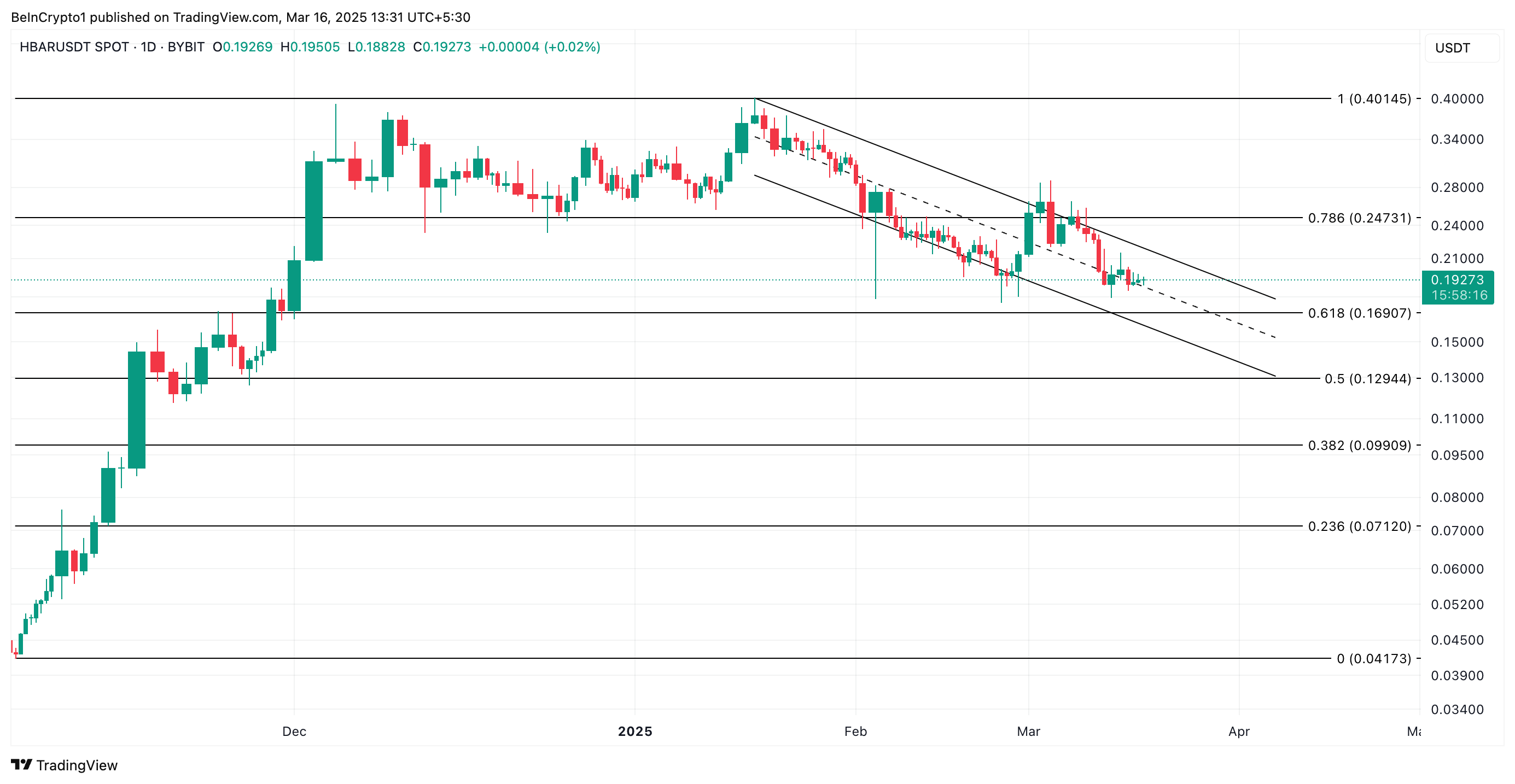
The price of Hedera’s HBAR has been on a downtrend since reaching its year-to-date (YTD) high of $0.40 on January 17. The altcoin has now dropped to $0.19, marking a 52% decline as bearish pressure continues to dominate the market.
Technical indicators suggest the downturn may not be over, as selling pressure remains high.
HBAR’s Price Woes Continue as Indicators Show No Relief
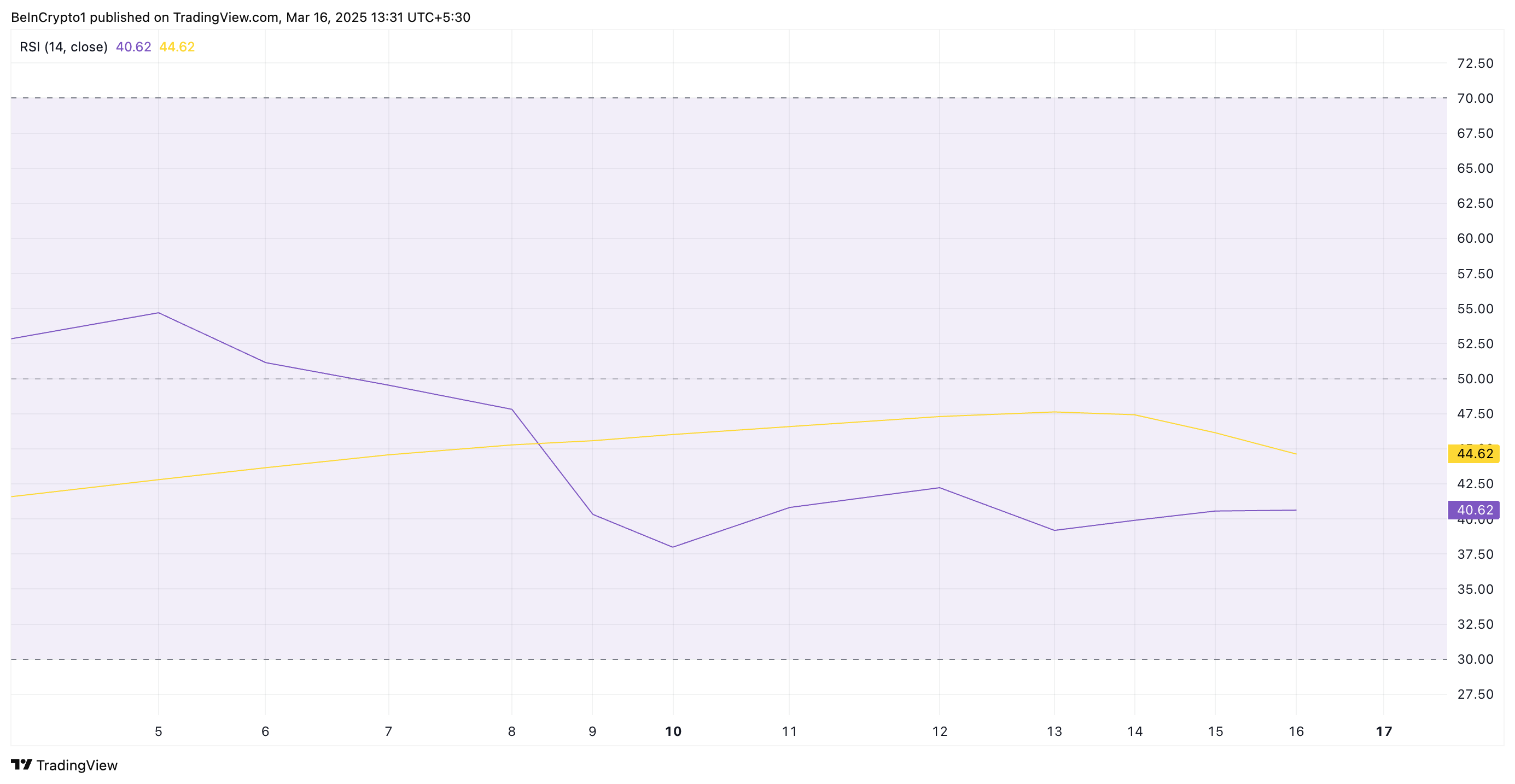
The sustained dip in HBAR’s Relative Strength Index (RSI) confirms the surging selling pressure among its spot traders. As of this writing, this is at 40.62.
 HBAR RSI. Source:
TradingView
HBAR RSI. Source:
TradingView
The RSI indicator measures an asset’s overbought and oversold market conditions. It ranges from 0 to 100, with values above 70 suggesting the asset is overbought and potentially due for a correction.
Conversely, RSI values below 30 signal the asset is oversold and may be primed for a rebound.
An RSI of 40.62 suggests that HBAR is in bearish territory but not yet oversold. This indicates that selling pressure is stronger than buying momentum, but there is still room for further decline before the token becomes undervalued.
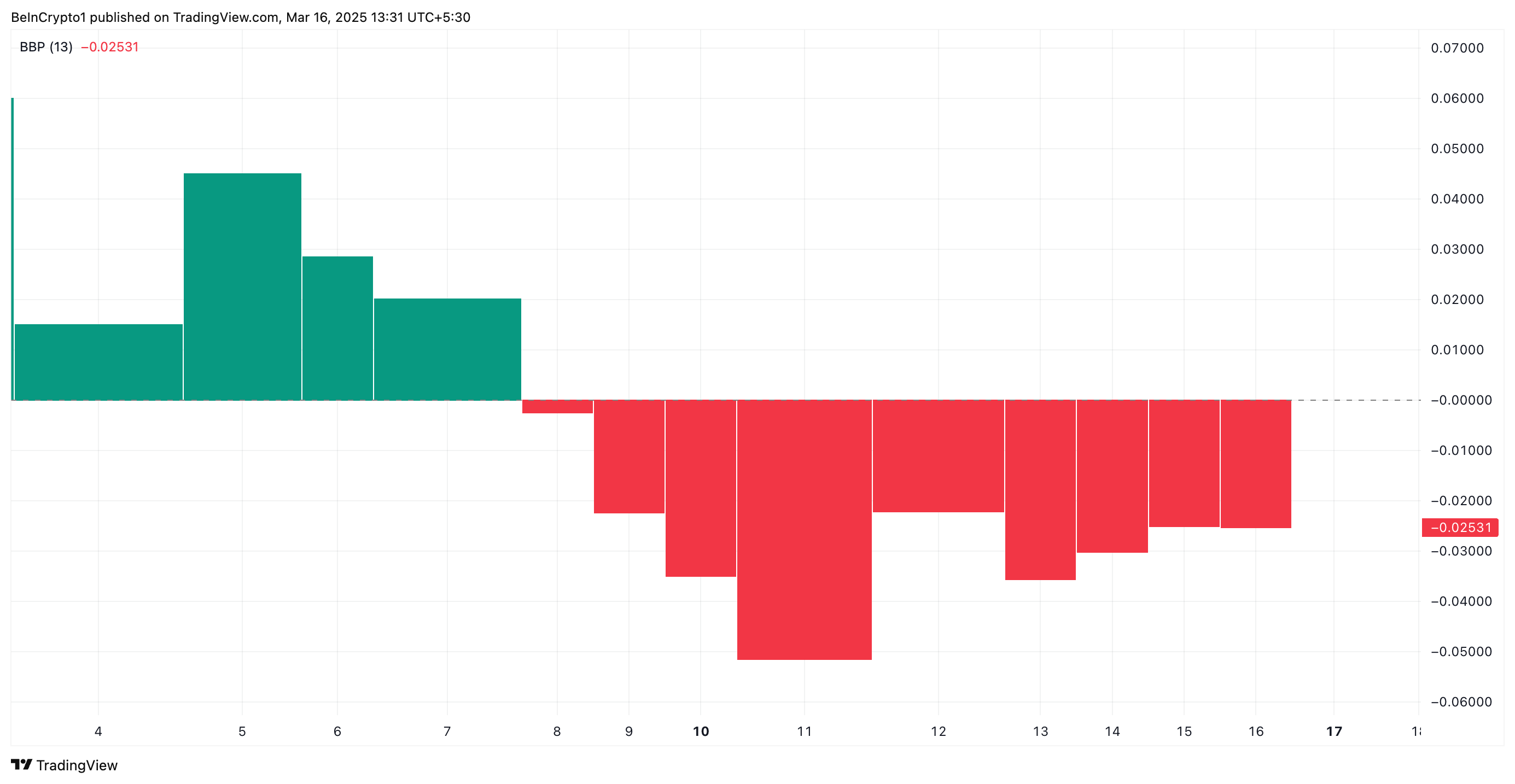
Additionally, readings from HBAR’s Elder-Ray Index support the bearish outlook. It currently sits at -0.02, marking its seventh consecutive day in negative territory.
 HBAR Elder-Ray Index. Source:
TradingView
HBAR Elder-Ray Index. Source:
TradingView
The Elder-Ray Index measures the balance of power between bulls and bears by analyzing the strength of buyers (Bull Power) and sellers (Bear Power).
When the index is negative, it indicates that sellers are in control, pushing prices lower and signaling a bearish trend. HBAR’s consistent negative Elder-Ray Index suggests sustained downward pressure, making a price recovery less likely in the short term.
HBAR Bears Dominate as Descending Channel Points to More Losses
Since it reached its YTD high of $0.40, HBAR has traded within a descending parallel channel, confirming the price decline.
This bearish pattern is formed when an asset’s price moves between two downward-sloping, parallel trendlines, indicating a consistent bearish trend. It suggests that HBAR sellers are dominant, which could lower its price even more.
If demand weakens further, HBAR could fall toward support formed at $0.16, a low it last reached in November.
 HBAR price Analysis. Source:
TradingView
HBAR price Analysis. Source:
TradingView
However, a positive shift in market sentiment would prevent this. If HBAR sees a surge in new demand, it could drive its price up to $0.24.
Disclaimer: The content of this article solely reflects the author's opinion and does not represent the platform in any capacity. This article is not intended to serve as a reference for making investment decisions.
You may also like
NEAR Traders Are Pleased to See the Altcoin Break Above $5 and Trade Above, Will This Momentum Hold?
After Toshiba reported news of HDD production expansion, Morgan Stanley turned more bullish rather than bearish.
Morgan Stanley’s research indicates that the market has seriously overestimated Toshiba’s expansion scale — the doubling of capacity at its Philippines plant over two years translates to an annualized growth rate of about 30%, which is similar to the overall industry supply growth rate and far lower than demand growth. More importantly, channel checks show that Seagate and Western Digital have no intention of following suit with capacity expansion, and there are no signs of loosening in industry pricing.
BitMine lifts ETH holdings to 6 million as price holds above $2,700

Energy & Utilities Roundup: Market Talk
The latest Market Talks covering Energy and Utilities. Published exclusively on Dow Jones Newswires at 4:20 ET, 12:20 ET and 16:50 ET. 0637 GMT - SK Innovation is likely to benefit from higher lubricant base oil prices, LS Securities analyst K.H. Chung says. The South Korean refiner is a global leader in premium lubricant base oils, producing about 80,000 barrels of Group III base oils a day, Chung writes in a note. She expects the supply shortage of lubricant base oils to persist for more than a year. Tight supply of kerosene and diesel and wider refining margins could also continue to boost the company's earnings, she adds. LS Securities upgrades the stock to buy from hold and raises its target price to 187,000 won from 126,000 won. Shares end 2.6% higher at 158,000 won. (kwanwoo.jun@wsj.com) 0113 GMT - YTL Power International could see upside from its expanding data-center and AI infrastructure, as well as renewed power-generation opportunities, says Hong Leong IB analyst Daniel Wong in a note. Its Kulai and Sedenak West hubs offer 2.4GW of potential data-center capacity, while its AI-GPU capacity could scale to 100MW or more and support a new services business. The procurement of seven gas turbines totaling 5.25GW also positions YTL for power-generation growth and supports its expanding data-center pipeline, he reckons. Higher water tariffs and planned treatment plants at its unit Ranhill Utilities should support earnings as Johor's water demand rises, he adds. Hong Leong raises its target price to 8.08 ringgit from 7.58 ringgit and keeps a buy rating. Shares are 1.4% higher at 5.62 ringgit. (yingxian.wong@wsj.com) The price fetched by Amplitude Energy for its natural gas in 1Q should improve on the prior three months, supporting growth in revenue. That's the view of Bell Potter analyst Stuart Howe, who points to higher gas volumes in the quarter. Also, spot natural gas prices recovered to a quarterly average of A$9.77 per gigajoule, from A$8.42 per gigajoule in 4Q of FY26. Amplitude is due to report its 1Q p
Crypto prices
More


