
XRP Could Unlock $1.5 Trillion in Liquidity for US, Proposal Claims

The document advocates classifying XRP as a payment asset rather than a security, urging regulatory changes and a presidential executive order to accelerate adoption.
A proposal suggesting XRP as a strategic financial asset has been submitted to the US Securities and Exchange Commission (SEC). The SEC often receives unsolicited proposals from individuals or entities, but these do not automatically lead to action.
The document outlines how the US could use XRP to unlock liquidity and potentially secure a substantial Bitcoin reserve.
XRP Suggested as Key Liquidity Tool For the US Crypto Reserve
The proposal’s author, Maximilian Staudinger, advocates for a structured approach to President Donald Trump’s crypto reserve initiative. Staudinger’s strategy places Bitcoin at the core of the US reserve while positioning Solana and Cardano within government applications.
He contends that while these blockchains enhance security and efficiency in state operations, XRP remains the key asset for financial transactions.
“Solana and Cardano should be integrated into US digital infrastructure, but not included in the reserve strategy. Instead, they enhance efficiency and security for state applications, while XRP remains the key asset for financial transactions,” Staudinger argued.
Considering this, Staudinger asserts that integrating XRP into the traditional financial system would release capital tied up in Nostro accounts. These accounts facilitate cross-border transactions and collectively hold $27 trillion worldwide.
He estimates that $5 trillion belongs to the US, with XRP potentially freeing up $1.5 trillion. This liquidity, he claims, could be redirected toward acquiring Bitcoin.
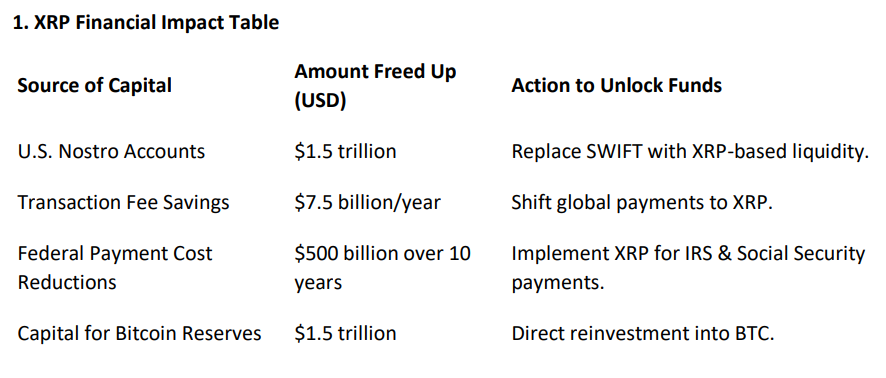 XRP’s Financial Impact as a Strategic Reserve Asset. Source:
Staudinger’s SEC Proposal
XRP’s Financial Impact as a Strategic Reserve Asset. Source:
Staudinger’s SEC Proposal
However, his suggestion that the US could secure 25 million BTC at a price of $60,000 per coin contradicts Bitcoin’s fixed 21 million supply cap.
Beyond liquidity, the proposal claims that shifting financial transactions to XRP could generate up to $7.5 billion in annual savings on transaction fees. It also suggests that XRP could streamline government payments, including IRS tax refunds and Social Security distributions
XRP’s Regulatory Uncertainty Poses Challenge
Despite its ambitious vision, the proposal acknowledges that XRP’s regulatory status remains a critical barrier.
Staudinger calls for the SEC to officially classify XRP as a payment asset rather than a security and urges a resolution in the agency’s ongoing legal battle with Ripple.
He also suggests that the Department of Justice (DOJ) lift restrictions preventing banks from utilizing XRP-based solutions. To fast-track adoption, he proposes a presidential executive order to override regulatory barriers.
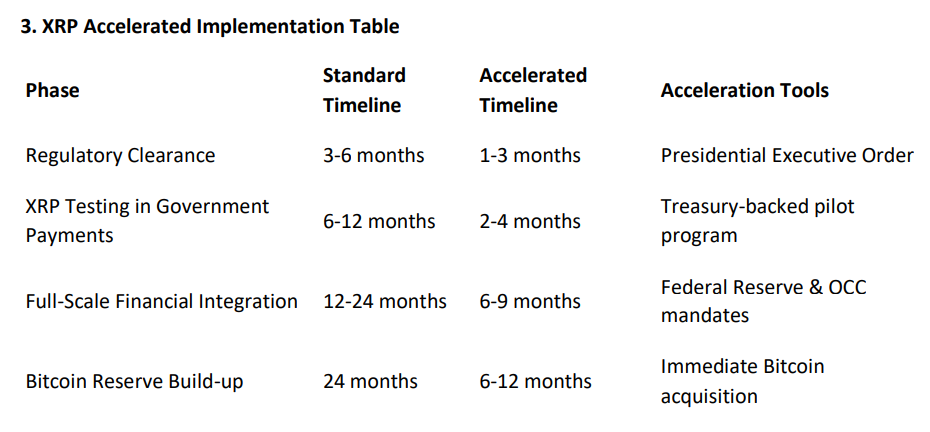 XRP’s Strategic Reserve Asset Implementation Timeline. Source:
Staudinger’s SEC Proposal
XRP’s Strategic Reserve Asset Implementation Timeline. Source:
Staudinger’s SEC Proposal
Meanwhile, the document outlines two potential timelines: a standard two-year implementation period and an expedited six- to twelve-month plan.
The latter would require immediate regulatory approvals, fast-tracked government XRP trials, and mandates for banks to integrate XRP as a liquidity tool.
It’s important to note that independent proposals, like Staudinger’s, generally have little weight unless backed by strong industry support or policy interest.
If a proposal comes from a major financial institution, regulatory body, or industry group, it is more likely to be reviewed seriously.
Disclaimer: The content of this article solely reflects the author's opinion and does not represent the platform in any capacity. This article is not intended to serve as a reference for making investment decisions.
You may also like
NEAR Traders Are Pleased to See the Altcoin Break Above $5 and Trade Above, Will This Momentum Hold?

After Toshiba reported news of HDD production expansion, Morgan Stanley turned more bullish rather than bearish.
Morgan Stanley’s research indicates that the market has seriously overestimated Toshiba’s expansion scale — the doubling of capacity at its Philippines plant over two years translates to an annualized growth rate of about 30%, which is similar to the overall industry supply growth rate and far lower than demand growth. More importantly, channel checks show that Seagate and Western Digital have no intention of following suit with capacity expansion, and there are no signs of loosening in industry pricing.
BitMine lifts ETH holdings to 6 million as price holds above $2,700

Energy & Utilities Roundup: Market Talk
The latest Market Talks covering Energy and Utilities. Published exclusively on Dow Jones Newswires at 4:20 ET, 12:20 ET and 16:50 ET. 0637 GMT - SK Innovation is likely to benefit from higher lubricant base oil prices, LS Securities analyst K.H. Chung says. The South Korean refiner is a global leader in premium lubricant base oils, producing about 80,000 barrels of Group III base oils a day, Chung writes in a note. She expects the supply shortage of lubricant base oils to persist for more than a year. Tight supply of kerosene and diesel and wider refining margins could also continue to boost the company's earnings, she adds. LS Securities upgrades the stock to buy from hold and raises its target price to 187,000 won from 126,000 won. Shares end 2.6% higher at 158,000 won. (kwanwoo.jun@wsj.com) 0113 GMT - YTL Power International could see upside from its expanding data-center and AI infrastructure, as well as renewed power-generation opportunities, says Hong Leong IB analyst Daniel Wong in a note. Its Kulai and Sedenak West hubs offer 2.4GW of potential data-center capacity, while its AI-GPU capacity could scale to 100MW or more and support a new services business. The procurement of seven gas turbines totaling 5.25GW also positions YTL for power-generation growth and supports its expanding data-center pipeline, he reckons. Higher water tariffs and planned treatment plants at its unit Ranhill Utilities should support earnings as Johor's water demand rises, he adds. Hong Leong raises its target price to 8.08 ringgit from 7.58 ringgit and keeps a buy rating. Shares are 1.4% higher at 5.62 ringgit. (yingxian.wong@wsj.com) The price fetched by Amplitude Energy for its natural gas in 1Q should improve on the prior three months, supporting growth in revenue. That's the view of Bell Potter analyst Stuart Howe, who points to higher gas volumes in the quarter. Also, spot natural gas prices recovered to a quarterly average of A$9.77 per gigajoule, from A$8.42 per gigajoule in 4Q of FY26. Amplitude is due to report its 1Q p
Crypto prices
More


