Bitget App
Trade smarter
Buy cryptoMarketsTradeFuturesStocksEarnInstitutionAI & More
Is Bitcoin’s Price Rally Over? Analysts Disagree

Is Bitcoin’s Price Rally Over? Analysts Disagree

DailyCoinDailyCoin2025/03/18 17:27
By:DailyCoin

Bitcoin’s recent price struggles have sparked a divide among crypto experts. While some predict a shift toward bearish sentiment and anticipate months of decline or stagnation, others remain confident the rally still has room to grow.

Metrics Signal Bearish Outlook

CryptoQuant CEO Ki Young Ju declares Bitcoin’s bull cycle dead, forecasting up to 12 months of decline.

#Bitcoin bull cycle is over, expecting 6–12 months of bearish or sideways price action. pic.twitter.com/f80bnNhjy4

— Ki Young Ju (@ki_young_ju) March 17, 2025

In a recent post on X, Ki warns all on-chain metrics point to a bear market as liquidity dries up and whales sell Bitcoin at lower prices.

Sponsored

“The data keeps signaling bearish,” he says.

Weak Demand and Fading Accumulation

On-chain analytics firm Glassnode reports weakening Bitcoin fundamentals in its March report . Since Bitcoin’s second attempt to break above $105,000 in late January, demand has been weak, and accumulation has diminished.

The failed rally triggered market contraction and consolidation, prolonging Bitcoin’s slump.

But unlike the earlier phase, there was no significant dip-buying response this time, indicating a shift in sentiment toward risk aversion and capital preservation, according to Glassnode.

“The lack of dip-buying at lower levels suggests that capital rotation is underway, potentially leading to a more prolonged consolidation or corrective phase before the market finds a firm support base.”
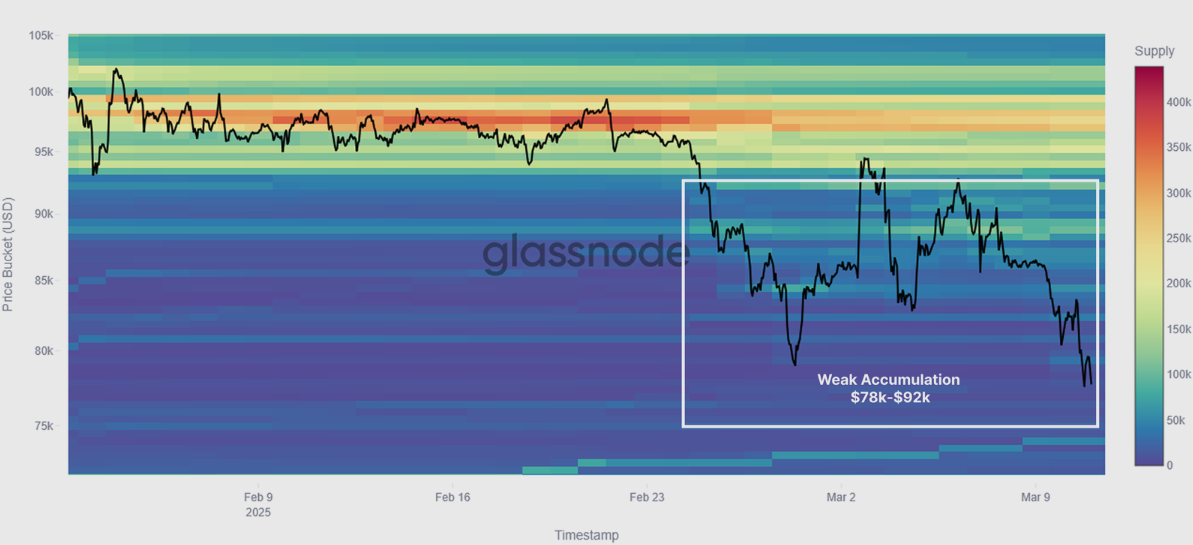
Is Bitcoin’s Price Rally Over? Analysts Disagree image 0 Is Bitcoin’s Price Rally Over? Analysts Disagree image 1 CBD heatmap confirms that as macro uncertainty increased and accumulation demand weakened. Source: Glassnode

Despite high trading volumes near $100,000, Bitcoin’s price remained stagnant, and ETF inflows have been negative for three consecutive weeks, reflecting waning institutional interest.

Bitcoin futures funding rates are also near 0%, reflecting weak demand for both long and short positions and growing trader uncertainty.

Broader macroeconomic concerns and trade tensions push investors away from risky assets like Bitcoin, Glassnode analysts say.

Bitcoin Holds Steady Ahead of FOMC Meeting

Bitcoin has held steady around the $82,000 support level for a week, showing a minor 1.3% change and no signs of volatility ahead of the Federal Open Market Committee (FOMC) meeting on Wednesday.

The FOMC meeting is crucial for the financial markets, as decisions on interest rates and monetary policy directly impact investor sentiment and market liquidity.

Market expectations are high that the Federal Reserve will keep interest rates unchanged between 4.25% and 4.50%. 

The CME FedWatch tool, which tracks market expectations for future Federal Reserve interest rate decisions, shows a 99% probability that no rate cuts will be announced. 

With no rate cut expected, Bitcoin’s price is likely to continue its current sideways trajectory.

Bitcoin Bottom Confirmed, Says Trader

However, not all crypto market participants are bearish. Crypto trader Astronomer stated in a series of posts on X that Bitcoin’s bottom is confirmed, expressing surprise that many reputable traders expected lower prices after Bitcoin briefly dipped below the $80,000 institutional level.

According to Astronomer, Bitcoin has bottomed and reached its higher timeframe support of nearly $80,000.
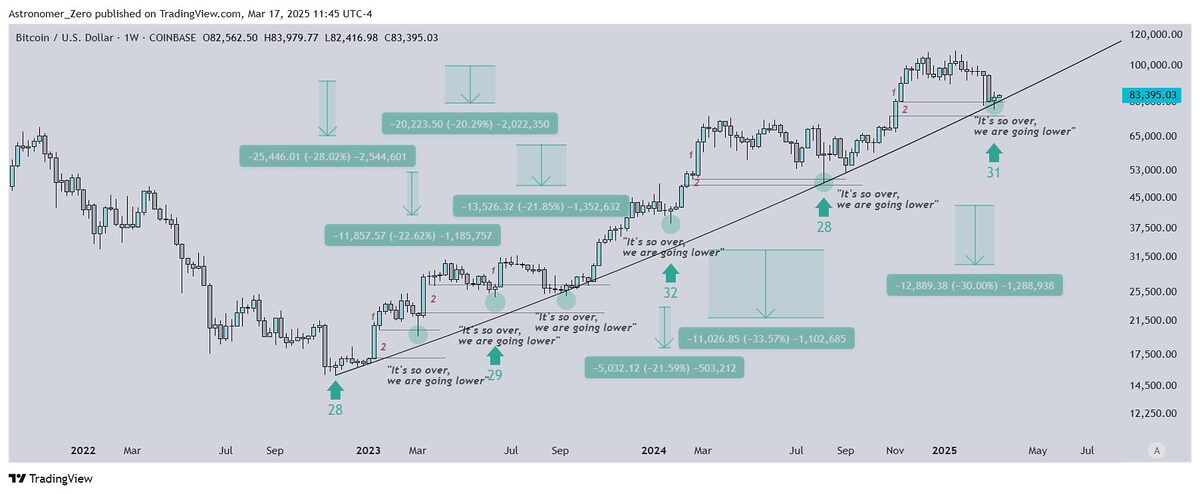
Is Bitcoin’s Price Rally Over? Analysts Disagree image 2 Is Bitcoin’s Price Rally Over? Analysts Disagree image 3 Bitcoin bottom is in, says crypto trader Astronomer. Source: X

Despite recent declines, the trader remains bullish , predicting Bitcoin will reach $160K–$200K by the end of this cycle. 

Astronomer believes Bitcoin’s current price action mirrors the parabolic advance seen in 2017, reinforcing his optimistic outlook.

Why This Matters

Bitcoin struggles to climb as demand weakens and uncertainty grows, signaling a cautious market ahead.

Check out DailyCoin’s popular crypto news:

FalconX Completes CME’s First Major Solana Futures Trade

Stablecoin Bill Moves Forward: A Key Step in U.S. Stablecoin Regulation

0
0

Disclaimer: The content of this article solely reflects the author's opinion and does not represent the platform in any capacity. This article is not intended to serve as a reference for making investment decisions.

Understand the market, then trade.
Bitget offers one-stop trading for cryptocurrencies, stocks, and gold.
Trade now!

You may also like

ROI - For the Trump-led Treasury, the "tail" of the auction is the most difficult part: McKeever

The views expressed in this article are solely those of the author, Reuters columnist Jamie McGeever. Reuters, Orlando, Florida, October 6 – U.S. Treasury auctions are typically dull, predictable, and not newsworthy. But these are not ordinary times, and the Trump administration now faces the risk of sluggish U.S. debt sales making headlines. The U.S. Treasury plans to issue nearly $120 billion in Treasuries this week, the first non-bill bond sales in two weeks: $58 billion in three-year notes on Tuesday, $39 billion in ten-year notes on Wednesday, and $22 billion in thirty-year bonds on Thursday. These auctions would usually be insignificant events, but due to the exceptionally weak performance of auctions from September 22 to 24—especially the five-year note auction on September 23, which triggered the largest spike in bond yields since April last year—they are attracting growing attention. Since then, yields have not only failed to retreat but have surged across most tenors to multi-decade highs. It's worth noting that the possibility of a U.S. Treasury auction "failing" is almost zero. Primary dealers—currently 26 Wall Street banks and institutions authorized by the New York Fed as market makers for Treasuries—are always involved. They effectively underwrite the sales, ensuring the smooth operation of the $30 trillion U.S. Treasury market, the most liquid market in the world. This, in turn, allows the entire global financial system to function, given that trillions of dollars in global debt, assets, and market derivatives are benchmarked against U.S. Treasuries. Treasuries are also the primary collateral for lubricating the financial “pipes” of the U.S. and global markets, including repo agreements, interbank loans, and financing. In short, as long as U.S. Treasuries remain the pillar of the global financial system, there will always be buyers at Treasury auctions. The question, as always, is at what price these bonds will be sold. Currently, borrowing costs in the secondary market are at their highest levels since the mid-2000s, so it's reasonable to expect that the Treasury will pay relatively high rates in the primary market as well. But as recent auctions have shown, negative surprises remain possible. "Too big to be absorbed by the market"? The $70 billion five-year auction on September 23 was among the most worrisome in years. Demand, as measured by the bid-to-cover ratio, was at a nine-year low. The Treasury ended up selling the notes at a yield of 5.033%, more than 3 basis points above the market yield at the close of bidding. Three basis points might not sound like much, but it's exceptional for a five-year note auction. This is the largest so-called "tail" since June 2022. According to JPMorgan analysts, the last time a five-year auction had a three-basis-point tail was back in 2011—amid the brewing debt ceiling crisis that eventually led to a U.S. credit rating downgrade in August that year. Currently, concerns over the U.S.'s daunting fiscal outlook are driving up long-term borrowing costs. As a result, markets generally expect the Trump administration to gradually shift the Treasury’s massive funding needs toward the lower-yield (and therefore lower-cost) short- and medium-term segments of the curve. That's why the five-year note auction two weeks ago sparked such concern. A three-basis-point tail is common in long bond auctions, but not in the "belly" of the yield curve. If the Treasury is forced to pay a higher premium to issue these bonds, then Houston, we have a problem. A large auction tail can be caused by many factors, including market volatility on the day of the auction or more concerning, fundamental issues that may erode demand over time. The two are often hard to distinguish because they are not mutually exclusive. On a brighter note, this unease has not yet spread to the short end of the yield curve. At least, not yet. Three-year and ten-year Treasury yields are up about 50 basis points from the last auction a month ago, hovering around 4.96% and 5.32%, respectively. The thirty-year yield is up roughly 35 basis points to 5.65%. These levels should be high enough to attract strong demand and ensure smooth sales, right? Maybe. But if surprises do occur, volatility and uncertainty could spill over across the market. Investors will be watching developments as closely as hawks. (The views in this article are solely those of the author, a Reuters columnist.) Like this column? Check out Reuters' "Unhedged" (ROI), your essential new source for global finance commentary. Follow ROI on LinkedIn and X. You can also listen to the daily "Morning Bid" podcast on Apple, Spotify, or the Reuters app—subscribe for in-depth market and finance news, seven days a week. US 5-year auction has biggest 'tail' since 2022 https://fingfx.thomsonreuters.com/gfx/mkt/dwpkmkzogpm/TAIL.png (For the convenience of non-English speakers, Reuters provides automated translations of its reports

路透社•2026/10/06 13:11

Money market fund inflows plummet to 158 billion—Is short-term US Treasury liquidity flashing a warning sign?

Money market fund inflows have sharply dropped to $158 billion in the first three quarters of this year, driving Treasury yields higher. Increased volatility at the short end has raised market concerns about tightening short-term financing.

智通财经•2026/10/06 13:07