Bitget App
Trade smarter
Buy cryptoMarketsTradeFuturesStocksEarnInstitutionAI & More
SUI Gains Traction as Canary Capital Files for ETF – Is a Breakout Ahead?

SUI Gains Traction as Canary Capital Files for ETF – Is a Breakout Ahead?

CoinsProbeCoinsProbe2025/03/18 18:55
By:Nilesh Hembade

Date: Tue, March 18, 2025 | 03:45 AM GMT

The layer-1 blockchain project Sui (SUI) is gaining significant traction this month, fueled by major developments in both institutional adoption and ETF-related filings. First, Trump-backed World Liberty Financial (WLFI) announced the addition of SUI to its strategic reserve, marking a notable step toward mainstream adoption. Following this, Canary Capital officially submitted an S-1 filing with the SEC for a SUI exchange-traded fund (ETF), further driving interest in the asset.

These bullish catalysts have helped SUI recover from its recent downtrend, posting a 10% weekly gains, after facing a 90-day correction. With this momentum building, technical indicators are now hinting at a potential breakout in the near future.

SUI Gains Traction as Canary Capital Files for ETF – Is a Breakout Ahead? image 0 Source: Coinmarketcap

Canary Capital Files S-1 With SEC for SUI ETF

Canary Capital filed an S-1 registration statement with the U.S. SEC on Monday, March 17, 2025, for a spot ETF tracking SUI, the native token of the Sui Network. The proposed fund aims to provide investors with regulated exposure to SUI’s price movements without requiring direct ownership of the cryptocurrency, marking a potential milestone for institutional adoption of the Layer-1 blockchain asset.
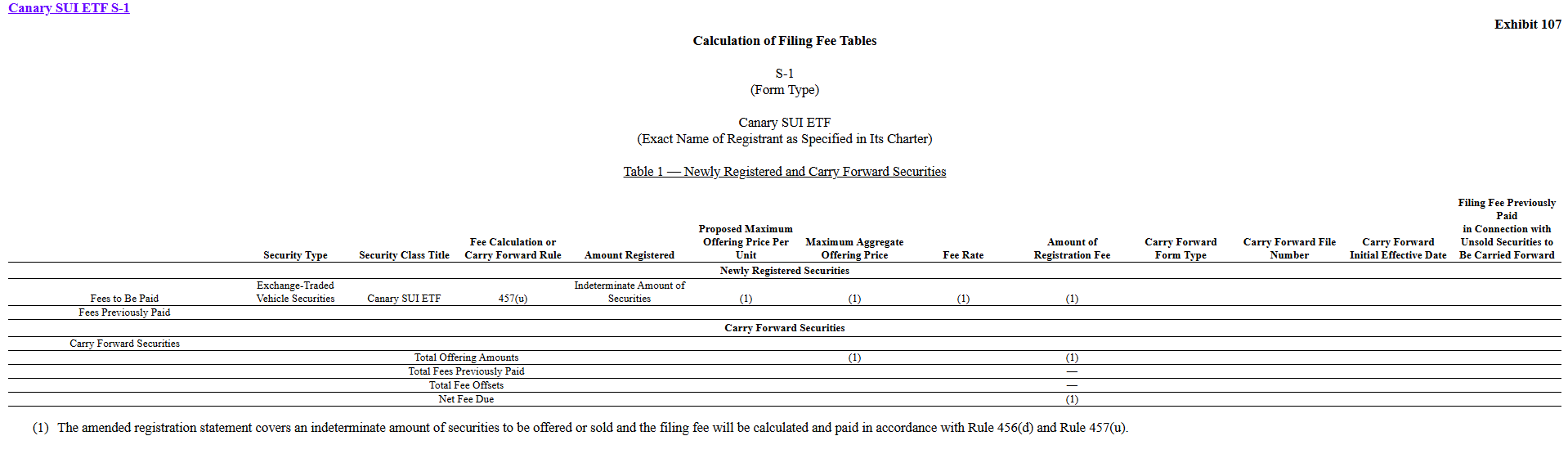
SUI Gains Traction as Canary Capital Files for ETF – Is a Breakout Ahead? image 1 Source: sec.gov

The filing follows Canary Capital’s registration of a statutory trust in Delaware on March 6, a procedural step commonly undertaken before SEC submissions to establish the fund’s legal framework. To complete the listing process, the firm must still submit a 19b-4 filing through its chosen exchange—such as Nasdaq or NYSE—pending SEC approval.

This development, coupled with SUI’s recent inclusion in World Liberty Financial’s reserves, underscores growing institutional confidence, driving a 10% price surge this week.

Is a Breakout Ahead?

From a technical analysis standpoint, SUI is at a crucial inflection point. After bouncing from its recent low of $1.97, the token has now reclaimed the $2.34 level, which also marks its demand zone. This price action brings it closer to breaking out of a falling wedge pattern, a structure that historically signals potential bullish reversals.
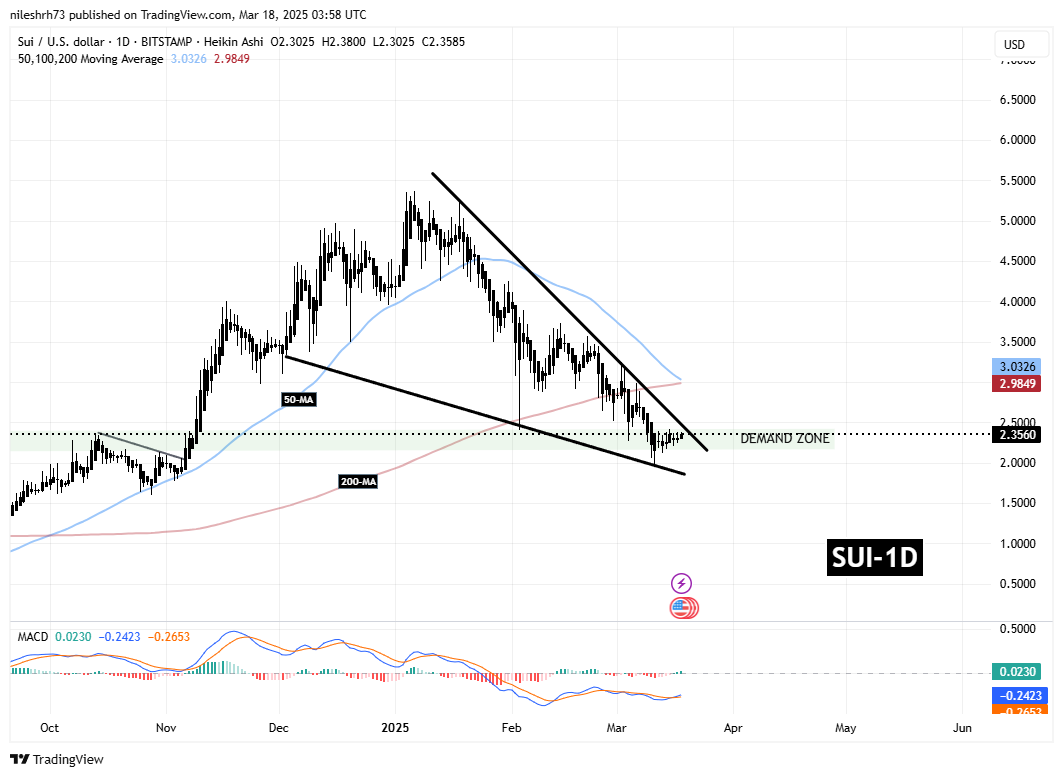
SUI Gains Traction as Canary Capital Files for ETF – Is a Breakout Ahead? image 2 SUI Daily Chart/Coinsprobe (Source: Tradingview)

SUI is now approaching the upper resistance of the falling wedge, a level that, if breached, could trigger a strong rally. The next major hurdle of resistance is at $3.00, which aligns with the 50-day moving average (50MA) and 200-day MA. A successful breakout above this zone could lead to a 26% upside from current levels.

The MACD indicator is also showing early signs of a bullish crossover, indicating that buying momentum is building. If this trend continues and SUI confirms a breakout with a retest of previous resistance as support, a new uptrend could emerge.

However, if the breakout attempt fails, SUI may retest lower support levels before making another move to the upside.

Final Thoughts

With both the ETF narrative gaining traction and the strategic partnership with WLFI, SUI is positioning itself for major growth. The Canary Capital ETF filing could pave the way for institutional capital inflows, while the World Liberty Financial partnership enhances its role in the DeFi ecosystem.

If these fundamental catalysts align with a technical breakout, SUI could experience a significant rally, further solidifying its standing in the blockchain space.

Disclaimer: This article is for informational purposes only and not financial advice. Always conduct your own research before investing in cryptocurrencies.

0
0

Disclaimer: The content of this article solely reflects the author's opinion and does not represent the platform in any capacity. This article is not intended to serve as a reference for making investment decisions.

Understand the market, then trade.
Bitget offers one-stop trading for cryptocurrencies, stocks, and gold.
Trade now!

You may also like

ROI - For the Trump-led Treasury, the "tail" of the auction is the most difficult part: McKeever

The views expressed in this article are solely those of the author, Reuters columnist Jamie McGeever. Reuters, Orlando, Florida, October 6 – U.S. Treasury auctions are typically dull, predictable, and not newsworthy. But these are not ordinary times, and the Trump administration now faces the risk of sluggish U.S. debt sales making headlines. The U.S. Treasury plans to issue nearly $120 billion in Treasuries this week, the first non-bill bond sales in two weeks: $58 billion in three-year notes on Tuesday, $39 billion in ten-year notes on Wednesday, and $22 billion in thirty-year bonds on Thursday. These auctions would usually be insignificant events, but due to the exceptionally weak performance of auctions from September 22 to 24—especially the five-year note auction on September 23, which triggered the largest spike in bond yields since April last year—they are attracting growing attention. Since then, yields have not only failed to retreat but have surged across most tenors to multi-decade highs. It's worth noting that the possibility of a U.S. Treasury auction "failing" is almost zero. Primary dealers—currently 26 Wall Street banks and institutions authorized by the New York Fed as market makers for Treasuries—are always involved. They effectively underwrite the sales, ensuring the smooth operation of the $30 trillion U.S. Treasury market, the most liquid market in the world. This, in turn, allows the entire global financial system to function, given that trillions of dollars in global debt, assets, and market derivatives are benchmarked against U.S. Treasuries. Treasuries are also the primary collateral for lubricating the financial “pipes” of the U.S. and global markets, including repo agreements, interbank loans, and financing. In short, as long as U.S. Treasuries remain the pillar of the global financial system, there will always be buyers at Treasury auctions. The question, as always, is at what price these bonds will be sold. Currently, borrowing costs in the secondary market are at their highest levels since the mid-2000s, so it's reasonable to expect that the Treasury will pay relatively high rates in the primary market as well. But as recent auctions have shown, negative surprises remain possible. "Too big to be absorbed by the market"? The $70 billion five-year auction on September 23 was among the most worrisome in years. Demand, as measured by the bid-to-cover ratio, was at a nine-year low. The Treasury ended up selling the notes at a yield of 5.033%, more than 3 basis points above the market yield at the close of bidding. Three basis points might not sound like much, but it's exceptional for a five-year note auction. This is the largest so-called "tail" since June 2022. According to JPMorgan analysts, the last time a five-year auction had a three-basis-point tail was back in 2011—amid the brewing debt ceiling crisis that eventually led to a U.S. credit rating downgrade in August that year. Currently, concerns over the U.S.'s daunting fiscal outlook are driving up long-term borrowing costs. As a result, markets generally expect the Trump administration to gradually shift the Treasury’s massive funding needs toward the lower-yield (and therefore lower-cost) short- and medium-term segments of the curve. That's why the five-year note auction two weeks ago sparked such concern. A three-basis-point tail is common in long bond auctions, but not in the "belly" of the yield curve. If the Treasury is forced to pay a higher premium to issue these bonds, then Houston, we have a problem. A large auction tail can be caused by many factors, including market volatility on the day of the auction or more concerning, fundamental issues that may erode demand over time. The two are often hard to distinguish because they are not mutually exclusive. On a brighter note, this unease has not yet spread to the short end of the yield curve. At least, not yet. Three-year and ten-year Treasury yields are up about 50 basis points from the last auction a month ago, hovering around 4.96% and 5.32%, respectively. The thirty-year yield is up roughly 35 basis points to 5.65%. These levels should be high enough to attract strong demand and ensure smooth sales, right? Maybe. But if surprises do occur, volatility and uncertainty could spill over across the market. Investors will be watching developments as closely as hawks. (The views in this article are solely those of the author, a Reuters columnist.) Like this column? Check out Reuters' "Unhedged" (ROI), your essential new source for global finance commentary. Follow ROI on LinkedIn and X. You can also listen to the daily "Morning Bid" podcast on Apple, Spotify, or the Reuters app—subscribe for in-depth market and finance news, seven days a week. US 5-year auction has biggest 'tail' since 2022 https://fingfx.thomsonreuters.com/gfx/mkt/dwpkmkzogpm/TAIL.png (For the convenience of non-English speakers, Reuters provides automated translations of its reports

路透社•2026/10/06 13:11

Money market fund inflows plummet to 158 billion—Is short-term US Treasury liquidity flashing a warning sign?

Money market fund inflows have sharply dropped to $158 billion in the first three quarters of this year, driving Treasury yields higher. Increased volatility at the short end has raised market concerns about tightening short-term financing.

智通财经•2026/10/06 13:07