
From Aave to Hyperliquid: Are Token Buybacks the Next Big Evolution in Crypto?

The surge in crypto token buybacks aims to boost scarcity and investor confidence, but regulatory risks and liquidity concerns remain.
Many cryptocurrency projects such as Aave, dYdX, Jupiter, and Hyperliquid have recently announced token buyback mechanisms.
Traditional stock markets inspire the token buyback strategy. But does this strategy help crypto projects build a sustainable economic model and contribute to increasing the price of their tokens?
The Booming of Crypto Projects’ Token Buyback Programs
Token buybacks occur when crypto projects repurchase their tokens from the market. These repurchased tokens can be held as reserves or even burned. In theory, buybacks reduce circulating supply, creating scarcity, which may drive up token prices. Although not a new strategy, BeInCrypto has observed that this trend is rapidly expanding.
For example, in early March 2025, the lending protocol Aave (AAVE) announced the implementation of a new Aavenomics. Aave will repurchase tokens to reduce supply and shift from staking rewards to a more sustainable liquidity model. This included a weekly AAVE token buyback worth $1 million for six months, funded by protocol fees.
In an ideal scenario, this buyback plan could reach a total value of $100 million (3% of the circulating supply).
“We consider it the most important proposal in our history, feel free to have a read and provide feedback,” said Marc Zeller, founder of the Aave Chan Initiative (ACI).
Also in March, the decentralized exchange (DEX) dYdX approved “Proposal #225” to buy back DYDX tokens. The protocol will use platform revenue for the buyback.
Other crypto projects like Hyperliquid (HYPE) and Jupiter (JUP) have similar plans. Estimates suggest Hyperliquid will repurchase $600 million worth of tokens annually, using 50-100% of transaction fees. This protocol dominates decentralized finance (DeFi) despite the market downturn.
Jupiter has committed to using 50% of fees for buyback, estimated at $250 million annually. Recently, this project surpassed Raydium and became Solana’s second-largest protocol.
These are just a few of the most typical crypto projects. Many other projects, including Gnosis, Gains Network, and Arbitrum, employ similar strategies. So, could this reshape the current cryptocurrency market?
What’s Driving This Token Buyback Trend?
Discussing this buyback strategy, an X (formerly Twitter) user commented:
“Buybacks create steady demand and reduce circulating supply, which can stabilize or even increase token prices.” commented Capitanike.
The fundamental economic principle of supply and demand is the key driver. By reducing circulating supply, crypto projects aim to increase token scarcity, which could push prices higher. According to SolanaFloor, projects with token buyback programs outperformed those without buybacks by 46.67% in 2024 (-0.6% vs. -47.15% YTD).
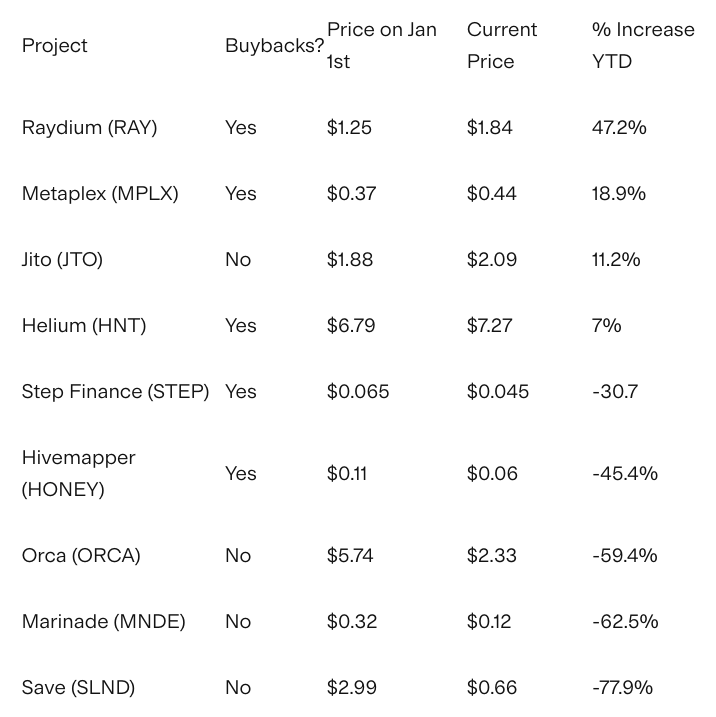 Performance of Projects with Token Buyback Programs Source:
SolanaFloor
Performance of Projects with Token Buyback Programs Source:
SolanaFloor
Secondly, the buyback can signal strong financial health for crypto projects. This is particularly effective in reassuring investors amid market volatility.
Thirdly, unlike the token burn strategy, many projects (such as AAVE and Gains Network) redistribute repurchased tokens to stakers or holders, aligning incentives. This approach could indicate the maturity of a project’s tokenomics model over time.
However, token buybacks are not without weaknesses. As this strategy becomes more widespread, regulators like the SEC may scrutinize it for potential manipulation or illicit activities.
Additionally, an improperly calculated buyback strategy could overly reduce token supply. If a project fails to balance new issuance or staking rewards, it might suffer from decreased trading volume. Moreover, buybacks could potentially mask financial weaknesses.
“What’s more plausible, in our opinion, is that these buybacks serve as proof that the projects raised too much during their ICO, are failing to develop anything useful, and don’t know what to do with their cash balances…” TokenData Research report.
The recent surge in crypto projects adopting token buybacks marks a significant evolution in tokenomics. While buybacks can enhance price stability, investor confidence, and ecosystem growth, they also carry manipulation risks and regulatory problems.
Disclaimer: The content of this article solely reflects the author's opinion and does not represent the platform in any capacity. This article is not intended to serve as a reference for making investment decisions.
You may also like
XRP News Today : Ripple Expands Prime Brokerage Services for Brevan Howard
ROI - For the Trump-led Treasury, the "tail" of the auction is the most difficult part: McKeever
The views expressed in this article are solely those of the author, Reuters columnist Jamie McGeever. Reuters, Orlando, Florida, October 6 – U.S. Treasury auctions are typically dull, predictable, and not newsworthy. But these are not ordinary times, and the Trump administration now faces the risk of sluggish U.S. debt sales making headlines. The U.S. Treasury plans to issue nearly $120 billion in Treasuries this week, the first non-bill bond sales in two weeks: $58 billion in three-year notes on Tuesday, $39 billion in ten-year notes on Wednesday, and $22 billion in thirty-year bonds on Thursday. These auctions would usually be insignificant events, but due to the exceptionally weak performance of auctions from September 22 to 24—especially the five-year note auction on September 23, which triggered the largest spike in bond yields since April last year—they are attracting growing attention. Since then, yields have not only failed to retreat but have surged across most tenors to multi-decade highs. It's worth noting that the possibility of a U.S. Treasury auction "failing" is almost zero. Primary dealers—currently 26 Wall Street banks and institutions authorized by the New York Fed as market makers for Treasuries—are always involved. They effectively underwrite the sales, ensuring the smooth operation of the $30 trillion U.S. Treasury market, the most liquid market in the world. This, in turn, allows the entire global financial system to function, given that trillions of dollars in global debt, assets, and market derivatives are benchmarked against U.S. Treasuries. Treasuries are also the primary collateral for lubricating the financial “pipes” of the U.S. and global markets, including repo agreements, interbank loans, and financing. In short, as long as U.S. Treasuries remain the pillar of the global financial system, there will always be buyers at Treasury auctions. The question, as always, is at what price these bonds will be sold. Currently, borrowing costs in the secondary market are at their highest levels since the mid-2000s, so it's reasonable to expect that the Treasury will pay relatively high rates in the primary market as well. But as recent auctions have shown, negative surprises remain possible. "Too big to be absorbed by the market"? The $70 billion five-year auction on September 23 was among the most worrisome in years. Demand, as measured by the bid-to-cover ratio, was at a nine-year low. The Treasury ended up selling the notes at a yield of 5.033%, more than 3 basis points above the market yield at the close of bidding. Three basis points might not sound like much, but it's exceptional for a five-year note auction. This is the largest so-called "tail" since June 2022. According to JPMorgan analysts, the last time a five-year auction had a three-basis-point tail was back in 2011—amid the brewing debt ceiling crisis that eventually led to a U.S. credit rating downgrade in August that year. Currently, concerns over the U.S.'s daunting fiscal outlook are driving up long-term borrowing costs. As a result, markets generally expect the Trump administration to gradually shift the Treasury’s massive funding needs toward the lower-yield (and therefore lower-cost) short- and medium-term segments of the curve. That's why the five-year note auction two weeks ago sparked such concern. A three-basis-point tail is common in long bond auctions, but not in the "belly" of the yield curve. If the Treasury is forced to pay a higher premium to issue these bonds, then Houston, we have a problem. A large auction tail can be caused by many factors, including market volatility on the day of the auction or more concerning, fundamental issues that may erode demand over time. The two are often hard to distinguish because they are not mutually exclusive. On a brighter note, this unease has not yet spread to the short end of the yield curve. At least, not yet. Three-year and ten-year Treasury yields are up about 50 basis points from the last auction a month ago, hovering around 4.96% and 5.32%, respectively. The thirty-year yield is up roughly 35 basis points to 5.65%. These levels should be high enough to attract strong demand and ensure smooth sales, right? Maybe. But if surprises do occur, volatility and uncertainty could spill over across the market. Investors will be watching developments as closely as hawks. (The views in this article are solely those of the author, a Reuters columnist.) Like this column? Check out Reuters' "Unhedged" (ROI), your essential new source for global finance commentary. Follow ROI on LinkedIn and X. You can also listen to the daily "Morning Bid" podcast on Apple, Spotify, or the Reuters app—subscribe for in-depth market and finance news, seven days a week. US 5-year auction has biggest 'tail' since 2022 https://fingfx.thomsonreuters.com/gfx/mkt/dwpkmkzogpm/TAIL.png (For the convenience of non-English speakers, Reuters provides automated translations of its reports
Crypto prices
More


