
Bitcoin Explosion: Expert Predicts Short-Term Price Spike

- Bitcoin Top Projection.
- Analysis of price cycles.
- Next top between 3 to 6 months.
A recent analysis highlighted the prediction that the top of the cycle Bitcoin may be closer than you think, with projections pointing to a period between 3 to 6 months. This analysis, based on historical data and technical indicators shared by market expert Egrag Crypto, seeks to identify patterns in previous Bitcoin cycles to predict the cryptocurrency's future behavior. After a turbulent period, the largest crypto asset has once again recorded significant gains, trading higher today.
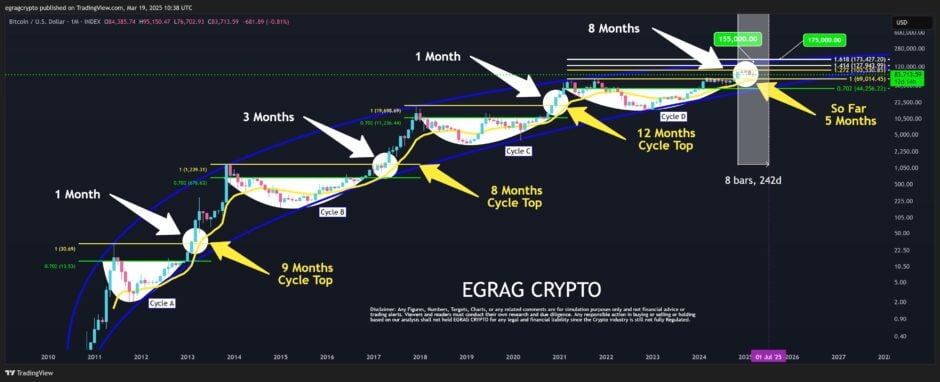
The expert’s analysis, which focuses on indicators such as Fib 1.0 and EMA 21, examines previous Bitcoin cycles to identify consolidation patterns and the periods required to reach cycle tops. The analyst identified different consolidation periods and times for BTC to reach cycle tops.
Compliant highlighted the expert in his technical analysis, in cycle A, Bitcoin consolidated for 1 month and took 9 months to reach the top of the cycle, while in cycle D, the longest consolidation was 8 months, with 5 months elapsed so far.
 Source: Egrag Crypto
Based on this data, Egrag Crypto calculated the average of the periods needed to reach cycle tops, arriving at an average of 9,6 months. This average suggests that the top of the Bitcoin cycle could occur between August and September 2025. However, the expert's analysis also considers other projections, such as April and November 2025, depending on the cycles analyzed. Despite the different projections, the analysis converges to the prediction that the top of the Bitcoin cycle should occur in the next 3 to 6 months.
“The average is calculated as 9 + 8 + 12 = 9,6 months, suggesting that the top of the cycle will likely occur between August and September. I believe the top of the cycle will occur within the next 3 to 6 months,” he explained.
At the time of publication, the price of Bitcoin was quoted at US$83.951,21, up 2.7% in the last 24 hours.
Today investors will accompany They will be closely watching the Federal Reserve’s quarterly projections at 14 p.m. ET, known as the Summary of Economic Projections (SEP), for signals about the next steps in monetary policy. They will also be paying close attention to Fed Chairman Jerome Powell’s remarks during a press conference scheduled for 14:30 p.m. ET.
Disclaimer: The content of this article solely reflects the author's opinion and does not represent the platform in any capacity. This article is not intended to serve as a reference for making investment decisions.
You may also like
ROI - For the Trump-led Treasury, the "tail" of the auction is the most difficult part: McKeever
The views expressed in this article are solely those of the author, Reuters columnist Jamie McGeever. Reuters, Orlando, Florida, October 6 – U.S. Treasury auctions are typically dull, predictable, and not newsworthy. But these are not ordinary times, and the Trump administration now faces the risk of sluggish U.S. debt sales making headlines. The U.S. Treasury plans to issue nearly $120 billion in Treasuries this week, the first non-bill bond sales in two weeks: $58 billion in three-year notes on Tuesday, $39 billion in ten-year notes on Wednesday, and $22 billion in thirty-year bonds on Thursday. These auctions would usually be insignificant events, but due to the exceptionally weak performance of auctions from September 22 to 24—especially the five-year note auction on September 23, which triggered the largest spike in bond yields since April last year—they are attracting growing attention. Since then, yields have not only failed to retreat but have surged across most tenors to multi-decade highs. It's worth noting that the possibility of a U.S. Treasury auction "failing" is almost zero. Primary dealers—currently 26 Wall Street banks and institutions authorized by the New York Fed as market makers for Treasuries—are always involved. They effectively underwrite the sales, ensuring the smooth operation of the $30 trillion U.S. Treasury market, the most liquid market in the world. This, in turn, allows the entire global financial system to function, given that trillions of dollars in global debt, assets, and market derivatives are benchmarked against U.S. Treasuries. Treasuries are also the primary collateral for lubricating the financial “pipes” of the U.S. and global markets, including repo agreements, interbank loans, and financing. In short, as long as U.S. Treasuries remain the pillar of the global financial system, there will always be buyers at Treasury auctions. The question, as always, is at what price these bonds will be sold. Currently, borrowing costs in the secondary market are at their highest levels since the mid-2000s, so it's reasonable to expect that the Treasury will pay relatively high rates in the primary market as well. But as recent auctions have shown, negative surprises remain possible. "Too big to be absorbed by the market"? The $70 billion five-year auction on September 23 was among the most worrisome in years. Demand, as measured by the bid-to-cover ratio, was at a nine-year low. The Treasury ended up selling the notes at a yield of 5.033%, more than 3 basis points above the market yield at the close of bidding. Three basis points might not sound like much, but it's exceptional for a five-year note auction. This is the largest so-called "tail" since June 2022. According to JPMorgan analysts, the last time a five-year auction had a three-basis-point tail was back in 2011—amid the brewing debt ceiling crisis that eventually led to a U.S. credit rating downgrade in August that year. Currently, concerns over the U.S.'s daunting fiscal outlook are driving up long-term borrowing costs. As a result, markets generally expect the Trump administration to gradually shift the Treasury’s massive funding needs toward the lower-yield (and therefore lower-cost) short- and medium-term segments of the curve. That's why the five-year note auction two weeks ago sparked such concern. A three-basis-point tail is common in long bond auctions, but not in the "belly" of the yield curve. If the Treasury is forced to pay a higher premium to issue these bonds, then Houston, we have a problem. A large auction tail can be caused by many factors, including market volatility on the day of the auction or more concerning, fundamental issues that may erode demand over time. The two are often hard to distinguish because they are not mutually exclusive. On a brighter note, this unease has not yet spread to the short end of the yield curve. At least, not yet. Three-year and ten-year Treasury yields are up about 50 basis points from the last auction a month ago, hovering around 4.96% and 5.32%, respectively. The thirty-year yield is up roughly 35 basis points to 5.65%. These levels should be high enough to attract strong demand and ensure smooth sales, right? Maybe. But if surprises do occur, volatility and uncertainty could spill over across the market. Investors will be watching developments as closely as hawks. (The views in this article are solely those of the author, a Reuters columnist.) Like this column? Check out Reuters' "Unhedged" (ROI), your essential new source for global finance commentary. Follow ROI on LinkedIn and X. You can also listen to the daily "Morning Bid" podcast on Apple, Spotify, or the Reuters app—subscribe for in-depth market and finance news, seven days a week. US 5-year auction has biggest 'tail' since 2022 https://fingfx.thomsonreuters.com/gfx/mkt/dwpkmkzogpm/TAIL.png (For the convenience of non-English speakers, Reuters provides automated translations of its reports
Money market fund inflows plummet to 158 billion—Is short-term US Treasury liquidity flashing a warning sign?
Money market fund inflows have sharply dropped to $158 billion in the first three quarters of this year, driving Treasury yields higher. Increased volatility at the short end has raised market concerns about tightening short-term financing.
Crypto prices
More


