
With US Solana Futures ETF Debut, Can SOL Price Reach $500?

The launch of the first Solana futures exchange-traded funds (ETFs) marks a major milestone for institutional crypto adoption in the U.S. With these new financial products, investors gain regulated exposure to Solana (SOL) , potentially driving demand and liquidity. But can this institutional push propel SOL’s price toward the $500 mark ?
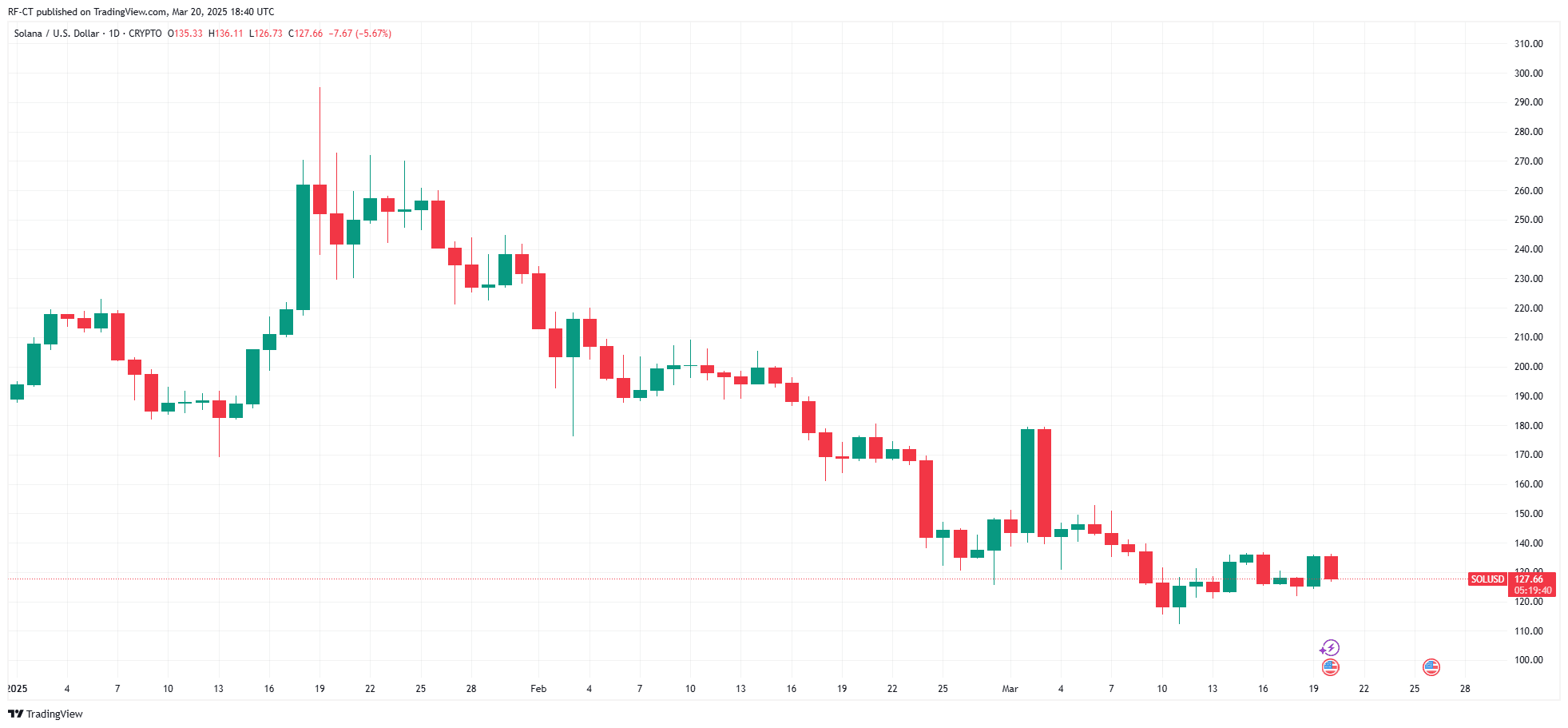 By TradingView - SOLUSD_2025-03-20 (YTD)
Solana Futures ETFs: A Game-Changer for Institutional Investors
On March 20, 2025, Volatility Shares LLC introduced two groundbreaking Solana futures ETFs:
- Volatility Shares Solana ETF (SOLZ): Provides standard exposure to Solana futures.
- Volatility Shares 2X Solana ETF (SOLT): Offers leveraged exposure, amplifying Solana’s price movements by twofold.
These ETFs represent the first U.S.-based funds tracking Solana futures, signaling growing institutional interest in the asset.
Regulatory Approval and Market Timing
The swift approval of Solana futures ETFs by U.S. regulators underscores a shifting stance toward digital assets. Experts suggest that this move could accelerate the path toward a spot Solana ETF, similar to the trajectory of Bitcoin and Ethereum.
Justin Young, CEO of Volatility Shares, emphasized that this approval reflects a broader recognition of the importance of crypto in maintaining the U.S.'s leadership in financial markets.
Will Institutional Demand Push SOL Price to New Highs?
With the launch of these ETFs, expectations are high for increased institutional adoption. Analysts predict that the influx of institutional funds could significantly boost Solana’s market capitalization, narrowing the gap with Ethereum. However, some remain cautious, noting that futures-based ETFs often attract less capital compared to spot ETFs.
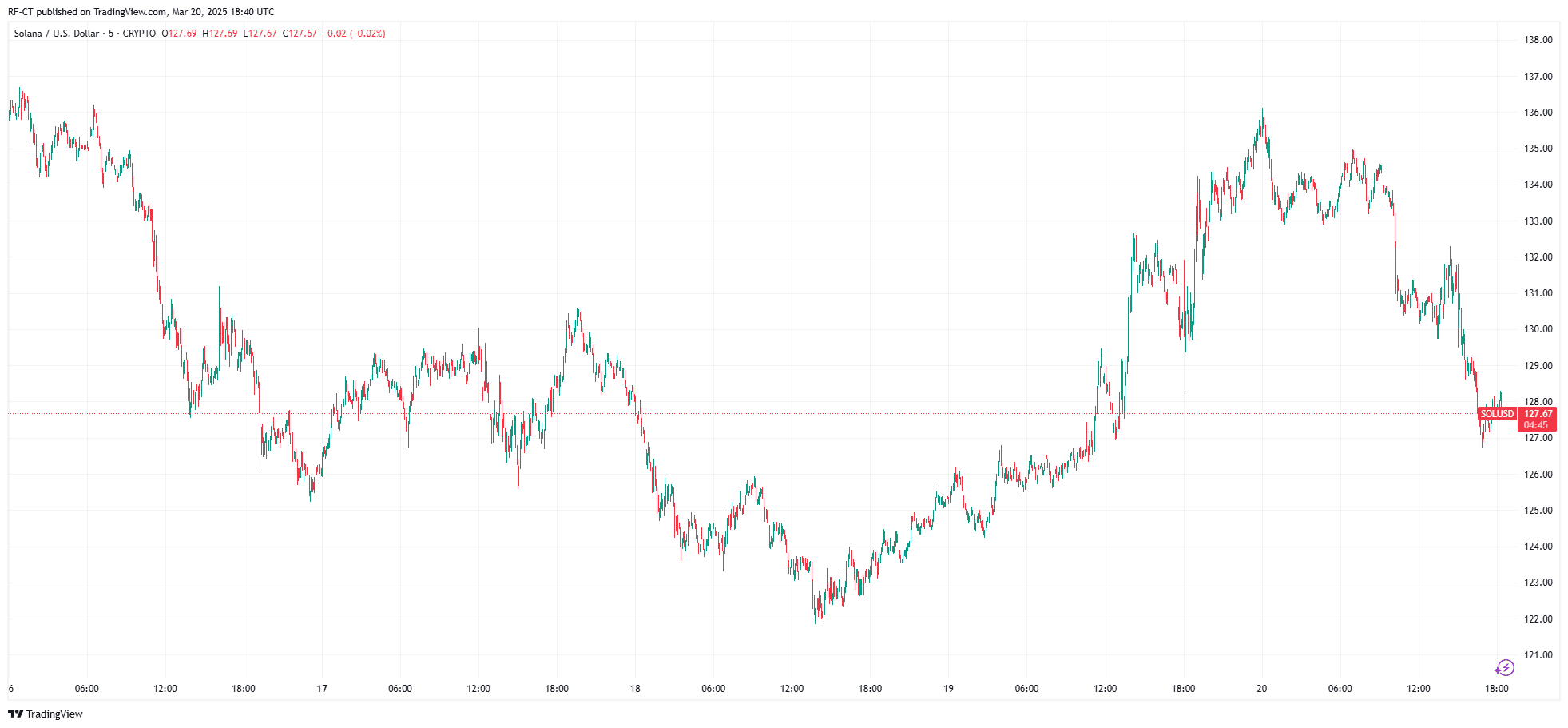 By TradingView - SOLUSD_2025-03-20 (5D)
Market Reactions and Price Projections
Ahead of the ETF debut, Solana's price surged 12% , reaching $136 as traders positioned themselves for potential institutional inflows. Short-term resistance levels are set around $140, while key support sits at $127.
While the immediate impact on Solana’s price remains uncertain, some analysts speculate that sustained institutional demand, combined with broader crypto market growth, could propel the SOL price toward the $500 target in the long run.
Solana Price Prediction: Can SOL Price Reach $500?
The launch of Solana futures ETFs marks a turning point in institutional adoption of the asset. While initial inflows may be moderate, this development sets the stage for potential future spot ETFs, further increasing accessibility and demand for Solana. Whether SOL can reach $500 will depend on continued institutional interest, broader market conditions, and upcoming regulatory decisions.
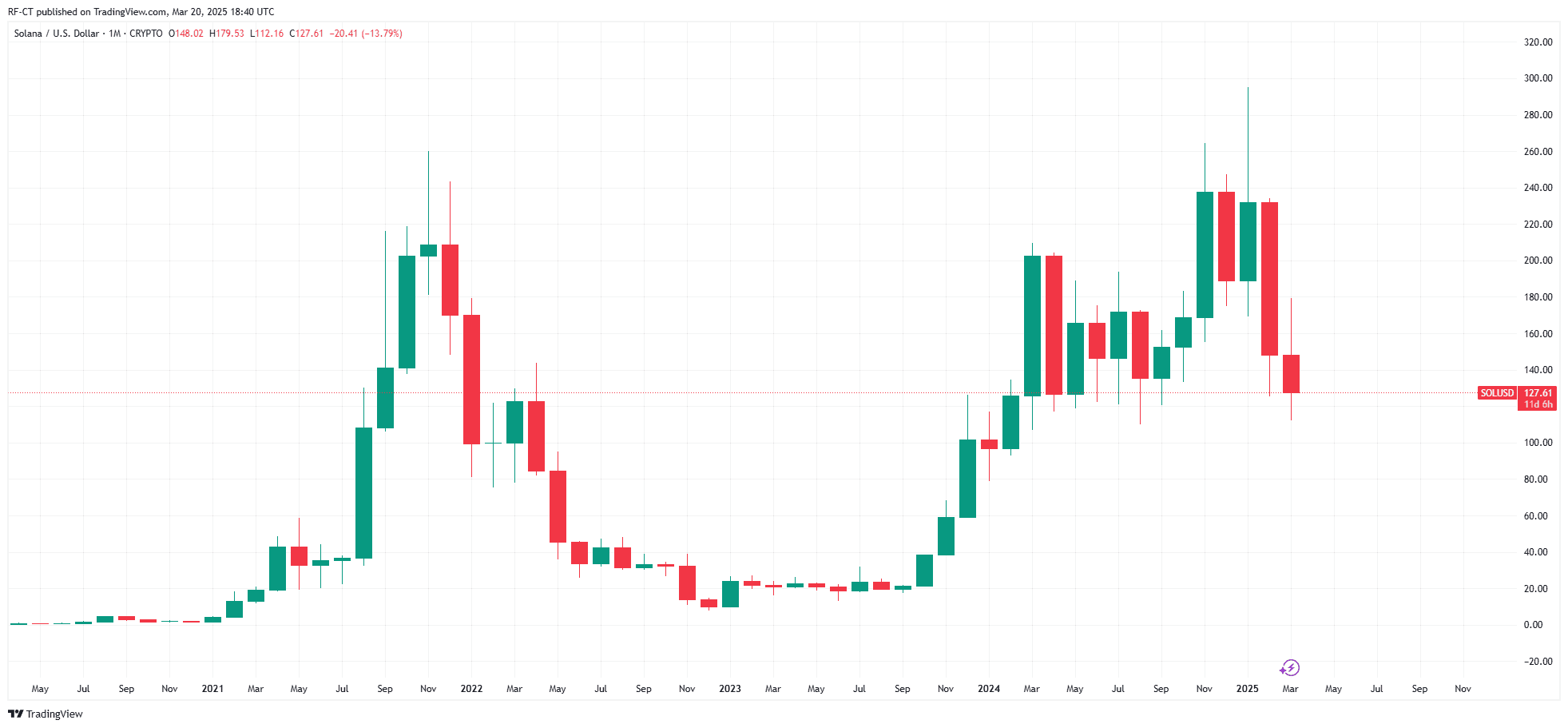 By TradingView - SOLUSD_2025-03-20 (All)
Solana Futures ETF vs Solana ETF
The key difference between a Solana ETF and a Solana Futures ETF lies in the underlying assets they track and how they provide exposure to Solana (SOL).
Solana ETF (Spot ETF)
- A Solana ETF (Spot ETF) would hold actual SOL tokens as its underlying asset.
- Investors buying shares of the ETF would indirectly own real Solana, making it similar to buying and holding SOL on a crypto exchange.
- A spot Solana ETF would directly impact the price of SOL, as fund managers would need to buy and store SOL tokens to match investor demand.
- As of now, no spot Solana ETF has been approved by regulators.
Solana Futures ETF
- A Solana Futures ETF does not hold real SOL tokens. Instead, it invests in futures contracts that track Solana’s price.
- Futures contracts are agreements to buy or sell Solana at a predetermined price on a specific future date.
- These ETFs allow investors to speculate on Solana’s price movements without directly owning SOL.
- Futures-based ETFs are often less correlated with the actual price of SOL due to factors like roll costs (costs incurred when rolling over expiring contracts).
Key Differences
| Underlying Asset | Holds real SOL tokens | Holds futures contracts on Solana |
| Market Impact | Directly affects SOL price | Indirect impact, based on futures prices |
| Investor Exposure | Direct ownership of Solana | Exposure to price movements via derivatives |
| Regulatory Status | Not yet approved | Approved and trading in the U.S. |
| Price Correlation | Closely follows SOL’s price | May deviate due to futures market conditions |
Which is Better?
- A Solana Spot ETF would provide a more direct and stable way to invest in Solana, as it tracks the actual price of SOL.
- A Solana Futures ETF offers exposure to price movements but comes with additional risks, such as futures market volatility and contract roll costs.
Currently, only Solana Futures ETFs have been launched in the U.S., while a Spot Solana ETF is still awaiting regulatory approval.
Disclaimer: The content of this article solely reflects the author's opinion and does not represent the platform in any capacity. This article is not intended to serve as a reference for making investment decisions.
You may also like
British Pound catches bid as BoE hawk warns inflation is embedded
AI Agents Ignite CPU Demand! Mizuho Estimates Market Size to Reach $209 Billion by 2030, Raises Target Prices for AMD (AMD.US), Intel (INTC.US), etc.
Mizuho stated that with the rapid increase in application scenarios for AI agents, server CPU demand is expected to grow significantly, which will further drive demand for DRAM, NAND, and server equipment.

Top Midday Stories: Google Strikes 20-Year Nuclear Power Deal With Constellation; Marvell Raises Revenue Guidance for 2026-27
11:45 AM EDT, 10/06/2026 (MT Newswires) -- All three major US stock indexes were up in late-morning trading Tuesday, as oil prices and Treasury yields were down. In company news, Alphabet's (GOOG, GOOGL) Google has entered into a 20-year deal with Constellation Energy (CEG) to add 890 megawatts of nuclear power to the PJM interconnection grid, the companies said Tuesday. The agreement will enable over $4.3 billion in investments in new equipment and technology at 11 Constellation nuclear facilities in Illinois, Pennsylvania and New Jersey, the companies said. Alphabet's Class C and Class A shares were up 0.3% and 0.6%, respectively, around midday. Constellation shares were up 13.7%. Marvell Technology (MRVL) now expects to generate revenue of $12 billion in 2026 and $18 billion in 2027, up from its previous guidance of a combined $20 billion over that period, Chairman and Chief Executive Matthew Murphy said Tuesday at a conference, according to a transcript. Marvell shares were up 7.0%. McKesson (MCK) and CD&R have entered into a definitive agreement to acquire Option Care Health (OPCH) for $32.05 per share, reflecting a total enterprise value of about $5.8 billion, the companies said Tuesday. After the deal closes, which is expected to occur in H1 2027, CD&R will hold a majority interest of 51% in Option Care Health, while McKesson will invest $1.4 billion to hold the remaining 49%, the companies said. McKesson shares were up 0.1%, while Option Care shares were up 32.7%. Uber Technologies (UBER) has agreed to acquire ezCater for $2.3 billion in cash, the ride-hailing company said Tuesday. The deal, expected to close in the coming months, will expand Uber's catering orders and give restaurants access to larger orders and more customers, the company said. Uber shares were down 0.4%. Energy Transfer (ET) said Tuesday it has entered into a definitive agreement to acquire Vaquero Midstream in a bolt-on deal valued at about $2.63 billion. The deal consideration will consist of $1.95 billion in cash and about 33.3 mill
Oil prices and the euro resonate, signaling an inflection point for major assets
Crypto prices
More


