
XRP correction may be ending as bulls watch $2 breakout zone

According to analysts, XRP is trading close to a key accumulation zone, which could strengthen its case for an upward rally.
In an April 8 X post , Analyst Dom pointed out that XRP is now filling a “liquidity void”, essentially correcting an inefficiency in price action from back in late November. That puts the asset in a tight range between around $1.50 and $2.00.
The analyst noted that the $2 mark serves as a critical resistance level and key accumulation zone. A clean break above it would signal a potential structure shift that could officially end the current downtrend.
At press time, XRP ( XRP ) was down 3.3% over the past 24 hours, exchanging hands at $1.80, while its market cap was seated at over $104 billion. Its daily trading volume had also dipped 42% to $6.3 billion.
Bullish catalysts for XRP
Nevertheless, a number of positive XRP-related developments are leading many traders to believe that XRP could be gearing up for a bullish rally.
First, the launch of Teucrium’s leveraged XRP ETF (XXRP) marks the first XRP-linked ETF in the U.S., offering double daily returns on XRP. This sets a major precedent for institutional involvement and legitimises Ripple-based investment products in traditional markets.
This milestone comes on the heels of the SEC dropping its appeal and settling the Ripple case with a $50 million penalty, effectively removing longstanding regulatory uncertainty around XRP. The legal clarity has sparked renewed institutional interest, with firms like Franklin Templeton, Bitwise, and 21Shares now pursuing spot XRP ETFs.
Excitement is also growing around the potential launch of a spot XRP ETF by the end of 2025. According to Polymarket data , approval odds have climbed back to 77%, recovering from a dip to 72% recorded on April 7.
Second, Ripple has announced the acquisition of prime brokerage firm Hidden Road in a $1.25 billion deal, one of the largest in the crypto industry’s history. The move expands Ripple’s institutional footprint by leveraging Hidden Road’s established client network, positioning Ripple as a more dominant player in global finance.
Third, on-chain metrics support a bullish outlook.
Data from Santiment reveals a steady accumulation by wallets holding 100,000 to 100 million XRP, typically considered smart money. This buying activity during the dip suggests strong conviction among larger investors, often seen as a precursor to upward price movement.
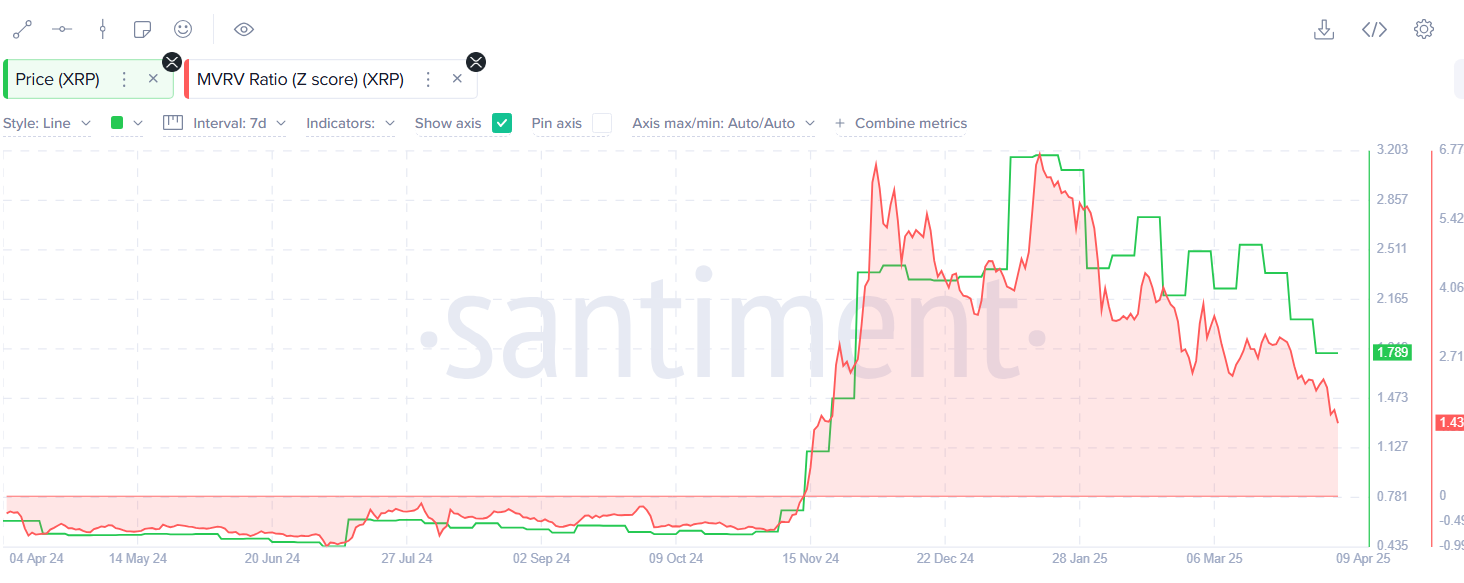
XRP’s MVRV Z-Score has also dropped to 1.43, its lowest level since November of last year. That’s notable because the last time it was this low, XRP kicked off a bull run and eventually hit its all-time high of $3.40.
 Source: Santiment
A lower MVRV Z-Score usually means the asset is undervalued compared to its historical average, which can be a sign that the market is near a bottom and primed for a rebound.
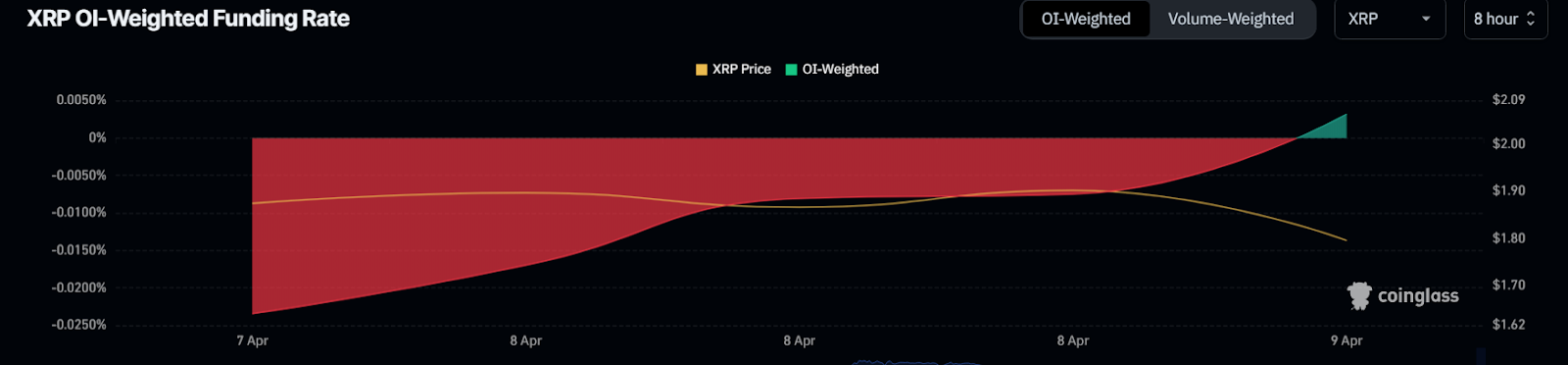
Meanwhile, its weighted funding rate has flipped back to green, indicating improved investor sentiment among XRP derivative traders, as more of them are now placing bullish bets after a period of caution.
 Source: CoinGlass
According to analysts at crypto.news , $2 is the most likely next target for XRP.
On a longer time frame, experts at Standard Chartered have set an even higher price target, projecting $5.5 as a realistic target by the year-end. Their forecast comes after XRP’s 580% rally from November 2024 to January 2025, suggesting there’s room for another 214% move from current levels.
XRP still in correction phase
However, Trader Chetan Gurjar believes XRP is still in its wave 2 correction phase, based on the Elliott Wave theory, a popular trading method where price moves in patterns of five waves up when the market is trending and three waves down when it’s correcting.
Right now, Chetan thinks XRP is in one of those “down” phases, wave 2, which usually happens before the next big move up. He sees this dip as a healthy retracement, with possible bottom zones around key Fibonacci levels: $1.48, $1.1453, and $0.8856.
Chetan has some lofty long-term targets too: at least $8–$12, with the possibility of XRP reaching as high as $23–$30 during the next major cycle. He does note, though, that a breakdown below $0.3823 would invalidate his current wave count.
Disclosure: This article does not represent investment advice. The content and materials featured on this page are for educational purposes only.
Disclaimer: The content of this article solely reflects the author's opinion and does not represent the platform in any capacity. This article is not intended to serve as a reference for making investment decisions.
You may also like
Nvidia’s Record Run Signals Another AI Wave: 5 Cryptos Worth Buying Before the Breakout
Apple (AAPL.US) Teams Up with LG to Enter Smart Home Market: Accessories such as doorbells, thermostats, and cameras to feature LG branding
According to sources, Apple is set to expand its smart home device lineup, including doorbells, thermostats, and other accessories. These products will be developed through an unusual partnership between Apple and LG Electronics.
Review Article - ROI - For Trump's Treasury, the "tail" of the auction is the toughest part: McKeever
Repeated, no changes to the main text. By Jamie McGeever Reuters, Orlando, Florida, October 6 - U.S. Treasury auctions are supposed to be dull, predictable, and lacking in news value. But these are unusual times, and the Trump administration now faces the risk of weak government bond sales making headlines. The U.S. Treasury plans to issue nearly $120 billion in bonds this week—the first auction of bonds other than short-term Treasury bills in two weeks: $58 billion in three-year notes on Tuesday, $39 billion in ten-year notes on Wednesday, and $22 billion in thirty-year bonds on Thursday. These auctions would ordinarily be inconsequential, but they're attracting increased attention due to the exceptionally weak auction results from September 22–24—particularly the five-year Treasury auction on September 23, which led to the largest jump in yields since April of last year. Since then, yields have not fallen back, and instead, have surged to multi-decade highs across most maturities. It's important to note that the possibility of a "failed" U.S. Treasury auction is nearly zero. The primary dealers—26 banks and institutions currently authorized by the New York Fed to act as Treasury market makers on Wall Street—are always involved. They essentially underwrite the sales, ensuring the smooth operation of the $30 trillion U.S. Treasury market, which is the most liquid in the world. This, in turn, keeps the entire global financial system running. Trillions of dollars of global debt, assets, and market derivatives are benchmarked off U.S. Treasuries. U.S. Treasuries also serve as collateral to "lubricate" the pipes of the U.S. and global financial systems—in repos, interbank lending, and financing. In short, as long as U.S. Treasuries remain the backbone of the global financial system, there will always be buyers in Treasury auctions. The perpetual question is the price at which these bonds ultimately clear. With borrowing costs in the secondary market now at their highest since the mid-2000s, it's reasonable to expect the Treasury will pay correspondingly high rates in the primary market. But as recent auction rounds have shown, there remains potential for negative surprises. “Too big for the market to digest?” The $70 billion five-year auction on September 23 was among the most concerning in recent years. Demand—as measured by bid-to-cover ratio—was the lowest in nine years. The Treasury sold these notes at a yield of 5.033%, more than 3 basis points above the market yield at the auction deadline. Three basis points might not sound like much, but for a five-year Treasury auction, that's highly unusual. This was the largest so-called "tail" since June 2022. JP Morgan analysts pointed out that the last time the five-year auction saw a three-basis-point tail was back in 2011—when the brewing debt ceiling crisis ultimately led to the U.S. credit rating being downgraded that August. Back to today, concerns over the U.S.'s bleak fiscal outlook have pushed up long-term borrowing costs. Consequently, markets widely expect the Trump administration to gradually shift the Treasury's massive funding needs toward the lower-cost, shorter end of the yield curve. That explains why the five-year auction two weeks ago caused such a stir. A three-basis-point tail is common in long-bond auctions, but rare for securities in the so-called "belly" of the curve. If the Treasury is forced to pay a higher premium to move these bonds, then Houston, we have a problem. Large auction tails can be caused by numerous factors, such as market volatility on the day of the auction or, more worryingly, underlying fundamental issues that could erode demand over time. It's usually difficult to distinguish between these dynamics, as they're not mutually exclusive. On the brighter side, this unease hasn't yet spread to the short end of the curve. At least, not for now. Three- and ten-year Treasury yields have risen by about 50 basis points from the last auction a month ago, hovering around 4.96% and 5.32% respectively. The 30-year yield is up about 35 basis points, to 5.65%. That should be high enough to attract strong demand and ensure smooth sales, right? Probably. But if we get a surprise, volatility and uncertainty could ripple across the entire market. Investors will be… watching developments like hawks. (The views expressed herein are those of the author, a Reuters columnist.) Enjoyed this column? Visit Reuters Open Interest, your essential new source for global financial commentary. Follow ROI on LinkedIn and X. You can also listen to the daily "Morning Bid" podcast on Apple, Spotify, or the Reuters app. Subscribe for seven-day-a-week in-depth analysis of market and financial news by Reuters journalists. US 5-year auction has biggest 'tail' since 2022 https://fingfx.thomsonreuters.com/gfx/mkt/dwpkmkzogpm/TAIL.png (For reader convenience, Reuters automatically translates its reports into several other languages. Automate
Will cancelling 20-year U.S. Treasury bonds backfire? BNP Paribas warns it could worsen market sell-off; maintains prediction of 30-year yield rising to 5.8%
BNP Paribas warns that U.S. Treasury Secretary Janet Yellen should resist calls to cancel the issuance of 20-year U.S. Treasury bonds, as this measure, seemingly aimed at lowering long-term financing costs, could have the opposite effect. Not only would it be difficult to continuously suppress Treasury yields, but it could also raise borrowing costs and weaken market liquidity.
Crypto prices
More


