Bitget App
Trade smarter
Buy cryptoMarketsTradeFuturesStocksEarnInstitutionAI & More
Bitcoin (BTC) has hit the Bottom: Is the Trend Reversal Starting Now?

Bitcoin (BTC) has hit the Bottom: Is the Trend Reversal Starting Now?

CryptodailyCryptodaily2025/03/31 16:00
By:Laurie Dunn

There are signs that the Bitcoin bottom is in, following a local downward trend that has been active since 20 January this year. In that time the $BTC price lost as much as $32,000, equating to around 30% of its overall value. Is Bitcoin about to start clawing its way back to the all-time high?

U.S. trade tariffs about to take effect 

Wednesday 2 April is dubbed “Liberation Day” by U.S. President Donald Trump. This is the day when the U.S. announces its plan for reciprocal tariffs on all countries that have standing tariffs imposed on U.S. goods, with an emphasis on countries with which the US has large trade imbalances.

Not content with this, the U.S. will also impose a 25% tariff on all imported cars and auto parts that enter the country. This takes effect on 3 April. 

While there is still uncertainty as to how this will play out, not just for the U.S. domestic market, but also for global trade, at least the market will know the main extent of the U.S. strategy on tariffs by the end of this week, and then the market will have a better opportunity to price everything in.

Has the SP 500 dipped enough?

The SP 500 has lost as much as 10.6% from top to bottom during these last seven weeks since the talk of impending tariffs unsettled the market. This is the biggest dip since 10.8% in October 23, and is now more than the 9.7% reversal of the Japanese carry trade crash in August 2024.

Could this current reversal continue on down as tariff reprisals start to come in from the likes of the European Union, Canada, and others? Yes, but the main thing is that these will shortly be known. The market will have the vast majority of its doubts clarified, and the current stock market dip may already have accounted for this.

Gold tops as Bitcoin begins its rise

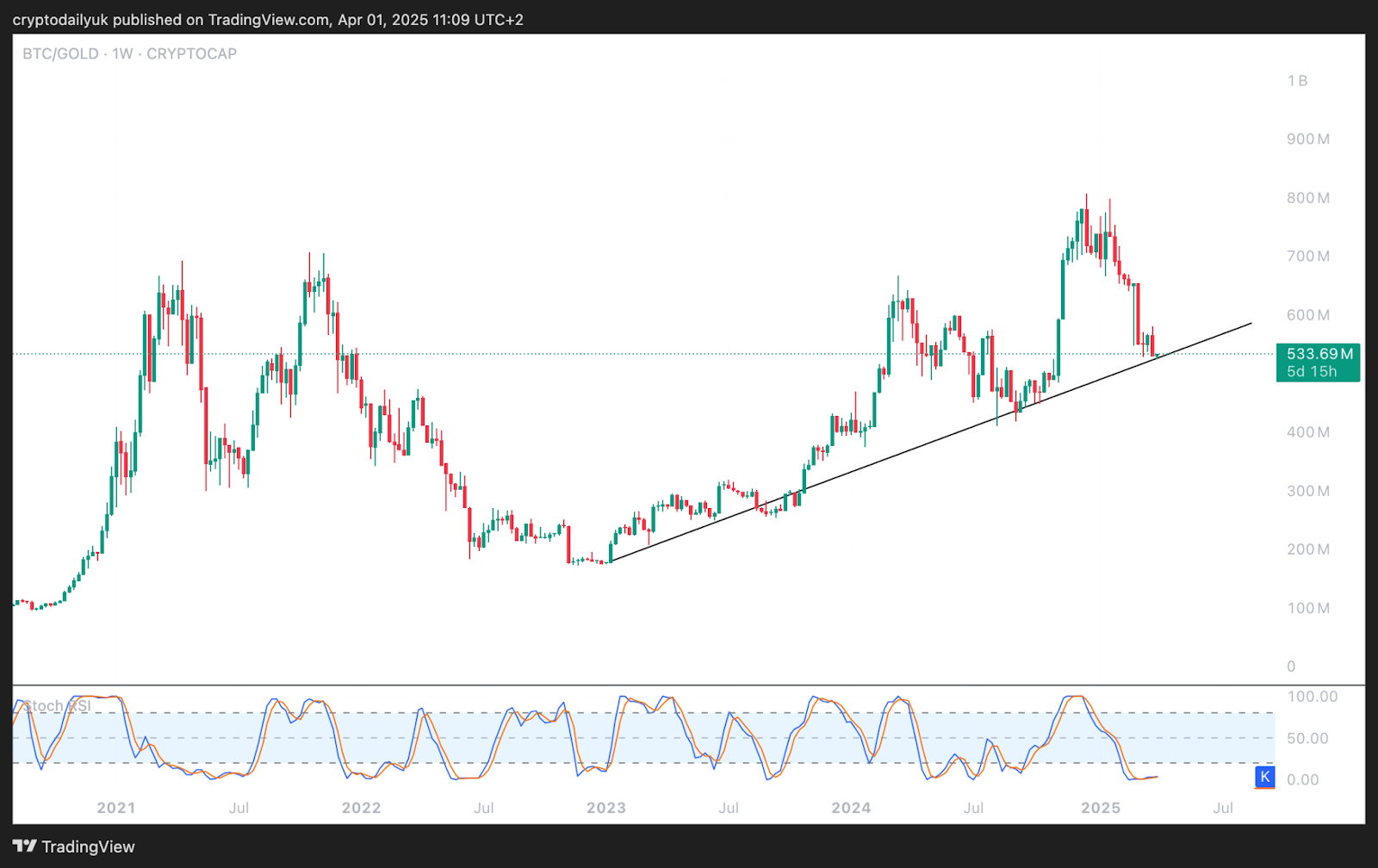
With this crisis arguably about to subside, with liquidity entering the system from the likes of China, and a slackening of QT from the US, the stage could be about to be set for a resurgence from Bitcoin. With the gold price having reached $3,150, a top may be fast approaching, while the converse is true of Bitcoin, which has now perhaps found a bottom. 
Bitcoin (BTC) has hit the Bottom: Is the Trend Reversal Starting Now? image 0

Source: TradingView

In the weekly chart above for BTC/GOLD, it can be seen that $BTC has now come down to the ascending trendline. This was a nearly 35% reversal against $GOLD, but should the bounce take place from here, it will be a very clear higher low, to add to the long sequence of higher highs and higher lows made since the beginning of the Bitcoin bull market which began in January 2023. The Stochastic RSI at the bottom of the chart is also very much in Bitcoin’s favour.

$BTC trend change taking place?
Bitcoin (BTC) has hit the Bottom: Is the Trend Reversal Starting Now? image 1

Source: TradingView

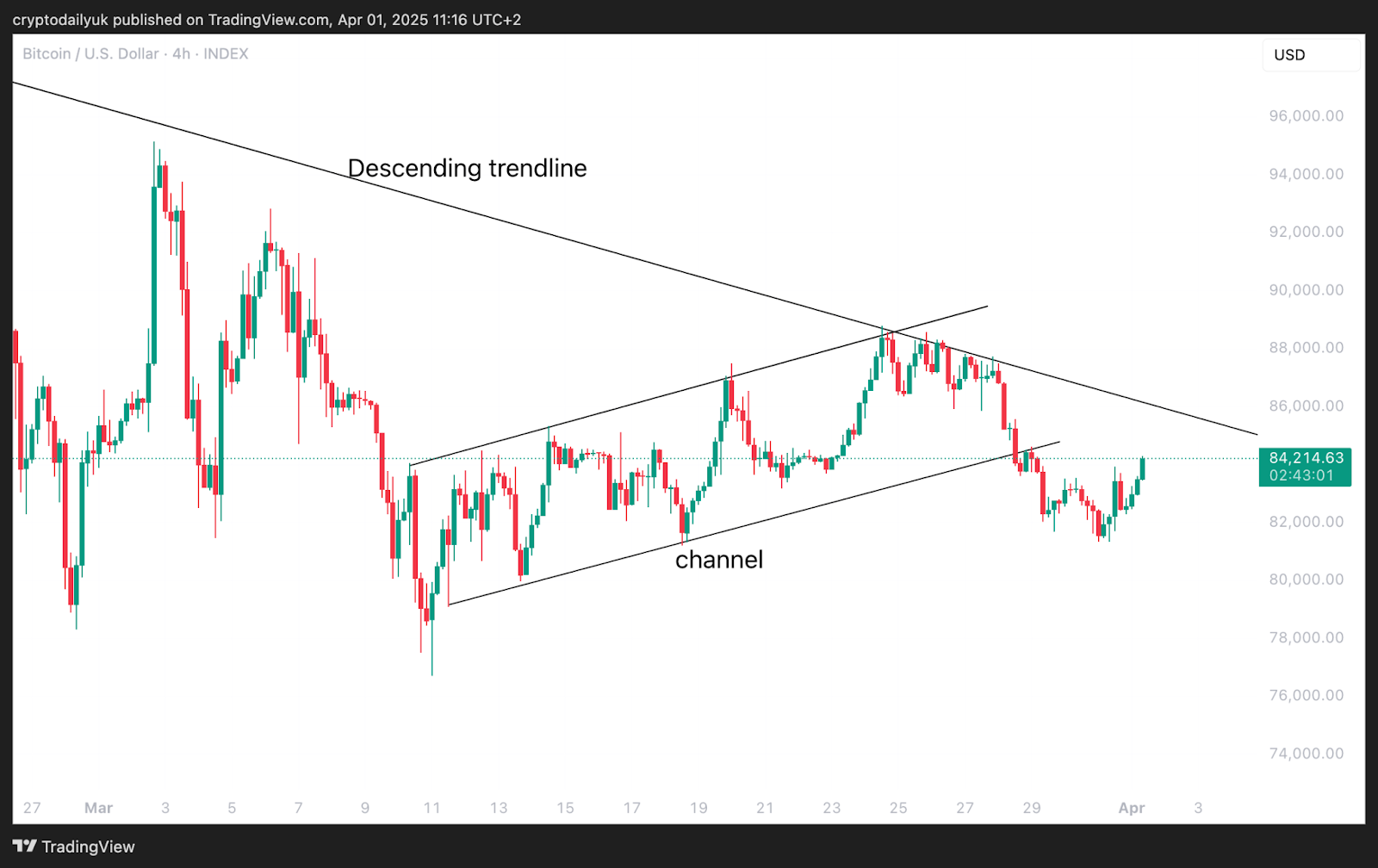
The short-term chart for the price of $BTC (BTC/USDT) shows that the price is currently trying to battle with a horizontal resistance level before moving up to the descending trendline once again.

With the last vestiges of U.S. stock market uncertainty still to play out during this week, it may be that there is some further choppiness to contend with. However, if the bulls can push the price up to, and beyond the descending trendline, a higher high at $88,800 will be the next target on the road to a trend change.

Of course, there is still the strong support at $80,000 to come back down to should things turn uglier than expected over the tariff wars. 

Bitcoin 2-week chart 
Bitcoin (BTC) has hit the Bottom: Is the Trend Reversal Starting Now? image 2

Source: TradingView

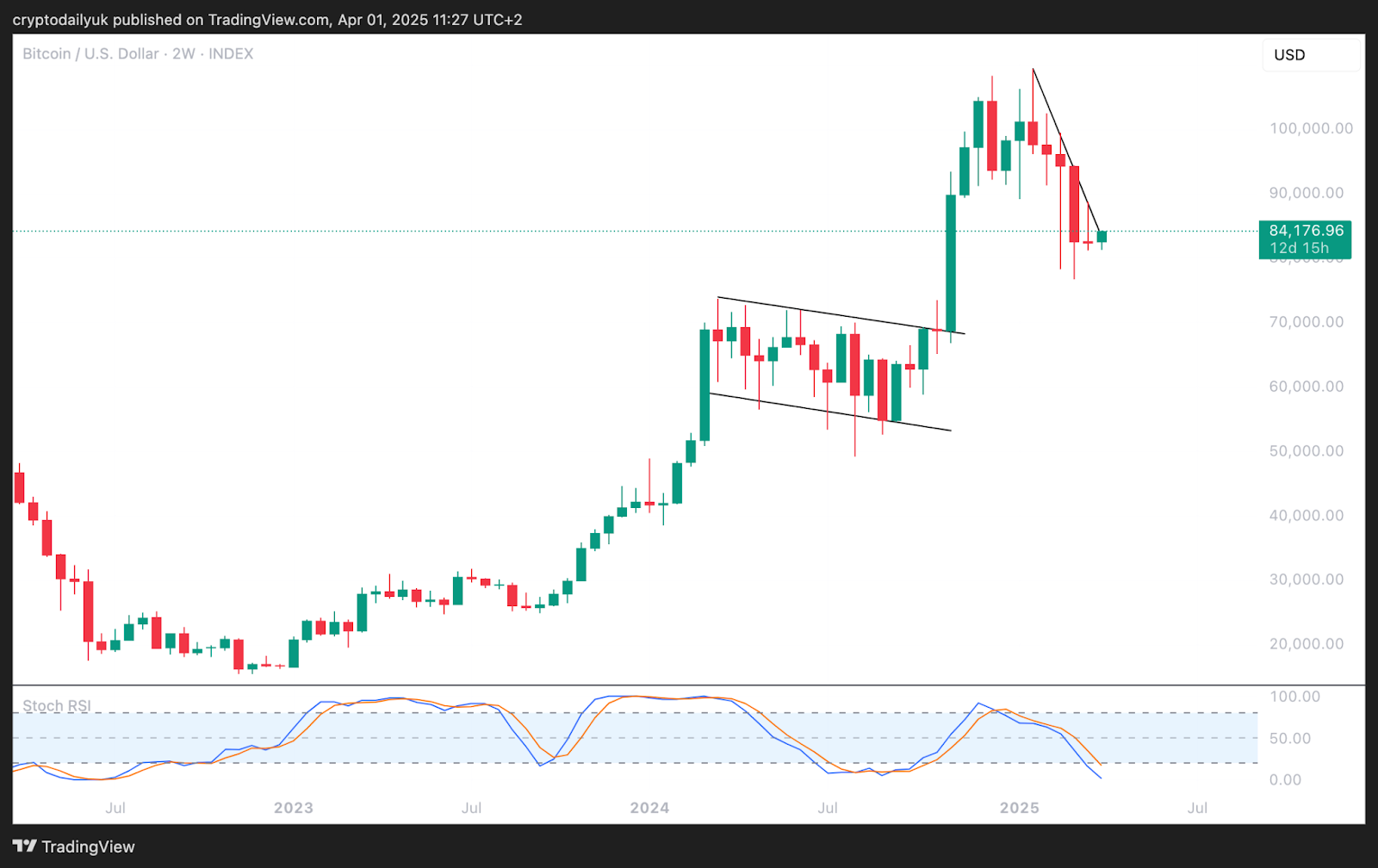
In the 2-week chart, which shows the entirety of this bull market, it can be seen that perhaps the price is ready to break through that descending trendline. Also, at the bottom of the chart, the Stochastic RSI may be making its lowest bottom of the bull market. With 12 days left in this period, this is a possibility. It just remains to be seen whether the price will jump straight back up, or whether it will chop sideways like it did during the 8-month bull flag. How the indicators in the Stochastic RSI rise from the bottom will have a say in the strength of the next upswing.

Disclaimer: This article is provided for informational purposes only. It is not offered or intended to be used as legal, tax, investment, financial, or other advice.

0
0

Disclaimer: The content of this article solely reflects the author's opinion and does not represent the platform in any capacity. This article is not intended to serve as a reference for making investment decisions.

Understand the market, then trade.
Bitget offers one-stop trading for cryptocurrencies, stocks, and gold.
Trade now!

You may also like

Review Article - ROI - For Trump's Treasury, the "tail" of the auction is the toughest part: McKeever

Repeated, no changes to the main text. By Jamie McGeever Reuters, Orlando, Florida, October 6 - U.S. Treasury auctions are supposed to be dull, predictable, and lacking in news value. But these are unusual times, and the Trump administration now faces the risk of weak government bond sales making headlines. The U.S. Treasury plans to issue nearly $120 billion in bonds this week—the first auction of bonds other than short-term Treasury bills in two weeks: $58 billion in three-year notes on Tuesday, $39 billion in ten-year notes on Wednesday, and $22 billion in thirty-year bonds on Thursday. These auctions would ordinarily be inconsequential, but they're attracting increased attention due to the exceptionally weak auction results from September 22–24—particularly the five-year Treasury auction on September 23, which led to the largest jump in yields since April of last year. Since then, yields have not fallen back, and instead, have surged to multi-decade highs across most maturities. It's important to note that the possibility of a "failed" U.S. Treasury auction is nearly zero. The primary dealers—26 banks and institutions currently authorized by the New York Fed to act as Treasury market makers on Wall Street—are always involved. They essentially underwrite the sales, ensuring the smooth operation of the $30 trillion U.S. Treasury market, which is the most liquid in the world. This, in turn, keeps the entire global financial system running. Trillions of dollars of global debt, assets, and market derivatives are benchmarked off U.S. Treasuries. U.S. Treasuries also serve as collateral to "lubricate" the pipes of the U.S. and global financial systems—in repos, interbank lending, and financing. In short, as long as U.S. Treasuries remain the backbone of the global financial system, there will always be buyers in Treasury auctions. The perpetual question is the price at which these bonds ultimately clear. With borrowing costs in the secondary market now at their highest since the mid-2000s, it's reasonable to expect the Treasury will pay correspondingly high rates in the primary market. But as recent auction rounds have shown, there remains potential for negative surprises. “Too big for the market to digest?” The $70 billion five-year auction on September 23 was among the most concerning in recent years. Demand—as measured by bid-to-cover ratio—was the lowest in nine years. The Treasury sold these notes at a yield of 5.033%, more than 3 basis points above the market yield at the auction deadline. Three basis points might not sound like much, but for a five-year Treasury auction, that's highly unusual. This was the largest so-called "tail" since June 2022. JP Morgan analysts pointed out that the last time the five-year auction saw a three-basis-point tail was back in 2011—when the brewing debt ceiling crisis ultimately led to the U.S. credit rating being downgraded that August. Back to today, concerns over the U.S.'s bleak fiscal outlook have pushed up long-term borrowing costs. Consequently, markets widely expect the Trump administration to gradually shift the Treasury's massive funding needs toward the lower-cost, shorter end of the yield curve. That explains why the five-year auction two weeks ago caused such a stir. A three-basis-point tail is common in long-bond auctions, but rare for securities in the so-called "belly" of the curve. If the Treasury is forced to pay a higher premium to move these bonds, then Houston, we have a problem. Large auction tails can be caused by numerous factors, such as market volatility on the day of the auction or, more worryingly, underlying fundamental issues that could erode demand over time. It's usually difficult to distinguish between these dynamics, as they're not mutually exclusive. On the brighter side, this unease hasn't yet spread to the short end of the curve. At least, not for now. Three- and ten-year Treasury yields have risen by about 50 basis points from the last auction a month ago, hovering around 4.96% and 5.32% respectively. The 30-year yield is up about 35 basis points, to 5.65%. That should be high enough to attract strong demand and ensure smooth sales, right? Probably. But if we get a surprise, volatility and uncertainty could ripple across the entire market. Investors will be… watching developments like hawks. (The views expressed herein are those of the author, a Reuters columnist.) Enjoyed this column? Visit Reuters Open Interest, your essential new source for global financial commentary. Follow ROI on LinkedIn and X. You can also listen to the daily "Morning Bid" podcast on Apple, Spotify, or the Reuters app. Subscribe for seven-day-a-week in-depth analysis of market and financial news by Reuters journalists. US 5-year auction has biggest 'tail' since 2022 https://fingfx.thomsonreuters.com/gfx/mkt/dwpkmkzogpm/TAIL.png (For reader convenience, Reuters automatically translates its reports into several other languages. Automate

路透社•2026/10/06 23:41

Will cancelling 20-year U.S. Treasury bonds backfire? BNP Paribas warns it could worsen market sell-off; maintains prediction of 30-year yield rising to 5.8%

BNP Paribas warns that U.S. Treasury Secretary Janet Yellen should resist calls to cancel the issuance of 20-year U.S. Treasury bonds, as this measure, seemingly aimed at lowering long-term financing costs, could have the opposite effect. Not only would it be difficult to continuously suppress Treasury yields, but it could also raise borrowing costs and weaken market liquidity.

智通财经•2026/10/06 23:21

Uncertainty Remains Over Fed Rate Hike Outlook; Daly Focuses on Inflation Shock Persistence, Bowman Advances Bank Regulatory Reforms

The Federal Reserve is simultaneously advancing significant adjustments in both monetary policy and banking supervision.

智通财经•2026/10/06 23:16
Uncertainty Remains Over Fed Rate Hike Outlook; Daly Focuses on Inflation Shock Persistence, Bowman Advances Bank Regulatory Reforms

Overnight US Stocks | S&P 500 and Nasdaq Reach All-Time Highs, Storage Concept Stocks Plunge, SK Hynix (SKHY.US) Drops Over 6%

At the close, the Dow Jones Index rose by 253.32 points, or 0.49%, to 51,521.22 points; the S&P 500 Index increased by 45.03 points, or 0.58%, to 7,818.98 points; and the Nasdaq Composite Index gained 122.48 points, or 0.45%, to 27,599.79 points.

智通财经•2026/10/06 23:16