

Last updated: April 9, 2025 12:28 EDT
Are Whales Betting Big on a SHIB Rebound? 874 Billion Tokens Just Bought
By:Alejandro Arrieche
Whales bought 874 billion Shiba Inu (SHIB) tokens during last week's dip as opportunistic buyers seem to be entering the scene.
Bitget offers one-stop trading for cryptocurrencies, stocks, and gold. Trade now!
A welcome pack worth 6200 USDT for new users! Sign up now!
Disclaimer: Crypto is a high-risk asset class. This article is provided for informational purposes and does not constitute investment advice. You could lose all of your capital.

As meme coins like Shiba Inu (SHIB) have dropped sharply in the past few days, opportunistic buyers have started to seize the moment and take advantage of these lower prices to pile on their favorite tokens.
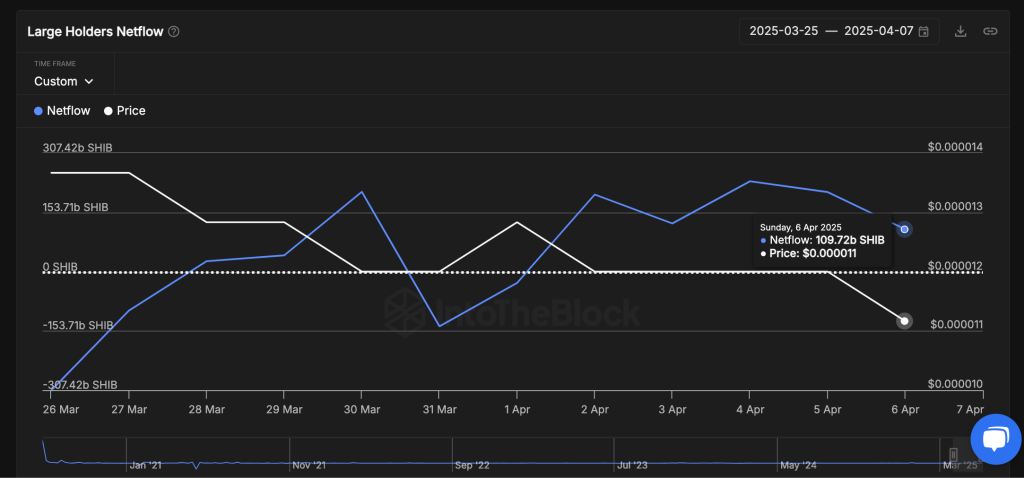
Recent data from IntoTheBlock indicated that SHIB whales just bought 874 billion tokens from April 2 to April 6 as the meme coin was dropping near a critical support area.
At a point when market sentiment is heavily depressed, this kind of move by “smart money” typically indicates that they expect the price to hit bottom in the near term.
Shiba Inu has gone down by 3.2% in the past 24 hours and has accumulated a 12% loss in the past week as President Donald Trump’s tariffs on key commercial allies spooked investors.
Market participants fear that this policy could result in higher inflation in the U.S. and could deter the Federal Reserve from making its planned interest rate cuts for the year.
Trading volumes have subsided a bit in the past 24 hours but market volatility is still quite high at a point when tariffs are already being enforced by customs officials in the U.S.
SHIB Could Drop by 20% if Bulls Fail to Recapture This Key Level
SHIB has been one of the most resilient meme coins this year as it has booked milder losses compared to other meme coins like Dogecoin (DOGE) and Pepe (PEPE).

Moving to the daily chart, we can see how SHIB broke below a key support at $0.0001082 yesterday and it is currently retesting that threshold during the Asian session this morning.
This bearish breakout results in a downside risk of nearly 21% for SHIB as the nearest support currently sits at $0.00000848.
A drop to this area would push SHIB to a yearly low and to its lowest level since January 2024, meaning that the token would have erased all of the gains it has seen in the past 2 years.
Momentum indicators are favoring a bearish short-term outlook as the Relative Strength Index (RSI) currently stands at 21% distance from the signal line, meaning that momentum has accelerated.
Moreover, the MACD’s histogram has posted four consecutive higher dark red bars, which also means that negative momentum has gained traction.
As whales take center stage during the sell-off, the best crypto presales of the year, like BTC Bull Token, are also attracting “smart money” as they offer significant upside to early buyers.
BTC Bull Token (BTCBULL) Gives Bitcoin Investors the Chance to Earn Passive Income
BTC Bull Token (BTCBULL) has introduced an innovative milestone-based rewards system that allows Bitcoin investors to earn money as the price recovers and makes new all-time highs this year.
Market conditions have not deterred investors from pouring money into this promising crypto presale. In less than three months, BTCBULL has raised $4.5 million.
The compensation mechanism is quite simple. Starting at $100,000, for every $25,000 that BTC adds to its price, a portion of BTCBULL’s circulating supply will be burned to foster scarcity, which should result in higher prices in the near term.
Meanwhile, for every $50,000 that BTC climbs above this level, BTCBULL holders will receive a direct airdrop.
To buy BTCBULL and earn passive income as Bitcoin recovers, head to the BTC Bull Token website and connect your wallet (e.g. Best Wallet ).
You can either swap USDT or ETH for this token or use a bank card to make your investment.
1
1
Disclaimer: The content of this article solely reflects the author's opinion and does not represent the platform in any capacity. This article is not intended to serve as a reference for making investment decisions.
Understand the market, then trade.
Bitget offers one-stop trading for cryptocurrencies, stocks, and gold.
Trade now!
You may also like
Review Article - ROI - For Trump's Treasury, the "tail" of the auction is the toughest part: McKeever
Repeated, no changes to the main text. By Jamie McGeever Reuters, Orlando, Florida, October 6 - U.S. Treasury auctions are supposed to be dull, predictable, and lacking in news value. But these are unusual times, and the Trump administration now faces the risk of weak government bond sales making headlines. The U.S. Treasury plans to issue nearly $120 billion in bonds this week—the first auction of bonds other than short-term Treasury bills in two weeks: $58 billion in three-year notes on Tuesday, $39 billion in ten-year notes on Wednesday, and $22 billion in thirty-year bonds on Thursday. These auctions would ordinarily be inconsequential, but they're attracting increased attention due to the exceptionally weak auction results from September 22–24—particularly the five-year Treasury auction on September 23, which led to the largest jump in yields since April of last year. Since then, yields have not fallen back, and instead, have surged to multi-decade highs across most maturities. It's important to note that the possibility of a "failed" U.S. Treasury auction is nearly zero. The primary dealers—26 banks and institutions currently authorized by the New York Fed to act as Treasury market makers on Wall Street—are always involved. They essentially underwrite the sales, ensuring the smooth operation of the $30 trillion U.S. Treasury market, which is the most liquid in the world. This, in turn, keeps the entire global financial system running. Trillions of dollars of global debt, assets, and market derivatives are benchmarked off U.S. Treasuries. U.S. Treasuries also serve as collateral to "lubricate" the pipes of the U.S. and global financial systems—in repos, interbank lending, and financing. In short, as long as U.S. Treasuries remain the backbone of the global financial system, there will always be buyers in Treasury auctions. The perpetual question is the price at which these bonds ultimately clear. With borrowing costs in the secondary market now at their highest since the mid-2000s, it's reasonable to expect the Treasury will pay correspondingly high rates in the primary market. But as recent auction rounds have shown, there remains potential for negative surprises. “Too big for the market to digest?” The $70 billion five-year auction on September 23 was among the most concerning in recent years. Demand—as measured by bid-to-cover ratio—was the lowest in nine years. The Treasury sold these notes at a yield of 5.033%, more than 3 basis points above the market yield at the auction deadline. Three basis points might not sound like much, but for a five-year Treasury auction, that's highly unusual. This was the largest so-called "tail" since June 2022. JP Morgan analysts pointed out that the last time the five-year auction saw a three-basis-point tail was back in 2011—when the brewing debt ceiling crisis ultimately led to the U.S. credit rating being downgraded that August. Back to today, concerns over the U.S.'s bleak fiscal outlook have pushed up long-term borrowing costs. Consequently, markets widely expect the Trump administration to gradually shift the Treasury's massive funding needs toward the lower-cost, shorter end of the yield curve. That explains why the five-year auction two weeks ago caused such a stir. A three-basis-point tail is common in long-bond auctions, but rare for securities in the so-called "belly" of the curve. If the Treasury is forced to pay a higher premium to move these bonds, then Houston, we have a problem. Large auction tails can be caused by numerous factors, such as market volatility on the day of the auction or, more worryingly, underlying fundamental issues that could erode demand over time. It's usually difficult to distinguish between these dynamics, as they're not mutually exclusive. On the brighter side, this unease hasn't yet spread to the short end of the curve. At least, not for now. Three- and ten-year Treasury yields have risen by about 50 basis points from the last auction a month ago, hovering around 4.96% and 5.32% respectively. The 30-year yield is up about 35 basis points, to 5.65%. That should be high enough to attract strong demand and ensure smooth sales, right? Probably. But if we get a surprise, volatility and uncertainty could ripple across the entire market. Investors will be… watching developments like hawks. (The views expressed herein are those of the author, a Reuters columnist.) Enjoyed this column? Visit Reuters Open Interest, your essential new source for global financial commentary. Follow ROI on LinkedIn and X. You can also listen to the daily "Morning Bid" podcast on Apple, Spotify, or the Reuters app. Subscribe for seven-day-a-week in-depth analysis of market and financial news by Reuters journalists. US 5-year auction has biggest 'tail' since 2022 https://fingfx.thomsonreuters.com/gfx/mkt/dwpkmkzogpm/TAIL.png (For reader convenience, Reuters automatically translates its reports into several other languages. Automate
路透社•2026/10/06 23:41
Will cancelling 20-year U.S. Treasury bonds backfire? BNP Paribas warns it could worsen market sell-off; maintains prediction of 30-year yield rising to 5.8%
BNP Paribas warns that U.S. Treasury Secretary Janet Yellen should resist calls to cancel the issuance of 20-year U.S. Treasury bonds, as this measure, seemingly aimed at lowering long-term financing costs, could have the opposite effect. Not only would it be difficult to continuously suppress Treasury yields, but it could also raise borrowing costs and weaken market liquidity.
智通财经•2026/10/06 23:21
Uncertainty Remains Over Fed Rate Hike Outlook; Daly Focuses on Inflation Shock Persistence, Bowman Advances Bank Regulatory Reforms
The Federal Reserve is simultaneously advancing significant adjustments in both monetary policy and banking supervision.
智通财经•2026/10/06 23:16

Overnight US Stocks | S&P 500 and Nasdaq Reach All-Time Highs, Storage Concept Stocks Plunge, SK Hynix (SKHY.US) Drops Over 6%
At the close, the Dow Jones Index rose by 253.32 points, or 0.49%, to 51,521.22 points; the S&P 500 Index increased by 45.03 points, or 0.58%, to 7,818.98 points; and the Nasdaq Composite Index gained 122.48 points, or 0.45%, to 27,599.79 points.
智通财经•2026/10/06 23:16
Crypto prices
More
Bitcoin
BTC
$85,437.27
-0.56%

Ethereum
ETH
$2,696.82
-0.70%

Tether USDt
USDT
$0.9998
-0.01%

BNB
BNB
$779.37
-1.13%

XRP
XRP
$1.5
-0.71%

USDC
USDC
$0.9998
-0.01%

Solana
SOL
$120.63
-0.16%

TRON
TRX
$0.3357
-0.18%

Zcash
ZEC
$1,369.07
+2.39%

Hyperliquid
HYPE
$91.91
-2.37%
How to buy BTC
Bitget lists BTC – Buy or sell BTC quickly on Bitget!
Trade now
Become a trader now?A welcome pack worth 6200 USDT for new users!
Sign up now