Bitget App
Trade smarter
Buy cryptoMarketsTradeFuturesStocksEarnInstitutionAI & More
Uniswap Faces Resistance at $5.5: Cautious Outlook for Potential Breakout Remains

Uniswap Faces Resistance at $5.5: Cautious Outlook for Potential Breakout Remains

CoinotagCoinotag2025/04/09 16:00
By:Crypto Vira
  • Uniswap’s recent performance has raised caution among traders, as resistance at the $5.5 mark remains unbroken, implying bearish sentiment ahead.

  • The broader market witnessed a momentary relief rally, yet Uniswap’s short-term bounce may not indicate a sustainable turnaround.

  • “The sell-off in the U.S. Treasury market appears to have provided a temporary boost across crypto assets, but Uniswap must clear hurdles to signal genuine recovery,” a COINOTAG analyst noted.

Uniswap struggles against resistance at $5.5, with recent market relief providing a momentary bounce; traders should brace for potential bearish trends ahead.

Market Overview: Uniswap’s Bobbles Among Bullish Waves

Following a minor relief rally in the larger crypto market, Uniswap has shown mixed signals, with its price recently stabilizing around the critical $5.5 resistance level. Investors should approach with caution as the trading activity suggests uncertainty about a significant trend reversal.

Technical Analysis: Uniswap’s Struggle at Key Resistance

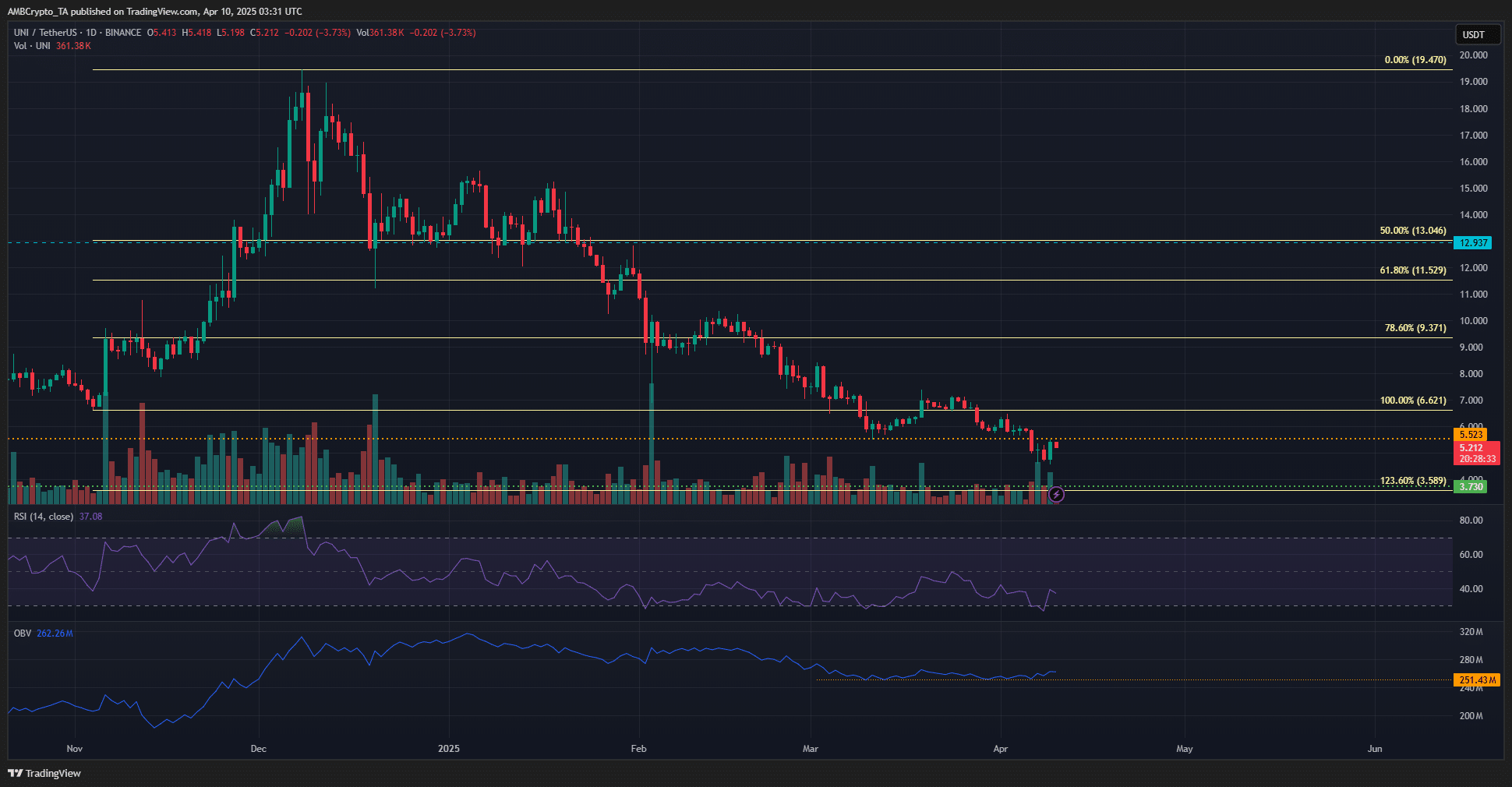
Over the past 24 hours, Uniswap’s price witnessed a commendable bounce from $4.55 to $5.5, marking a substantial 20% increase. This phase of retracement represents a retest of the former support zone, now acting as resistance. Current trading signals indicate that Uniswap bulls have yet to make a decisive breakout past this level, highlighting the ongoing bearish sentiment in the market.
Uniswap Faces Resistance at $5.5: Cautious Outlook for Potential Breakout Remains image 0

Source: UNI/USDT on TradingView

The daily Relative Strength Index (RSI), which has remained below the neutral 50 threshold since January, and the pattern of lower lows and lower highs point towards a persistent downtrend with no immediate indications of a turnaround.

Future Outlook: Key Support Level and Market Sentiment

The ongoing resistance at $5.5 still looms largely, leaving the door open for potential declines towards the $3.7 support level before any recovery takes shape. Although a recent surge in Bitcoin’s price above $80k has provided some hope, market participants should not consider it a definitive turning point as the overall bearish trend is persisting.
Uniswap Faces Resistance at $5.5: Cautious Outlook for Potential Breakout Remains image 1

Source: UNI/USDT on TradingView

Short-Term Trading Strategy

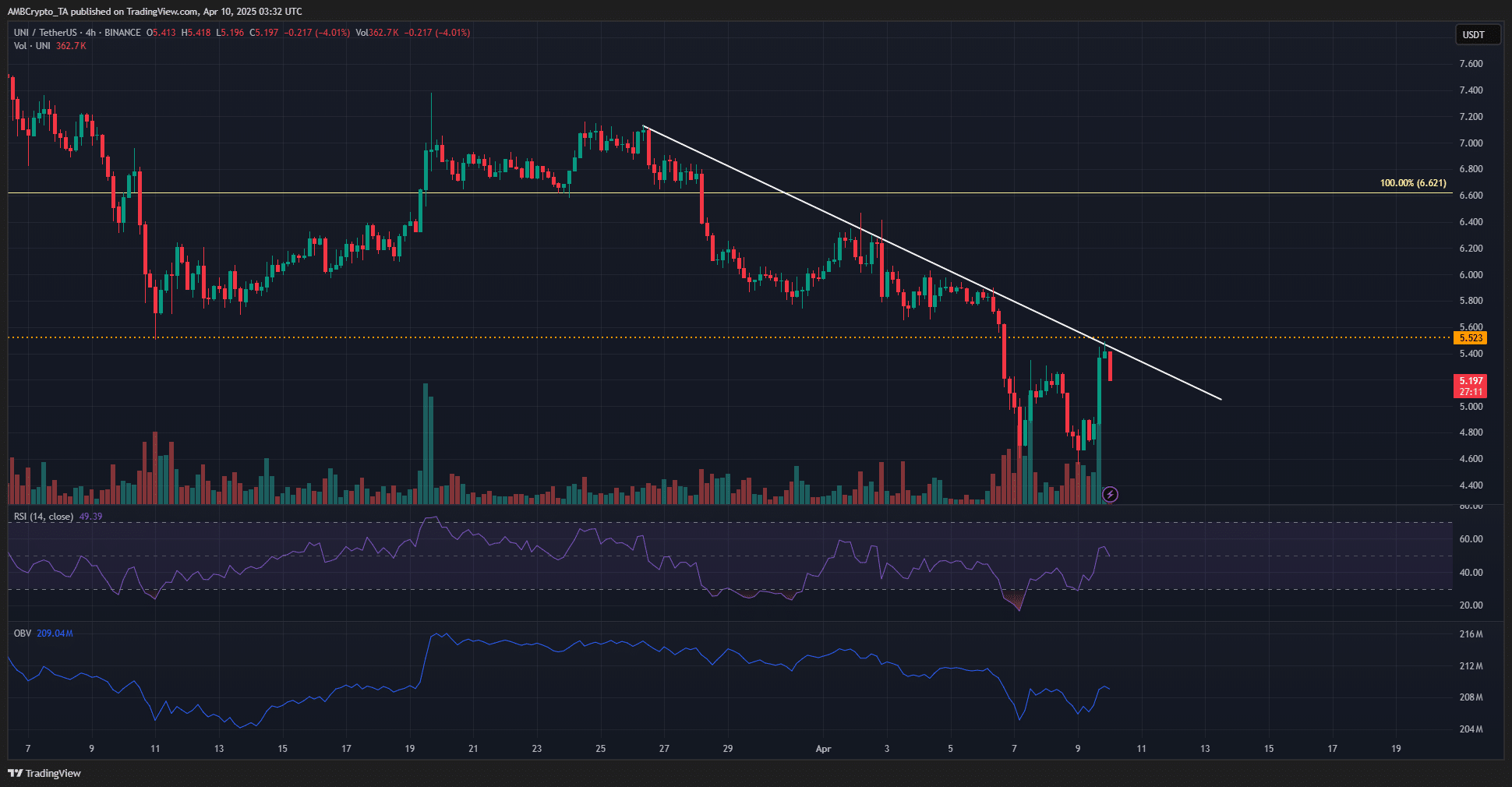
Traders observing the 4-hour chart noted that Uniswap’s recent price action has been confined within a descending trendline. Despite a minor bounce, the inability to breach this trendline signals an ongoing bearish sentiment. The fact that the OBV shows a slight uptick could represent a glimmer of hope for bulls; however, until a breakout establishes itself above $5.5, caution is advisable.

Monitoring the $4.6 support level will be essential; a decline below this point may compel traders to adopt a more aggressively bearish stance, potentially shorting the asset on further declines.

Conclusion

In summary, while recent market movements may suggest temporary optimism, Uniswap’s prospects largely hinge on overcoming the significant resistance at $5.5. In the absence of such a breakthrough, traders should prepare for potential downward pressures and adjust their trading strategies accordingly.

In Case You Missed It: Bitcoin Price Outlook: Potential Local Bottom Above $70K Amid Possible Mid-Bull Correction
0
0

Disclaimer: The content of this article solely reflects the author's opinion and does not represent the platform in any capacity. This article is not intended to serve as a reference for making investment decisions.

Understand the market, then trade.
Bitget offers one-stop trading for cryptocurrencies, stocks, and gold.
Trade now!

You may also like

Apple (AAPL.US) Teams Up with LG to Enter Smart Home Market: Accessories such as doorbells, thermostats, and cameras to feature LG branding

According to sources, Apple is set to expand its smart home device lineup, including doorbells, thermostats, and other accessories. These products will be developed through an unusual partnership between Apple and LG Electronics.

智通财经•2026/10/06 23:52

Review Article - ROI - For Trump's Treasury, the "tail" of the auction is the toughest part: McKeever

Repeated, no changes to the main text. By Jamie McGeever Reuters, Orlando, Florida, October 6 - U.S. Treasury auctions are supposed to be dull, predictable, and lacking in news value. But these are unusual times, and the Trump administration now faces the risk of weak government bond sales making headlines. The U.S. Treasury plans to issue nearly $120 billion in bonds this week—the first auction of bonds other than short-term Treasury bills in two weeks: $58 billion in three-year notes on Tuesday, $39 billion in ten-year notes on Wednesday, and $22 billion in thirty-year bonds on Thursday. These auctions would ordinarily be inconsequential, but they're attracting increased attention due to the exceptionally weak auction results from September 22–24—particularly the five-year Treasury auction on September 23, which led to the largest jump in yields since April of last year. Since then, yields have not fallen back, and instead, have surged to multi-decade highs across most maturities. It's important to note that the possibility of a "failed" U.S. Treasury auction is nearly zero. The primary dealers—26 banks and institutions currently authorized by the New York Fed to act as Treasury market makers on Wall Street—are always involved. They essentially underwrite the sales, ensuring the smooth operation of the $30 trillion U.S. Treasury market, which is the most liquid in the world. This, in turn, keeps the entire global financial system running. Trillions of dollars of global debt, assets, and market derivatives are benchmarked off U.S. Treasuries. U.S. Treasuries also serve as collateral to "lubricate" the pipes of the U.S. and global financial systems—in repos, interbank lending, and financing. In short, as long as U.S. Treasuries remain the backbone of the global financial system, there will always be buyers in Treasury auctions. The perpetual question is the price at which these bonds ultimately clear. With borrowing costs in the secondary market now at their highest since the mid-2000s, it's reasonable to expect the Treasury will pay correspondingly high rates in the primary market. But as recent auction rounds have shown, there remains potential for negative surprises. “Too big for the market to digest?” The $70 billion five-year auction on September 23 was among the most concerning in recent years. Demand—as measured by bid-to-cover ratio—was the lowest in nine years. The Treasury sold these notes at a yield of 5.033%, more than 3 basis points above the market yield at the auction deadline. Three basis points might not sound like much, but for a five-year Treasury auction, that's highly unusual. This was the largest so-called "tail" since June 2022. JP Morgan analysts pointed out that the last time the five-year auction saw a three-basis-point tail was back in 2011—when the brewing debt ceiling crisis ultimately led to the U.S. credit rating being downgraded that August. Back to today, concerns over the U.S.'s bleak fiscal outlook have pushed up long-term borrowing costs. Consequently, markets widely expect the Trump administration to gradually shift the Treasury's massive funding needs toward the lower-cost, shorter end of the yield curve. That explains why the five-year auction two weeks ago caused such a stir. A three-basis-point tail is common in long-bond auctions, but rare for securities in the so-called "belly" of the curve. If the Treasury is forced to pay a higher premium to move these bonds, then Houston, we have a problem. Large auction tails can be caused by numerous factors, such as market volatility on the day of the auction or, more worryingly, underlying fundamental issues that could erode demand over time. It's usually difficult to distinguish between these dynamics, as they're not mutually exclusive. On the brighter side, this unease hasn't yet spread to the short end of the curve. At least, not for now. Three- and ten-year Treasury yields have risen by about 50 basis points from the last auction a month ago, hovering around 4.96% and 5.32% respectively. The 30-year yield is up about 35 basis points, to 5.65%. That should be high enough to attract strong demand and ensure smooth sales, right? Probably. But if we get a surprise, volatility and uncertainty could ripple across the entire market. Investors will be… watching developments like hawks. (The views expressed herein are those of the author, a Reuters columnist.) Enjoyed this column? Visit Reuters Open Interest, your essential new source for global financial commentary. Follow ROI on LinkedIn and X. You can also listen to the daily "Morning Bid" podcast on Apple, Spotify, or the Reuters app. Subscribe for seven-day-a-week in-depth analysis of market and financial news by Reuters journalists. US 5-year auction has biggest 'tail' since 2022 https://fingfx.thomsonreuters.com/gfx/mkt/dwpkmkzogpm/TAIL.png (For reader convenience, Reuters automatically translates its reports into several other languages. Automate

路透社•2026/10/06 23:41

Will cancelling 20-year U.S. Treasury bonds backfire? BNP Paribas warns it could worsen market sell-off; maintains prediction of 30-year yield rising to 5.8%

BNP Paribas warns that U.S. Treasury Secretary Janet Yellen should resist calls to cancel the issuance of 20-year U.S. Treasury bonds, as this measure, seemingly aimed at lowering long-term financing costs, could have the opposite effect. Not only would it be difficult to continuously suppress Treasury yields, but it could also raise borrowing costs and weaken market liquidity.

智通财经•2026/10/06 23:21

Uncertainty Remains Over Fed Rate Hike Outlook; Daly Focuses on Inflation Shock Persistence, Bowman Advances Bank Regulatory Reforms

The Federal Reserve is simultaneously advancing significant adjustments in both monetary policy and banking supervision.

智通财经•2026/10/06 23:16
Uncertainty Remains Over Fed Rate Hike Outlook; Daly Focuses on Inflation Shock Persistence, Bowman Advances Bank Regulatory Reforms