
Deconstructing First Principles of Payments: How Can Stablecoins Unlock a Trillion-Dollar Opportunity?

The stablecoin supercycle is upon us.
Original Article Title: A First Principles Breakdown of the Crypto Payments Stack
Original Article Author: @proofofnathan
Original Article Translation: zhouzhou, BlockBeats
Editor's Note: This article explores the huge potential of stablecoins in the payment space, suggesting that stablecoins will surpass traditional payment systems due to being more efficient, faster, and cheaper. The article introduces the various layers of the crypto payments stack, from consumer wallets and payment providers to the financial integration layer, such as Banking as a Service and over-the-counter trading platforms. The application of stablecoins has not only boosted financial firms' profits but also improved user experience, driving the adoption of crypto payments. Ultimately, the core role of stablecoins in crypto payments will drive nearly all blockchains towards the payments space.
The following is the original content (slightly rephrased for better readability):
It's not just because stablecoins' supply has exceeded $230 billion, or that Circle has filed for an IPO, or that I often say, "It's already here."
It's because stablecoins are fundamentally disrupting the payments industry, and this disruption will continue at an exponential pace.
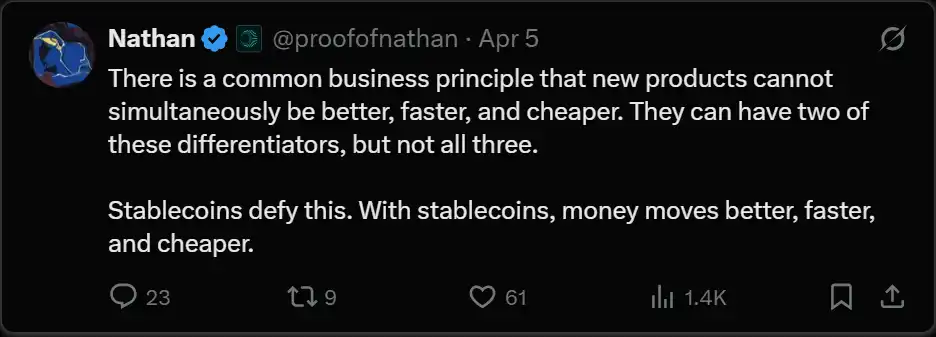
My core thesis is simple: Stablecoins will replace traditional payment methods because they are better, faster, and cheaper.
However, "payment" is a broad concept. Today's payment system is still dominated by traditional payment networks, banks, and fintech companies, each playing different roles in the payment structure of Web2.
While stablecoins offer a more efficient, highly available alternative, today's payment stack is gradually replicating the complexity of Web2 systems—this is why it is necessary for us to break it down.
Currently, hundreds of companies are building stablecoin-based payment networks or establishing complementary infrastructure alongside them.
@Dberenzon put together a fantastic chart that breaks down the on-chain payment ecosystem into nine different subdomains, and below is that chart.
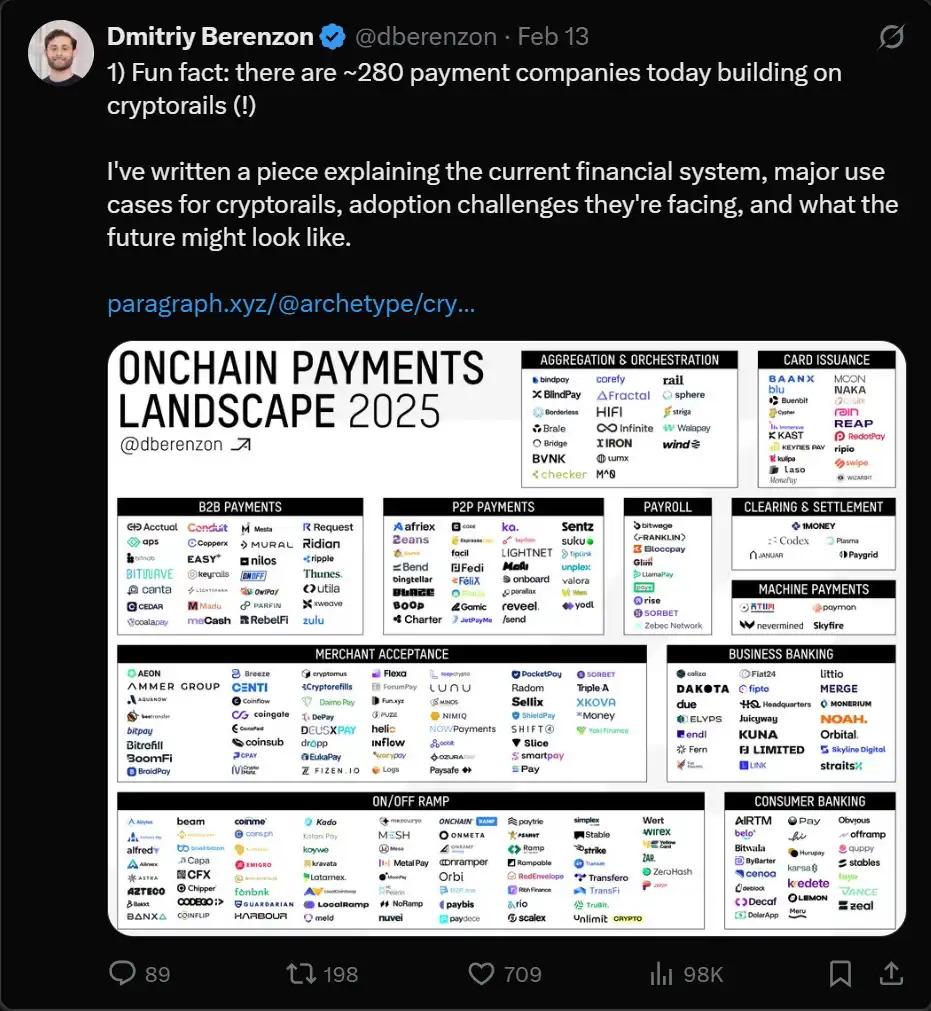
What Dmitriy provides is a deep and somewhat technical breakdown, while entities like Pantera in "The Trillion-Dollar Opportunity" take a more macro view, dividing the entire payment system into four layers.
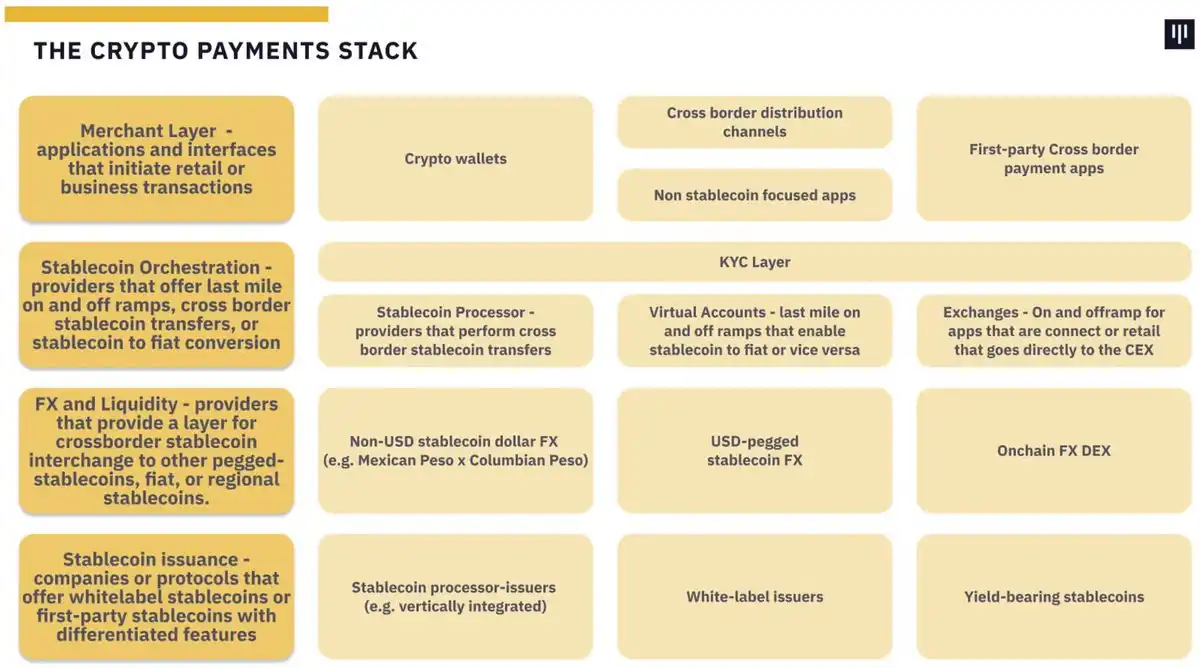
In this article, I attempt to reframe the payment stack in a crypto-native, first principles-based manner. Of course, the classification methods proposed by individuals such as Dmitriy and Pantera remain highly valuable, providing a good framework from another perspective.
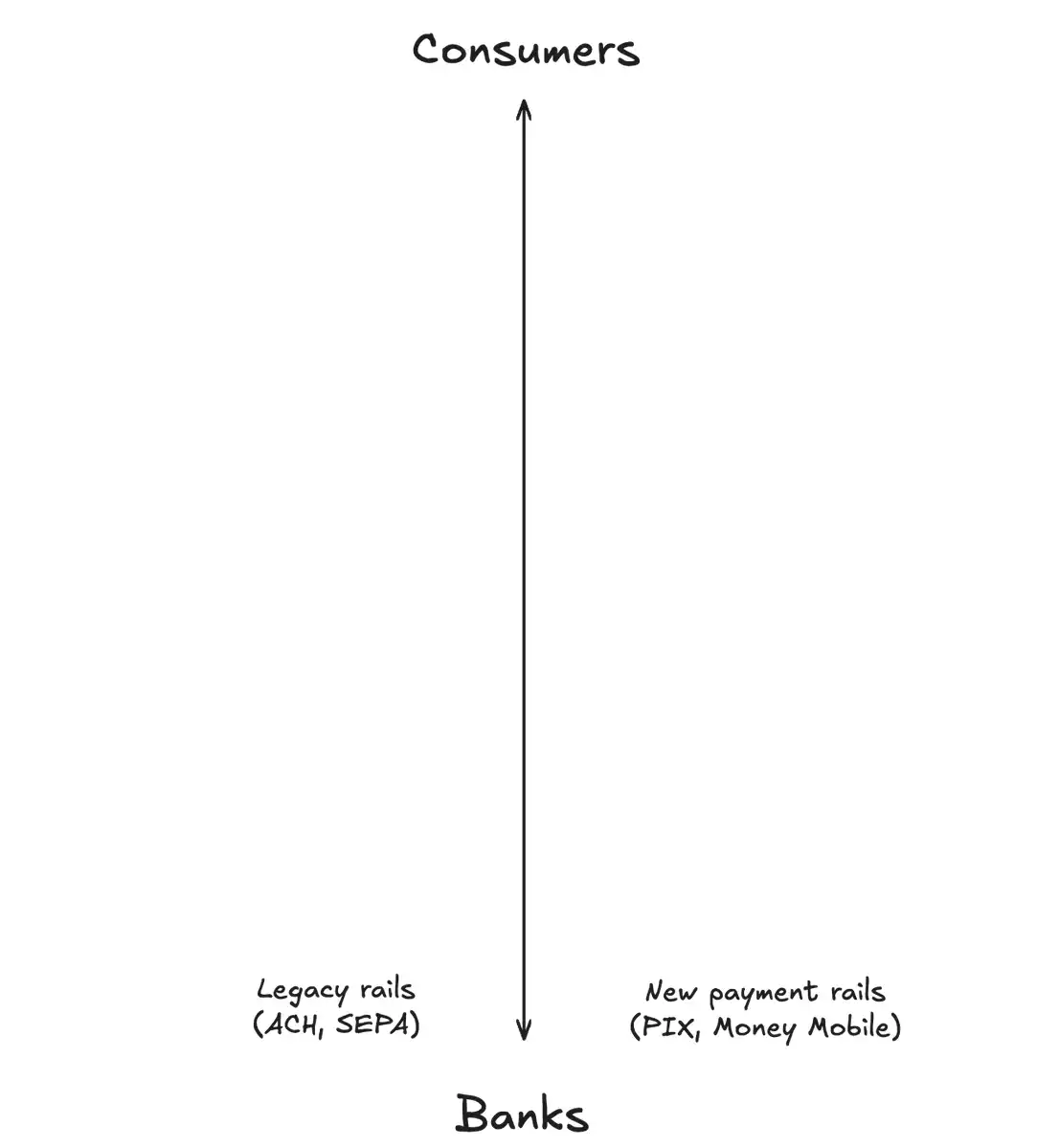
For a better understanding, I see the structure of the entire payment stack as a vertical path—where the top is one type of user and the bottom is another type of user. And I believe the ultimate achievement of the payment stack is to allow billions of users to seamlessly access the crypto system, even unknowingly.
Crypto Payments Stack
Starting from first principles, a stablecoin is a token on the blockchain that represents a fiat currency unit, with the most common being pegged to the US Dollar.
There are several types of stablecoins, including:
· Fiat-backed, such as USDT
· Crypto-backed, such as DAI
· Synthetic, such as USDe
The most dominant type is fiat-backed stablecoins. These stablecoins are backed by highly liquid assets such as US Treasuries, cash, and equivalents, held in reserves by custodians at a 1:1 ratio. Therefore, at the bottom layer of the payment stack, traditional banks and payment systems still exist.
As mentioned earlier, stablecoins are disrupting the traditional payment system because they are better, faster, and cheaper. This has not only increased the profit margins of fintech and payment companies but has also provided end-users with a better experience. Therefore, from a user perspective, consumers are at the topmost layer of the payment stack.
In conclusion, the current payment stack can be roughly understood as follows:
(An illustrative diagram will be shown here)
Now, let's look at the most core use case in the payment stack. We have seen that one of the highest user retention use cases in the crypto industry is actually the "off-ramp"—converting cryptocurrency to fiat currency.
While the concept of an "on-ramp" (converting fiat into crypto) is also common, the predominant need has always been the ability to easily spend crypto assets, especially stablecoins.
In the payment stack we are building, on/off-ramp service providers sit right in the middle.
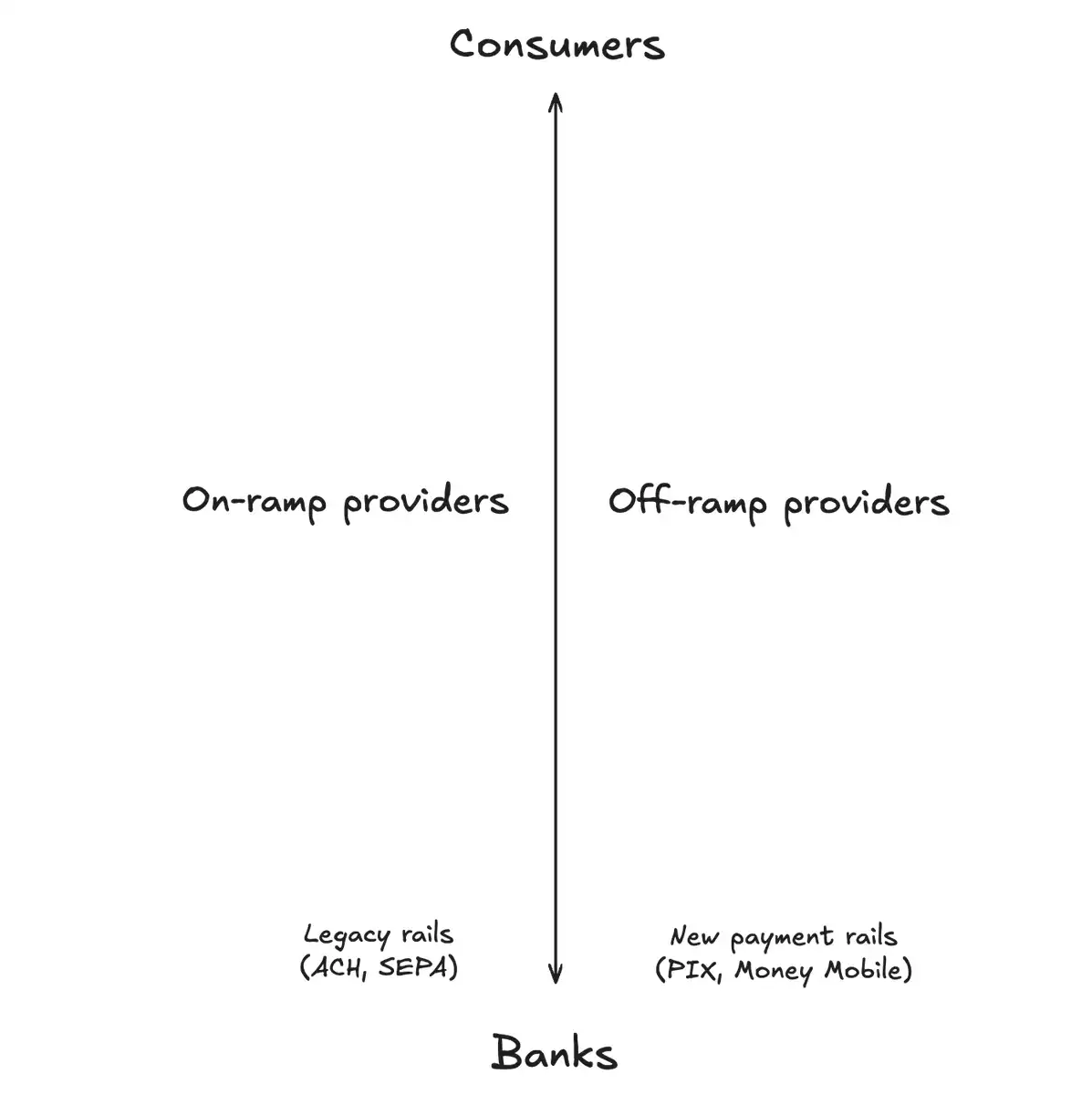
Above the on/off-ramp service providers is a section primarily focused on consumers or tools that support consumer usage, which I refer to as the **"Consumer Serving Layers".
Below them — from on/off-ramp to traditional banks — lies the part that integrates stablecoins into the traditional financial system, which I call the "Financial Integration Layers".
It is worth noting that the number of layers in the Consumer Serving Layers is much greater than in the Financial Integration Layers.
The reason is simple: building a Financial Integration Layer often requires licensing, compliance processes, and highly structured operations. Consumer Serving Layers can directly leverage the services and contractual relationships established in the lower layers to rapidly build on top of them.
Of course, there may be other modules in the Consumer Serving Layers, but here I have only selected the key parts in the entire payment stack that have clear functionality, well-defined dependencies, and a crucial role to explain.
Consumer Serving Layers
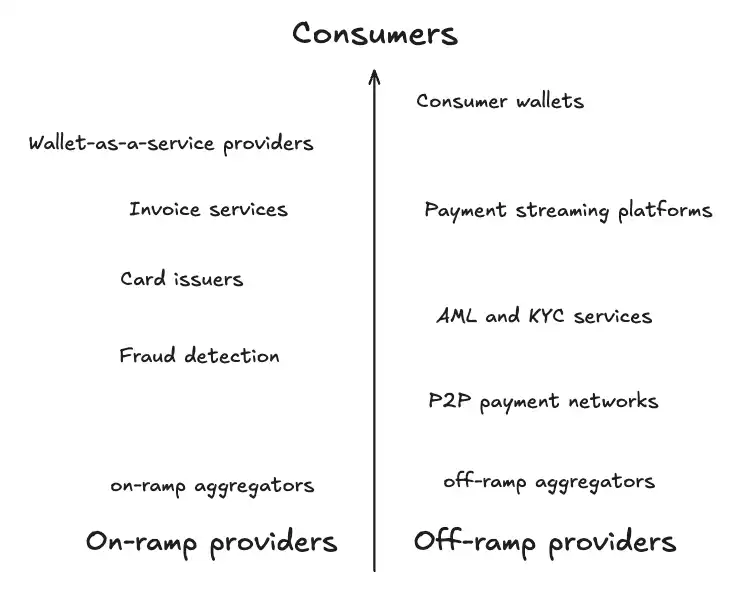
From the consumer's perspective, the first step into the crypto payment stack is a wallet.
A wallet is not just a tool for storing crypto assets; it is actually the gateway to the entire "save, spend, earn" experience.
Modern wallets usually have various functions, such as debit card payments, virtual bank accounts, peer-to-peer transfers, etc., designed to meet users' diverse scenario needs.
There are already a wide range of wallet products on the market, some targeting global users and others focusing on specific regional markets.
Building a wallet is actually very complex
It involves integrating multiple services and requires high-level security measures to prevent hacking attacks.
Therefore, many teams choose to rely on Wallet-as-a-Service (WaaS) providers. These WaaS solutions have been audited, battle-tested, and usually integrate infrastructure such as on/off-ramp services, issuer interfaces, and more.
In order to get consumer wallets truly "running," they also need to rely on various B2B stablecoin payment service providers, with key modules including:
· Invoice services: allow users to invoice their employer in crypto or fiat, with the platform receiving the payment, converting on demand, and then depositing into the user's wallet.
· Payment streaming: as companies globalize and employees are distributed worldwide, these platforms support regular stablecoin payroll, especially useful in countries where local bank access is not available.
· Card issuers: as user spending shifts from cash to electronic payments, encrypted cards become increasingly important. These issuing entities usually partner with Visa, Mastercard, enabling wallets to have the ability to "swipe card" for real-world transactions.
Compliance is also crucial, and to safeguard user funds, most platforms integrate comprehensive compliance tools at the wallet layer, including:
· KYC/AML (Know Your Customer/Anti-Money Laundering)
· On-chain fraud detection services
These compliance service providers play a significant role in the consumer service layer, both ensuring platform compliance and enhancing user trust.
Additionally, peer-to-peer payment networks are also part of the consumer layer. These networks bypass traditional payment pathways, directly connecting users and merchants for encrypted and fiat transaction exchanges.
P2P payments are widely adopted in some developing countries, but compared to the overall payment stack, they are less efficient with smaller transaction volumes, serving more as a complementary solution to traditional channels. Finally, the on/off-ramp aggregators sit at the bottom of the consumer service layer.
They consolidate multiple on/off-ramp services into a single unified API, allowing wallet developers to automatically choose solutions with faster speeds, lower fees, and better regional coverage, enhancing user experience.
Financial Integration Layers
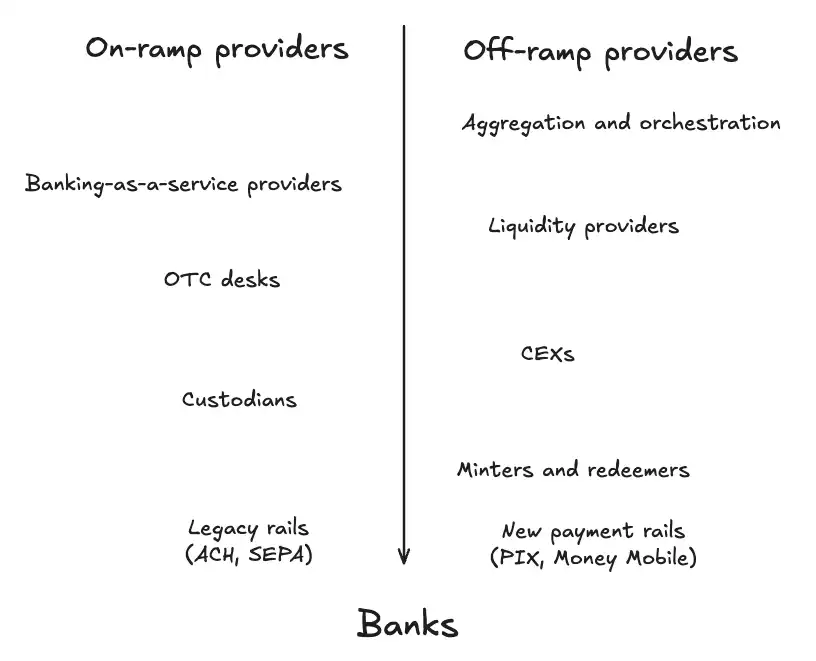
Transitioning to Financial Integration Layers brings us to the "backbone" of the entire crypto payment stack.
In the traditional payment stack, the part we are about to discuss is usually referred to as the Aggregation & Orchestration Layer. However, I believe that the reason it can "aggregate" and "orchestrate" is because it sits on top of a robust and intricate infrastructure. Therefore, this layer should be placed at the very top of the financial integration layer.
Below the Aggregation & Orchestration Layer lies the core support for the entire fund flow, with the following three layers being key foundational modules that are frequently aggregated and orchestrated:
1. Banking-as-a-Service (BaaS) Providers
These platforms offer modular financial infrastructure that allows companies to integrate services such as virtual bank accounts, card issuance, payment channels, and more.
They typically assist clients in completing compliance, back-office settlement, and other processes, enabling businesses to provide quasi-banking services in their products without holding a financial license themselves.
2. Over-the-Counter (OTC) Trading Platforms
OTC platforms specialize in handling large-volume transactions, serving as a bridge for companies that cannot directly interface with major exchanges or liquidity providers.
They can swiftly and efficiently facilitate bi-directional exchanges between stablecoins and fiat currencies, greatly simplifying the settlement process for large trades.
3. Liquidity Providers
Working closely with OTC platforms, they ensure sufficient fund availability and timely settlement for transactions globally. These institutions shield the complexity of fund movement between crypto and fiat currencies, allowing various applications to execute coin swaps, payments, and other operations through simple API calls.
Many companies are unwilling to self-custody millions of dollars' worth of stablecoins or other crypto assets. Therefore, custody service providers have become an indispensable foundational component. They offer regulated, insured, institutional-grade secure custody solutions, serving as the trust anchor for almost all crypto payment applications.
In the payment stack, Centralized Exchanges (CEXs) play a critical role, especially in the financial integration stage. They facilitate large-scale fiat-to-stablecoin settlements through liquidity provider integrations and mint/redeem services. These exchanges typically hold a portion of stablecoins and cash reserves to ensure smooth fund transfers for both parties.
At the bottom layer are the Mint & Redeem services, which form the foundation of the entire payment stack. Stablecoins exist because someone "mints" them, and others "redeem" them.
· Tether (USDT) operates its minting and redemption mechanism based on whitelisted partners who directly receive user bank transfers and exchange them for an equivalent amount of USDT.
·Circle (USDC) provides minting and redemption services through Circle Mint for companies that have completed KYB (Know Your Business) verification.
Final Summary: A Comprehensive Payment Stack Overview
The payment stack is dynamic and highly interconnected. Each layer relies on the tools, services, and providers behind it. Overall, the cryptocurrency payment stack looks like this:
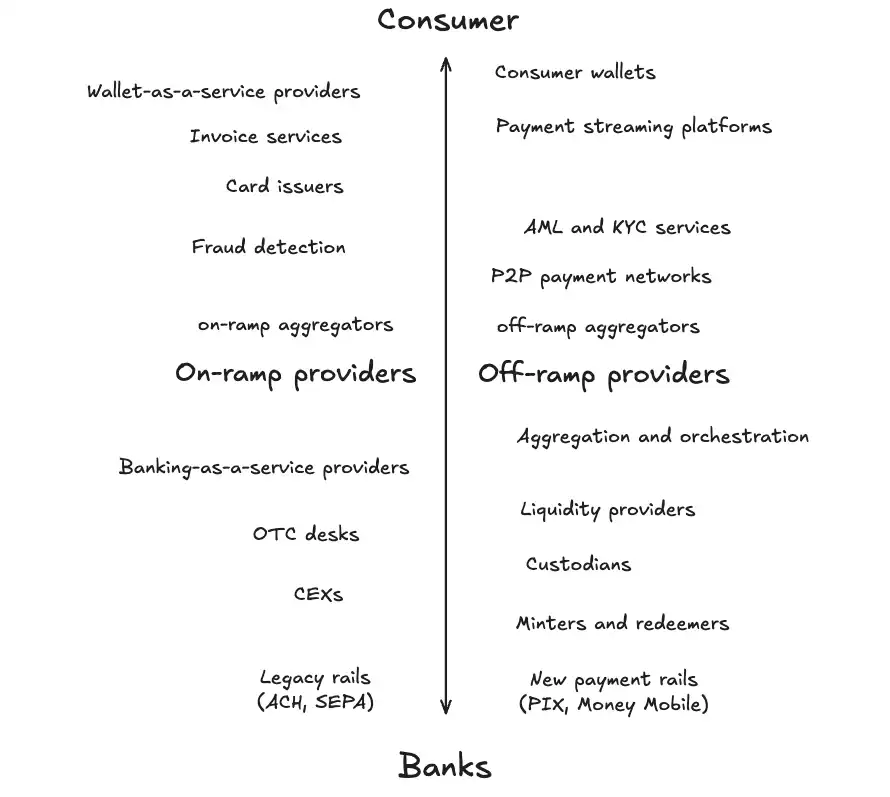
Stablecoin-driven payments represent one of the most influential and easily adoptable real-world use cases for cryptocurrencies beyond Bitcoin as a store of value. @PlasmaFDN is a blockchain designed specifically for stablecoin payments and is well-positioned in this area. However, I expect that almost all blockchains will eventually pivot towards stablecoins and the payments space.
To achieve this goal, they must rethink their payment stack—simply being EVM-compatible is no longer sufficient.
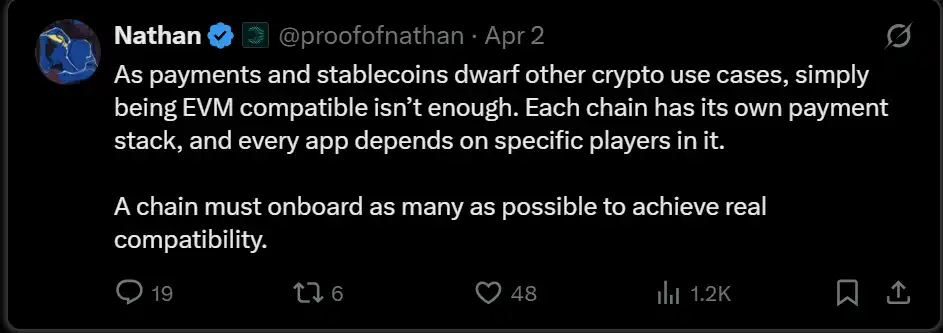
In summary, stablecoins indeed present a trillion-dollar opportunity, and those who play key roles in the payment stack will reap the greatest rewards.

Source: Original Article Link
Disclaimer: The content of this article solely reflects the author's opinion and does not represent the platform in any capacity. This article is not intended to serve as a reference for making investment decisions.
You may also like
Nvidia’s Record Run Signals Another AI Wave: 5 Cryptos Worth Buying Before the Breakout
Apple (AAPL.US) Teams Up with LG to Enter Smart Home Market: Accessories such as doorbells, thermostats, and cameras to feature LG branding
According to sources, Apple is set to expand its smart home device lineup, including doorbells, thermostats, and other accessories. These products will be developed through an unusual partnership between Apple and LG Electronics.
Review Article - ROI - For Trump's Treasury, the "tail" of the auction is the toughest part: McKeever
Repeated, no changes to the main text. By Jamie McGeever Reuters, Orlando, Florida, October 6 - U.S. Treasury auctions are supposed to be dull, predictable, and lacking in news value. But these are unusual times, and the Trump administration now faces the risk of weak government bond sales making headlines. The U.S. Treasury plans to issue nearly $120 billion in bonds this week—the first auction of bonds other than short-term Treasury bills in two weeks: $58 billion in three-year notes on Tuesday, $39 billion in ten-year notes on Wednesday, and $22 billion in thirty-year bonds on Thursday. These auctions would ordinarily be inconsequential, but they're attracting increased attention due to the exceptionally weak auction results from September 22–24—particularly the five-year Treasury auction on September 23, which led to the largest jump in yields since April of last year. Since then, yields have not fallen back, and instead, have surged to multi-decade highs across most maturities. It's important to note that the possibility of a "failed" U.S. Treasury auction is nearly zero. The primary dealers—26 banks and institutions currently authorized by the New York Fed to act as Treasury market makers on Wall Street—are always involved. They essentially underwrite the sales, ensuring the smooth operation of the $30 trillion U.S. Treasury market, which is the most liquid in the world. This, in turn, keeps the entire global financial system running. Trillions of dollars of global debt, assets, and market derivatives are benchmarked off U.S. Treasuries. U.S. Treasuries also serve as collateral to "lubricate" the pipes of the U.S. and global financial systems—in repos, interbank lending, and financing. In short, as long as U.S. Treasuries remain the backbone of the global financial system, there will always be buyers in Treasury auctions. The perpetual question is the price at which these bonds ultimately clear. With borrowing costs in the secondary market now at their highest since the mid-2000s, it's reasonable to expect the Treasury will pay correspondingly high rates in the primary market. But as recent auction rounds have shown, there remains potential for negative surprises. “Too big for the market to digest?” The $70 billion five-year auction on September 23 was among the most concerning in recent years. Demand—as measured by bid-to-cover ratio—was the lowest in nine years. The Treasury sold these notes at a yield of 5.033%, more than 3 basis points above the market yield at the auction deadline. Three basis points might not sound like much, but for a five-year Treasury auction, that's highly unusual. This was the largest so-called "tail" since June 2022. JP Morgan analysts pointed out that the last time the five-year auction saw a three-basis-point tail was back in 2011—when the brewing debt ceiling crisis ultimately led to the U.S. credit rating being downgraded that August. Back to today, concerns over the U.S.'s bleak fiscal outlook have pushed up long-term borrowing costs. Consequently, markets widely expect the Trump administration to gradually shift the Treasury's massive funding needs toward the lower-cost, shorter end of the yield curve. That explains why the five-year auction two weeks ago caused such a stir. A three-basis-point tail is common in long-bond auctions, but rare for securities in the so-called "belly" of the curve. If the Treasury is forced to pay a higher premium to move these bonds, then Houston, we have a problem. Large auction tails can be caused by numerous factors, such as market volatility on the day of the auction or, more worryingly, underlying fundamental issues that could erode demand over time. It's usually difficult to distinguish between these dynamics, as they're not mutually exclusive. On the brighter side, this unease hasn't yet spread to the short end of the curve. At least, not for now. Three- and ten-year Treasury yields have risen by about 50 basis points from the last auction a month ago, hovering around 4.96% and 5.32% respectively. The 30-year yield is up about 35 basis points, to 5.65%. That should be high enough to attract strong demand and ensure smooth sales, right? Probably. But if we get a surprise, volatility and uncertainty could ripple across the entire market. Investors will be… watching developments like hawks. (The views expressed herein are those of the author, a Reuters columnist.) Enjoyed this column? Visit Reuters Open Interest, your essential new source for global financial commentary. Follow ROI on LinkedIn and X. You can also listen to the daily "Morning Bid" podcast on Apple, Spotify, or the Reuters app. Subscribe for seven-day-a-week in-depth analysis of market and financial news by Reuters journalists. US 5-year auction has biggest 'tail' since 2022 https://fingfx.thomsonreuters.com/gfx/mkt/dwpkmkzogpm/TAIL.png (For reader convenience, Reuters automatically translates its reports into several other languages. Automate
Will cancelling 20-year U.S. Treasury bonds backfire? BNP Paribas warns it could worsen market sell-off; maintains prediction of 30-year yield rising to 5.8%
BNP Paribas warns that U.S. Treasury Secretary Janet Yellen should resist calls to cancel the issuance of 20-year U.S. Treasury bonds, as this measure, seemingly aimed at lowering long-term financing costs, could have the opposite effect. Not only would it be difficult to continuously suppress Treasury yields, but it could also raise borrowing costs and weaken market liquidity.
Crypto prices
More


