
Dogecoin ETF Hype Builds as SEC Turns Pro-Crypto Under New Chair | US Crypto News

Dogecoin’s ETF ambitions gain traction under pro-crypto SEC leadership, while Fed policy and inflation concerns continue to sway sentiment.
Welcome to the US Crypto News Morning Briefing—your essential rundown of the most important developments in crypto for the day ahead.
Grab a coffee to see how Dogecoin’s ETF hopes are gaining traction under a new SEC chair, why the Fed’s rate pause is shaking up crypto sentiment, and what Buffett, CPI, and Bitcoin flows reveal about the market’s next move.
Spotlight on Dogecoin: ETF Momentum Builds Under New SEC Leadership
On Wednesday, 21Shares announced a partnership with the House of Doge, backed by an endorsement from the Dogecoin Foundation for a new Dogecoin ETP.
The move comes as the US Senate approved Paul Atkins as SEC Chair, and conversations around a potential spot Dogecoin ETF intensify.
“A spot Dogecoin ETF is not about fundamentals; it’s really about driving cultural momentum. It’s easy to laugh it off, but retail demand drives markets—and this product validates that. Whether you see it as a meme or a movement, packaging it in a regulated wrapper shows just how far crypto has come from the fringe of the zeitgeist to the front and center of the cultural stage.” – Mike Cahill, CEO at Douro Labs told BeInCrypto.
The focus is less on technical merit and more on meeting market interest where it already exists, according to Cahill:
“With Paul Atkins as SEC Chair, we’re going to see a major shift in the institutional and governmental tone towards crypto. He’s historically favored market access and lighter-touch regulation, which could open the door for more novel products like a spot Dogecoin ETF. But his role as SEC Chair is obviously about so much more than just Dogecoin—it would signal that the SEC is ready to treat digital assets like a mature asset class and a critical component of the US economy.”
Enmanuel Cardozo, Market Analyst at Brickken, discussed what this leadership change at the SEC could mean for the meme coin’s future in regulated markets.
“Paul Atkins has a pro-crypto background—he’s been in the space for many years and with Trump’s administration pushing a crypto-friendly vibe, the odds look more in favor in my opinion. I think Atkins could really open the door for something like this, especially since Bitcoin and Ethereum ETFs got the green light last year, setting a precedent.” – Cardozo told BeInCrypto.
Atkins brings a reputation for openness to innovation, especially in digital assets.
“The potential for a Dogecoin ETF definitely goes up with Atkins in charge, no question. He’s known for wanting clearer rules for crypto, which could make the SEC more open to approving something like this, especially with dozens of other crypto ETF proposals already on their desk.”
According to Cardozo, momentum is building, but it doesn’t guarantee approval.
“That said, it’s not a done deal—Dogecoin as all cryptocurrencies have a history of being very volatile, which might give regulators pause, and they’ll probably want to make sure it’s not too risky for investors.”
But even with optimism around regulatory progress, macroeconomic pressures continue to shape crypto’s near-term outlook. The odds of a Fed rate cut in May have plunged to just 15% following Trump’s 90-day tariff pause and hawkish FOMC minutes.
Policymakers cited persistent inflation risks—especially from tariffs on core goods—as a reason to keep rates steady.
The news has dampened hopes for near-term monetary easing, putting pressure on crypto markets through reduced liquidity expectations and a stronger dollar.
Crypto Chart of the Day
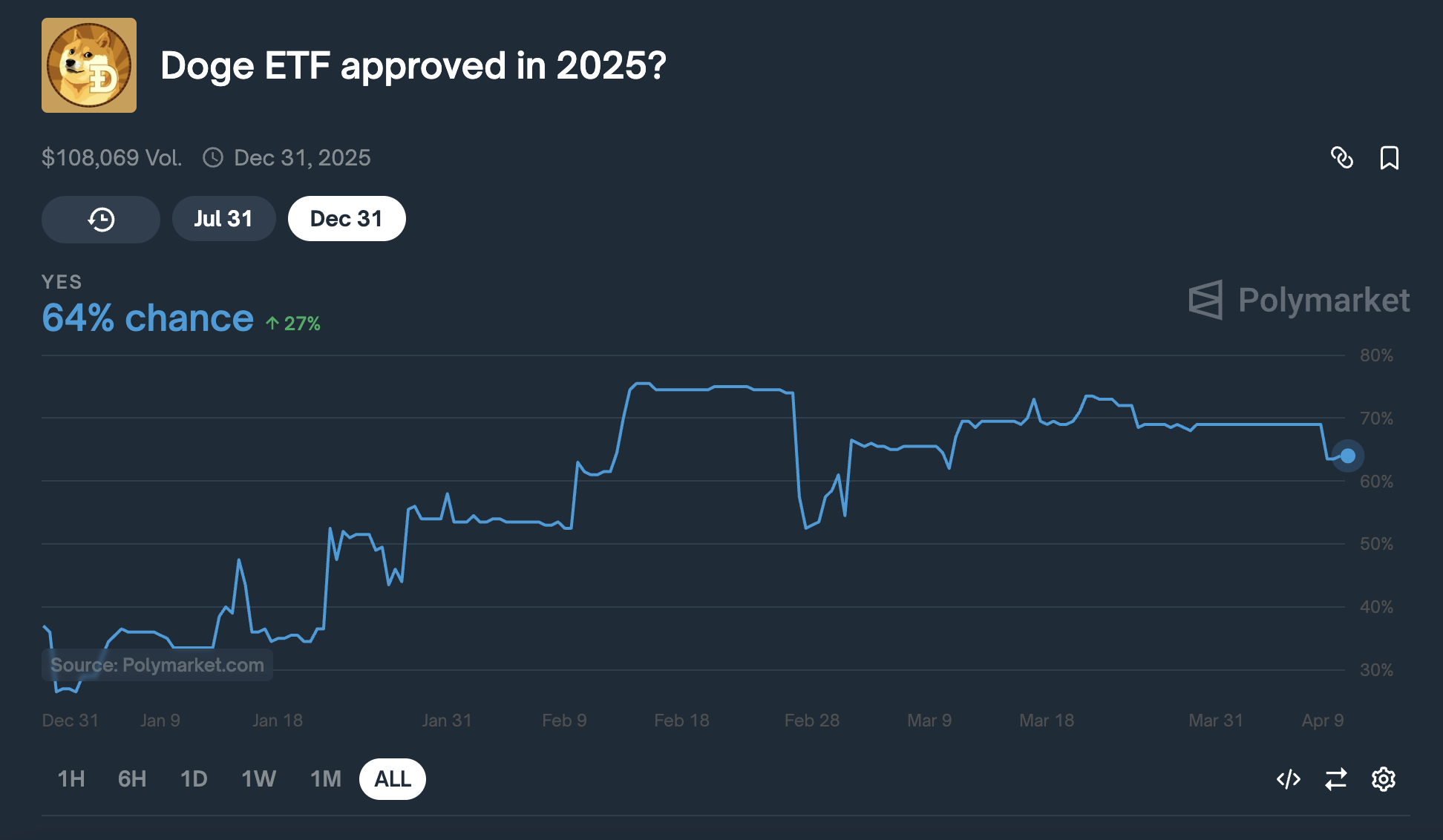 DOGE ETF Approval Odds. Source: Polymarket.
The odds of the DOGE ETF being approved in 2025 are currently at 64% on prediction markets.
Byte-Sized Alpha
– All eyes are on today’s CPI (Consumer Price Index) release, a key inflation gauge that could sway crypto markets depending on how consumer prices move.
– Warren Buffett’s Berkshire Hathaway is sitting on a record $334 billion in cash after dumping stocks ahead of the 2025 crash—still steering clear of Bitcoin despite mounting interest and ETF adoption.
– Trump’s tariff pause ignited a market rally and pushed Bitcoin back above $80,000, but experts caution it could be a ‘dead cat bounce’ before another downturn hits.
– Bitcoin spot ETFs just notched a five-day outflow streak totaling $127 million, hinting at fading investor confidence—even as futures data points to lingering bullish sentiment.
– Paul Atkins has been confirmed as SEC chair in a 52-44 Senate vote, signaling a continued rollback of crypto enforcement under the Trump administration.
– The SEC has greenlit options trading on BlackRock’s Ethereum ETF, boosting ETH’s legitimacy and liquidity—even as broader market attention stays locked on tariff drama.
Disclaimer: The content of this article solely reflects the author's opinion and does not represent the platform in any capacity. This article is not intended to serve as a reference for making investment decisions.
You may also like

Nvidia’s Record Run Signals Another AI Wave: 5 Cryptos Worth Buying Before the Breakout
Apple (AAPL.US) Teams Up with LG to Enter Smart Home Market: Accessories such as doorbells, thermostats, and cameras to feature LG branding
According to sources, Apple is set to expand its smart home device lineup, including doorbells, thermostats, and other accessories. These products will be developed through an unusual partnership between Apple and LG Electronics.
Review Article - ROI - For Trump's Treasury, the "tail" of the auction is the toughest part: McKeever
Repeated, no changes to the main text. By Jamie McGeever Reuters, Orlando, Florida, October 6 - U.S. Treasury auctions are supposed to be dull, predictable, and lacking in news value. But these are unusual times, and the Trump administration now faces the risk of weak government bond sales making headlines. The U.S. Treasury plans to issue nearly $120 billion in bonds this week—the first auction of bonds other than short-term Treasury bills in two weeks: $58 billion in three-year notes on Tuesday, $39 billion in ten-year notes on Wednesday, and $22 billion in thirty-year bonds on Thursday. These auctions would ordinarily be inconsequential, but they're attracting increased attention due to the exceptionally weak auction results from September 22–24—particularly the five-year Treasury auction on September 23, which led to the largest jump in yields since April of last year. Since then, yields have not fallen back, and instead, have surged to multi-decade highs across most maturities. It's important to note that the possibility of a "failed" U.S. Treasury auction is nearly zero. The primary dealers—26 banks and institutions currently authorized by the New York Fed to act as Treasury market makers on Wall Street—are always involved. They essentially underwrite the sales, ensuring the smooth operation of the $30 trillion U.S. Treasury market, which is the most liquid in the world. This, in turn, keeps the entire global financial system running. Trillions of dollars of global debt, assets, and market derivatives are benchmarked off U.S. Treasuries. U.S. Treasuries also serve as collateral to "lubricate" the pipes of the U.S. and global financial systems—in repos, interbank lending, and financing. In short, as long as U.S. Treasuries remain the backbone of the global financial system, there will always be buyers in Treasury auctions. The perpetual question is the price at which these bonds ultimately clear. With borrowing costs in the secondary market now at their highest since the mid-2000s, it's reasonable to expect the Treasury will pay correspondingly high rates in the primary market. But as recent auction rounds have shown, there remains potential for negative surprises. “Too big for the market to digest?” The $70 billion five-year auction on September 23 was among the most concerning in recent years. Demand—as measured by bid-to-cover ratio—was the lowest in nine years. The Treasury sold these notes at a yield of 5.033%, more than 3 basis points above the market yield at the auction deadline. Three basis points might not sound like much, but for a five-year Treasury auction, that's highly unusual. This was the largest so-called "tail" since June 2022. JP Morgan analysts pointed out that the last time the five-year auction saw a three-basis-point tail was back in 2011—when the brewing debt ceiling crisis ultimately led to the U.S. credit rating being downgraded that August. Back to today, concerns over the U.S.'s bleak fiscal outlook have pushed up long-term borrowing costs. Consequently, markets widely expect the Trump administration to gradually shift the Treasury's massive funding needs toward the lower-cost, shorter end of the yield curve. That explains why the five-year auction two weeks ago caused such a stir. A three-basis-point tail is common in long-bond auctions, but rare for securities in the so-called "belly" of the curve. If the Treasury is forced to pay a higher premium to move these bonds, then Houston, we have a problem. Large auction tails can be caused by numerous factors, such as market volatility on the day of the auction or, more worryingly, underlying fundamental issues that could erode demand over time. It's usually difficult to distinguish between these dynamics, as they're not mutually exclusive. On the brighter side, this unease hasn't yet spread to the short end of the curve. At least, not for now. Three- and ten-year Treasury yields have risen by about 50 basis points from the last auction a month ago, hovering around 4.96% and 5.32% respectively. The 30-year yield is up about 35 basis points, to 5.65%. That should be high enough to attract strong demand and ensure smooth sales, right? Probably. But if we get a surprise, volatility and uncertainty could ripple across the entire market. Investors will be… watching developments like hawks. (The views expressed herein are those of the author, a Reuters columnist.) Enjoyed this column? Visit Reuters Open Interest, your essential new source for global financial commentary. Follow ROI on LinkedIn and X. You can also listen to the daily "Morning Bid" podcast on Apple, Spotify, or the Reuters app. Subscribe for seven-day-a-week in-depth analysis of market and financial news by Reuters journalists. US 5-year auction has biggest 'tail' since 2022 https://fingfx.thomsonreuters.com/gfx/mkt/dwpkmkzogpm/TAIL.png (For reader convenience, Reuters automatically translates its reports into several other languages. Automate
Crypto prices
More


