
Spot Bitcoin ETFs Shed $127M Despite Market Rally

In an unexpected twist, U.S. spot Bitcoin exchange-traded funds (ETFs) witnessed net outflows totaling $127.12 million on Wednesday, despite a broad-based rally in both traditional finance (TradFi) and crypto markets. This is puzzling, considering such rallies are typically accompanied by bullish inflows into risk assets, including Bitcoin and crypto-related funds.
The outflows were led by BlackRock’s IBIT, which saw a significant $89.71 million exit, followed by Grayscale’s GBTC, shedding $33.8 million, according to SoSoValue data . Smaller issuers like VanEck and WisdomTree also reported negative flows. Surprisingly, Bitwise’s BITB stood out as the only fund reporting positive inflows of $6.71 million.
This marks the fifth consecutive day of negative flows for spot Bitcoin ETFs, raising critical questions about investor sentiment and the actual drivers of these funds in the current macro environment.
Is the Trump Tariff Pause Not Enough to Reignite Bitcoin ETF Demand?
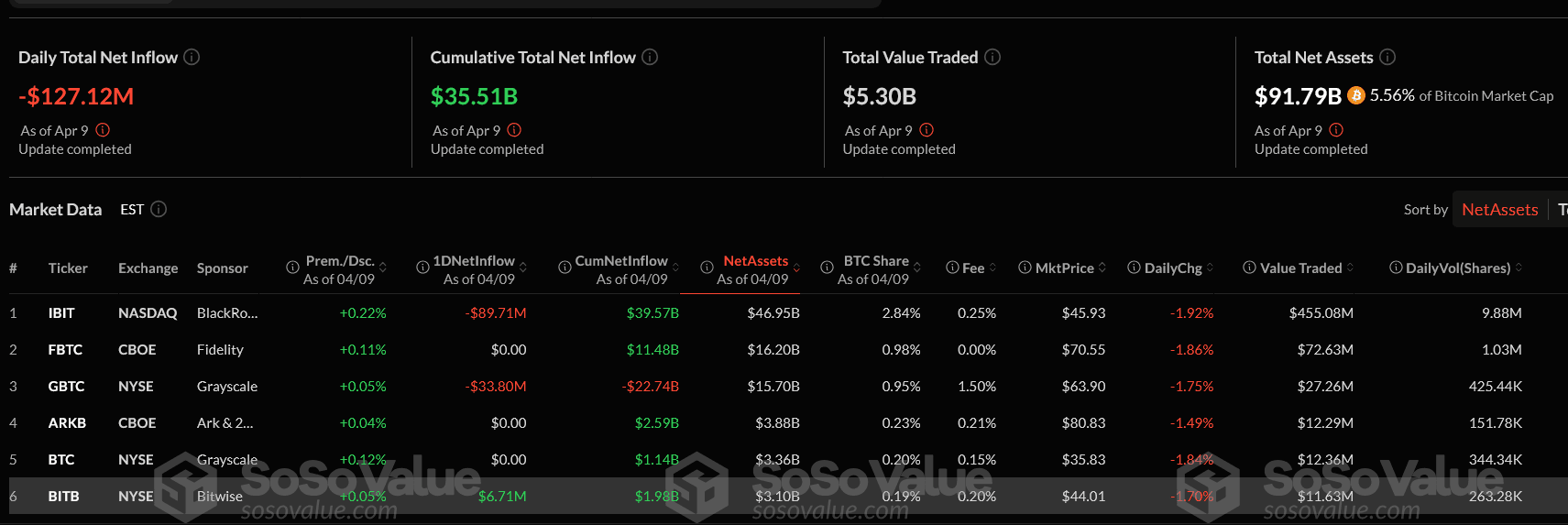 Image Source: SoSoValue
President Donald Trump’s surprise announcement of a 90-day pause on new tariffs and a reduction in reciprocal duties to 10% for most countries acted as a massive catalyst for global equities. However, the policy simultaneously introduced a sharp escalation against China, with tariffs rising to 125%—a signal of selective economic aggression.
While this spurred a record rally across equity markets—S&P 500 up 9.52%, Nasdaq up 12.16%, and Dow up 7.87%—Bitcoin ETFs didn’t share the enthusiasm. This divergence suggests that macroeconomic clarity alone isn't enough to pull capital back into crypto funds.
The message from Spot Bitcoin ETF investors seems clear: short-term policy relief isn't enough to override deeper concerns, possibly related to regulatory overhangs, profit-taking after earlier inflows, or a tactical shift away from ETF structures.
Could Grayscale’s GBTC Be Driving Broader Outflows?
Grayscale’s GBTC has long been a key player in institutional Bitcoin exposure. Yet its consistent outflows hint at continued profit realization and potential fee-related migration to lower-cost ETFs like BlackRock's IBIT and Fidelity’s FBTC (although the latter didn’t report major inflows here either).
The current data shows GBTC alone contributing over 26% of the day’s net outflows, which might be skewing broader ETF sentiment. Even IBIT, which has generally attracted steady inflows, joined the red-flow trend this time. The market may be seeing structural ETF rotation rather than a rejection of Bitcoin altogether.
--> Wanna trade Cryptocurrencies? Now is the perfect time, especially that the market is consolidating before a volatile period. Click here to open an account with Bitget using our link and benefit from 100% transaction fee rebates in BGB on your first transaction <--
Are Investors Rotating from Crypto to Equities?
With Coinbase stock soaring 16.91% and Strategy (formerly MicroStrategy) surging 24.76%, the traditional equities associated with crypto rallied far more aggressively than Bitcoin itself. This implies a possible rotation from spot crypto products (like ETFs) into higher-beta crypto equities that offer amplified exposure during rallies.
Investors may also be rebalancing portfolios to capture momentum in equity markets that have just been injected with new optimism thanks to Trump’s policy shift. With TradFi roaring back, crypto ETFs may have temporarily lost their shine in risk-adjusted terms.
What Does This Mean for Bitcoin Price and ETF Flows Going Forward?
Although Spot Bitcoin ETF outflows are often interpreted as bearish, it’s important to consider the broader context. Bitcoin itself didn’t plunge in response —on the contrary, it remained relatively resilient alongside global markets. This suggests that underlying demand still exists, but it may be temporarily parked outside ETF wrappers.
Looking ahead, if this market euphoria continues, and macro conditions stabilize or improve, ETF inflows could rebound swiftly, particularly if Bitcoin breaks through key resistance levels. Bitwise’s small but notable inflow hints at selective investor confidence returning.
In short, the current outflows could represent a healthy pause, not a trend reversal—especially in a climate where sentiment and capital allocation are extremely reactive to geopolitical and regulatory signals.
In an unexpected twist, U.S. spot Bitcoin exchange-traded funds (ETFs) witnessed net outflows totaling $127.12 million on Wednesday, despite a broad-based rally in both traditional finance (TradFi) and crypto markets. This is puzzling, considering such rallies are typically accompanied by bullish inflows into risk assets, including Bitcoin and crypto-related funds.
The outflows were led by BlackRock’s IBIT, which saw a significant $89.71 million exit, followed by Grayscale’s GBTC, shedding $33.8 million, according to SoSoValue data . Smaller issuers like VanEck and WisdomTree also reported negative flows. Surprisingly, Bitwise’s BITB stood out as the only fund reporting positive inflows of $6.71 million.
This marks the fifth consecutive day of negative flows for spot Bitcoin ETFs, raising critical questions about investor sentiment and the actual drivers of these funds in the current macro environment.
Is the Trump Tariff Pause Not Enough to Reignite Bitcoin ETF Demand?
Image Source: SoSoValue
President Donald Trump’s surprise announcement of a 90-day pause on new tariffs and a reduction in reciprocal duties to 10% for most countries acted as a massive catalyst for global equities. However, the policy simultaneously introduced a sharp escalation against China, with tariffs rising to 125%—a signal of selective economic aggression.
While this spurred a record rally across equity markets—S&P 500 up 9.52%, Nasdaq up 12.16%, and Dow up 7.87%—Bitcoin ETFs didn’t share the enthusiasm. This divergence suggests that macroeconomic clarity alone isn't enough to pull capital back into crypto funds.
The message from Spot Bitcoin ETF investors seems clear: short-term policy relief isn't enough to override deeper concerns, possibly related to regulatory overhangs, profit-taking after earlier inflows, or a tactical shift away from ETF structures.
Could Grayscale’s GBTC Be Driving Broader Outflows?
Grayscale’s GBTC has long been a key player in institutional Bitcoin exposure. Yet its consistent outflows hint at continued profit realization and potential fee-related migration to lower-cost ETFs like BlackRock's IBIT and Fidelity’s FBTC (although the latter didn’t report major inflows here either).
The current data shows GBTC alone contributing over 26% of the day’s net outflows, which might be skewing broader ETF sentiment. Even IBIT, which has generally attracted steady inflows, joined the red-flow trend this time. The market may be seeing structural ETF rotation rather than a rejection of Bitcoin altogether.
--> Wanna trade Cryptocurrencies? Now is the perfect time, especially that the market is consolidating before a volatile period. Click here to open an account with Bitget using our link and benefit from 100% transaction fee rebates in BGB on your first transaction <--
Are Investors Rotating from Crypto to Equities?
With Coinbase stock soaring 16.91% and Strategy (formerly MicroStrategy) surging 24.76%, the traditional equities associated with crypto rallied far more aggressively than Bitcoin itself. This implies a possible rotation from spot crypto products (like ETFs) into higher-beta crypto equities that offer amplified exposure during rallies.
Investors may also be rebalancing portfolios to capture momentum in equity markets that have just been injected with new optimism thanks to Trump’s policy shift. With TradFi roaring back, crypto ETFs may have temporarily lost their shine in risk-adjusted terms.
What Does This Mean for Bitcoin Price and ETF Flows Going Forward?
Although Spot Bitcoin ETF outflows are often interpreted as bearish, it’s important to consider the broader context. Bitcoin itself didn’t plunge in response —on the contrary, it remained relatively resilient alongside global markets. This suggests that underlying demand still exists, but it may be temporarily parked outside ETF wrappers.
Looking ahead, if this market euphoria continues, and macro conditions stabilize or improve, ETF inflows could rebound swiftly, particularly if Bitcoin breaks through key resistance levels. Bitwise’s small but notable inflow hints at selective investor confidence returning.
In short, the current outflows could represent a healthy pause, not a trend reversal—especially in a climate where sentiment and capital allocation are extremely reactive to geopolitical and regulatory signals.
Disclaimer: The content of this article solely reflects the author's opinion and does not represent the platform in any capacity. This article is not intended to serve as a reference for making investment decisions.
You may also like

Nvidia’s Record Run Signals Another AI Wave: 5 Cryptos Worth Buying Before the Breakout
Apple (AAPL.US) Teams Up with LG to Enter Smart Home Market: Accessories such as doorbells, thermostats, and cameras to feature LG branding
According to sources, Apple is set to expand its smart home device lineup, including doorbells, thermostats, and other accessories. These products will be developed through an unusual partnership between Apple and LG Electronics.
Review Article - ROI - For Trump's Treasury, the "tail" of the auction is the toughest part: McKeever
Repeated, no changes to the main text. By Jamie McGeever Reuters, Orlando, Florida, October 6 - U.S. Treasury auctions are supposed to be dull, predictable, and lacking in news value. But these are unusual times, and the Trump administration now faces the risk of weak government bond sales making headlines. The U.S. Treasury plans to issue nearly $120 billion in bonds this week—the first auction of bonds other than short-term Treasury bills in two weeks: $58 billion in three-year notes on Tuesday, $39 billion in ten-year notes on Wednesday, and $22 billion in thirty-year bonds on Thursday. These auctions would ordinarily be inconsequential, but they're attracting increased attention due to the exceptionally weak auction results from September 22–24—particularly the five-year Treasury auction on September 23, which led to the largest jump in yields since April of last year. Since then, yields have not fallen back, and instead, have surged to multi-decade highs across most maturities. It's important to note that the possibility of a "failed" U.S. Treasury auction is nearly zero. The primary dealers—26 banks and institutions currently authorized by the New York Fed to act as Treasury market makers on Wall Street—are always involved. They essentially underwrite the sales, ensuring the smooth operation of the $30 trillion U.S. Treasury market, which is the most liquid in the world. This, in turn, keeps the entire global financial system running. Trillions of dollars of global debt, assets, and market derivatives are benchmarked off U.S. Treasuries. U.S. Treasuries also serve as collateral to "lubricate" the pipes of the U.S. and global financial systems—in repos, interbank lending, and financing. In short, as long as U.S. Treasuries remain the backbone of the global financial system, there will always be buyers in Treasury auctions. The perpetual question is the price at which these bonds ultimately clear. With borrowing costs in the secondary market now at their highest since the mid-2000s, it's reasonable to expect the Treasury will pay correspondingly high rates in the primary market. But as recent auction rounds have shown, there remains potential for negative surprises. “Too big for the market to digest?” The $70 billion five-year auction on September 23 was among the most concerning in recent years. Demand—as measured by bid-to-cover ratio—was the lowest in nine years. The Treasury sold these notes at a yield of 5.033%, more than 3 basis points above the market yield at the auction deadline. Three basis points might not sound like much, but for a five-year Treasury auction, that's highly unusual. This was the largest so-called "tail" since June 2022. JP Morgan analysts pointed out that the last time the five-year auction saw a three-basis-point tail was back in 2011—when the brewing debt ceiling crisis ultimately led to the U.S. credit rating being downgraded that August. Back to today, concerns over the U.S.'s bleak fiscal outlook have pushed up long-term borrowing costs. Consequently, markets widely expect the Trump administration to gradually shift the Treasury's massive funding needs toward the lower-cost, shorter end of the yield curve. That explains why the five-year auction two weeks ago caused such a stir. A three-basis-point tail is common in long-bond auctions, but rare for securities in the so-called "belly" of the curve. If the Treasury is forced to pay a higher premium to move these bonds, then Houston, we have a problem. Large auction tails can be caused by numerous factors, such as market volatility on the day of the auction or, more worryingly, underlying fundamental issues that could erode demand over time. It's usually difficult to distinguish between these dynamics, as they're not mutually exclusive. On the brighter side, this unease hasn't yet spread to the short end of the curve. At least, not for now. Three- and ten-year Treasury yields have risen by about 50 basis points from the last auction a month ago, hovering around 4.96% and 5.32% respectively. The 30-year yield is up about 35 basis points, to 5.65%. That should be high enough to attract strong demand and ensure smooth sales, right? Probably. But if we get a surprise, volatility and uncertainty could ripple across the entire market. Investors will be… watching developments like hawks. (The views expressed herein are those of the author, a Reuters columnist.) Enjoyed this column? Visit Reuters Open Interest, your essential new source for global financial commentary. Follow ROI on LinkedIn and X. You can also listen to the daily "Morning Bid" podcast on Apple, Spotify, or the Reuters app. Subscribe for seven-day-a-week in-depth analysis of market and financial news by Reuters journalists. US 5-year auction has biggest 'tail' since 2022 https://fingfx.thomsonreuters.com/gfx/mkt/dwpkmkzogpm/TAIL.png (For reader convenience, Reuters automatically translates its reports into several other languages. Automate
Crypto prices
More


