
3 Altcoins that Look Bullish After Trump’s Tariff Pause

Altcoins are rebounding post-tariff pause, with XRP, HYPE, and ONDO standing out thanks to regulatory shifts, revenue gains, and RWA growth.
Altcoins are showing fresh signs of life following Trump’s 90-day tariff pause, and three names in particular—XRP, HYPE, and ONDO—are catching investor attention.
Each has its own catalyst: XRP is getting a regulatory boost with Paul Atkins taking over the SEC, HYPE is defying the broader market downturn with impressive protocol revenue, and ONDO is riding the wave of rising institutional interest in Real-World Assets (RWA).
XRP
XRP fell sharply in the past month, losing 34% and dropping below $1.70 for the first time since November 2024. The decline came as macro uncertainty and regulatory pressure weighed on sentiment.
However, with Trump’s 90-day tariff pause and Paul Atkins confirmed as the new, pro-crypto SEC Chair, optimism is starting to return.
These developments could give XRP the regulatory breathing room it needs to regain momentum as one of the top-performing altcoins.
 XRP Price Analysis. Source:
TradingView.
XRP Price Analysis. Source:
TradingView.
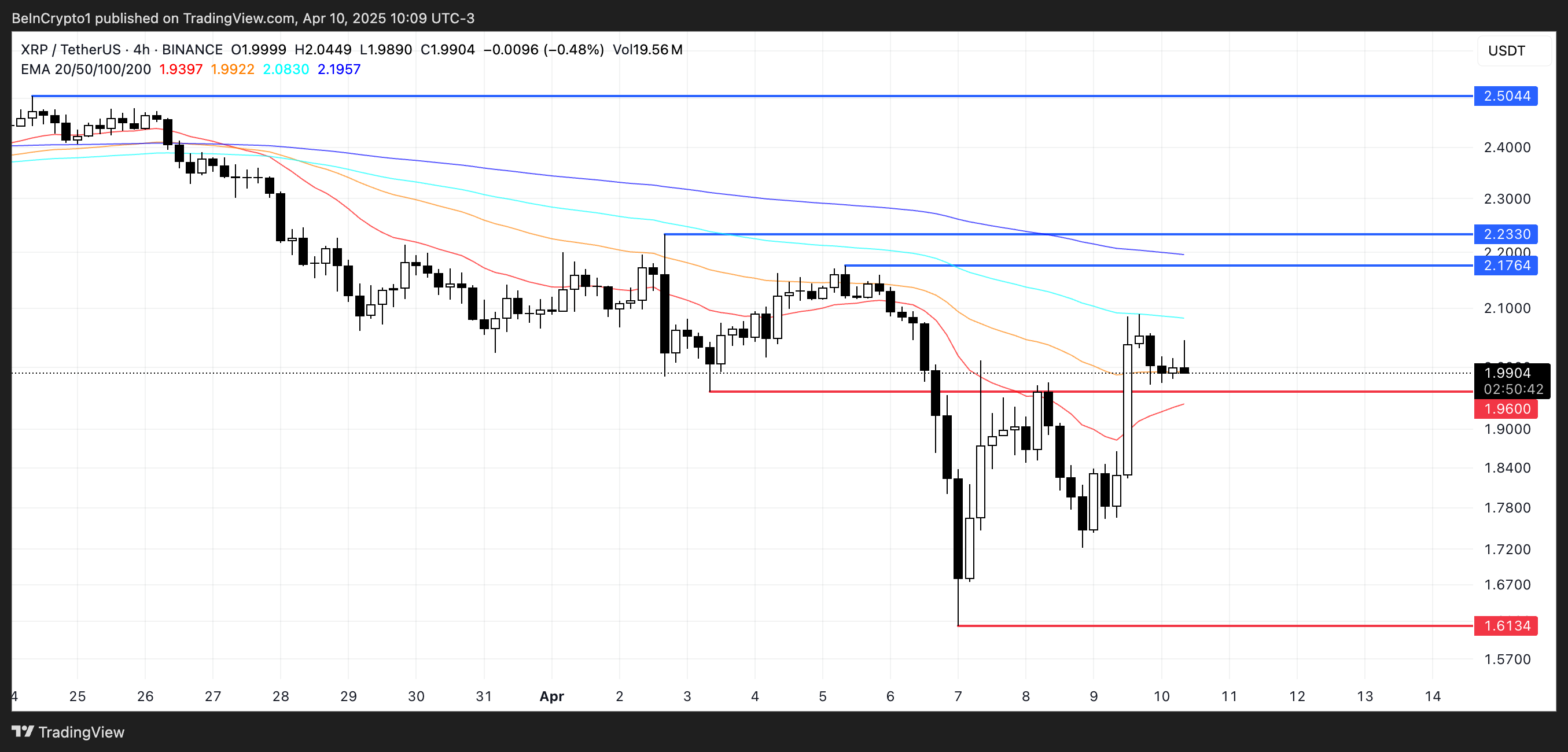
If that shift materializes, XRP may retest resistance at $2.17 and $2.23.
A break above those levels could set the stage for a push toward $2.50. Standard Chartered has even suggested XRP could overtake Ethereum by 2028, and Ripple’s acquisition of Hidden Road has fueled new expectations for rising institutional demand.
Still, holding $1.96 as support is key—if that level fails, a drop back toward sub-$1.70 lows remains possible.
Hyperliquid (HYPE)
HYPE has climbed 21.5% over the past week, defying the broader altcoin market downturn. The rally comes despite lingering criticism of the platform following the JELLY crisis, which raised concerns about Hyperliquid’s stability.
Still, traders seem to be regaining confidence, especially as the macro backdrop improves after Trump’s 90-day tariff pause.
 HYPE Price Analysis. Source:
TradingView.
HYPE Price Analysis. Source:
TradingView.
Hyperliquid remains a powerhouse in terms of protocol revenue, pulling in $38 million in fees over the past month—$2.4 million of that in just the last 24 hours—ranking it 6th globally, ahead of names like PancakeSwap and Tron.
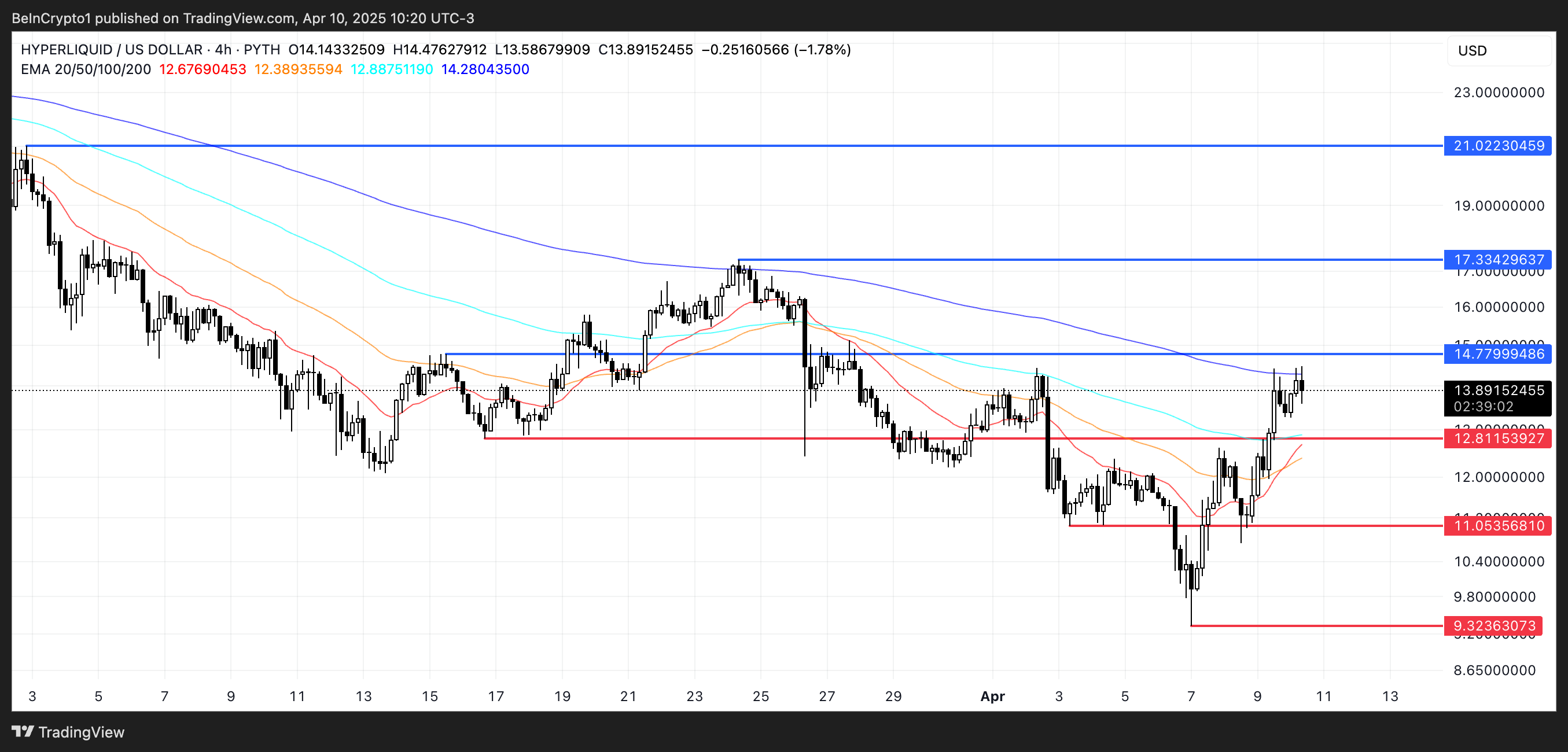
If momentum holds, HYPE could push toward resistance at $14.77, and a breakout could lead to $17.33 or even $21. But if the rally stalls support at $12.81 becomes key; losing that could send the price back to $11 or even below $10 in a deeper correction
Ondo Finance (ONDO)
Real-world asset (RWA) tokens are gaining momentum as a defensive narrative in crypto, especially in light of global economic uncertainty.
Binance Research recently stated that RWA altcoins remain safer than Bitcoin during tariff-driven volatility.
At the same time, BlackRock’s BUIDL token is nearing $1.5 billion in assets, and Fidelity has entered the RWA tokenization race—signaling growing institutional commitment to this emerging sector.
 ONDO Price Analysis. Source:
TradingView.
ONDO Price Analysis. Source:
TradingView.
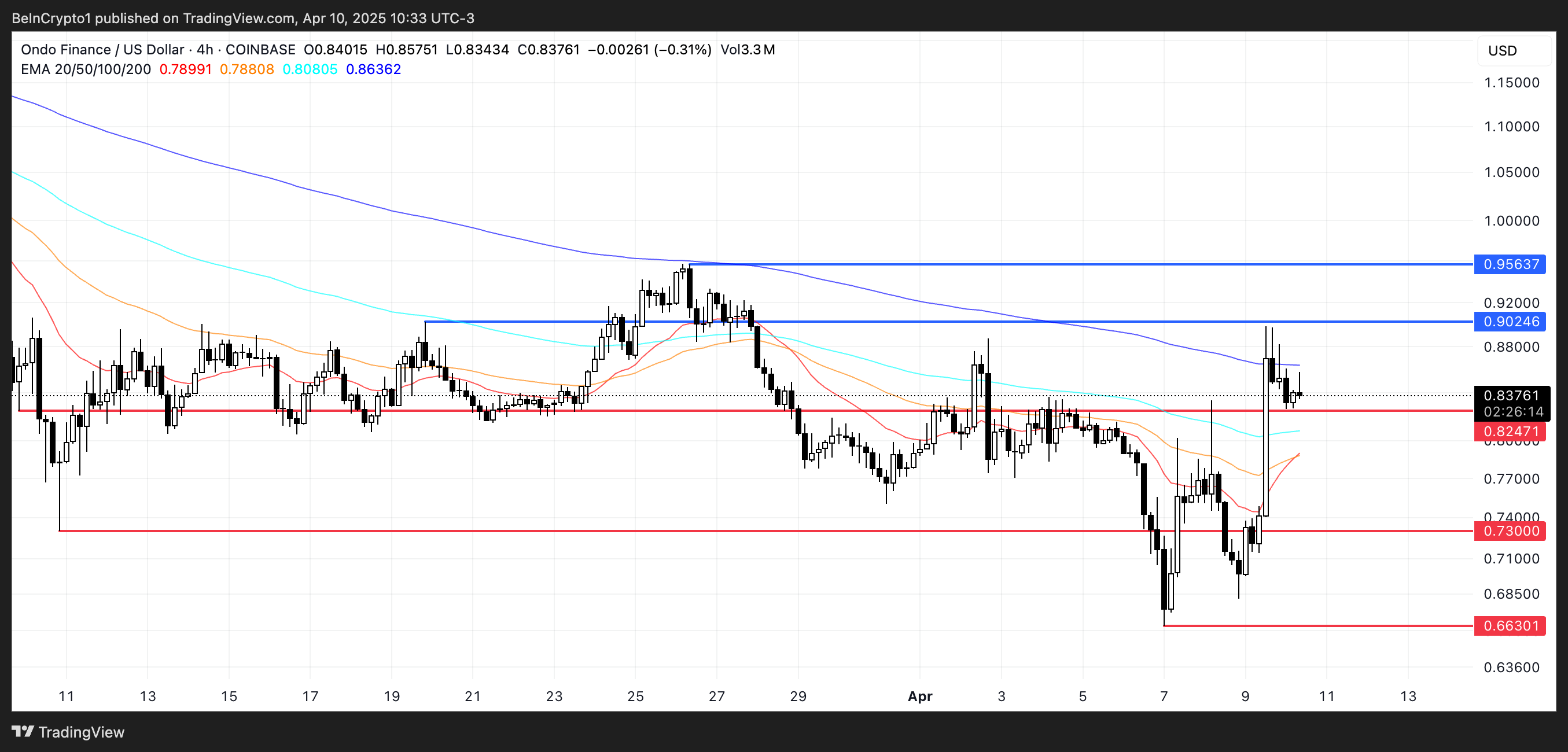
ONDO, one of the key tokens in the RWA space, is showing signs of strength on the charts, with a golden cross nearly forming.
If confirmed, ONDO could climb toward resistance levels at $0.90 and $0.95, with a breakout possibly pushing it above $1.
However, the price is hovering just above a key support at $0.82. If that level fails, the next downside target is $0.73, with a deeper slide potentially taking it below $0.70.
Disclaimer: The content of this article solely reflects the author's opinion and does not represent the platform in any capacity. This article is not intended to serve as a reference for making investment decisions.
You may also like
Nvidia’s Record Run Signals Another AI Wave: 5 Cryptos Worth Buying Before the Breakout
Apple (AAPL.US) Teams Up with LG to Enter Smart Home Market: Accessories such as doorbells, thermostats, and cameras to feature LG branding
According to sources, Apple is set to expand its smart home device lineup, including doorbells, thermostats, and other accessories. These products will be developed through an unusual partnership between Apple and LG Electronics.
Review Article - ROI - For Trump's Treasury, the "tail" of the auction is the toughest part: McKeever
Repeated, no changes to the main text. By Jamie McGeever Reuters, Orlando, Florida, October 6 - U.S. Treasury auctions are supposed to be dull, predictable, and lacking in news value. But these are unusual times, and the Trump administration now faces the risk of weak government bond sales making headlines. The U.S. Treasury plans to issue nearly $120 billion in bonds this week—the first auction of bonds other than short-term Treasury bills in two weeks: $58 billion in three-year notes on Tuesday, $39 billion in ten-year notes on Wednesday, and $22 billion in thirty-year bonds on Thursday. These auctions would ordinarily be inconsequential, but they're attracting increased attention due to the exceptionally weak auction results from September 22–24—particularly the five-year Treasury auction on September 23, which led to the largest jump in yields since April of last year. Since then, yields have not fallen back, and instead, have surged to multi-decade highs across most maturities. It's important to note that the possibility of a "failed" U.S. Treasury auction is nearly zero. The primary dealers—26 banks and institutions currently authorized by the New York Fed to act as Treasury market makers on Wall Street—are always involved. They essentially underwrite the sales, ensuring the smooth operation of the $30 trillion U.S. Treasury market, which is the most liquid in the world. This, in turn, keeps the entire global financial system running. Trillions of dollars of global debt, assets, and market derivatives are benchmarked off U.S. Treasuries. U.S. Treasuries also serve as collateral to "lubricate" the pipes of the U.S. and global financial systems—in repos, interbank lending, and financing. In short, as long as U.S. Treasuries remain the backbone of the global financial system, there will always be buyers in Treasury auctions. The perpetual question is the price at which these bonds ultimately clear. With borrowing costs in the secondary market now at their highest since the mid-2000s, it's reasonable to expect the Treasury will pay correspondingly high rates in the primary market. But as recent auction rounds have shown, there remains potential for negative surprises. “Too big for the market to digest?” The $70 billion five-year auction on September 23 was among the most concerning in recent years. Demand—as measured by bid-to-cover ratio—was the lowest in nine years. The Treasury sold these notes at a yield of 5.033%, more than 3 basis points above the market yield at the auction deadline. Three basis points might not sound like much, but for a five-year Treasury auction, that's highly unusual. This was the largest so-called "tail" since June 2022. JP Morgan analysts pointed out that the last time the five-year auction saw a three-basis-point tail was back in 2011—when the brewing debt ceiling crisis ultimately led to the U.S. credit rating being downgraded that August. Back to today, concerns over the U.S.'s bleak fiscal outlook have pushed up long-term borrowing costs. Consequently, markets widely expect the Trump administration to gradually shift the Treasury's massive funding needs toward the lower-cost, shorter end of the yield curve. That explains why the five-year auction two weeks ago caused such a stir. A three-basis-point tail is common in long-bond auctions, but rare for securities in the so-called "belly" of the curve. If the Treasury is forced to pay a higher premium to move these bonds, then Houston, we have a problem. Large auction tails can be caused by numerous factors, such as market volatility on the day of the auction or, more worryingly, underlying fundamental issues that could erode demand over time. It's usually difficult to distinguish between these dynamics, as they're not mutually exclusive. On the brighter side, this unease hasn't yet spread to the short end of the curve. At least, not for now. Three- and ten-year Treasury yields have risen by about 50 basis points from the last auction a month ago, hovering around 4.96% and 5.32% respectively. The 30-year yield is up about 35 basis points, to 5.65%. That should be high enough to attract strong demand and ensure smooth sales, right? Probably. But if we get a surprise, volatility and uncertainty could ripple across the entire market. Investors will be… watching developments like hawks. (The views expressed herein are those of the author, a Reuters columnist.) Enjoyed this column? Visit Reuters Open Interest, your essential new source for global financial commentary. Follow ROI on LinkedIn and X. You can also listen to the daily "Morning Bid" podcast on Apple, Spotify, or the Reuters app. Subscribe for seven-day-a-week in-depth analysis of market and financial news by Reuters journalists. US 5-year auction has biggest 'tail' since 2022 https://fingfx.thomsonreuters.com/gfx/mkt/dwpkmkzogpm/TAIL.png (For reader convenience, Reuters automatically translates its reports into several other languages. Automate
Crypto prices
More


