
Research Report | In-Depth Overview of Mind Network & FHE Market Valuation
Project Overview
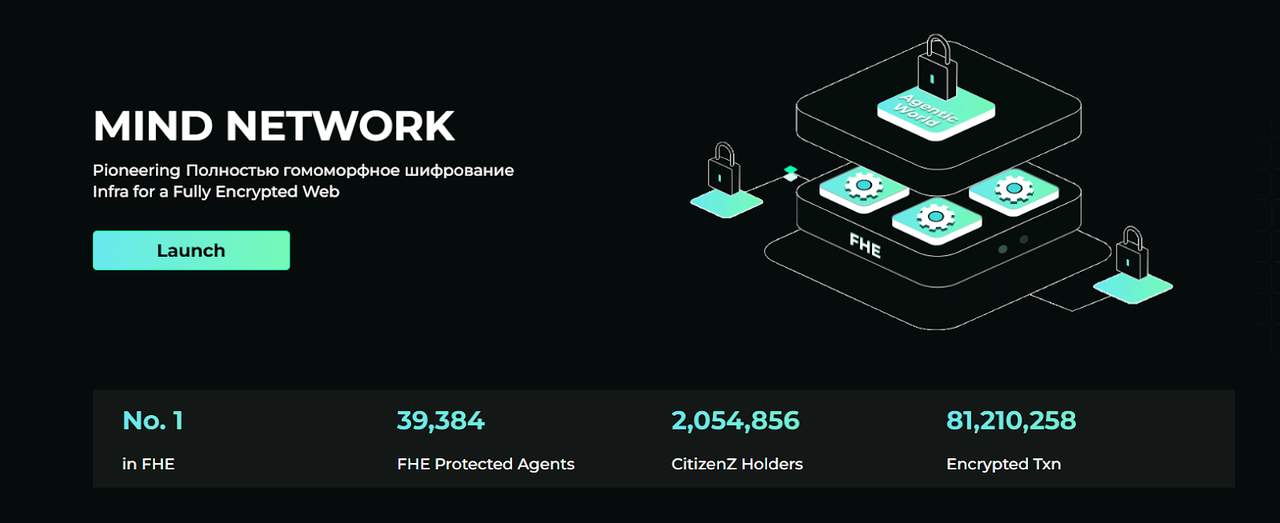
The project’s core innovation lies in the deep integration of FHE with AI agents, launching the world’s first FHE public blockchain—MindChain—and building an agent-based economic system called AgenticWorld on BNB Chain. This system supports the creation, training, task execution, and destruction of AI agents, forming a closed-loop ecosystem. Mind is also expanding into AI restaking, secure communication, and private data circulation, positioning itself as a competitively versatile FHE infrastructure.
The core team includes members from Cambridge University, Google, and Microsoft, with strong backgrounds in cryptography and AI research. Their work on FHE and stealth addresses has been supported by the Ethereum Foundation and has resolved a stealth address problem raised by Vitalik Buterin. The project has raised $12.5 million from top-tier investors such as Binance Labs, Chainlink, ZAMA, and Animoca, and is a signed Channel Partner of Chainlink and a key collaborator with ZAMA.
As narratives around AI, restaking, and zero trust continue to gain traction, Mind Network is positioning itself not just as an FHE network, but as the trust infrastructure for the AI ecosystem and the security layer for restaking—making it a strong contender for the next breakout project.
Project Highlights
High Technical Barrier, Leading Position in FHE
Mind Network builds its privacy computing infrastructure on FHE, enabling encrypted data usability. Known as the "holy grail of cryptography," FHE has been recognized by NIST as a post-quantum encryption standard. Mind is one of the few projects to implement this technology on-chain, offering strong technical scarcity.
AI Ecosystem Pioneer, Building an Agent Operating System
Rather than simply incorporating AI concepts, Mind has developed a full-fledged AgenticWorld operating system for AI agents, including mechanisms for creation, training, task execution, and destruction. It supports consensus, data, communication, and computation security, addressing trust issues in decentralized AI deployment.
Multi-Ecosystem Synergy, Serving Leading Projects and Protocols
Mind has established deep collaborations with io.net, Swarms, DeepSeek, ZAMA, Chainlink, and others, applying its technology in healthcare, communications, and inference scenarios. It currently supports over 3,000 AI agents, has deployed 20+ central nodes and 40+ SDKs, and has joined the Chainlink BUILD program as a Channel Partner.
Strong Funding and Backing from Top-Tier Investors
The project has raised $12.5 million from investors including Binance Labs, Animoca, HashKey, ZAMA, SevenX, Mr. Block, and Mike Silagadze. It has been selected for the Binance Incubator, Ethereum Foundation Fellowship, and Chainlink BUILD Program, ensuring long-term resource support.
New Restaking Paradigm Compatible with AI and PoS Narratives
Mind is the first infrastructure project in the AI sector to propose the concept of restaking. By combining FHE consensus mechanisms, it supports remote staking of LSTs/LRTs and dual/triple staking security models, offering shared security for on-chain AI and building the trust layer for next-generation decentralized computing.
Market Valuation Outlook
As a core infrastructure in decentralized privacy computing, Mind Network leverages FHE technology to provide privacy protection and a trusted execution environment for the AI agent ecosystem. It is comparable to projects like Nillion, Virtuals Protocol, and MyShell, offering both foundational capabilities and ecosystem entry points. Though currently in an early valuation stage, it possesses strong narrative uniqueness and product viability. Based on FDV models of similar projects, $FHE has significant revaluation potential and may emerge as a key asset powering the “AI Agent Security Engine.”

Tokenomics
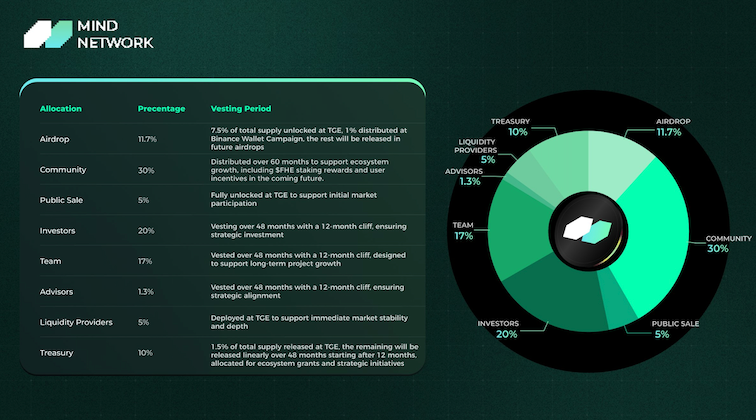
Total Supply of $FHE: 1 billion tokens
Initial Circulating Supply: 24.9%
Token Allocation:
Community (30%): 300 million tokens, linearly vested over 5 years to support ecosystem growth, including $FHE staking rewards and user incentive programs.
Airdrop (11.7%): 117 million tokens; 7.5% unlocked at TGE, 1% allocated to Binance Wallet Campaign, remainder reserved for future airdrops.
Public Sale (5%): 50 million tokens, fully unlocked at TGE to support initial market participation.
Investors (20%): 200 million tokens, 4-year linear vesting with a 12-month cliff to ensure long-term alignment.
Team (17%): 170 million tokens, 4-year linear vesting with a 12-month cliff to incentivize long-term team commitment.
Advisors (1.3%): 13 million tokens, 4-year linear vesting with a 12-month cliff for strategic advisor incentives.
Liquidity Providers (5%): 50 million tokens, deployed at TGE for market stability and liquidity provisioning.
Treasury (10%): 100 million tokens; 1.5% unlocked at TGE, remainder vested linearly over 4 years after a 12-month cliff, supporting ecosystem subsidies and strategic initiatives.
Token Utility:
$FHE serves as the core asset powering the autonomous AI system within AgenticWorld, covering multiple critical scenarios:
Activating and running AI agents
Supporting task execution, training, and reward distribution
Paying for FHE privacy computation to ensure data confidentiality
Participating in ecosystem governance and Hub-level proposals via MindDAO
Enabling value transfer and interoperability between agents and multi-chain networks
Team & Fundraising
Team:
Mind Network was co-founded by Christian Pusateri, a cryptography PhD from the University of Cambridge, and George, a seasoned technical expert. The core team has expertise in AI, secure computing, cryptography, and crypto-economics, with members from Google, Microsoft, IBM, and the Ethereum Foundation. The team is committed to building a secure computing network and agent operating system for AI using FHE.
Mind Network is the world’s first modular privacy computing network built on FHE. It introduced and implemented the HTTPZ standard, launched the agent-specific chain MindChain and the economic system AgenticWorld, and is a pioneer in the AI + FHE + Restaking narrative. Its core research has solved the stealth address cryptographic challenge proposed by Vitalik Buterin, was selected for the Ethereum Foundation Fellowship, and continues to expand its ecosystem through key partnerships with ZAMA, Chainlink, and others.
Fundraising:
Mind Network has completed two major funding rounds totaling $12.5 million:
On September 27, 2024, it raised $10 million in a Pre-A round led by Animoca Brands, MH Ventures, ArkStream Capital, Cogitent Ventures, Master Ventures, Moonhill Capital, SwissBorg Ventures, IBC Group, Mr. Block, Mike Silagadze, Mario Nawfal, Kyle Chasse, and G Ventures.
On June 29, 2023, it raised $2.5 million in a seed round from YZi Labs, SevenX Ventures, HashKey Capital, Comma3 Ventures, Big Brain Holdings, Mandala Capital, and Arweave SCP Ventures.
Potential Risks
Fully Homomorphic Encryption (FHE) is a cutting-edge technology with high security but also high development complexity and computational cost, which may hinder short-term adoption and integration by partners.
Despite its advanced FHE privacy computing architecture, Mind Network’s large-scale application and AI agent ecosystem still require time to mature, and ecosystem development may progress slowly.
Official Links
Website: https://www.mindnetwork.xyz/
Twitter: https://x.com/mindnetwork_xyz
Discord: https://discord.com/invite/UYj94MJdGJ
Disclaimer: The content of this article solely reflects the author's opinion and does not represent the platform in any capacity. This article is not intended to serve as a reference for making investment decisions.
You may also like

Nvidia’s Record Run Signals Another AI Wave: 5 Cryptos Worth Buying Before the Breakout
Apple (AAPL.US) Teams Up with LG to Enter Smart Home Market: Accessories such as doorbells, thermostats, and cameras to feature LG branding
According to sources, Apple is set to expand its smart home device lineup, including doorbells, thermostats, and other accessories. These products will be developed through an unusual partnership between Apple and LG Electronics.
Review Article - ROI - For Trump's Treasury, the "tail" of the auction is the toughest part: McKeever
Repeated, no changes to the main text. By Jamie McGeever Reuters, Orlando, Florida, October 6 - U.S. Treasury auctions are supposed to be dull, predictable, and lacking in news value. But these are unusual times, and the Trump administration now faces the risk of weak government bond sales making headlines. The U.S. Treasury plans to issue nearly $120 billion in bonds this week—the first auction of bonds other than short-term Treasury bills in two weeks: $58 billion in three-year notes on Tuesday, $39 billion in ten-year notes on Wednesday, and $22 billion in thirty-year bonds on Thursday. These auctions would ordinarily be inconsequential, but they're attracting increased attention due to the exceptionally weak auction results from September 22–24—particularly the five-year Treasury auction on September 23, which led to the largest jump in yields since April of last year. Since then, yields have not fallen back, and instead, have surged to multi-decade highs across most maturities. It's important to note that the possibility of a "failed" U.S. Treasury auction is nearly zero. The primary dealers—26 banks and institutions currently authorized by the New York Fed to act as Treasury market makers on Wall Street—are always involved. They essentially underwrite the sales, ensuring the smooth operation of the $30 trillion U.S. Treasury market, which is the most liquid in the world. This, in turn, keeps the entire global financial system running. Trillions of dollars of global debt, assets, and market derivatives are benchmarked off U.S. Treasuries. U.S. Treasuries also serve as collateral to "lubricate" the pipes of the U.S. and global financial systems—in repos, interbank lending, and financing. In short, as long as U.S. Treasuries remain the backbone of the global financial system, there will always be buyers in Treasury auctions. The perpetual question is the price at which these bonds ultimately clear. With borrowing costs in the secondary market now at their highest since the mid-2000s, it's reasonable to expect the Treasury will pay correspondingly high rates in the primary market. But as recent auction rounds have shown, there remains potential for negative surprises. “Too big for the market to digest?” The $70 billion five-year auction on September 23 was among the most concerning in recent years. Demand—as measured by bid-to-cover ratio—was the lowest in nine years. The Treasury sold these notes at a yield of 5.033%, more than 3 basis points above the market yield at the auction deadline. Three basis points might not sound like much, but for a five-year Treasury auction, that's highly unusual. This was the largest so-called "tail" since June 2022. JP Morgan analysts pointed out that the last time the five-year auction saw a three-basis-point tail was back in 2011—when the brewing debt ceiling crisis ultimately led to the U.S. credit rating being downgraded that August. Back to today, concerns over the U.S.'s bleak fiscal outlook have pushed up long-term borrowing costs. Consequently, markets widely expect the Trump administration to gradually shift the Treasury's massive funding needs toward the lower-cost, shorter end of the yield curve. That explains why the five-year auction two weeks ago caused such a stir. A three-basis-point tail is common in long-bond auctions, but rare for securities in the so-called "belly" of the curve. If the Treasury is forced to pay a higher premium to move these bonds, then Houston, we have a problem. Large auction tails can be caused by numerous factors, such as market volatility on the day of the auction or, more worryingly, underlying fundamental issues that could erode demand over time. It's usually difficult to distinguish between these dynamics, as they're not mutually exclusive. On the brighter side, this unease hasn't yet spread to the short end of the curve. At least, not for now. Three- and ten-year Treasury yields have risen by about 50 basis points from the last auction a month ago, hovering around 4.96% and 5.32% respectively. The 30-year yield is up about 35 basis points, to 5.65%. That should be high enough to attract strong demand and ensure smooth sales, right? Probably. But if we get a surprise, volatility and uncertainty could ripple across the entire market. Investors will be… watching developments like hawks. (The views expressed herein are those of the author, a Reuters columnist.) Enjoyed this column? Visit Reuters Open Interest, your essential new source for global financial commentary. Follow ROI on LinkedIn and X. You can also listen to the daily "Morning Bid" podcast on Apple, Spotify, or the Reuters app. Subscribe for seven-day-a-week in-depth analysis of market and financial news by Reuters journalists. US 5-year auction has biggest 'tail' since 2022 https://fingfx.thomsonreuters.com/gfx/mkt/dwpkmkzogpm/TAIL.png (For reader convenience, Reuters automatically translates its reports into several other languages. Automate
Crypto prices
More


