
Ethereum Tries to Recover After Capitulation, But $2,000 Remains Unlikely

Ethereum's recovery effort is under pressure as short-term holders look to sell for profits. Despite recent gains, a breakout toward $2,000 remains unlikely unless sustained support emerges.
Ethereum has recently shown an attempt to recover from the significant losses it sustained toward the end of March. The altcoin, often considered the leader in the smart contract space, is currently trading at $1,774.
While this reflects an effort to regain momentum, Ethereum’s recovery might be hindered by short-term holders (STHs) looking to capitalize on any immediate profits.
Ethereum Investors Are Prone To Selling
Ethereum’s network value and user activity are showing signs of a possible recovery, but its current market sentiment remains under pressure. The Net Unrealized Profit/Loss (NUPL) indicator, which gauges the overall profit or loss of coins in circulation, has entered a phase of capitulation.
Despite the uptick in Ethereum’s price, the underlying sentiment remains cautious. The increase in the NUPL could quickly reverse if short-term holders (STHs) decide to liquidate their positions.
Ethereum’s recovery hinges on investor confidence, with those holding onto their assets being the key to avoiding another sell-off. If more STHs choose to HODL instead of selling, Ethereum could see sustained upward momentum in the coming weeks.
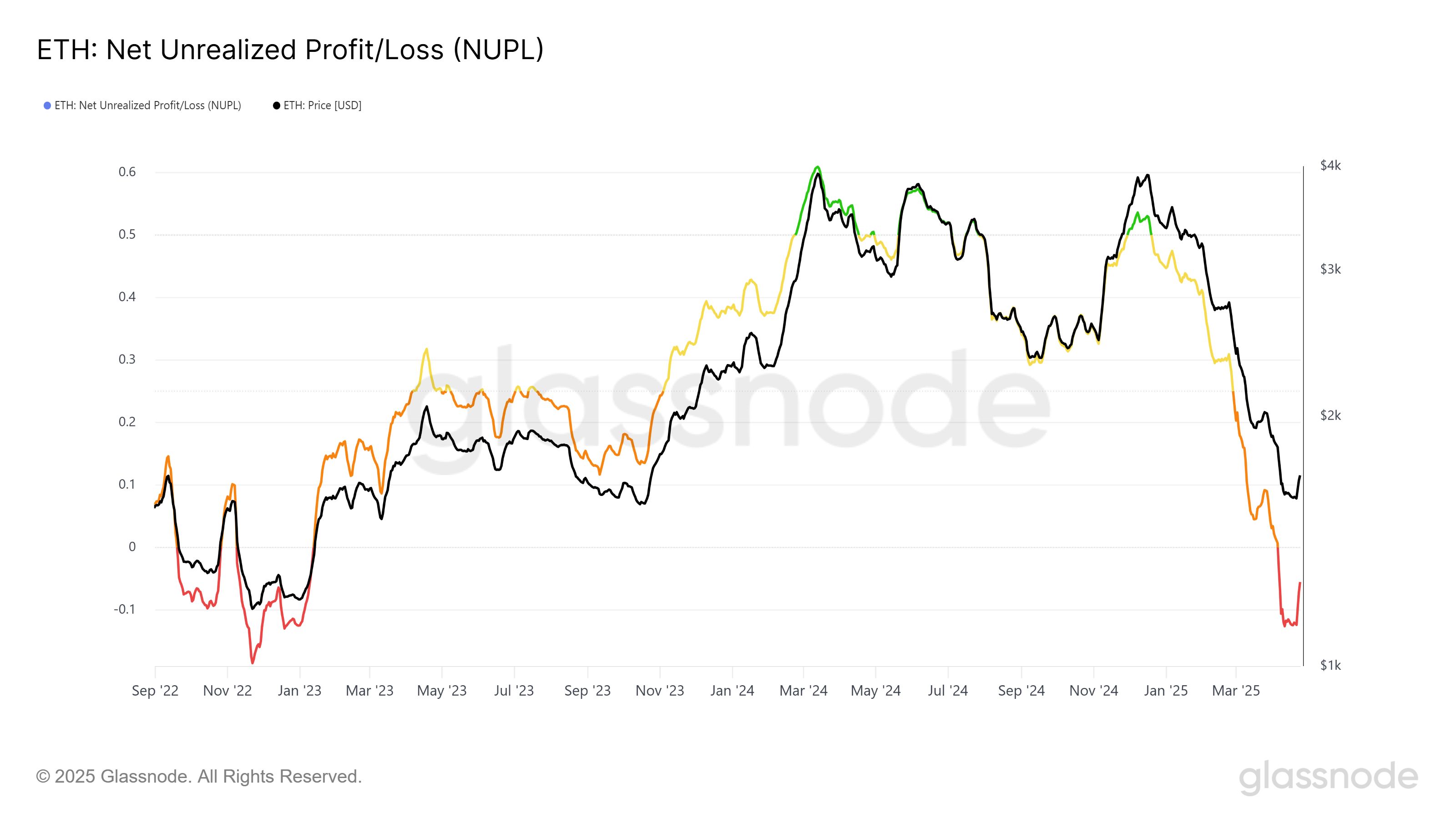 Ethereum NUPL. Source:
Glassnode
Ethereum NUPL. Source:
Glassnode
On a broader scale, Ethereum’s macro momentum presents mixed signals. The Market Value to Realized Value (MVRV) Long/Short Difference indicator is currently deeply negative at -30%. This suggests that the market may face additional resistance in its recovery efforts.
The indicator highlights the disconnect between long-term and short-term holders, with the latter showing profits at a two-year high. The last time this occurred was in January 2023, when Ethereum experienced significant sell-offs, pushing the price lower.
The presence of STHs in a profitable position increases the likelihood of further selling pressure on Ethereum. As these investors are more likely to liquidate at the first sign of profits, the recovery could face challenges.
Ethereum’s price could struggle to maintain upward momentum, especially if short-term holders capitalize on their gains, pushing the altcoin back into a downtrend.
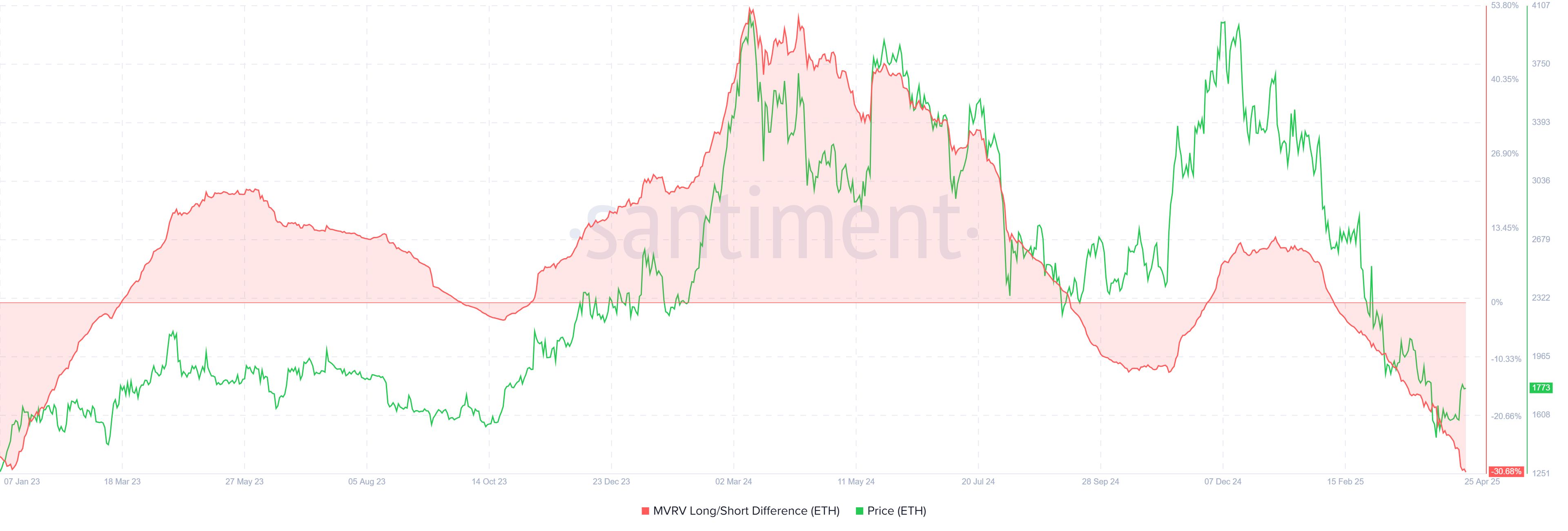 Ethereum MVRV Long/Short Difference. Source:
Santiment
Ethereum MVRV Long/Short Difference. Source:
Santiment
ETH Price Needs Support
Ethereum’s price has risen by 11% in the past week, currently trading at $1,774. It is now testing the resistance at $1,796, and breaching this level is crucial for Ethereum to continue its recovery toward the $2,000 mark. A successful breakout above this resistance would signal a continuation of the recovery trend, pushing Ethereum closer to its previous high.
However, considering the market sentiment and the current indicators, Ethereum’s chances of reaching $2,000 in the short term seem unlikely. Ethereum is at risk of falling below the $1,671 support, which could trigger a deeper pullback to $1,522. This bearish outlook suggests that the recovery may be short-lived unless strong buying support materializes.
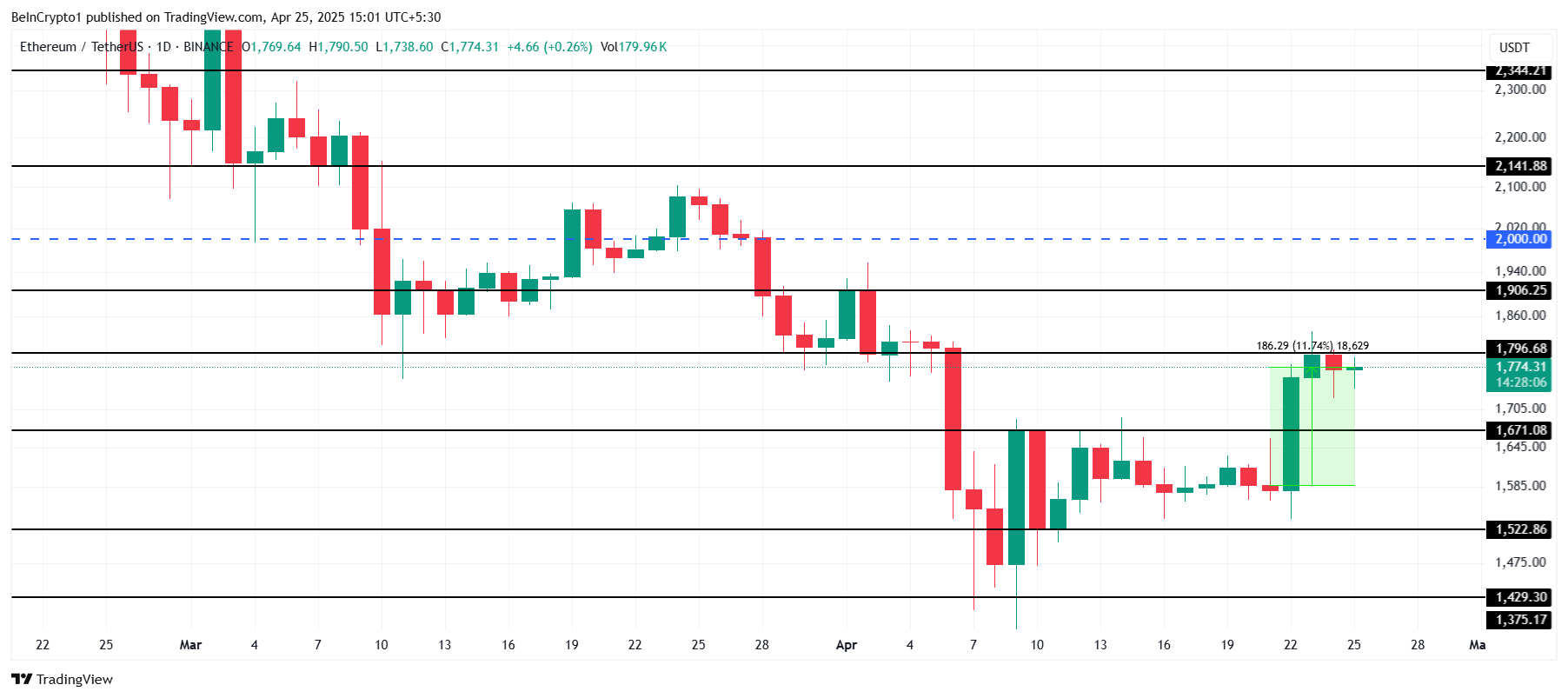 Ethereum Price Analysis. Source:
TradingView
Ethereum Price Analysis. Source:
TradingView
If the broader market conditions remain strong, Ethereum could manage to breach the $1,796 resistance and even push past $1,906. A move above these levels would set Ethereum on track to reach $2,000, invalidating the bearish outlook and signaling a more sustainable recovery for the altcoin.
Disclaimer: The content of this article solely reflects the author's opinion and does not represent the platform in any capacity. This article is not intended to serve as a reference for making investment decisions.
You may also like
Federal Reserve meeting minutes: All 19 policymakers support a rate hike in September, but reasons vary; most expect further hikes this year, suggesting no urgency in October.
Most officials view a September interest rate hike as an "insurance" measure against stubborn inflation; a minority see it as a necessary step to curb inflation. Overall, there is no indication of a desire to push for consecutive rate hikes. The "New Fed News Agency" emphasized the minutes: "Most participants believe that it may be appropriate to raise interest rates again before the end of the year." Nearly all officials believe inflation remains elevated and the labor market is close to full employment. Many noted that, despite the rise in long-term U.S. Treasury yields, financial conditions are still conducive to economic growth. Some officials believe that AI will boost investment and productivity, but may also contribute to inflation. The minutes revealed that the U.S.-Japan joint intervention in July to support the yen was a U.S. Treasury action, with no Federal Reserve funds used.
Solana Consolidates After Sharp Expansion
FLOKI Recovery Tests Key Resistance
100 Million Barrels Shrinkage? Reports Say EU Believes Oil Reserve Release Plan Mainly Fulfills Previous Commitments, Not New Quotas
Last Friday, G7 member countries agreed to release up to 100 million barrels of crude oil and diesel reserves. The IEA had announced a plan to release 400 million barrels in March, and as of last Friday, about 75 million barrels had yet to be released. Most EU member states believe that this action is simply fulfilling previous commitments rather than adding new releases. Regarding the earlier-than-scheduled release of diesel stocks emphasized in last week's G7 agreement, EU member states consider it feasible, but on a limited scale.
Crypto prices
More


