
Stacks (STX) Leads the Market with 20% Jump Amid Bearish Futures Bets

Stacks (STX) has seen impressive gains, but traders' preference for short positions and an overbought RSI indicate a potential downturn. Still, strong demand could keep the rally going.
STX is today’s top performer, soaring nearly 20% in the past 24 hours. Alongside the price surge, the token’s trading volume has also spiked, signaling strong interest from investors.
However, despite the rally, on-chain data reveals a high demand for short positions among traders, suggesting doubts around the longevity of STX’s current uptrend.
Stacks (STX) Jumps 20%, But Bearish Traders Dominate
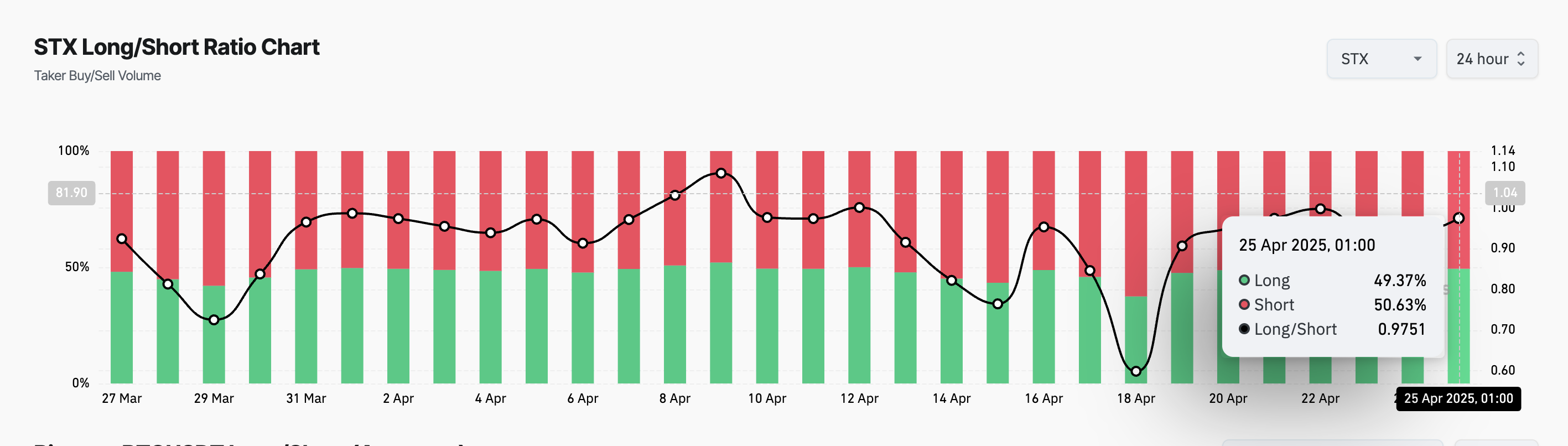
According to Coinglass, STX’s long/short ratio is currently at 0.97, signaling a preference for short positions among its futures market participants.
 STX Long/Short Ratio. Source:
Coinglass
STX Long/Short Ratio. Source:
Coinglass
The long/short ratio measures the proportion of bullish (long) positions to bearish (short) positions in the market. When the ratio is above one, there are more long positions than short ones. This suggests bullish sentiment, with most traders expecting the asset’s value to rise.
Converesly, as with STX, a ratio below one indicates that more traders are betting on a price decline than on an increase. This suggests that many token holders are unimpressed by STX’s double-digit gains over the past day and anticipate a bearish reversal soon.
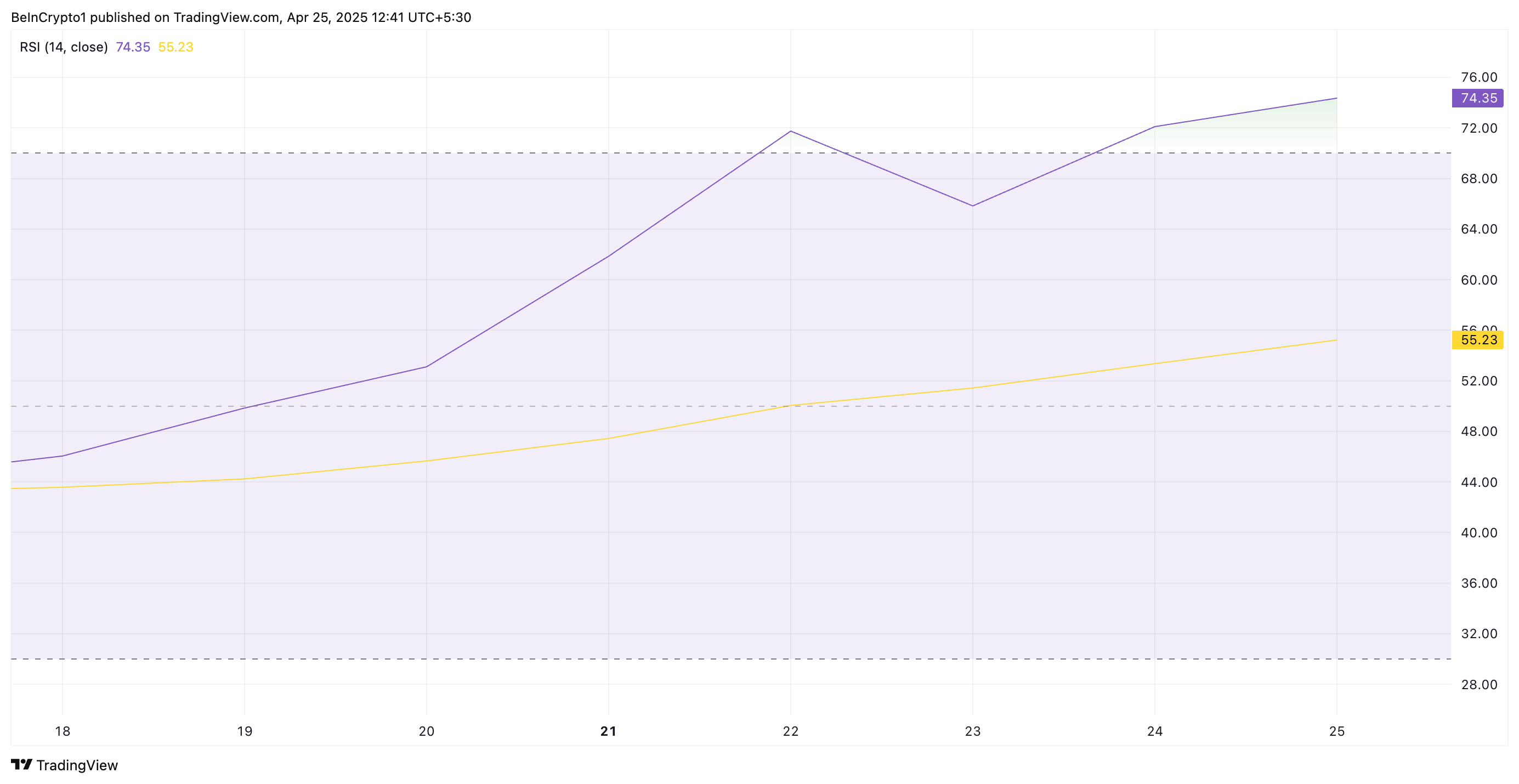
Moreover, STX’s overbought Relative Strength Index (RSI) supports this bearish outlook. At press time, this momentum indicator is at 74.35 and on an upward trend.
 STX RSI. Source:
TradingView
STX RSI. Source:
TradingView
The RSI indicator measures an asset’s overbought and oversold market conditions. It ranges between 0 and 100, with values above 70 suggesting that the asset is overbought and due for a price decline. Converesly, values under 30 indicate that the asset is oversold and may witness a rebound.
Therefore, STX’s RSI reading confirms that altcoin might be overbought and could witness a price decline in the near term.
Can STX Defy Overbought Signals?
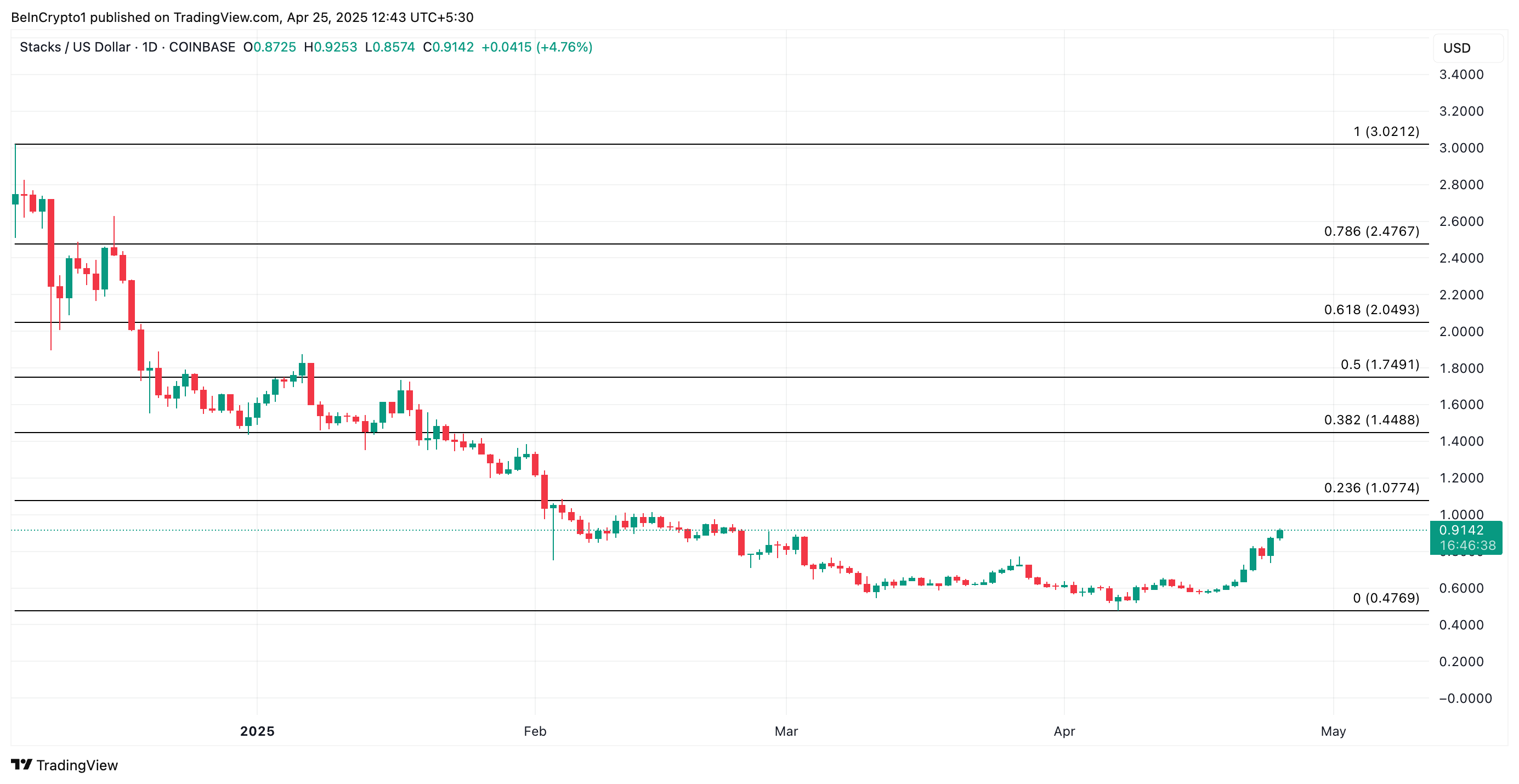
Once buyer exhaustion sets in, STX could shed some of its recent gains. In this scenario, the altcoin’s value could plunge to its year-to-date low of $0.47.
However, an RSI reading above 70 does not always signal an immediate reversal. Strong bullish momentum can sometimes sustain the rally, pushing prices even higher despite overbought conditions.
 STX Price Analysis. Source:
TradingView
STX Price Analysis. Source:
TradingView
If demand strengthens, STX’s rally could persist, potentially allowing the token to break above the resistance level at $1.07.
Disclaimer: The content of this article solely reflects the author's opinion and does not represent the platform in any capacity. This article is not intended to serve as a reference for making investment decisions.
You may also like
Federal Reserve meeting minutes: All 19 policymakers support a rate hike in September, but reasons vary; most expect further hikes this year, suggesting no urgency in October.
Most officials view a September interest rate hike as an "insurance" measure against stubborn inflation; a minority see it as a necessary step to curb inflation. Overall, there is no indication of a desire to push for consecutive rate hikes. The "New Fed News Agency" emphasized the minutes: "Most participants believe that it may be appropriate to raise interest rates again before the end of the year." Nearly all officials believe inflation remains elevated and the labor market is close to full employment. Many noted that, despite the rise in long-term U.S. Treasury yields, financial conditions are still conducive to economic growth. Some officials believe that AI will boost investment and productivity, but may also contribute to inflation. The minutes revealed that the U.S.-Japan joint intervention in July to support the yen was a U.S. Treasury action, with no Federal Reserve funds used.
Solana Consolidates After Sharp Expansion
FLOKI Recovery Tests Key Resistance
100 Million Barrels Shrinkage? Reports Say EU Believes Oil Reserve Release Plan Mainly Fulfills Previous Commitments, Not New Quotas
Last Friday, G7 member countries agreed to release up to 100 million barrels of crude oil and diesel reserves. The IEA had announced a plan to release 400 million barrels in March, and as of last Friday, about 75 million barrels had yet to be released. Most EU member states believe that this action is simply fulfilling previous commitments rather than adding new releases. Regarding the earlier-than-scheduled release of diesel stocks emphasized in last week's G7 agreement, EU member states consider it feasible, but on a limited scale.
Crypto prices
More


