
Pi Network (PI) Awaits Breakout As Trading Sentiment Improves

Pi Network is in a holding pattern after a modest rebound, with mixed signals from RSI and Ichimoku Cloud. Traders await a breakout from the $0.61–$0.68 range.
Pi Network (PI) has seen a modest 5% gain over the past week, despite being down more than 17% in the last 30 days. This bounce has brought some relief but hasn’t yet translated into a clear bullish reversal.
The price is currently consolidating between key levels, with technical indicators like the Ichimoku Cloud, RSI, and EMA lines all pointing to indecision. Whether this consolidation leads to a breakout or further downside could depend on how PI reacts to resistance at $0.68 and support at $0.617 in the coming sessions.
Ichimoku Signals Uncertainty for PI
Pi Network trades inside the red Ichimoku Cloud, reflecting indecision and a lack of strong directional bias.
The price sits between the red baseline (Kijun-sen) and just above the blue conversion line (Tenkan-sen), indicating weak short-term momentum but no clear breakdown.
The presence of the red cloud shows that the prevailing trend is still slightly bearish, and price action within the cloud generally signals consolidation or neutrality.
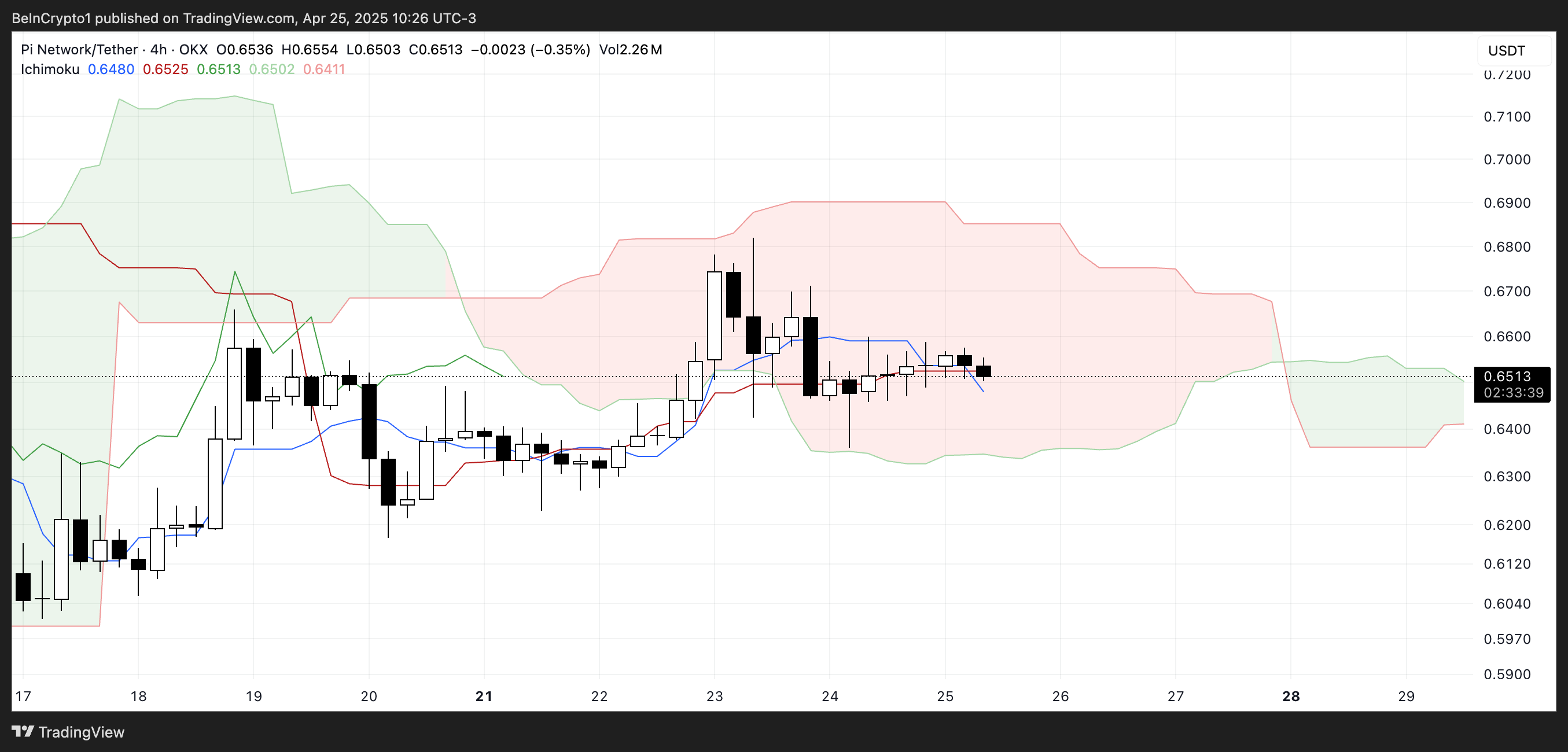 PI Ichimoku Cloud. Source:
TradingView.
PI Ichimoku Cloud. Source:
TradingView.
However, looking ahead, the cloud shifts to green, suggesting that sentiment may be starting to shift.
A green cloud in the future points to a potential bullish transition, but only if the price manages to break above the cloud with strong follow-through.
A decisive move above the cloud would support a trend reversal, while a rejection and move below the Tenkan-sen and Kijun-sen would reinforce bearish pressure.
PI RSI Cools Off: What Comes Next?
Pi Network’s Relative Strength Index (RSI) is currently sitting at 51.41, falling from a high of 70 just two days ago.
This drop reflects a noticeable momentum cooling, as the asset moved from near-overbought territory to more neutral levels.
The RSI measures the speed and magnitude of recent price changes to evaluate overbought or oversold conditions. Values above 70 are generally considered overbought, and those below 30 are considered oversold.
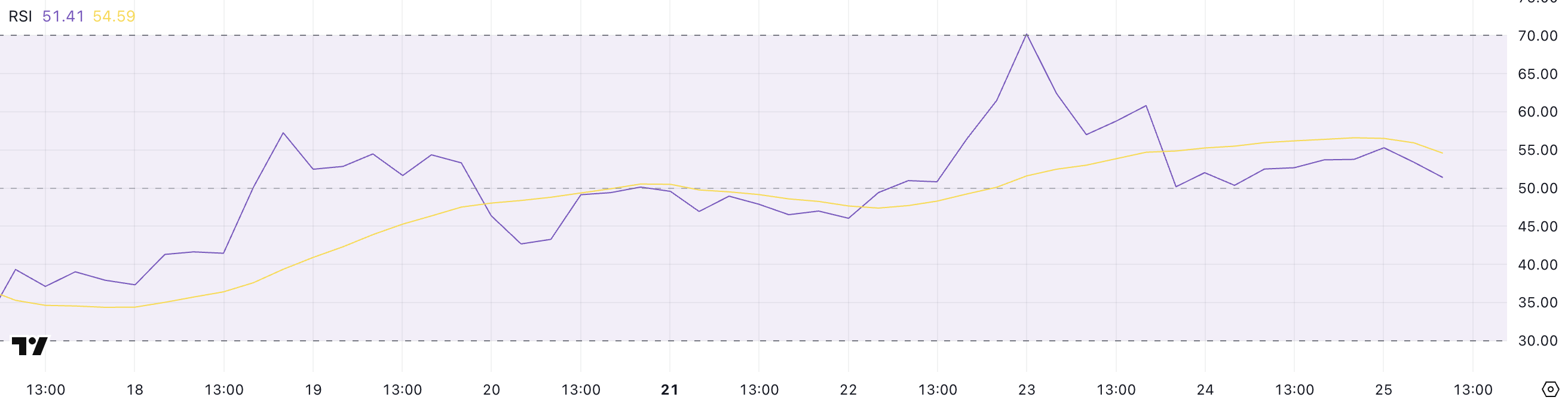 PI RSI. Source:
TradingView.
PI RSI. Source:
TradingView.
An RSI at 51.41 places PI right in the middle of the range, suggesting that neither buyers nor sellers currently have a clear advantage.
This neutral reading often coincides with a consolidation phase, where the price stabilizes before deciding its next direction. If the RSI trends again, it could point to renewed bullish momentum.
On the other hand, continued decline toward 40 or below may signal growing weakness and open the door for a deeper pullback.
PI Consolidates—Is a Breakout Coming?
Pi Network price has been consolidating over the past few days, currently trading within a range defined by resistance at $0.68 and support at $0.61.
This sideways movement is reflected in the EMA lines, which are clustered closely together—a classic sign of low volatility and a lack of strong directional momentum.
The market appears to be waiting for a decisive push from either buyers or sellers before committing to a new trend. Until then, PI remains in a holding pattern, with price action trapped between key levels.
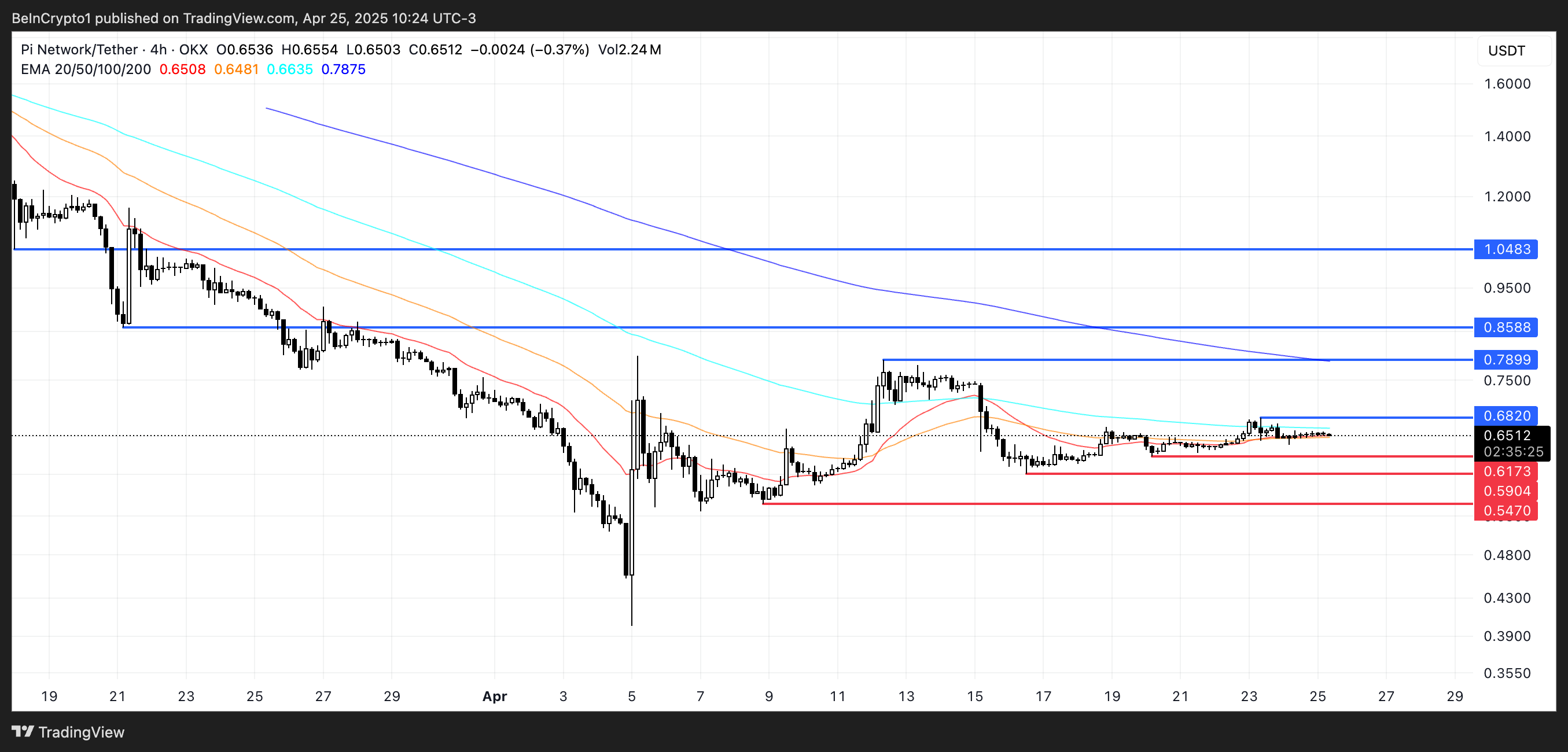 PI Price Analysis. Source:
TradingView.
PI Price Analysis. Source:
TradingView.
If bullish momentum returns, a breakout above $0.68 could signal the start of a fresh rally.
In that case, the next resistance levels to watch are $0.789 and $0.85. If the uptrend strengthens further, PI could target $1.04—marking its first move above $1 since March 23.
However, a breakdown below the $0.617 support could lead to renewed bearish pressure, with $0.59 and $0.54 as the next potential downside targets.
Disclaimer: The content of this article solely reflects the author's opinion and does not represent the platform in any capacity. This article is not intended to serve as a reference for making investment decisions.
You may also like
Federal Reserve meeting minutes: All 19 policymakers support a rate hike in September, but reasons vary; most expect further hikes this year, suggesting no urgency in October.
Most officials view a September interest rate hike as an "insurance" measure against stubborn inflation; a minority see it as a necessary step to curb inflation. Overall, there is no indication of a desire to push for consecutive rate hikes. The "New Fed News Agency" emphasized the minutes: "Most participants believe that it may be appropriate to raise interest rates again before the end of the year." Nearly all officials believe inflation remains elevated and the labor market is close to full employment. Many noted that, despite the rise in long-term U.S. Treasury yields, financial conditions are still conducive to economic growth. Some officials believe that AI will boost investment and productivity, but may also contribute to inflation. The minutes revealed that the U.S.-Japan joint intervention in July to support the yen was a U.S. Treasury action, with no Federal Reserve funds used.
Solana Consolidates After Sharp Expansion
FLOKI Recovery Tests Key Resistance
100 Million Barrels Shrinkage? Reports Say EU Believes Oil Reserve Release Plan Mainly Fulfills Previous Commitments, Not New Quotas
Last Friday, G7 member countries agreed to release up to 100 million barrels of crude oil and diesel reserves. The IEA had announced a plan to release 400 million barrels in March, and as of last Friday, about 75 million barrels had yet to be released. Most EU member states believe that this action is simply fulfilling previous commitments rather than adding new releases. Regarding the earlier-than-scheduled release of diesel stocks emphasized in last week's G7 agreement, EU member states consider it feasible, but on a limited scale.
Crypto prices
More


