
Stripe Enters the Stablecoin Market After Decade of Internal Discussions

Stripe plans to initially target businesses outside the United States, European Union, and United Kingdom, aiming to offer faster and more efficient cross-border transactions.
Stripe, a global leader in payment infrastructure, is entering the stablecoin market amid the sector’s continued growth.
On April 25, CEO Patrick Collison confirmed that the company is actively developing a stablecoin-based product, marking a major milestone after nearly a decade of internal discussions.
Stripe to Launch Stablecoin Product Powered by Bridge Acquisition
Collison revealed that Stripe had long envisioned this project but had only now found the right environment to move forward.
The company has yet to share in-depth details about its moves. However, plans suggest the initial rollout will target businesses outside the United States, the European Union, and the United Kingdom.
We've wanted to build this product for around a decade, and it's now happening. https://t.co/zK9dADvGhG
— Patrick Collison (@patrickc) April 25, 2025
Stripe’s venture into stablecoins comes shortly after its February $1.1 billion acquisition of Bridge, a company specializing in stablecoin infrastructure. Bridge’s technology is expected to be the foundation for Stripe’s upcoming digital currency initiatives.
The confirmation follows mounting speculation about Stripe’s interest in blockchain technologies. Stripe, which handles transactions across more than 135 currencies and supports billions of dollars in global commerce yearly, sees stablecoins as a natural extension of its services.
Adding a stablecoin product could offer businesses faster, cheaper, and more efficient ways to handle cross-border transactions.
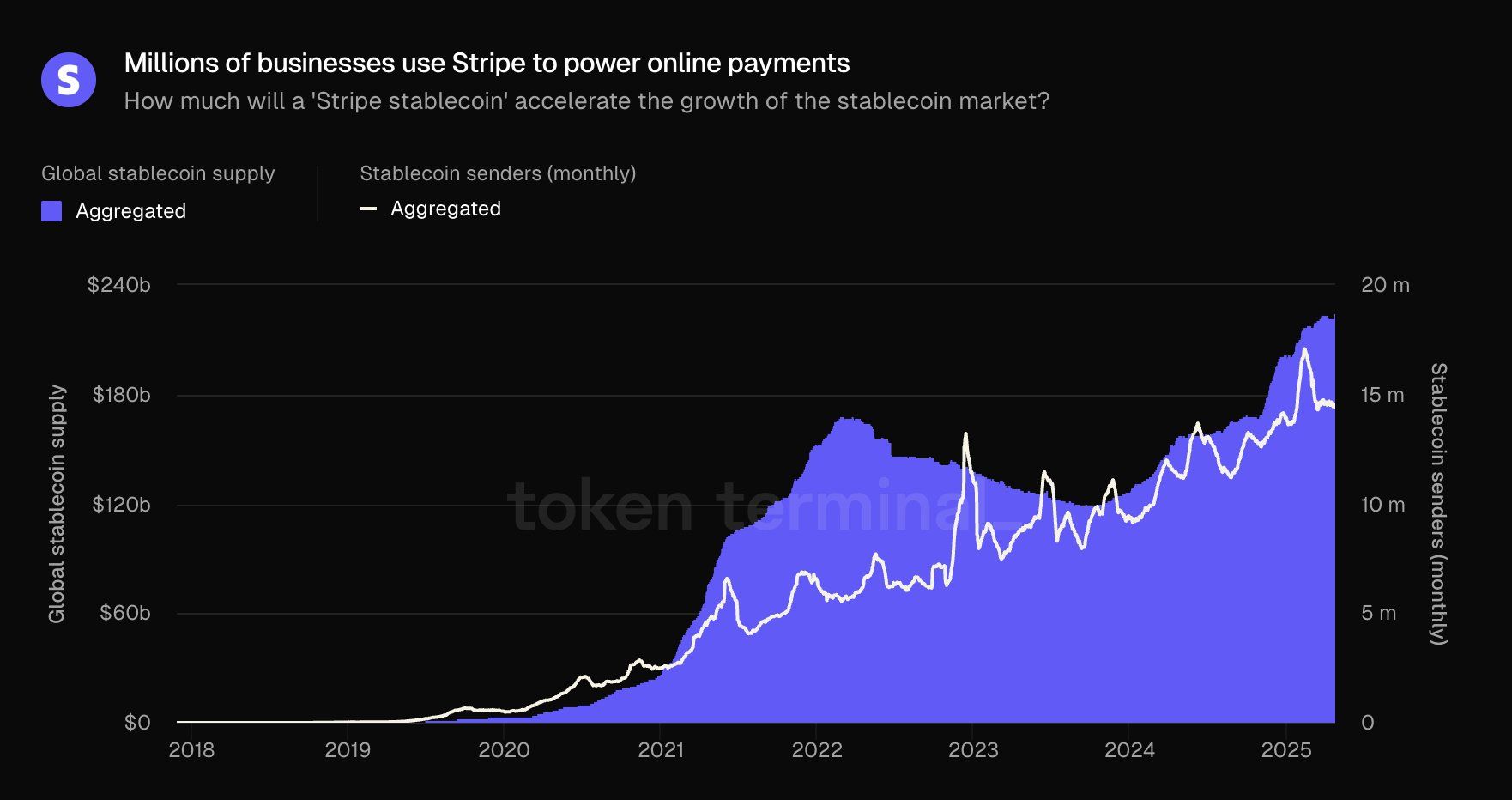 Over 15 Million Businesses Use Stripe’s Payment Solution. Source:
X/Token Terminal
Over 15 Million Businesses Use Stripe’s Payment Solution. Source:
X/Token Terminal
The payment giant’s move comes as other major fintech companies are also exploring stablecoins. Major traditional financial institutions like PayPal are already interacting with the sector, highlighting its growing momentum.
Today, the stablecoin market is dominated by major players like Tether (USDT) and Circle (USDC).
However, industry analysts, including those at Standard Chartered, believe stablecoin circulation could surge past $2 trillion by 2028, driven by increased regulatory clarity.
In Washington, lawmakers are advancing legislation to provide oversight and structure to the stablecoin industry.
Two key bills — the Stablecoin Transparency and Accountability for a Better Ledger Economy (STABLE) Act and the Guiding and Establishing National Innovation for US Stablecoins (GENIUS) Act — propose stronger liquidity requirements and anti-money laundering standards.
These efforts aim to foster greater trust in US-issued stablecoins and preserve the dollar’s dominance in global finance.
Disclaimer: The content of this article solely reflects the author's opinion and does not represent the platform in any capacity. This article is not intended to serve as a reference for making investment decisions.
You may also like
Federal Reserve meeting minutes: All 19 policymakers support a rate hike in September, but reasons vary; most expect further hikes this year, suggesting no urgency in October.
Most officials view a September interest rate hike as an "insurance" measure against stubborn inflation; a minority see it as a necessary step to curb inflation. Overall, there is no indication of a desire to push for consecutive rate hikes. The "New Fed News Agency" emphasized the minutes: "Most participants believe that it may be appropriate to raise interest rates again before the end of the year." Nearly all officials believe inflation remains elevated and the labor market is close to full employment. Many noted that, despite the rise in long-term U.S. Treasury yields, financial conditions are still conducive to economic growth. Some officials believe that AI will boost investment and productivity, but may also contribute to inflation. The minutes revealed that the U.S.-Japan joint intervention in July to support the yen was a U.S. Treasury action, with no Federal Reserve funds used.
Solana Consolidates After Sharp Expansion
FLOKI Recovery Tests Key Resistance
100 Million Barrels Shrinkage? Reports Say EU Believes Oil Reserve Release Plan Mainly Fulfills Previous Commitments, Not New Quotas
Last Friday, G7 member countries agreed to release up to 100 million barrels of crude oil and diesel reserves. The IEA had announced a plan to release 400 million barrels in March, and as of last Friday, about 75 million barrels had yet to be released. Most EU member states believe that this action is simply fulfilling previous commitments rather than adding new releases. Regarding the earlier-than-scheduled release of diesel stocks emphasized in last week's G7 agreement, EU member states consider it feasible, but on a limited scale.
Crypto prices
More


