
XRP Price at $2.19 With 9% Bi-Weekly Gain: Is XRP Preparing for a Breakout as Regulatory Picture Clears?

 XRP Price at $2.19 With 9% Bi-Weekly Gain: Is XRP Preparing for a Breakout as Regulatory Picture Clears?
Ripple’s XRP coin has gained 9% over the past two weeks, trading around $2.19 as of Saturday, supported by rising institutional interest. The major catalyst fueling this momentum is CME Group’s upcoming launch of XRP futures on May 19.
These cash-settled contracts—sized at 2,500 and 50,000 XRP—will settle against the CME CF XRP-Dollar Reference Rate.
According to Giovanni Vicioso, Global Head of Crypto Products at CME Group, growing demand from institutional players prompted this addition. Ripple CEO Brad Garlinghouse hailed the move as a “milestone” for Ripple’s adoption.
Analysts forecast that the futures launch could bring new liquidity and price stability, positioning Ripple alongside Bitcoin and Ethereum within regulated markets.
Key Highlights:
- CME XRP futures launch scheduled for May 19.
- Two contract sizes: 2,500 XRP and 50,000 XRP.
- Analysts project price targets toward $6.50 if momentum holds.
Brazil’s XRP ETF Boosts Global Exposure
In another bullish development, Brazil’s B3 exchange debuted XRPH11—the world’s first Ripple-focused ETF. Managed by Hashdex, the fund allocates 95% of its assets directly or indirectly into XRP, tracking the Nasdaq XRP Reference Price Index.
While U.S.-based XRP ETF applications remain stalled amid regulatory hurdles, Brazil’s launch marks a breakthrough moment. It offers investors outside the United States regulated access to Ripple, reinforcing Ripple’s global strategy.
Key Highlights:
- Brazil launches XRPH11, tracking Nasdaq XRP Index.
- 95% of assets allocated to XRP.
- Expands XRP’s institutional footprint beyond the U.S.
XRP Technical Setup: Breakout Eyes $2.30 and Beyond
Technically, XRP is consolidating around $2.19–$2.21, respecting an ascending trendline that has underpinned its rally since mid-April. The 50 EMA at $2.18 continues to act as dynamic support, with buyers stepping in to defend pullbacks.
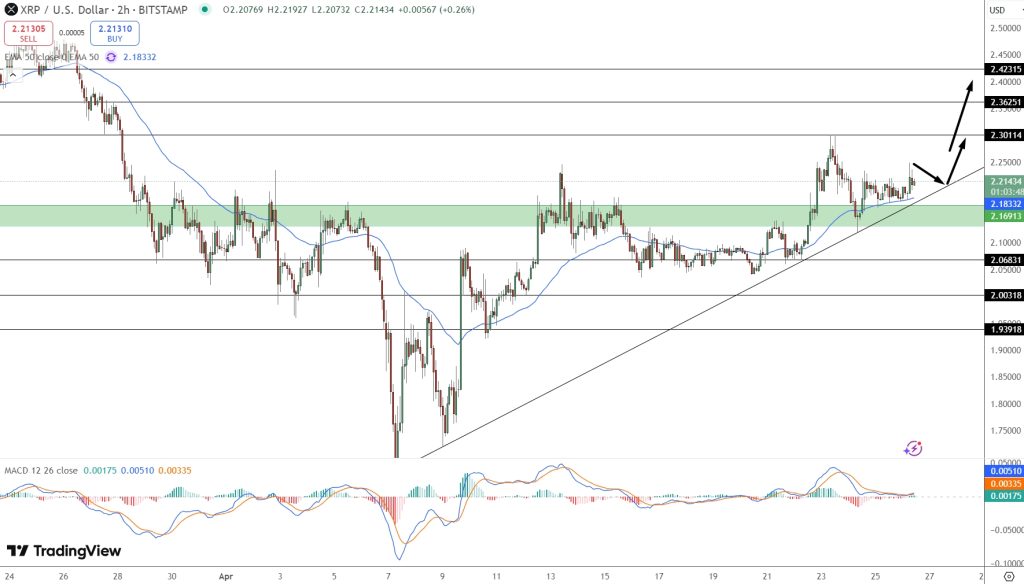
The immediate challenge lies at $2.30—historically a major resistance zone. A confirmed breakout above this level could open the door to $2.36 and $2.42 in the short term.
The MACD indicator is stabilizing, signaling consolidation rather than weakness, and setting the stage for a potential breakout.
Trade Setup:
- Buy breakout: Above $2.30
- Targets: $2.36 and $2.42
- Stop-loss: Below $2.17
For beginners, the strategy is straightforward: avoid buying inside the range and wait for either a clean breakout above $2.30 or a bounce from the ascending trendline.
Bottom Line
With a 9% bi-weekly gain, rising institutional support, and clearer regulatory frameworks emerging, XRP appears well-positioned for a potential breakout. Watch the $2.30 level closely—confirmation there could ignite the next leg higher.
Disclaimer: The content of this article solely reflects the author's opinion and does not represent the platform in any capacity. This article is not intended to serve as a reference for making investment decisions.
You may also like
Federal Reserve meeting minutes: All 19 policymakers support a rate hike in September, but reasons vary; most expect further hikes this year, suggesting no urgency in October.
Most officials view a September interest rate hike as an "insurance" measure against stubborn inflation; a minority see it as a necessary step to curb inflation. Overall, there is no indication of a desire to push for consecutive rate hikes. The "New Fed News Agency" emphasized the minutes: "Most participants believe that it may be appropriate to raise interest rates again before the end of the year." Nearly all officials believe inflation remains elevated and the labor market is close to full employment. Many noted that, despite the rise in long-term U.S. Treasury yields, financial conditions are still conducive to economic growth. Some officials believe that AI will boost investment and productivity, but may also contribute to inflation. The minutes revealed that the U.S.-Japan joint intervention in July to support the yen was a U.S. Treasury action, with no Federal Reserve funds used.
Solana Consolidates After Sharp Expansion
FLOKI Recovery Tests Key Resistance
100 Million Barrels Shrinkage? Reports Say EU Believes Oil Reserve Release Plan Mainly Fulfills Previous Commitments, Not New Quotas
Last Friday, G7 member countries agreed to release up to 100 million barrels of crude oil and diesel reserves. The IEA had announced a plan to release 400 million barrels in March, and as of last Friday, about 75 million barrels had yet to be released. Most EU member states believe that this action is simply fulfilling previous commitments rather than adding new releases. Regarding the earlier-than-scheduled release of diesel stocks emphasized in last week's G7 agreement, EU member states consider it feasible, but on a limited scale.
Crypto prices
More


