
XRP Climbs 8% In a Week as Price Stays Range-Bound Between Key Levels

XRP has climbed 8.5% this week as technical indicators show cautious bullishness, but price remains confined within a tight trading range.
XRP has gained roughly 8% over the past seven days. Earlier in the week, the world’s first XRP ETF was launched in Brazil. Despite the positive momentum, XRP remains caught in a tight trading range, with key resistance and support levels still defining its short-term outlook.
Recent indicators, including the RSI rebound and a slightly bullish Ichimoku Cloud structure, point to cautious optimism.
XRP’s RSI Rebounds: What It Means for the Price Action
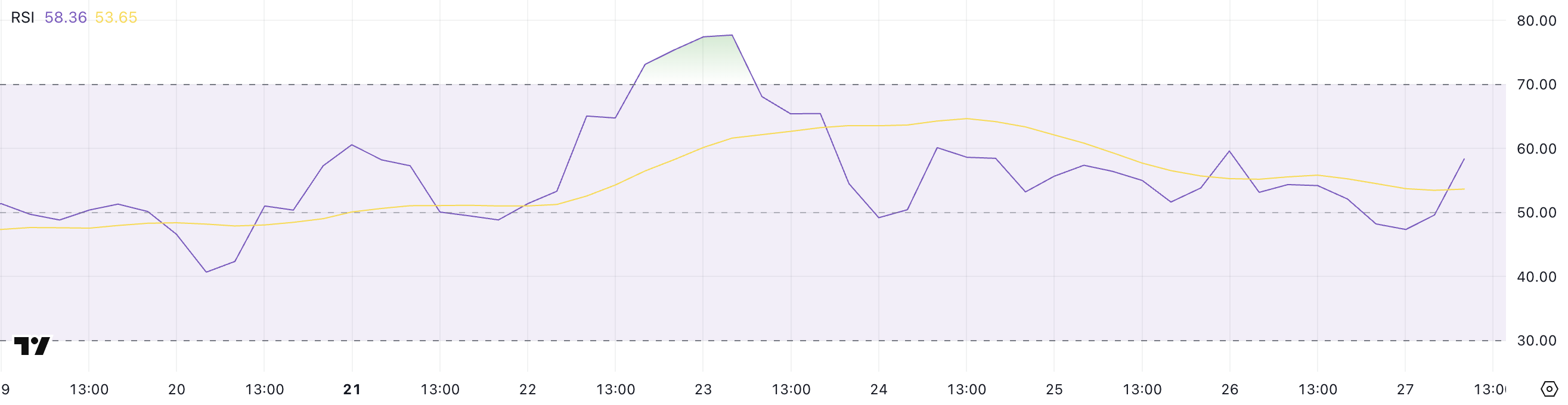
XRP’s Relative Strength Index (RSI) currently stands at 58.36, rising from 47.34 earlier today but still down from 77.7 reached four days ago.
This movement shows a recovery from recent lower levels, although it remains below the overbought conditions seen earlier in the week.
The recent RSI trend suggests that while bullish momentum has resurfaced in the short term, XRP has not yet regained the same strength it displayed just a few days ago, signaling a more cautious sentiment among traders.
 XRP RSI. Source:
TradingView.
XRP RSI. Source:
TradingView.
RSI, or Relative Strength Index, is a momentum oscillator that measures the speed and change of price movements on a scale from 0 to 100.
Typically, an RSI above 70 signals that an asset is overbought and might be due for a correction, while an RSI below 30 indicates it is oversold and could be poised for a rebound.
With XRP’s RSI now at 58.36, the asset is in neutral-to-slightly-bullish territory, suggesting there is still room for further gains without immediately triggering overbought conditions.
If buying pressure continues, this could set the stage for a gradual upward move, though a lack of strong momentum could also result in range-bound trading.
XRP Hovers Above Cloud as Momentum Stalls
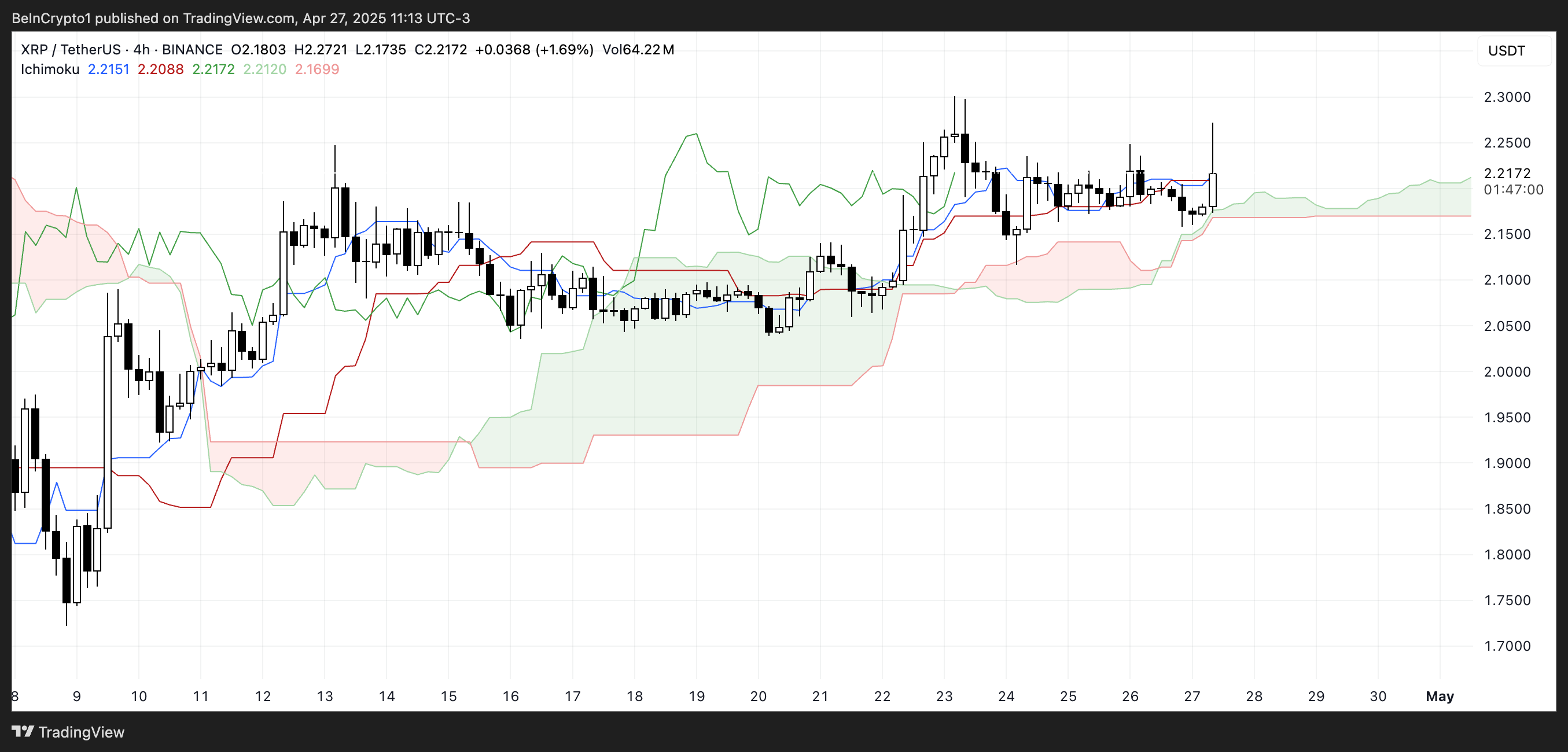
The Ichimoku Cloud for XRP presents a bullish structure, with the price just slightly above the cloud.
The blue (Tenkan-sen) and red (Kijun-sen) lines are close to the current candle, reflecting a market with a slight bullish bias but without strong momentum.
The future cloud remains green, indicating that bullish conditions are still projected ahead. However, the proximity of the lines to the price suggests some hesitation or consolidation in the short term.
 XRP Ichimoku Cloud. Source:
TradingView.
XRP Ichimoku Cloud. Source:
TradingView.
The Ichimoku system fully views trend direction, momentum, and support/resistance areas.
When the price is above the cloud with a green cloud ahead, it usually signals a favorable trend, but when the Tenkan-sen and Kijun-sen hug the price closely, it can indicate a lack of clear conviction from either buyers or sellers.
In XRP’s case, the bullish trend remains intact, but the tight positioning of the lines points to a fragile uptrend where a sharp move in either direction could easily shift the structure.
XRP Outlook: Will Bulls or Bears Take Control?
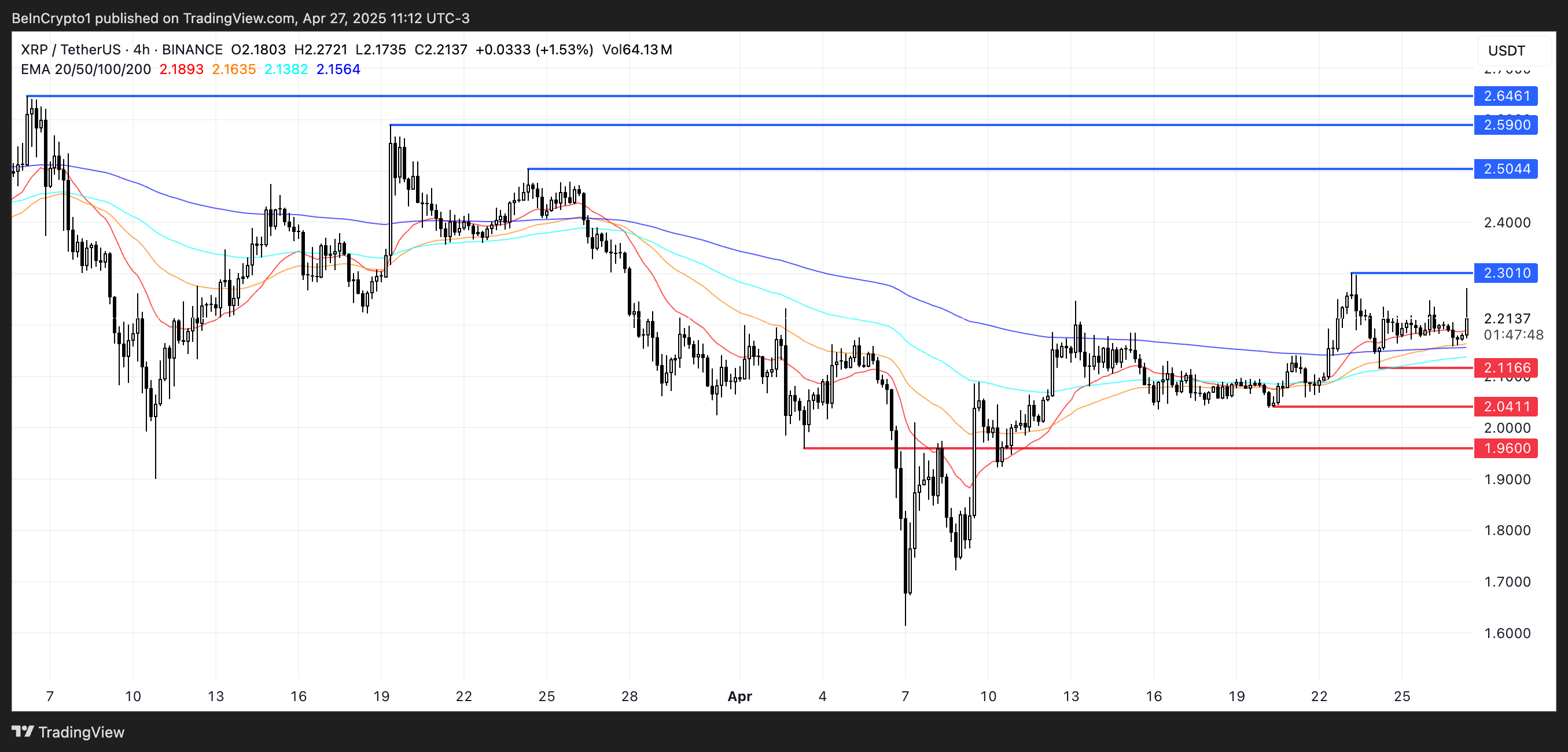
XRP price is trading within a tight range, caught between a resistance level of $2.30 and a support level of $2.11.
This sideways movement comes just two days after the launch of the world’s first XRP ETF in Brazil, a development that could eventually influence market sentiment.
If XRP falls and loses the $2.11 support, it could lead to a decline toward the next support level, $2.04.
 XRP Price Analysis. Source:
TradingView.
XRP Price Analysis. Source:
TradingView.
Should bearish momentum intensify further, a deeper retracement could see XRP test lower levels at $1.96, making it crucial for buyers to defend the current support zone.
Conversely, if XRP tests and breaks above the $2.30 resistance with strong bullish momentum, the next upside target would be around $2.50.
Continued strength could push the price toward $2.59, potentially extending to $2.64 if buyers maintain control.
Disclaimer: The content of this article solely reflects the author's opinion and does not represent the platform in any capacity. This article is not intended to serve as a reference for making investment decisions.
You may also like
Federal Reserve meeting minutes turn "hawkish"! Most officials support another rate hike this year, US dollar continues to rise
The latest minutes released by the Federal Reserve show that all 19 officials support a rate hike in September, and most participants believe that further interest rate increases may still be needed before the end of the year.
High yields on US Treasuries start attracting buyers; $39 billion 10-year Treasury auction sees strong demand as long-end yields give back gains
U.S. Treasury bonds showed mixed performance on Wednesday after a $39 billion 10-year Treasury auction saw strong demand, indicating that as yields reach multi-decade highs, some major investors are starting to re-enter the market.
Overnight U.S. Stocks | Federal Reserve officials expect another rate hike before the end of the year, three major indexes closed lower, Micron Technology (MU.US) rose 4%
At the close, the Dow Jones Industrial Average fell by 341.41 points, down 0.66%, to 51,179.87 points; the S&P 500 Index dropped by 17.20 points, down 0.22%, to 7,801.73 points; and the Nasdaq Composite Index declined by 61.20 points, down 0.22%, to 27,538.69 points.
Federal Reserve meeting minutes: All 19 policymakers support a rate hike in September, but reasons vary; most expect further hikes this year, suggesting no urgency in October.
Most officials view a September interest rate hike as an "insurance" measure against stubborn inflation; a minority see it as a necessary step to curb inflation. Overall, there is no indication of a desire to push for consecutive rate hikes. The "New Fed News Agency" emphasized the minutes: "Most participants believe that it may be appropriate to raise interest rates again before the end of the year." Nearly all officials believe inflation remains elevated and the labor market is close to full employment. Many noted that, despite the rise in long-term U.S. Treasury yields, financial conditions are still conducive to economic growth. Some officials believe that AI will boost investment and productivity, but may also contribute to inflation. The minutes revealed that the U.S.-Japan joint intervention in July to support the yen was a U.S. Treasury action, with no Federal Reserve funds used.
Crypto prices
More


