
North Carolina House passes state crypto investment bill

North Carolina’s House of Representatives has passed a bill allowing the state’s treasurer to invest public funds in approved cryptocurrencies, which will now head to the Senate.
The House passed the Digital Assets Investment Act, or House Bill 92, on its third reading on April 30 by a vote of 71 to 44.
Republican House Speaker Destin Hall introduced the bill in February, which would allow the treasurer to allocate 5% of the state’s investments into designated digital assets.
The investments can only be made after obtaining an independent third-party assessment confirming that the crypto holdings are maintained with a secure custody solution and risk oversight and regulatory compliance standards are met.
New amendments allow the treasurer to examine the feasibility of allowing members of retirement and deferred compensation plans to elect to invest in digital assets held as exchange-traded products ( ETPs ).
The House also passed a related bill, the State Investment Modernization Act, or HB 506 , with little discussion on April 30, in a 110 to 3 vote.
The bill aims to create the North Carolina Investment Authority (NCIA) to take over investment management from the treasurer.
If passed into law, authority to invest in digital assets would transfer from the treasurer to NICA, and it would require approval from its board of directors based on third-party assessments to make crypto investments.
Local news outlet NC Newsline reported that Treasurer Brad Briner supports both bills.
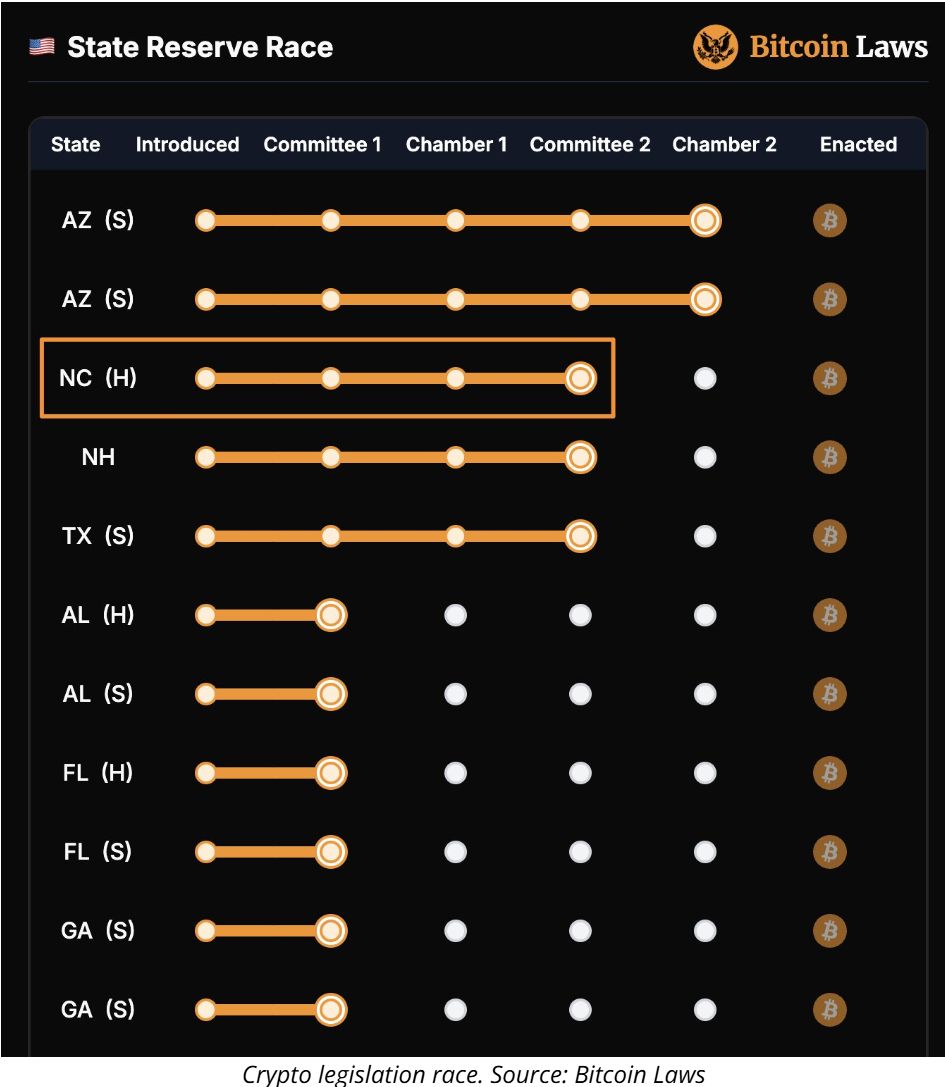
Arizona leads the crypto bill race
North Carolina is second to Arizona in the state-level race to approve legislation allowing local governments to invest in cryptocurrencies.
On April 28, Arizona’s House approved two bills , SB 1025 and SB 1373, proposing different methods for the state to establish a crypto reserve.
Arizona is the only state whose House and Senate have passed crypto-related bills, which are both awaiting Governor Katie Hobbs’ decision.
Disclaimer: The content of this article solely reflects the author's opinion and does not represent the platform in any capacity. This article is not intended to serve as a reference for making investment decisions.
You may also like
What does Meta Muse mean for GPU and CPU?
Unlike chatbots with a high idle rate, the “always online” nature of intelligent agents like Meta Muse leads to a dramatic increase in computing power consumption. Citi predicts that this trend will shift the CPU-GPU ratio from 1:8 during the training phase to 1:1, driving the CPU market to reach $300 billion by 2030. Meanwhile, just 100 million daily active Muse users could generate up to $19 billion in GPU revenue for Nvidia.
Amazon (AMZN.US) begins a new round of small-scale layoffs, with the retail division hit hardest
Amazon confirmed on Wednesday that the company has laid off a small number of employees, mainly involving its Stores division, which is responsible for its main e-commerce website.
The US stock Q3 earnings season kicks off: Profit growth expected to approach 30%. Can this boost the S&P 500 to new highs?
The AI engine is running at full speed, with S&P 500 profit growth approaching 30%. However, the deterioration in market breadth and high U.S. Treasury yields remain concerns.
Crypto prices
More


