
New Litecoin Price Prediction Targets $100 and Beyond – Where Is LTC Headed Next?

By:Michael Davis
Bitget offers one-stop trading for cryptocurrencies, stocks, and gold. Trade now!
A welcome pack worth 6200 USDT for new users! Sign up now!
Disclaimer: Crypto is a high-risk asset class. This article is provided for informational purposes and does not constitute investment advice. You could lose all of your capital.
 New Litecoin Price Prediction Targets $100 and Beyond / Source: Cryptonews
Litecoin (LTC) price predictions are becoming more bullish, with traders turning their focus to a near-term retest of $100, and perhaps as high as late-2024/early-2025 highs in the $140 area in the coming weeks.
Last around $87, the Litecoin price has been in a strong uptrend in recent weeks. Since bouncing at its early April lows under $64, LTC has risen around 40%.
In doing so, its broken convincingly above its 21 and 50DMAs, as well as a multi-week downtrend.
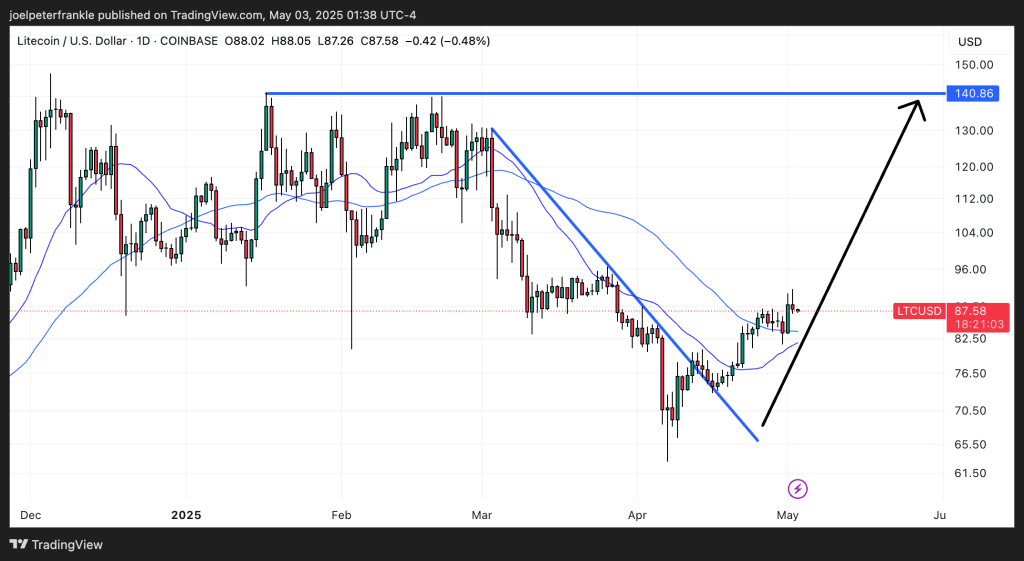
Bulls are now focused on a likely near-term retest of the $97 area, a major zone of support-turned-resistance going back to December.
A break above here would unlock a move higher towards recent multi-month highs in the $140s, more than 60% up versus current levels.
Chart analysis suggests this is the likeliest next move for Litecoin . But with macro risks growing in the background, a lot of uncertainty remains.
Where Next for the Litecoin Price?
The strong rally in crypto and US stock markets in recent weeks has been driven by hopes that US President Donald Trump is backing off from his trade war, and the economic shock of trade uncertainty won’t be so bad.
Forward looking “soft” US economic data releases paint a picture of a rapidly deteriorating economy.
But more backwards looking “hard” data, like the US jobs report released on Friday , show the economy holding up for now, underpinning the optimistic attitude of the market.
That said, sentiment could quick turn for the worse if recession fears come flooding back. And altcoins like Litecoin are highly exposed to a possible pullback.
Sure, the Litecoin price could reach back to its recent highs in the $140 area in the coming months.
But traders would do well not to chase the rally higher. That’s not until the conditions for a new altcoin season really start to fall into place.
Historically these conditions have been 1) major central banks pumping the market full of liquidity and 2) strong economic growth and optimism about the future.
With the Fed still concerned about “sticky” inflation and trade uncertainty unlikely to abate any time soon, these goldilocks conditions for altcoins aren’t likely to arrive any time soon.
0
1
Disclaimer: The content of this article solely reflects the author's opinion and does not represent the platform in any capacity. This article is not intended to serve as a reference for making investment decisions.
Understand the market, then trade.
Bitget offers one-stop trading for cryptocurrencies, stocks, and gold.
Trade now!
You may also like
Analysis - European Dilemma Provides New Reason for Dollar Bulls to Remain Optimistic
The US dollar has risen 5% against the euro, with some investors expecting further strengthening. The options market has become strongly bearish on the euro, as concerns over France’s fiscal situation and political uncertainty are creating pressure points for the eurozone. Laura Matthews/Saqib Iqbal Ahmed, Reuters New York, October 8 – This fall, the dollar surged to an 18-month high, with the latest rally fueled by uncertainty across the Atlantic, prompting some investors to bet the dollar will appreciate further. Analysts say the dollar continues to receive support from high—and possibly rising—US interest rates, robust economic growth, and persistent inflation risks. However, broader pressure centered on France’s massive fiscal deficit, potentially spreading to Italy and the wider eurozone, is emerging as a primary driver for the dollar in the coming months. So far this year, the dollar has appreciated about 5% against the euro, boosting the dollar index .DXY, which measures the dollar’s strength against six major currencies, including the euro (its largest component). “The euro remains under pressure, limiting one of the main alternatives to the dollar,” said Yuuto Shinohara, Senior Investment Strategist at Mesirow Currency Management. Last week, the yield spread between French and German 10-year government bonds recorded its largest weekly increase in decades, while the Italy-Germany yield spread saw its biggest weekly surge since the pandemic. The euro EUR= was last at 1.1183, down 0.67% against the dollar. “The market is focused on countries that, due to political dysfunction, cannot restore sustainable fiscal trajectories,” said Karl Schamotta, Chief Market Strategist at Toronto’s Corpay. One concern is that the euro no longer receives much support from the European Central Bank’s hawkish signals. The ECB raised rates by 25 basis points in September—its second hike this year to counter energy-driven inflation—but the euro fell after the decision, as markets worried about the impact of future hikes on the economy. Typically, rising European bond yields support the euro, but the euro's muted response suggests investors are increasingly concerned about growth and fiscal risks. Rising energy prices could add further pressure. “Structurally, Europe is a major energy importer and is more manufacturing-dependent than the US. The impact is obvious: high energy prices will drag down the region,” said Benjamin Ford, a researcher at Macro Hive. Ford expects the euro to fall to $1.10 within the next month, nearly 2% lower than current levels. “The US medium-term outlook seems stronger, while Europe is more susceptible to shocks,” Ford said. Policy Missteps Investors are also weighing whether the ECB can continue fighting inflation without causing greater harm to already weakening economies. The eurozone inflation rate (link) exceeded expectations in September, and with energy costs surging, it may rise further in coming months, keeping pressure on the ECB to hike rates. “There’s clear asymmetric downside risk for the euro at present,” said Dan Tobon, Citi’s Head of G10 FX Strategy in New York. “One of the likeliest triggers is policy error—if the ECB overtightens at a time when markets can’t bear it.” Euro risk reversal for one-month options, which measures whether traders are paying more to hedge against euro losses than gains, hit its most bearish level since March last Friday, while the three-month indicator touched its lowest point since June 2024. Federal Reserve policymakers have signaled that inflation risks remain high, which has helped keep US Treasury yields at multi-year highs. “Yields continue to rise, and US rates have an absolute advantage over most developed markets,” Shinohara said. Federal funds futures show about an 84% chance of at least one more 25-basis-point hike by December. Although few strategists expect the dollar to surge dramatically from current levels, they note that US economic resilience, sustained high yields, and Europe’s unique risks continue to tilt the balance toward the dollar. “For now, this imbalance looks very unfavorable for Europe,” Citi’s Tobon said. (For the convenience of non-native English speakers, Reuters automates translation of its reports into several other languages. As automated translation may be flawed or lack necessary context, Reuters does not guarantee the accuracy of such translations. They are provided solely for the readers’ convenience, and Reuters accepts no liability for any damage or loss arising from use of automated translation.)
路透社•2026/10/08 10:11

Privacy coins: the missing layer between crypto and institutions
CryptoValleyJournal•2026/10/08 09:24
Altcoin NEAR Pumps by Over 6% as the Rest of the Crypto Market Bleeds, Next Bull Target for NEAR Soon?
Cryptonewsland•2026/10/08 08:54
Crypto prices
More
Bitcoin
BTC
$82,641.15
-1.32%

Ethereum
ETH
$2,547.51
-1.29%

Tether USDt
USDT
$0.9993
-0.04%

BNB
BNB
$766.05
-0.06%

XRP
XRP
$1.4
-3.35%

USDC
USDC
$0.9998
-0.01%

Solana
SOL
$114.34
-2.83%

TRON
TRX
$0.3361
+0.85%

Hyperliquid
HYPE
$86.49
-3.32%

Zcash
ZEC
$1,204.63
-7.87%
How to buy BTC
Bitget lists BTC – Buy or sell BTC quickly on Bitget!
Trade now
Become a trader now?A welcome pack worth 6200 USDT for new users!
Sign up now