
PENGU vs. DOOD: Which Token is Winning the NFT Race?

PENGU vs. DOOD: A Tale of Two NFT Tokens
In the fast-evolving world of NFTs and crypto, two powerhouse projects have captured the spotlight: Pudgy Penguins and Doodles . Both launched their own native tokens—PENGU and DOOD—with ambitions to strengthen their ecosystems and reward their communities. But despite sharing similar goals, their strategies, market receptions, and token performances tell very different stories. In this article, we break down what’s common, what sets them apart, and how each token has performed since launch.
🔍 Overview
PENGU (Pudgy Penguins) DOOD (Doodles)| Launch Date | December 17, 2024 | May 8, 2025 |
| Blockchain | Solana | Solana |
| Total Supply | 88.88 billion | 10 billion |
| Community Allocation | ~25.9% via airdrop | 68% allocated to community growth |
| Initial Market Cap | ~$2.8 billion | Over $100 million |
| Current Price (as of May 13, 2025) | ~$0.0138 | ~$0.0057 |
| All-Time High (ATH) | $0.0692 on Dec 17, 2024 | $0.01314 on May 9, 2025 |
| Current Market Cap | ~$874 million | ~$45 million |
📈 Token Performance Since Launch
PENGU
- Launch Price: $0.05738
- All-Time High: $0.0692 on December 17, 2024
- All-Time Low: $0.003715 on April 9, 2025
- Current Price: ~$0.0138
- Performance: PENGU experienced heavy volatility after an initial surge, dropping over 50% shortly after launch. Despite this, it demonstrated resilience with a strong recovery early in 2025, including a notable 28% pump in January.
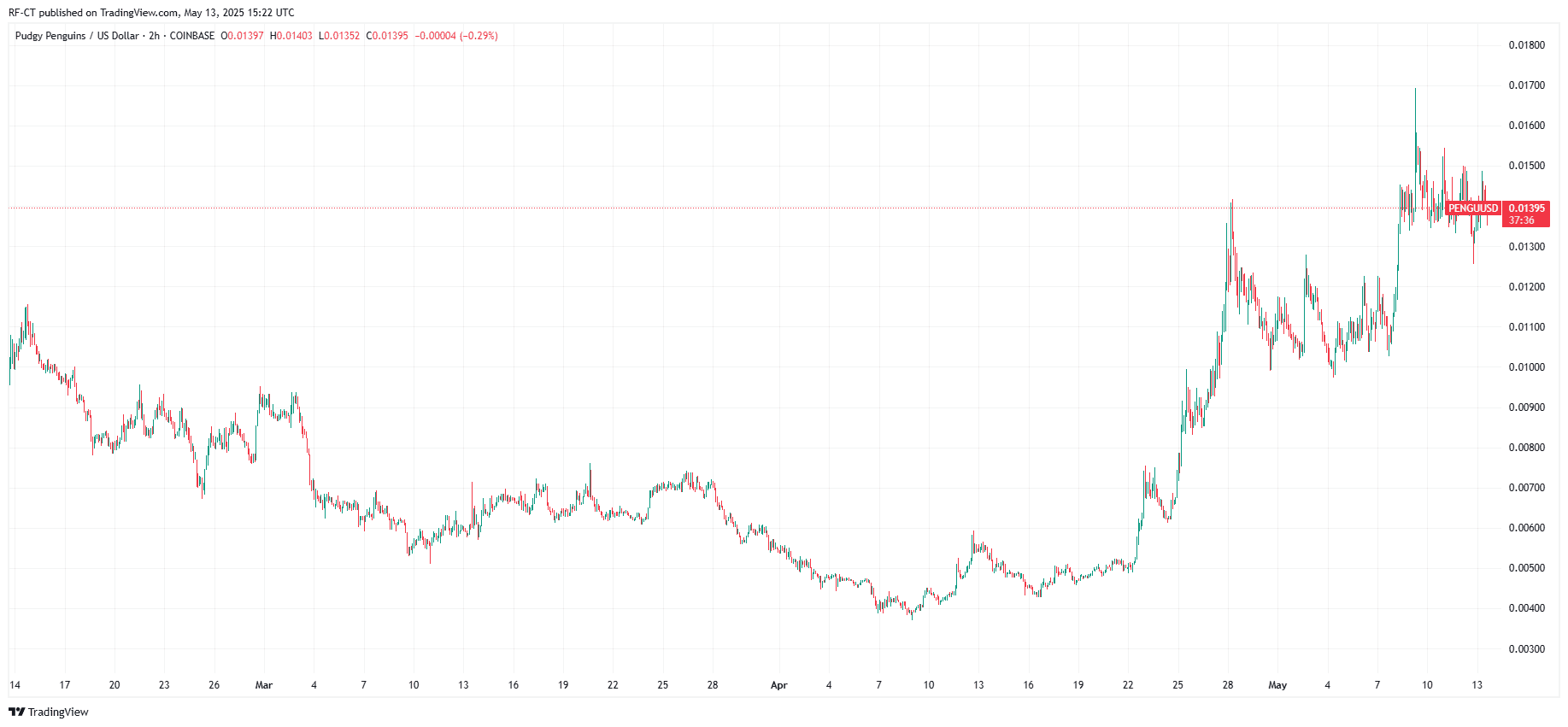 By TradingView - PENGUUSD_2025-05-13 (All)
DOOD
- Launch Date: May 8, 2025
- All-Time High: $0.00897 on May 9, 2025
- Current Price: ~$0.0057
- Performance: DOOD struggled to maintain its initial momentum. It faced an almost immediate drop of 40% in market cap, driven by confusion over its utility and the surprising choice of launching on Solana despite Doodles originally being an Ethereum-based collection.
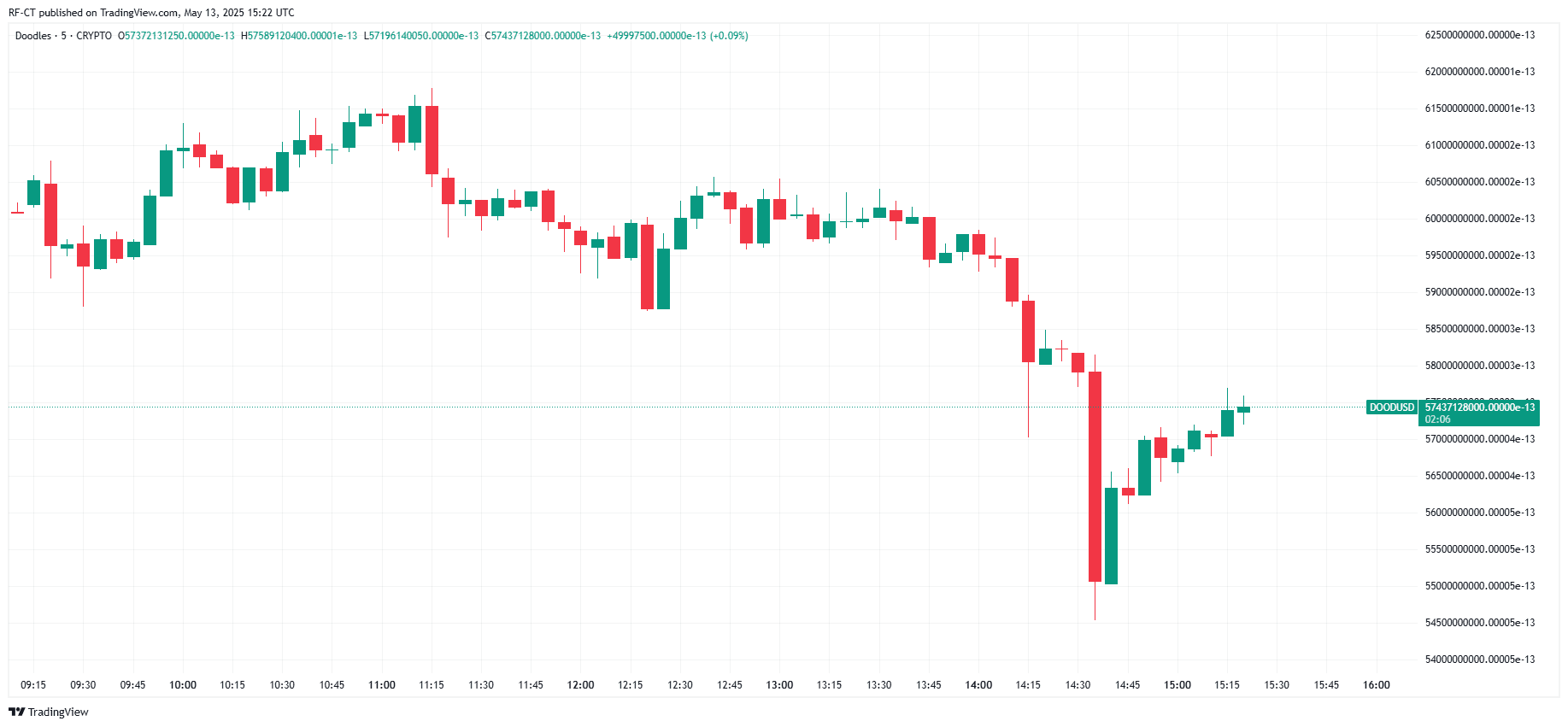 By TradingView - DOODUSD_2025-05-13 (All)
🔄 Commonalities
Blockchain: Both tokens launched on Solana , taking advantage of its speed and low transaction fees .
Community Focus: Both emphasized strong community involvement through significant token allocations.
NFT Ecosystem Expansion: PENGU and DOOD are both tied directly to their respective NFT projects, designed to reward holders and enhance ecosystem utility.
⚖️ Key Differences
Launch Timing: PENGU launched in December 2024, capitalizing on year-end market activity. DOOD launched in May 2025 but faced challenges from the start.
Token Utility: PENGU quickly integrated with physical products and brand partnerships like Walmart and Amazon. DOOD, however, is still in the early phases of defining its real-world utility.
Market Reception: PENGU has shown better resilience after initial volatility, while DOOD is still finding its footing in the market.
📊 Token Performance Summary
| PENGU | $0.05738 | $0.0692 | $0.003715 | ~$0.0138 | ~$874 million |
| DOOD | $0.01314 | $0.00897 | $0.005476 | ~$0.0057 | ~$45 million |
🧠 Conclusion
Both PENGU and DOOD represent bold moves by their parent NFT projects to grow beyond digital art into full-fledged ecosystems. While PENGU appears to have found stronger footing through tangible product integrations and wider brand appeal, DOOD’s journey is just beginning , and its success will largely depend on how effectively the Doodles team delivers real-world utility.
For investors and collectors alike, keeping a close eye on the development of each ecosystem is crucial, as the NFT space continues to blend with mainstream consumer markets.
PENGU vs. DOOD: A Tale of Two NFT Tokens
In the fast-evolving world of NFTs and crypto, two powerhouse projects have captured the spotlight: Pudgy Penguins and Doodles . Both launched their own native tokens—PENGU and DOOD—with ambitions to strengthen their ecosystems and reward their communities. But despite sharing similar goals, their strategies, market receptions, and token performances tell very different stories. In this article, we break down what’s common, what sets them apart, and how each token has performed since launch.
🔍 Overview
PENGU (Pudgy Penguins) DOOD (Doodles)| Launch Date | December 17, 2024 | May 8, 2025 |
| Blockchain | Solana | Solana |
| Total Supply | 88.88 billion | 10 billion |
| Community Allocation | ~25.9% via airdrop | 68% allocated to community growth |
| Initial Market Cap | ~$2.8 billion | Over $100 million |
| Current Price (as of May 13, 2025) | ~$0.0138 | ~$0.0057 |
| All-Time High (ATH) | $0.0692 on Dec 17, 2024 | $0.01314 on May 9, 2025 |
| Current Market Cap | ~$874 million | ~$45 million |
📈 Token Performance Since Launch
PENGU
- Launch Price: $0.05738
- All-Time High: $0.0692 on December 17, 2024
- All-Time Low: $0.003715 on April 9, 2025
- Current Price: ~$0.0138
- Performance: PENGU experienced heavy volatility after an initial surge, dropping over 50% shortly after launch. Despite this, it demonstrated resilience with a strong recovery early in 2025, including a notable 28% pump in January.
By TradingView - PENGUUSD_2025-05-13 (All)
DOOD
- Launch Date: May 8, 2025
- All-Time High: $0.00897 on May 9, 2025
- Current Price: ~$0.0057
- Performance: DOOD struggled to maintain its initial momentum. It faced an almost immediate drop of 40% in market cap, driven by confusion over its utility and the surprising choice of launching on Solana despite Doodles originally being an Ethereum-based collection.
By TradingView - DOODUSD_2025-05-13 (All)
🔄 Commonalities
Blockchain: Both tokens launched on Solana , taking advantage of its speed and low transaction fees .
Community Focus: Both emphasized strong community involvement through significant token allocations.
NFT Ecosystem Expansion: PENGU and DOOD are both tied directly to their respective NFT projects, designed to reward holders and enhance ecosystem utility.
⚖️ Key Differences
Launch Timing: PENGU launched in December 2024, capitalizing on year-end market activity. DOOD launched in May 2025 but faced challenges from the start.
Token Utility: PENGU quickly integrated with physical products and brand partnerships like Walmart and Amazon. DOOD, however, is still in the early phases of defining its real-world utility.
Market Reception: PENGU has shown better resilience after initial volatility, while DOOD is still finding its footing in the market.
📊 Token Performance Summary
| PENGU | $0.05738 | $0.0692 | $0.003715 | ~$0.0138 | ~$874 million |
| DOOD | $0.01314 | $0.00897 | $0.005476 | ~$0.0057 | ~$45 million |
🧠 Conclusion
Both PENGU and DOOD represent bold moves by their parent NFT projects to grow beyond digital art into full-fledged ecosystems. While PENGU appears to have found stronger footing through tangible product integrations and wider brand appeal, DOOD’s journey is just beginning , and its success will largely depend on how effectively the Doodles team delivers real-world utility.
For investors and collectors alike, keeping a close eye on the development of each ecosystem is crucial, as the NFT space continues to blend with mainstream consumer markets.
Disclaimer: The content of this article solely reflects the author's opinion and does not represent the platform in any capacity. This article is not intended to serve as a reference for making investment decisions.
You may also like
Anthropic (ANT.US) nearly “broke issue price,” but Claude knocks on the doors of “the highest peak in mathematics”! 17 million lines of Lean code used to write a candidate proof for the Riemann Hypothesis
On November 20th, Eastern Time, on its second day of trading, Anthropic's intraday price dropped to a low of $83.05, just 5 cents above the offering price of $83, and finally closed at $88.91, a decline of 8.50%. On the same day, the company's mathematician Levant Alperg announced on his personal website that he and Claude had found a candidate proof for the Riemann hypothesis, which has puzzled the mathematics community for 167 years, and released about 17 million lines of Lean formalized code.

As US stocks plummet, the parent company of GTA 6 rises against the market! First-day sales hit a record $3.79 billion; Wall Street shifts focus to next-generation GTA Online.
According to Rentrak data, the global box office of "Grand Theft Auto VI" has also surpassed that of "Avengers: Endgame," the highest-grossing film of all time, which has a global box office of approximately $2.94 billion.

$2.3 trillion “vanished into thin air”! The last time US chip stocks fell this badly was in 2001, Nvidia has already “lost an Amazon’s worth”.
This week, the Philadelphia Semiconductor Index dropped by over 10%, wiping out approximately $2.3 trillion in market capitalization from the chip sector, marking its worst single-week performance since 2001. Nvidia’s stock price has fallen for seven consecutive weeks, shrinking its market value by about $2.7 trillion since its October peak. Tightened financing support from Nvidia and the Anthropic IPO siphoning off liquidity, combined with continued hawkish signals from the Federal Reserve, have added further pressure. AI-related trades have faced concentrated sell-offs, and market concerns about future growth prospects are intensifying.
Nasdaq evaporated over $4 trillion in a week! After the global stock market's "Black Friday," the market begins to anticipate an AI industry chain rebound after excessive declines.
The S&P 500 Index plunged by 3.70% on Friday to 6,910.39 points, falling for the seventh consecutive trading day. Alongside the Dow Jones Industrial Average, which dropped 1.93%, both indices pulled back more than 10% from their historic closing highs, confirming entry into a technical correction. The Nasdaq Composite Index fell 5.28%, erasing its gains for the year. The Nasdaq 100 Index dropped 5.61%, falling about 19.84% from its historic closing high on October 6. At one point during the session, the decline exceeded 20%, entering what is referred to as a "technical bear market area."
Crypto prices
More


