
Kaito: Previously Signed Market-Making Agreement with Web3Port, but Terminated Cooperation Before Exchange Investigation in March

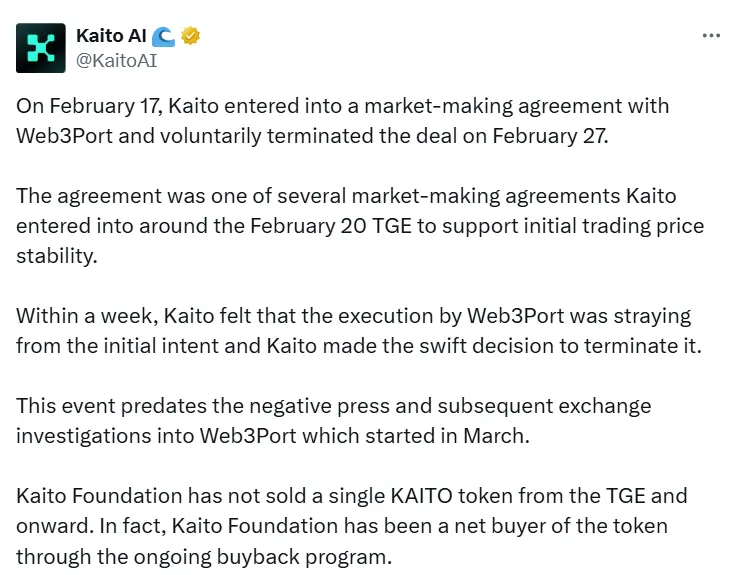
Kaito Al disclosed on the X platform that on February 17, Kaito signed a market-making agreement with Web3Port and voluntarily terminated the transaction on February 27.
This agreement was one of several market-making agreements Kaito reached around the TGE on February 20, aimed at supporting the stability of the initial trading price. In less than a week, Kaito felt that Web3Port's execution deviated from the original intention and quickly decided to terminate the project.
This incident occurred before the negative reports about Web3Port and the subsequent exchange investigation in March. Since the TGE, the Kaito Foundation has never sold any KAITO tokens. In fact, through an ongoing buyback program, the Kaito Foundation has consistently been a net buyer of the token.
Disclaimer: The content of this article solely reflects the author's opinion and does not represent the platform in any capacity. This article is not intended to serve as a reference for making investment decisions.
You may also like
Analyst Gu Jingci: Follow the trend and adapt flexibly
XRP Ledger adds account control feature, enabling enterprises to manage assets offline.

BUZZ - Goldman Sachs says the price cap on cancer drugs has limited impact on Indian hospitals
October 9 – Goldman Sachs pointed out that India's implementation of a 30% profit margin cap on non-scheduled anticancer drugs (link) will have limited impact on hospitals. The report states that, based on preliminary discussions with hospital chain groups, such drugs account for less than 5% of hospital revenue and 2% to 2.5% of operating profit. The report adds that hospitals can offset the losses by slightly adjusting service charges, such as administration fees. According to a government notice, an expert committee will finalize the list of drugs to be brought under regulation. Driven by the anticipated price cap, the share prices of Max Healthcare MAXE.NS, Apollo Hospitals APLH.NS, and Fortis Healthcare FOHE.NS rose by 1.6% to 2.5%. Previously, since September 30, these stocks had collectively declined by 11% to 11.5%. Year-to-date, FOHE and MAXE are down 11.7% and 14.8%, respectively, while APLH has risen by 11%. (To assist non-English speakers, Reuters provides automated translations of its reports into several other languages. Due to potential errors or missing context in automated translations, Reuters does not guarantee the accuracy of automatic translation texts and offers them solely for readers’ convenience. Reuters accepts no responsibility for any damage or loss caused by using these automated translation features.)

Adding insult to injury! Japanese electronics giant Nidec downgraded by UBS, stock price plunges over 9% and approaches an 11-month low
UBS has downgraded Nidec's rating from "Buy" to "Neutral" and lowered its target price from 2,800 yen to 2,400 yen, citing a more challenging market environment.
Crypto prices
More


