Bitget App
Trade smarter
Buy cryptoMarketsTradeFuturesStocksEarnInstitutionAI & More
Worldcoin Secures $135 Million Investment to Expand Biometric Operations in the US While Increasing WLD Token Circulation

Worldcoin Secures $135 Million Investment to Expand Biometric Operations in the US While Increasing WLD Token Circulation

CoinotagCoinotag2025/05/21 16:00
By:Marisol Navaro
  • Worldcoin is making headlines by securing $135 million in funding through a strategic sale of its WLD tokens, aimed at expanding its biometric operations in the US.

  • The investment, featuring notable firms like a16z and Bain Capital Crypto, highlights the growing interest in biometric identity solutions despite previous regulatory hiccups.

  • As stated by Worldcoin, “This was a direct purchase of non-discounted liquid tokens,” underscoring the confidence of early backers amidst regulatory uncertainties.

This article explores Worldcoin’s recent $135 million funding through WLD tokens aimed at expanding its biometric identity verification infrastructure in the US.

Worldcoin Fundraises with WLD Tokens

Worldcoin, spearheaded by OpenAI founder Sam Altman, has recently captured attention by announcing a substantial fundraise involving a direct sale of WLD tokens. Through this initiative, the company raised $135 million, primarily intended for bolstering its biometric identity verification operations across the United States.

According to a press release from the company, these funds will not only fortify existing operations but also facilitate the rollout of new eye-scanning infrastructure in key US cities, following a similar expansion that took place in May.

“World Foundation raised $135 million from a16z and Bain Capital Crypto. Funding was through a recent direct purchase of liquid, market-priced WLD. The funding comes from two of World’s earliest backers and long-term holders — a16z and Bain Capital Crypto. This wasn’t a venture round. It was a direct purchase of non-discounted liquid tokens,” stated the firm.

The deal not only increases the circulating supply of WLD but also triggered a significant market cap spike of $135 million within hours of the announcement. This unusual market activity directly correlates with the timing of the funding, raising questions about market dynamics and investor confidence.
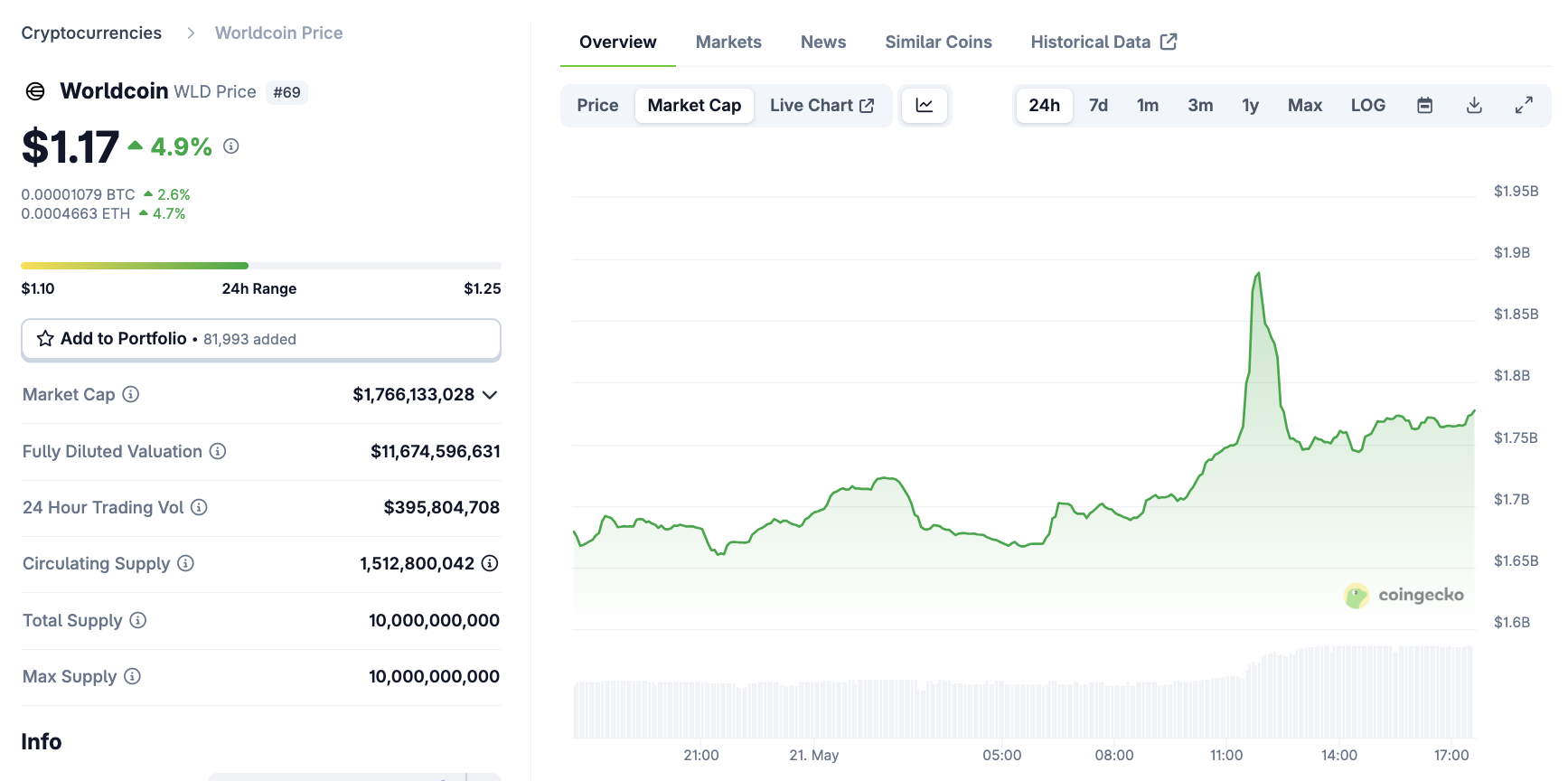
Worldcoin Secures $135 Million Investment to Expand Biometric Operations in the US While Increasing WLD Token Circulation image 0

Worldcoin (WLD) Market Cap. Source: CoinGecko

This fresh influx of capital is critical for Worldcoin as it navigates a turbulent regulatory landscape. In recent months, German authorities, along with regulators in Kenya and Indonesia, have imposed restrictions on its data collection practices, challenging the project’s operational viability.

Previously, WLD experienced a surge in value due to speculations surrounding potential integration with OpenAI’s services, but the anticipated partnership has yet to materialize.

Beyond a16z and Bain Capital Crypto, other investors including Selini Capital, Mirana Ventures, and Arctic Digital participated in a traditional funding round, which did not involve WLD tokens.

Strategic Growth in Biometric Operations

Thanks to this financial backing, Worldcoin is poised to enhance its biometric identity verification initiatives. The company is enthusiastic about expanding its user base and constructing additional physical hubs for data collection across the United States.

While details regarding specific applications of the $135 million remain vague, company representatives discussed the potential for integrating AI technologies along with their existing biometric infrastructure.

Future Prospects Amid Regulatory Challenges

Looking ahead, the outcome of this investment will be essential for Worldcoin, particularly in light of ongoing scrutiny from various international regulatory bodies. The firm’s proactive approach in securing additional funding may signal a strategic pivot towards compliance and innovation.

Worldcoin’s commitment to expanding its operations amidst regulatory hurdles underscores its determination to remain a significant player in the biometric identity sector.

Conclusion

In summary, Worldcoin’s recent funding round through direct WLD token sales exemplifies a bold move to solidify its operations in the US market while facing regulatory challenges. As it continues to enhance its biometric verification infrastructure, stakeholders will keenly observe how this investment shapes its future in an increasingly competitive landscape.

In Case You Missed It: Coinbase Could Potentially Lead Circle Buyout Amid IPO Plans Uncertainty
1
0

Disclaimer: The content of this article solely reflects the author's opinion and does not represent the platform in any capacity. This article is not intended to serve as a reference for making investment decisions.

Understand the market, then trade.
Bitget offers one-stop trading for cryptocurrencies, stocks, and gold.
Trade now!

You may also like

Updated: Delta Air Lines warns that as fuel prices hit profits, airline capacity will tighten further

Delta Airlines lowers its annual profit forecast due to an expected increase in fuel costs to $6 billion. The CEO stated that ticket prices have risen by about 20% this year, with limited passenger resistance. Analysts warn that maintaining high ticket prices in 2027 is critical for improving profitability. The article includes comments from the earnings call and analyst remarks. Rajesh Kumar Singh/Shivansh Tiwary, Reuters Chicago, October 9 - Delta Airlines (DAL.N) said on Friday that, despite strong travel demand and rising ticket prices, soaring fuel costs have forced it to cut its 2026 profit expectations by nearly a quarter. So, the airline industry may need to further limit flight growth next year to protect profitability. This warning highlights the increasingly tough challenges faced by U.S. airlines. While strong demand and restricted seat growth have allowed airlines to significantly raise ticket prices and offset higher fuel costs, aggressively increasing flights to capture more demand may intensify competition, making it harder to maintain high fares and protect profits. Based in Atlanta, Delta now expects its annual fuel expenditure to increase by about $6 billion compared to last year—about $2 billion higher than its July forecast—due to the Iran war (link) causing global jet fuel prices to spike. Airlines worldwide are preparing for a prolonged fuel shock. Michael O’Leary, CEO of Ryanair Group RYA.I, said Thursday that high jet fuel prices could persist for another 12-18 months (link), adding more pressure on airlines to raise fares and control costs. https://www.reuters.com/graphics/AUTOMATED-20261008/A4A-JET-FUEL-DAILY-1Y/xmpjwjnmbvr/chart.png “In a high-cost environment, you can’t simply grow your way out,” Delta CEO Ed Bastian said on the earnings call. He noted that the industry has already taken steps to restrict capacity, but more measures will be needed next year to improve profitability. Bastian said Delta raised ticket prices about 20% this year, and passenger resistance has been limited. He is confident that even if fuel costs eventually drop, the high fares can still be maintained. Delta lowered its adjusted annual earnings per share forecast from the July prediction of $6.50-$7.50 to $5.10-$5.60. According to LSEG data, the midpoint of the new range is below analysts’ average expectation of $5.46. Third-quarter adjusted earnings per share were $1.72, four cents below analysts’ average forecast. In midday trading, shares of Delta dropped 1.7%, United Airlines UAL.O fell 1.4%, and both American Airlines AAL.O and Southwest Airlines LUV.N were down about 1%. Delta partly shields itself from rising fuel costs by owning a refinery outside Philadelphia (link), which is expected to generate over $700 million in profits this year. Even with this buffer, the airline expects its fourth-quarter fuel price to rise from $3.61 per gallon in Q3 to $4.25 per gallon. Delta forecasts adjusted fourth-quarter earnings per share to be between $1.15-$1.65, with the $1.40 midpoint roughly matching analysts’ average expectation of $1.39. Fare increases Government data shows that in the first eight months of 2026, U.S. airlines spent $42.9 billion on fuel, an increase of $13.2 billion compared to the same period last year despite slightly reduced consumption. According to the U.S. Bureau of Labor Statistics, strong demand and limited seat growth pushed average U.S. airline ticket prices up by about 25% year-on-year between April and August. https://www.reuters.com/graphics/USA-AIRLINES/FUEL/lbpgdnbzwvq/chart.png Analysts at Melius Research said that despite surging fuel costs, Delta’s ability to raise fares helps keep second-half profits roughly stable. Still, they warn that the company’s profit margin has struggled to improve over the years. “It is critical for margin improvement to maintain or raise fares in 2027,” they wrote in their research report. With industry capacity growth expected to accelerate in Q4, this challenge will likely become even tougher. Deutsche Bank analysts expect the proportion of fuel costs recouped through revenue measures to fall in Q4 and predict full recovery won’t happen until early 2027. Bastian noted that low industry returns are another reason for limiting capacity growth. He said Delta will be cautious with its 2027 capacity plan until the fuel price outlook becomes clearer. He added that international routes may account for a larger share of Delta’s capacity expansion compared to domestic routes. Currently, Delta says its premium cabins and corporate travel business remain strong, and its economy cabin business is gradually improving. With Q4 ticket bookings already exceeding 60%, Delta expects revenue to increase about 20% year-on-year, despite limited capacity growth. Executives said early booking trends for Q1 2027 are also encouraging. (For the convenience of non-native English speakers, Reuters automatically translates its reports into several

路透社•2026/10/09 17:36

Wall Street giants to release financial reports next week: stock trading revenue expected to approach $19 billion, "everyone is a winner" may be a thing of the past

According to analyst expectations compiled by Bloomberg, the combined equity trading revenue of the five major U.S. banks in the third quarter will approach $19 billion, but fixed income trading revenue is expected to drop to its lowest point of the year, and M&A activity has also cooled. Meanwhile, AI-driven cash optimization tools may lead to deposit outflows, sparking concerns about bank stocks in the market. Analysts believe that while the profit performance of each bank may further diverge, market concerns about the impact of AI may be overblown.

华尔街见闻•2026/10/09 16:11