
Analysts Expect the Biggest Altcoin Season in History as Bitcoin Surpasses $111,000

As Bitcoin hits $111,000, analysts predict a historic altcoin rally by May 2025, citing crypto cycles, market dominance, and seasonal trends.
Bitcoin has set a new all-time high, leading analysts to predict that the biggest altcoin season in history might be on the horizon.
Their arguments are based on capital flow cycles and the historical behavior of the crypto market. Analysts believe Bitcoin’s excitement will soon spread to altcoins. This article will break down the key factors behind that belief.
Why Expect the Biggest Altcoin Season Ever?
Analyst Wimar.X highlights one key factor. Historically, each altcoin season tends to begin around 380 days after a Bitcoin Halving event.
The most recent Halving occurred in April 2024. Based on this timeline, altseason could kick off as early as May 2025.
“The biggest Altseason in history starts on May 25…Altcoins’ market cap will hit $15 trillion this cycle,” Wimar.X predicts.
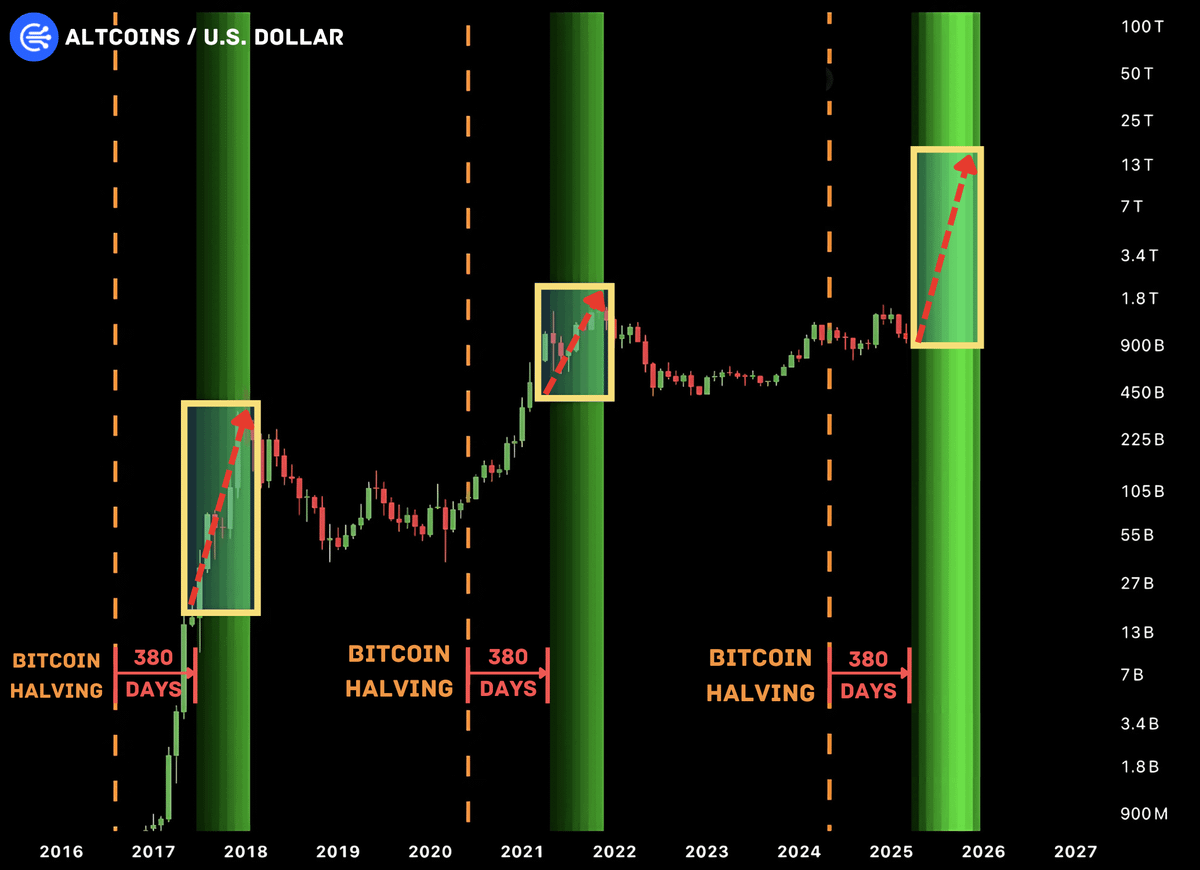 Altcoin Market Cap Prediction. Source:
Wimax.X
Altcoin Market Cap Prediction. Source:
Wimax.X
Wimar.X also points out another typical trigger for altcoin season. It often starts after Bitcoin reaches a new all-time high (ATH), then enters a stabilization or slight correction phase. During this time, Bitcoin Dominance (BTC.D) tends to drop. That’s when capital starts flowing from Bitcoin into altcoins, fueling their surge.
BTC Dominance measures Bitcoin’s market cap relative to the total crypto market cap. Recent data shows that BTC.D has fallen from 65.4% to a low of 62%, before stabilizing around 63.7%.
“The crypto market runs on cycles—it’s the only consistent pattern year after year. And when it comes to altseason, the formula is simple. Bitcoin Dominance Drops + Bitcoin Price Stagnates or Rises = Altcoins Pump. This is the one undeniable truth of the crypto market,” Wimar.X emphasizes.
Carl Moon – Founder of The Moon Show – shares the same view.
“Bitcoin Dominance is falling! Altcoin Season is imminent!” Carl Moon declared.
Another supporting factor is the crypto market’s historical performance in the second quarter (Q2). Data from Coinglass shows that Q2 is typically one of the strongest quarters for both Bitcoin and Ethereum.
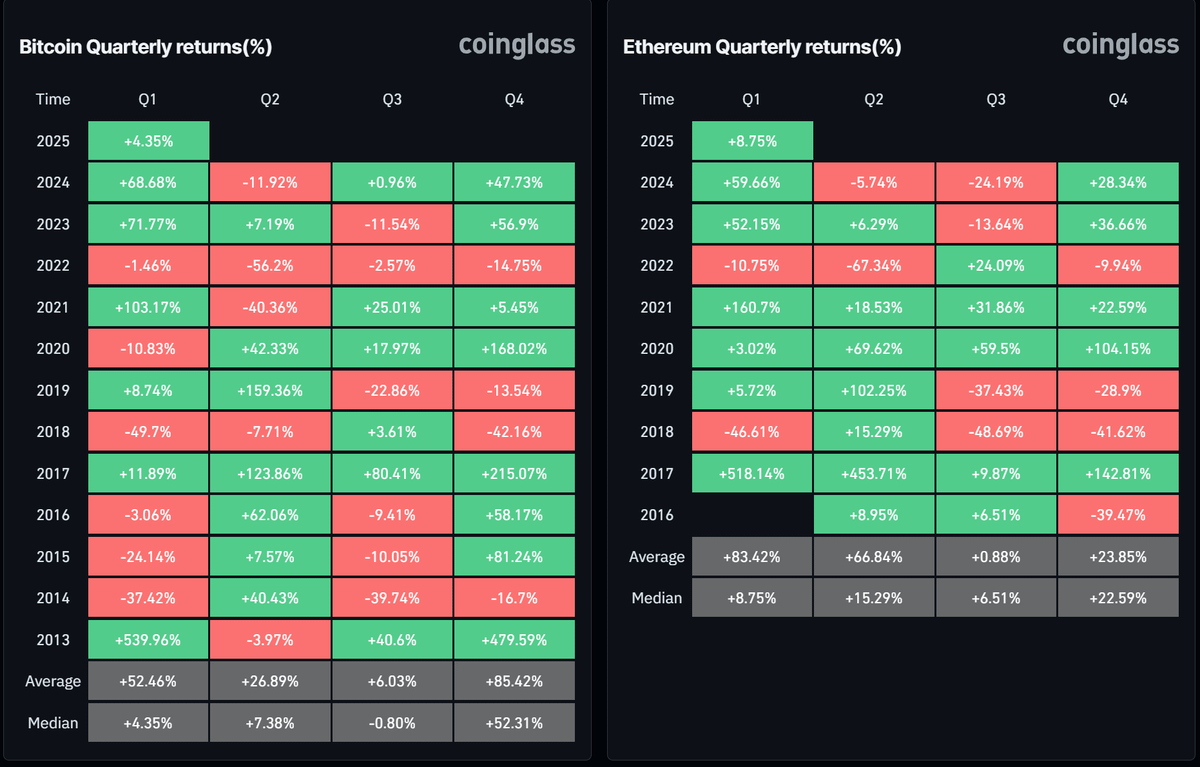 Bitcoin And Ethereum Quarterly Returns. Source:
Coinglass.
Bitcoin And Ethereum Quarterly Returns. Source:
Coinglass.
Specifically, Bitcoin has delivered an average Q2 return of about 26.89%. Ethereum has performed even better, with an average return of 66.8%. Similar or higher returns could be expected since altcoins often follow Ethereum’s trend. With Q2 underway in 2025, this might be the perfect window for altcoins to break out.
However, not all signals are entirely positive. According to Blockchain Center, the Altcoin Season Index dropped to its lowest point of the year, 13, right when Bitcoin hit its new ATH. It has since risen slightly to 18 at the time of writing.
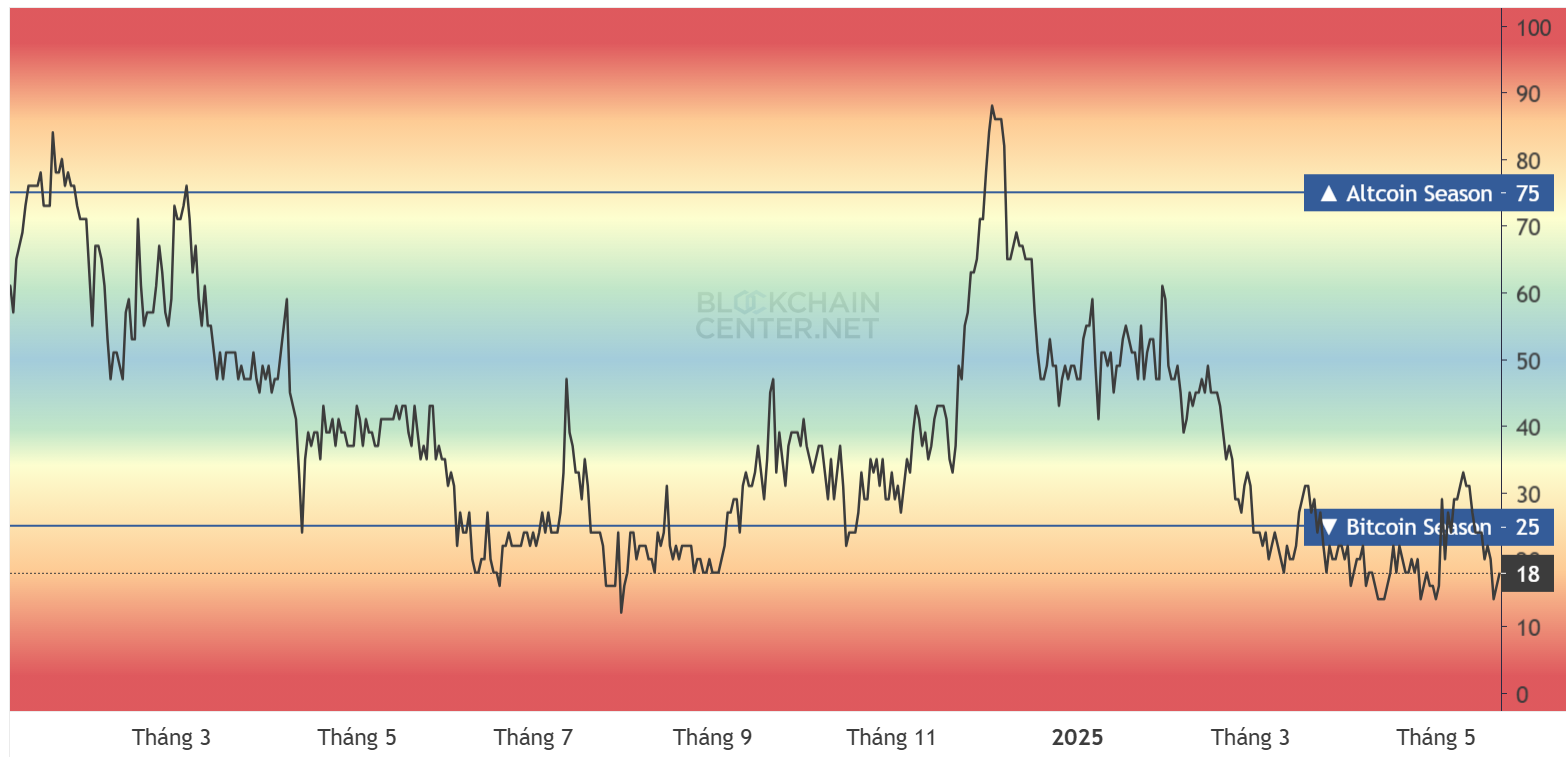 Altcoin Season Index. Source:
Blockchain Center.
Altcoin Season Index. Source:
Blockchain Center.
This index measures how well the top 100 altcoins have performed against Bitcoin over the past 90 days. If 75% of them outperform Bitcoin, the market is considered in altseason. Despite the optimistic outlook, the recent drop suggests that altcoins are not yet leading the market.
This raises an important question: Will altseason still follow historical patterns, or do investors need to wait more before capital shifts from Bitcoin to altcoins?
Disclaimer: The content of this article solely reflects the author's opinion and does not represent the platform in any capacity. This article is not intended to serve as a reference for making investment decisions.
You may also like
Chipmaker earnings growth cools to 136% as AI boom lifts S&P 500
Updated: Delta Air Lines warns that as fuel prices hit profits, airline capacity will tighten further
Delta Airlines lowers its annual profit forecast due to an expected increase in fuel costs to $6 billion. The CEO stated that ticket prices have risen by about 20% this year, with limited passenger resistance. Analysts warn that maintaining high ticket prices in 2027 is critical for improving profitability. The article includes comments from the earnings call and analyst remarks. Rajesh Kumar Singh/Shivansh Tiwary, Reuters Chicago, October 9 - Delta Airlines (DAL.N) said on Friday that, despite strong travel demand and rising ticket prices, soaring fuel costs have forced it to cut its 2026 profit expectations by nearly a quarter. So, the airline industry may need to further limit flight growth next year to protect profitability. This warning highlights the increasingly tough challenges faced by U.S. airlines. While strong demand and restricted seat growth have allowed airlines to significantly raise ticket prices and offset higher fuel costs, aggressively increasing flights to capture more demand may intensify competition, making it harder to maintain high fares and protect profits. Based in Atlanta, Delta now expects its annual fuel expenditure to increase by about $6 billion compared to last year—about $2 billion higher than its July forecast—due to the Iran war (link) causing global jet fuel prices to spike. Airlines worldwide are preparing for a prolonged fuel shock. Michael O’Leary, CEO of Ryanair Group RYA.I, said Thursday that high jet fuel prices could persist for another 12-18 months (link), adding more pressure on airlines to raise fares and control costs. https://www.reuters.com/graphics/AUTOMATED-20261008/A4A-JET-FUEL-DAILY-1Y/xmpjwjnmbvr/chart.png “In a high-cost environment, you can’t simply grow your way out,” Delta CEO Ed Bastian said on the earnings call. He noted that the industry has already taken steps to restrict capacity, but more measures will be needed next year to improve profitability. Bastian said Delta raised ticket prices about 20% this year, and passenger resistance has been limited. He is confident that even if fuel costs eventually drop, the high fares can still be maintained. Delta lowered its adjusted annual earnings per share forecast from the July prediction of $6.50-$7.50 to $5.10-$5.60. According to LSEG data, the midpoint of the new range is below analysts’ average expectation of $5.46. Third-quarter adjusted earnings per share were $1.72, four cents below analysts’ average forecast. In midday trading, shares of Delta dropped 1.7%, United Airlines UAL.O fell 1.4%, and both American Airlines AAL.O and Southwest Airlines LUV.N were down about 1%. Delta partly shields itself from rising fuel costs by owning a refinery outside Philadelphia (link), which is expected to generate over $700 million in profits this year. Even with this buffer, the airline expects its fourth-quarter fuel price to rise from $3.61 per gallon in Q3 to $4.25 per gallon. Delta forecasts adjusted fourth-quarter earnings per share to be between $1.15-$1.65, with the $1.40 midpoint roughly matching analysts’ average expectation of $1.39. Fare increases Government data shows that in the first eight months of 2026, U.S. airlines spent $42.9 billion on fuel, an increase of $13.2 billion compared to the same period last year despite slightly reduced consumption. According to the U.S. Bureau of Labor Statistics, strong demand and limited seat growth pushed average U.S. airline ticket prices up by about 25% year-on-year between April and August. https://www.reuters.com/graphics/USA-AIRLINES/FUEL/lbpgdnbzwvq/chart.png Analysts at Melius Research said that despite surging fuel costs, Delta’s ability to raise fares helps keep second-half profits roughly stable. Still, they warn that the company’s profit margin has struggled to improve over the years. “It is critical for margin improvement to maintain or raise fares in 2027,” they wrote in their research report. With industry capacity growth expected to accelerate in Q4, this challenge will likely become even tougher. Deutsche Bank analysts expect the proportion of fuel costs recouped through revenue measures to fall in Q4 and predict full recovery won’t happen until early 2027. Bastian noted that low industry returns are another reason for limiting capacity growth. He said Delta will be cautious with its 2027 capacity plan until the fuel price outlook becomes clearer. He added that international routes may account for a larger share of Delta’s capacity expansion compared to domestic routes. Currently, Delta says its premium cabins and corporate travel business remain strong, and its economy cabin business is gradually improving. With Q4 ticket bookings already exceeding 60%, Delta expects revenue to increase about 20% year-on-year, despite limited capacity growth. Executives said early booking trends for Q1 2027 are also encouraging. (For the convenience of non-native English speakers, Reuters automatically translates its reports into several
AI and Quantum: Trump's $6 Billion Plan Could Also Impact Bitcoin
Wall Street giants to release financial reports next week: stock trading revenue expected to approach $19 billion, "everyone is a winner" may be a thing of the past
According to analyst expectations compiled by Bloomberg, the combined equity trading revenue of the five major U.S. banks in the third quarter will approach $19 billion, but fixed income trading revenue is expected to drop to its lowest point of the year, and M&A activity has also cooled. Meanwhile, AI-driven cash optimization tools may lead to deposit outflows, sparking concerns about bank stocks in the market. Analysts believe that while the profit performance of each bank may further diverge, market concerns about the impact of AI may be overblown.
Crypto prices
More


