
Why Meme Coins MOODENG, PNUT, and GOAT Experienced Explosive Gains in May

MOODENG, PNUT, and GOAT saw triple-digit gains due to community excitement and Binance listings, but experts caution that their rapid rise may be unsustainable and driven by speculative trends.
Moo Deng (MOODENG), Pnut (PNUT), and Goatseus Maximus (GOAT) recently experienced a remarkable rally. Each coin posted triple-digit gains and reached multi-month highs.
While the momentum has since slowed slightly, BeInCrypto consulted experts to uncover the factors behind the recent surge in meme coin activity.
What’s Behind MOODENG, PNUT, and GOAT’s Surge?
For context, the cryptocurrency market experienced a significant slump in early April after President Trump’s tariff announcement. Bitcoin (BTC) fell below the $80,000 mark, leading to substantial losses across the sector. Nonetheless, a slight recovery began to take shape.
Meme coins like MOODENG, PNUT, and GOAT tokens started gaining momentum in mid-April. On May 8, they experienced consecutive surges, reaching highs not seen since the beginning of the year.
MOODENG posted the strongest gains, surging by 771% in less than a week. GOAT followed with a 257% increase. PNUT also saw a 220% rise in value.
A key moment came on May 11 when Binance Alpha announced the listing of MOODENG and GOAT. Chris Duggan, Senior Marketing Manager at ChainGPT, explained that this decision “added fuel to the fire.”
He highlighted that the rally resulted from a combination of early community excitement, traction from influencers and key opinion leaders (KOLs) on X, and low liquidity. These set the stage for a quick price surge.
“Social media doesn’t just amplify—these days it creates the trend. Coins can go from obscurity to global attention in a matter of hours thanks to a few well-timed posts,” Duggan told BeInCrypto.
However, he added that Binance’s involvement further strengthened the momentum. Duggan stated that such exposure can quickly turn niche coins into popular assets.
“It was retail-driven at first, but once smart money sniffed it out, the rally intensified,” he said.
In addition to these factors, Dean Chen, an analyst at Bitunix, outlined several key catalysts behind the meme coin rally.
“The surge of MOODENG, PNUT, and GOAT was not caused by a single event but was the result of a combination of capital rotation, market narratives, platform exposure, and overall sentiment,” Chen said.
He explained that major meme coins like Dogecoin (DOGE) and dogwifhat (WIF) had already experienced significant rallies earlier in the year. This, in turn, led to more conservative market expectations.
As a result, speculative capital shifted focus to smaller-cap meme coins like MOODENG and PNUT. These meme coins became key targets for investment. Chen noted that these coins attract whale accumulation when prices are low, and once price volatility sets in, it triggers FOMO among retail investors.
The analyst also emphasized that the rise of these meme coins was closely tied to market sentiment. With Bitcoin surpassing $100,000 in May, investor risk appetite increased, leading to a shift toward high-volatility assets like meme coins.
“During bull market phases, meme coins typically exhibit high elasticity and room for speculation, making them popular targets for concentrated capital bets,” Chen disclosed to BeInCrypto.
While the initial rise may have been extraordinary, it was also fleeting. By mid-May, increased selling pressure had pushed the coins to shed some of their gains. Nevertheless, they remained resilient, and a modest recovery followed.
At the time of writing, MOODENG, PNUT, and GOAT’s values were still up 675.7%, 112.2%, and 237.9%, respectively, from their early April lows.
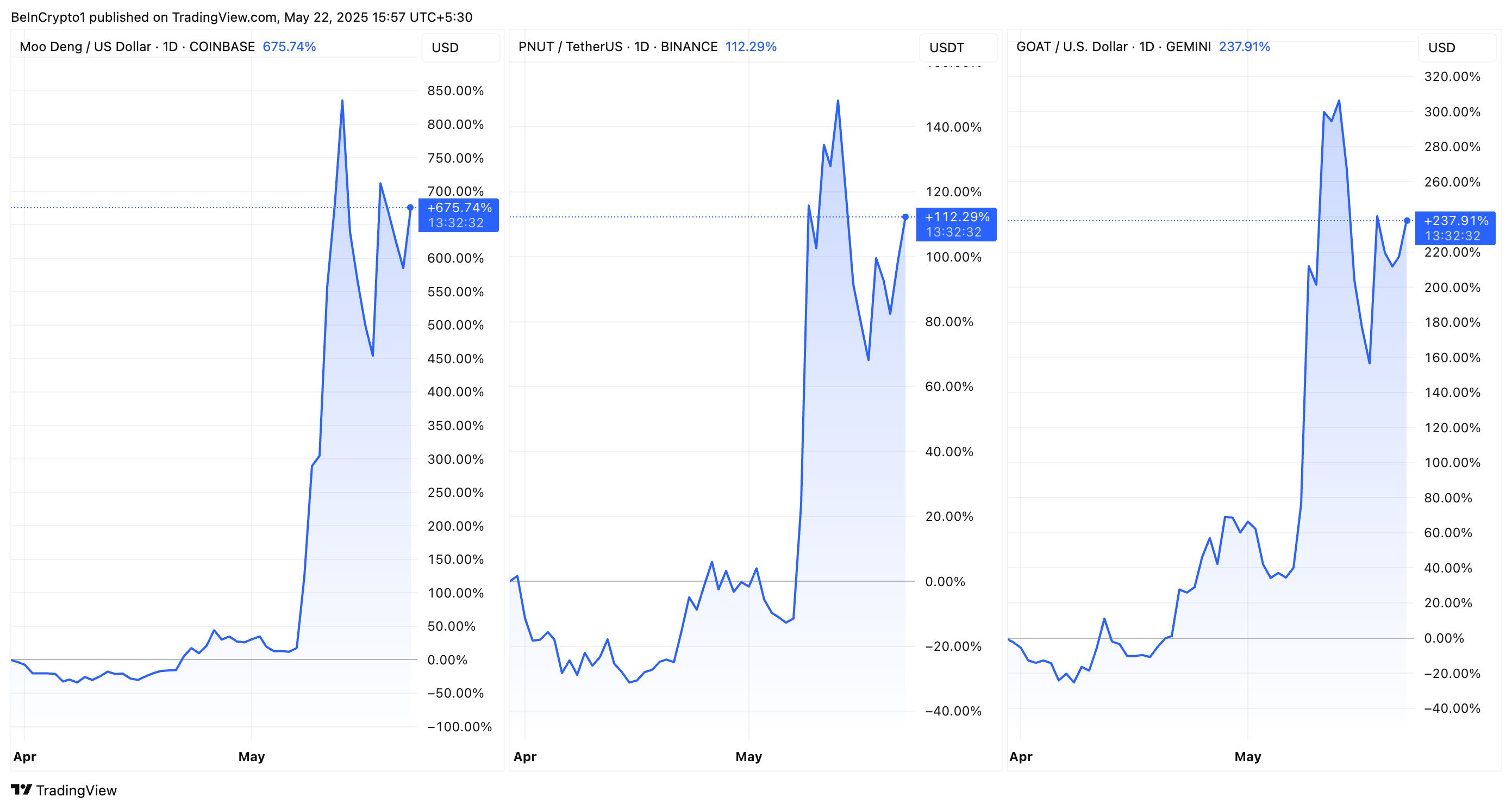 MOODENG, PNUT, and GOAT Meme Coins Price Performance. Source:
TradingView
MOODENG, PNUT, and GOAT Meme Coins Price Performance. Source:
TradingView
The volatility raises concerns about the sustainability of the meme coin rallies. Chen believes that the capital rotation to the new meme coins exhibits strong speculative characteristics. He stressed that, from a short-term perspective, this wave of capital flow mirrors an emotionally driven hype cycle.
According to him, market participants are generally focused on quick profits. Therefore, under the influence of community narratives and online sentiment, some low-cap tokens are pushed up by several multiples in a very short time.
“However, such hype often lacks solid fundamental support and long-term development strategies, making it prone to forming bubbles. The cycle of price surges and pullbacks tends to be very short, often completing an entire speculative round within three to seven days,” Chen cautioned.
Moreover, Chen noted that this short-term bubble typically exhibits several traits. Many projects rely solely on viral meme content or catchy themes, lacking real-world applications or technical development to support them.
The teams behind these projects often cash out quickly once prices surge, sometimes coordinating large sell-offs through internal wallets, which leads to frequent “rug pull” incidents within the community. Furthermore, the spike in community interest tends to be explosive but short-lived, emphasizing the highly speculative nature of the current cycle.
“From a long-term perspective, the meme coin space does have the potential to emerge from these high-volatility shakeouts with a few projects that demonstrate lasting viability,” he remarked.
Chen elaborated that the enduring meme coins typically possess more developed narrative frameworks, strong community cohesion, and some level of development and market promotion capabilities. After the bubble bursts, these surviving coins could emerge as “meme blue chips,” becoming key targets in the next phase of capital rotation.
He also emphasized that the current capital movement should not be seen merely as a bubble but as a reflection of a changing market preference for high-risk, high-reward assets, particularly in a bullish market that favors high-volatility assets. Consequently, he forecasted that this market activity may continue for some time.
Disclaimer: The content of this article solely reflects the author's opinion and does not represent the platform in any capacity. This article is not intended to serve as a reference for making investment decisions.
You may also like
Gold price holds critical $4,100 support, but can it break $4,200 as inflation risks loom?
Hinkal joins Mastercard Crypto Partner Program for private stablecoin payments
Chipmaker earnings growth cools to 136% as AI boom lifts S&P 500
Updated: Delta Air Lines warns that as fuel prices hit profits, airline capacity will tighten further
Delta Airlines lowers its annual profit forecast due to an expected increase in fuel costs to $6 billion. The CEO stated that ticket prices have risen by about 20% this year, with limited passenger resistance. Analysts warn that maintaining high ticket prices in 2027 is critical for improving profitability. The article includes comments from the earnings call and analyst remarks. Rajesh Kumar Singh/Shivansh Tiwary, Reuters Chicago, October 9 - Delta Airlines (DAL.N) said on Friday that, despite strong travel demand and rising ticket prices, soaring fuel costs have forced it to cut its 2026 profit expectations by nearly a quarter. So, the airline industry may need to further limit flight growth next year to protect profitability. This warning highlights the increasingly tough challenges faced by U.S. airlines. While strong demand and restricted seat growth have allowed airlines to significantly raise ticket prices and offset higher fuel costs, aggressively increasing flights to capture more demand may intensify competition, making it harder to maintain high fares and protect profits. Based in Atlanta, Delta now expects its annual fuel expenditure to increase by about $6 billion compared to last year—about $2 billion higher than its July forecast—due to the Iran war (link) causing global jet fuel prices to spike. Airlines worldwide are preparing for a prolonged fuel shock. Michael O’Leary, CEO of Ryanair Group RYA.I, said Thursday that high jet fuel prices could persist for another 12-18 months (link), adding more pressure on airlines to raise fares and control costs. https://www.reuters.com/graphics/AUTOMATED-20261008/A4A-JET-FUEL-DAILY-1Y/xmpjwjnmbvr/chart.png “In a high-cost environment, you can’t simply grow your way out,” Delta CEO Ed Bastian said on the earnings call. He noted that the industry has already taken steps to restrict capacity, but more measures will be needed next year to improve profitability. Bastian said Delta raised ticket prices about 20% this year, and passenger resistance has been limited. He is confident that even if fuel costs eventually drop, the high fares can still be maintained. Delta lowered its adjusted annual earnings per share forecast from the July prediction of $6.50-$7.50 to $5.10-$5.60. According to LSEG data, the midpoint of the new range is below analysts’ average expectation of $5.46. Third-quarter adjusted earnings per share were $1.72, four cents below analysts’ average forecast. In midday trading, shares of Delta dropped 1.7%, United Airlines UAL.O fell 1.4%, and both American Airlines AAL.O and Southwest Airlines LUV.N were down about 1%. Delta partly shields itself from rising fuel costs by owning a refinery outside Philadelphia (link), which is expected to generate over $700 million in profits this year. Even with this buffer, the airline expects its fourth-quarter fuel price to rise from $3.61 per gallon in Q3 to $4.25 per gallon. Delta forecasts adjusted fourth-quarter earnings per share to be between $1.15-$1.65, with the $1.40 midpoint roughly matching analysts’ average expectation of $1.39. Fare increases Government data shows that in the first eight months of 2026, U.S. airlines spent $42.9 billion on fuel, an increase of $13.2 billion compared to the same period last year despite slightly reduced consumption. According to the U.S. Bureau of Labor Statistics, strong demand and limited seat growth pushed average U.S. airline ticket prices up by about 25% year-on-year between April and August. https://www.reuters.com/graphics/USA-AIRLINES/FUEL/lbpgdnbzwvq/chart.png Analysts at Melius Research said that despite surging fuel costs, Delta’s ability to raise fares helps keep second-half profits roughly stable. Still, they warn that the company’s profit margin has struggled to improve over the years. “It is critical for margin improvement to maintain or raise fares in 2027,” they wrote in their research report. With industry capacity growth expected to accelerate in Q4, this challenge will likely become even tougher. Deutsche Bank analysts expect the proportion of fuel costs recouped through revenue measures to fall in Q4 and predict full recovery won’t happen until early 2027. Bastian noted that low industry returns are another reason for limiting capacity growth. He said Delta will be cautious with its 2027 capacity plan until the fuel price outlook becomes clearer. He added that international routes may account for a larger share of Delta’s capacity expansion compared to domestic routes. Currently, Delta says its premium cabins and corporate travel business remain strong, and its economy cabin business is gradually improving. With Q4 ticket bookings already exceeding 60%, Delta expects revenue to increase about 20% year-on-year, despite limited capacity growth. Executives said early booking trends for Q1 2027 are also encouraging. (For the convenience of non-native English speakers, Reuters automatically translates its reports into several
Crypto prices
More


