
Over $3.3 Billion in Bitcoin and Ethereum Options Expire Today Following Bitcoin’s All-Time High

The expiration of Bitcoin and Ethereum options contracts today could spark price volatility. With max pain prices set lower than current levels, traders anticipate short-term corrections, yet the long-term outlook remains bullish for both assets.
Today, over $3.3 billion worth of Bitcoin (BTC) and Ethereum (ETH) options contracts will expire. This could affect the market’s short-term price movements.
Although smaller than last week’s, the expiration of crypto options often triggers price volatility. This comes after Bitcoin hit a new all-time high yesterday.
Bitcoin and Ethereum Options Expiry: What Traders Should Know
Deribit data revealed that today’s expiring options carry a notional value of $2.8 billion. The total open interest is currently at 25,438 contracts, down slightly from last week’s 26,543 contracts.
Of the total, 11,435 are call contracts, and 14,004 are put contracts. This results in a put-to-call ratio of 1.22. This suggests the market is skewed toward bearish sentiment, with traders expecting downward price movement or hedging against it.
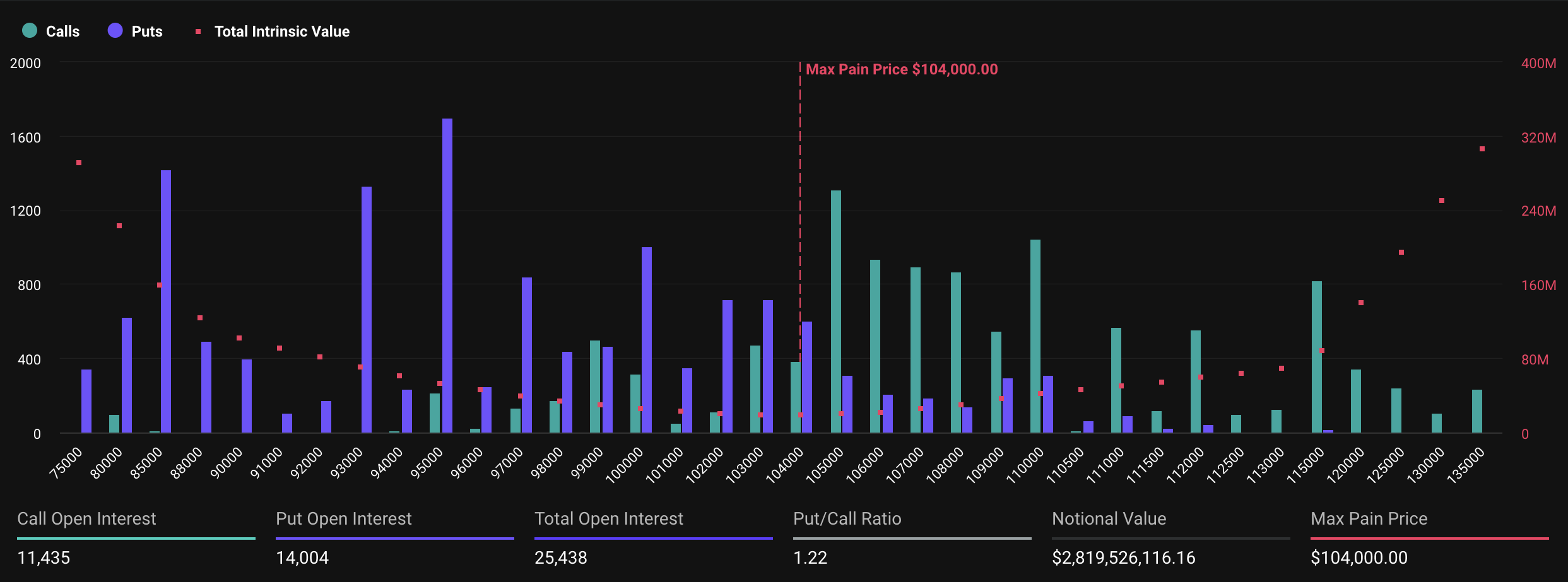 Expiring Bitcoin Options. Source:
Deribit
Expiring Bitcoin Options. Source:
Deribit
Meanwhile, the market sentiment for Ethereum is similarly bearish, with a put-to-call ratio of 1.27. The notional value of the 201,167 expiring contracts is over $542 million.
This includes 112,565 put contracts and 88,602 call contracts. This is a decrease from last week’s 219,986 total contracts.
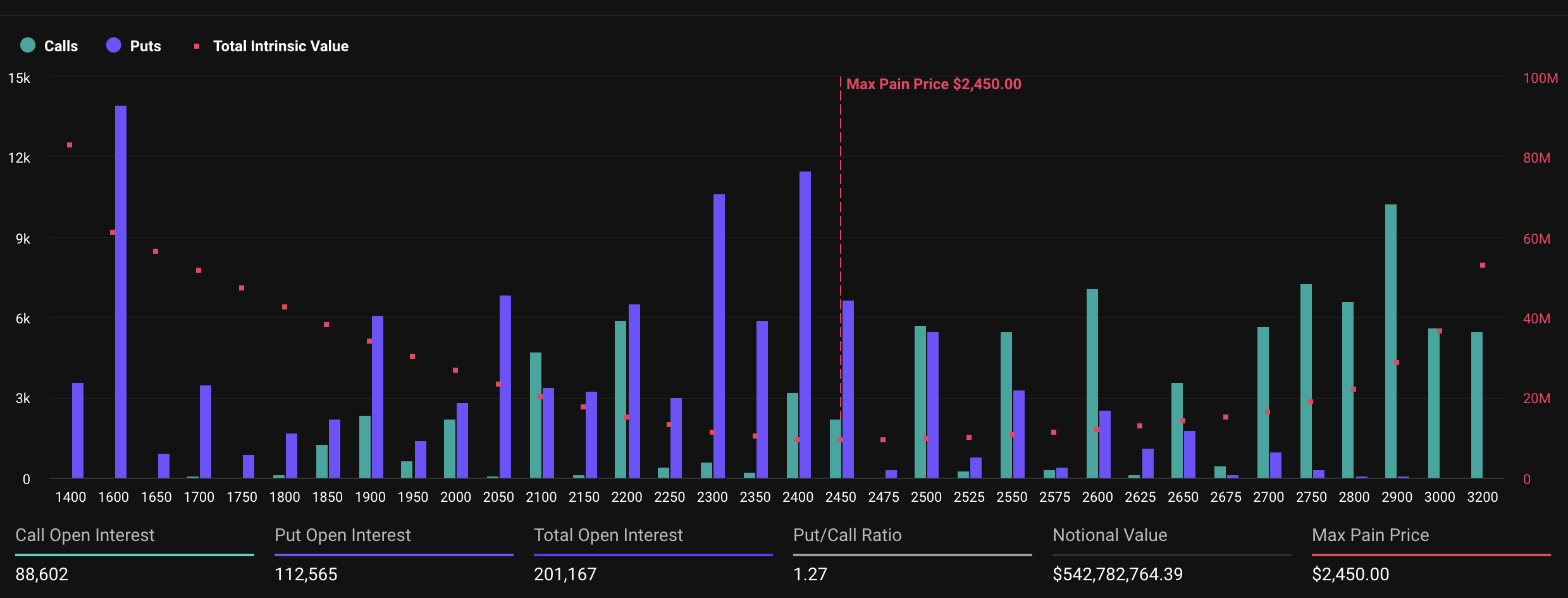 Expiring Ethereum Options. Source:
Deribit
Expiring Ethereum Options. Source:
Deribit
Notably, the maximum pain price for both Bitcoin and Ethereum is below their current price. According to the Max Pain theory, the market could gravitate toward these lower price points as expiration approaches, potentially making the highest number of options contracts worthless.
For Bitcoin, the max pain price is $104,000. At the time of writing, BTC was trading at $110,787. It reached an all-time high of $111,917 yesterday but has since slipped around 1.0% from its peak.
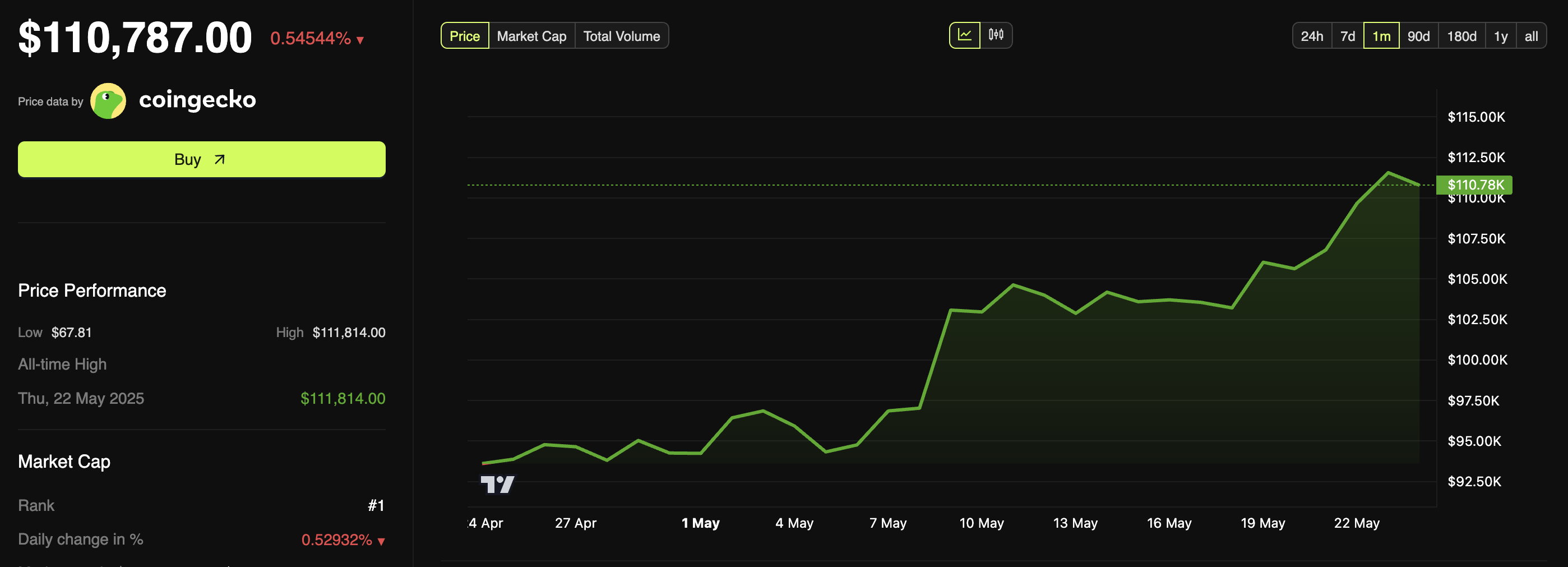 Bitcoin Price Performance. Source:
BeInCrypto
Bitcoin Price Performance. Source:
BeInCrypto
Analysts at Greek.live highlighted that a 15-20% correction in the short term could occur. They explained that many traders are securing downside protection through puts, anticipating a brief pullback to the $100,000–$103,000 range.
Despite this, the predominant market sentiment remains bullish, with many expecting Bitcoin to resume its upward trajectory.
The analysts also pointed out that negative funding rates reflect ongoing skepticism. Many participants are still shorting the market. This could potentially trigger a short squeeze and drive prices even higher.
“Key levels being watched include $110,000 as immediate support, $120,000 as a near-term target, and $150,000-200,000 as longer-term targets, with negative funding rates suggesting many are still shorting despite the rally,” the post read.
For Ethereum, the max pain price stands at $2,450. Despite trading at $2,693, a 2.6% increase over the past day, the market may still see price movements toward the max pain level as expiration approaches.
“Ethereum’s underperformance relative to Bitcoin is notable, with ETH failing to follow BTC’s new all-time high despite expectations for ETH to reach $3,000 by June,” Greek.live added.
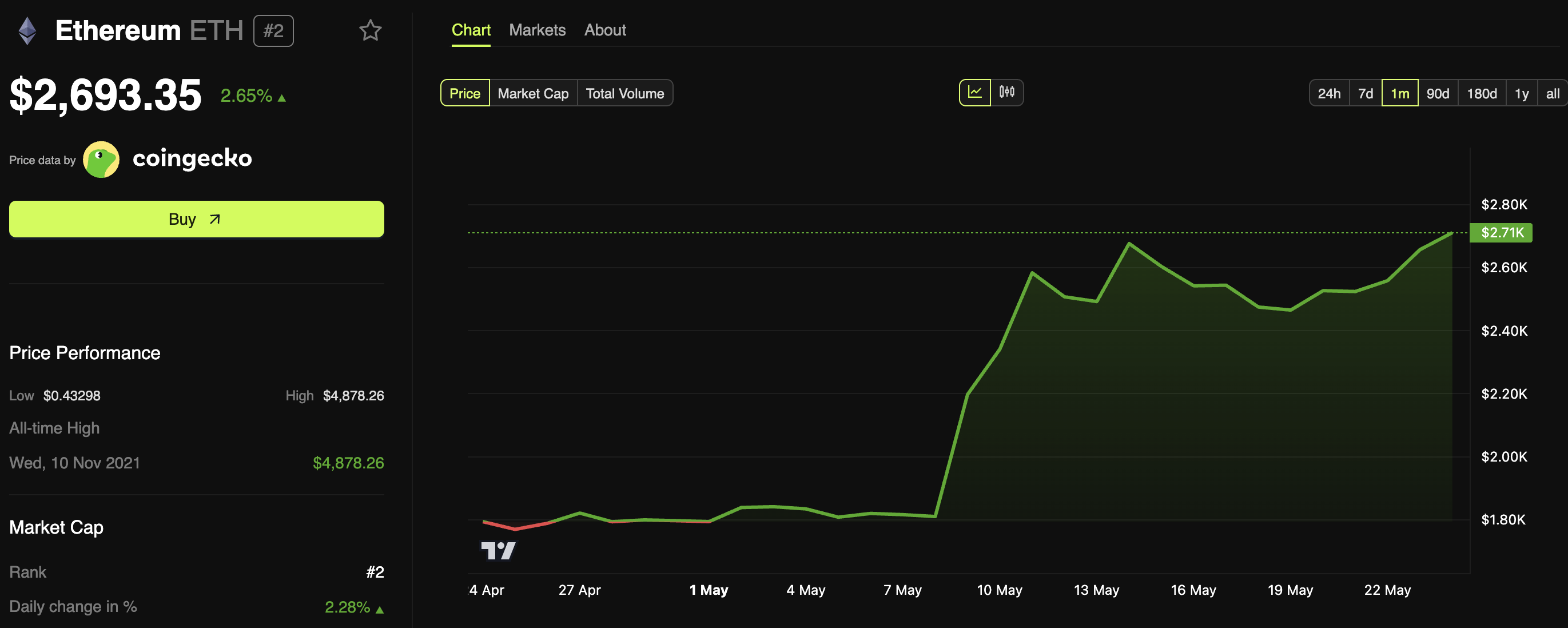 Ethereum Price Performance. Source:
BeInCrypto
Ethereum Price Performance. Source:
BeInCrypto
Thus, while short-term price swings may follow the options expirations, it’s worth noting that markets usually find their footing again pretty quickly as traders adjust to the new price levels.
Disclaimer: The content of this article solely reflects the author's opinion and does not represent the platform in any capacity. This article is not intended to serve as a reference for making investment decisions.
You may also like
Gold price holds critical $4,100 support, but can it break $4,200 as inflation risks loom?
Hinkal joins Mastercard Crypto Partner Program for private stablecoin payments
Chipmaker earnings growth cools to 136% as AI boom lifts S&P 500
Updated: Delta Air Lines warns that as fuel prices hit profits, airline capacity will tighten further
Delta Airlines lowers its annual profit forecast due to an expected increase in fuel costs to $6 billion. The CEO stated that ticket prices have risen by about 20% this year, with limited passenger resistance. Analysts warn that maintaining high ticket prices in 2027 is critical for improving profitability. The article includes comments from the earnings call and analyst remarks. Rajesh Kumar Singh/Shivansh Tiwary, Reuters Chicago, October 9 - Delta Airlines (DAL.N) said on Friday that, despite strong travel demand and rising ticket prices, soaring fuel costs have forced it to cut its 2026 profit expectations by nearly a quarter. So, the airline industry may need to further limit flight growth next year to protect profitability. This warning highlights the increasingly tough challenges faced by U.S. airlines. While strong demand and restricted seat growth have allowed airlines to significantly raise ticket prices and offset higher fuel costs, aggressively increasing flights to capture more demand may intensify competition, making it harder to maintain high fares and protect profits. Based in Atlanta, Delta now expects its annual fuel expenditure to increase by about $6 billion compared to last year—about $2 billion higher than its July forecast—due to the Iran war (link) causing global jet fuel prices to spike. Airlines worldwide are preparing for a prolonged fuel shock. Michael O’Leary, CEO of Ryanair Group RYA.I, said Thursday that high jet fuel prices could persist for another 12-18 months (link), adding more pressure on airlines to raise fares and control costs. https://www.reuters.com/graphics/AUTOMATED-20261008/A4A-JET-FUEL-DAILY-1Y/xmpjwjnmbvr/chart.png “In a high-cost environment, you can’t simply grow your way out,” Delta CEO Ed Bastian said on the earnings call. He noted that the industry has already taken steps to restrict capacity, but more measures will be needed next year to improve profitability. Bastian said Delta raised ticket prices about 20% this year, and passenger resistance has been limited. He is confident that even if fuel costs eventually drop, the high fares can still be maintained. Delta lowered its adjusted annual earnings per share forecast from the July prediction of $6.50-$7.50 to $5.10-$5.60. According to LSEG data, the midpoint of the new range is below analysts’ average expectation of $5.46. Third-quarter adjusted earnings per share were $1.72, four cents below analysts’ average forecast. In midday trading, shares of Delta dropped 1.7%, United Airlines UAL.O fell 1.4%, and both American Airlines AAL.O and Southwest Airlines LUV.N were down about 1%. Delta partly shields itself from rising fuel costs by owning a refinery outside Philadelphia (link), which is expected to generate over $700 million in profits this year. Even with this buffer, the airline expects its fourth-quarter fuel price to rise from $3.61 per gallon in Q3 to $4.25 per gallon. Delta forecasts adjusted fourth-quarter earnings per share to be between $1.15-$1.65, with the $1.40 midpoint roughly matching analysts’ average expectation of $1.39. Fare increases Government data shows that in the first eight months of 2026, U.S. airlines spent $42.9 billion on fuel, an increase of $13.2 billion compared to the same period last year despite slightly reduced consumption. According to the U.S. Bureau of Labor Statistics, strong demand and limited seat growth pushed average U.S. airline ticket prices up by about 25% year-on-year between April and August. https://www.reuters.com/graphics/USA-AIRLINES/FUEL/lbpgdnbzwvq/chart.png Analysts at Melius Research said that despite surging fuel costs, Delta’s ability to raise fares helps keep second-half profits roughly stable. Still, they warn that the company’s profit margin has struggled to improve over the years. “It is critical for margin improvement to maintain or raise fares in 2027,” they wrote in their research report. With industry capacity growth expected to accelerate in Q4, this challenge will likely become even tougher. Deutsche Bank analysts expect the proportion of fuel costs recouped through revenue measures to fall in Q4 and predict full recovery won’t happen until early 2027. Bastian noted that low industry returns are another reason for limiting capacity growth. He said Delta will be cautious with its 2027 capacity plan until the fuel price outlook becomes clearer. He added that international routes may account for a larger share of Delta’s capacity expansion compared to domestic routes. Currently, Delta says its premium cabins and corporate travel business remain strong, and its economy cabin business is gradually improving. With Q4 ticket bookings already exceeding 60%, Delta expects revenue to increase about 20% year-on-year, despite limited capacity growth. Executives said early booking trends for Q1 2027 are also encouraging. (For the convenience of non-native English speakers, Reuters automatically translates its reports into several
Crypto prices
More


