Bitget App
Trade smarter
Buy cryptoMarketsTradeFuturesStocksEarnInstitutionAI & More
Bitcoin Surges Amid Institutional Demand and Global Instability, Suggesting a Shift Toward Macro Asset Status

Bitcoin Surges Amid Institutional Demand and Global Instability, Suggesting a Shift Toward Macro Asset Status

CoinotagCoinotag2025/05/22 16:00
By:Marisol Navaro
  • Bitcoin prices have soared past $110,000, driven by a surge in institutional demand amidst rising global instability and central banks’ increasing interest in digital assets.

  • Major U.S. financial institutions, such as JPMorgan and Citigroup, are collaborating to create a joint stablecoin, setting the stage to capitalize on a projected $3.7 trillion market by 2030.

  • Bitcoin’s structural scarcity, along with recent inflows from Exchange-Traded Funds (ETFs), is positioning it as a critical macro asset during turbulent times for traditional bonds.

Discover how Bitcoin’s rise to $110K and institutional interest in stablecoins are changing the crypto landscape in today’s market analysis.

Crypto News of the Day: Bitcoin Goes Mainstream: How Global Instability Is Turning BTC Into a Macro Benchmark

Global bond markets are experiencing significant strain, with dismal auction results igniting fear across various risk assets. Japan’s Bank of Japan reported the worst results in JGB auctions since 1987, while U.S. Treasury auctions recorded a sharp increase in yields, closing at 5.104%, up from the previous 4.810%. This upheaval has rekindled interest in safe havens, including both tangible and digital assets.

“Global bond markets are seeing poor auction results. Japan BOJ JGBs had the worst auction since 1987, while the US 20-year auction today closed 5.104% (versus) 4.810% previously. This has brought back fear into risk-assets, causing Gold to rally back to $3322 (up +$200 from last week’s low). Today we’re seeing the ‘digital gold’ bid come back for Bitcoin. This is causing Bitcoin dominance to return as it continues to outperform altcoins (which are trading as pure risk-assets). There’s still the potential for Bitcoin to hit astronomical prices if some world central banks (or any one major central bank) begins to buy Bitcoin instead of regular gold as a diversification. Today we’re seeing many private companies do this, which is lifting Bitcoin to new ATHs.” – Greg Magadini, Director of Derivatives, Amberdata

This capital rotation is evident as investors seek alternatives to traditional sovereign debt. Bitcoin stands at the forefront of these investments.

“Looks like US debt isn’t too attractive right now given the global mess. Investors are hunting for yield, and Bitcoin’s where they’re parking capital.” – Dave Sedacca, Director of Finance at Parity Technologies

Evidence is mounting that Bitcoin is evolving beyond a niche asset, finding its place within institutional portfolios.

“Bitcoin breaking through $110K reflects the new reality: it’s no longer a fringe asset—it’s a macro instrument. ETF inflows, sovereign interest, and structurally limited supply are driving institutional demand at scale. For funds sitting on cash in a low-yield world, Bitcoin is starting to look less like a risk and more like a benchmark.” – Mike Cahill, CEO of Douro Labs, a leading contributor to the Pyth Network

In tandem with burgeoning institutional interest, Bitcoin’s hard-coded scarcity is influencing its price action, making it a reflection of broader capital market cycles.

“We’re seeing what happens when structurally constrained supply meets reflexive institutional demand. This isn’t just speculation—it’s systemic repricing. Bitcoin is now part of macro portfolios, and that means price action is being driven by the same capital rotation and liquidity cycles that move traditional markets.” – Doug Colkitt, Initial Fogo Contributor

Wall Street’s Stablecoin Push: Big Banks Prepare for a $3.7 Trillion Digital Asset Future

Major U.S. banks—including JPMorgan, Bank of America, Citigroup, and Wells Fargo—are engaged in discussions to collaboratively launch a stablecoin, aiming to regain influence in the fast-evolving digital finance landscape.

This ambitious project is being spearheaded through organizations like Early Warning Services and is contingent upon forthcoming legislation, particularly the GENIUS Act, which is expected to advance through the U.S. Senate.

With the stablecoin market projected to balloon to $3.7 trillion by 2030, banks recognize the importance of positioning themselves against crypto-native platforms and fintech players. Policymakers, including Senator Cynthia Lummis, are advocating for regulatory clarity to ensure U.S. leadership in financial innovation.

“I predict stablecoin growth to $2 trillion, as well as the US Treasury’s note where this forms the basis of their stablecoin forecast, as the point of the stablecoin Act is that stablecoins will further legitimize the whole asset class, all boats rise,” remarked Geoff Kendrick, Standard Chartered Head of Digital Assets Research.

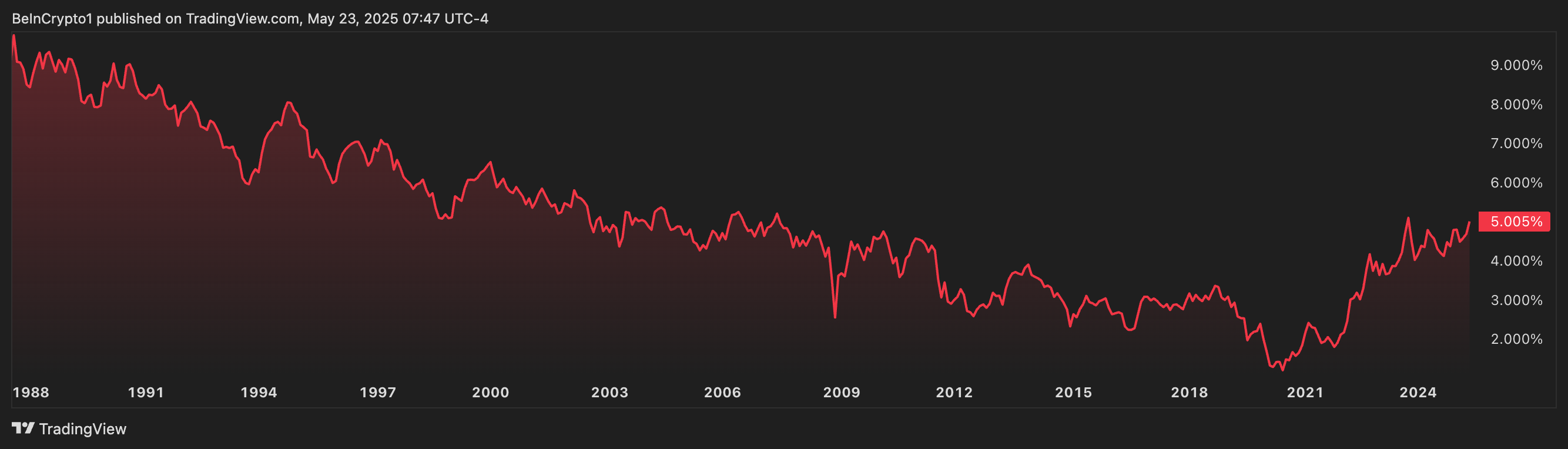
Chart of the Day
Bitcoin Surges Amid Institutional Demand and Global Instability, Suggesting a Shift Toward Macro Asset Status image 0

United States 30-Year Bond Yield. Source: TradingView.

Byte-Sized Alpha

Here’s a summary of more U.S. crypto news to follow today:

  • Over $3.3 Billion in Bitcoin and Ethereum Options Expire Today Following Bitcoin’s All-Time High
  • US Banking Giants JPMorgan, Bank of America, and Others Eye Joint Stablecoin Launch
  • Robinhood lists MOODENG and MEW, Sparking 20% Rally
  • SEC Hits Pause on XRP and Litecoin ETFs While TRX Staking Fund Advances
  • Bitcoin Price Surge Explained: What’s Next for BTC After Hitting $111,980 All-Time High?
  • Worldcoin’s WLD Token Soars to 3-Month High After $135 Million Investment
  • ETF Inflows Hit 1-Month High as Bitcoin Sets New Record | ETF News

Crypto Equities Pre-Market Overview

Company At the Close of May 22 Pre-Market Overview
Strategy (MSTR) $399.46 $399.72 (+0.07%)
Coinbase Global (COIN) $271.95 $270.01 (-0.71%)
Galaxy Digital (GLXY) $24.46 $23.70 (-3.11%)
MARA Holdings (MARA) $15.65 $15.46 (-1.21%)
Riot Platforms (RIOT) $8.94 $8.84 (-1.12%)
Core Scientific (CORZ) $10.83 $10.70 (-1.20%)
In Case You Missed It: Bitcoin Reaches New All-Time High as US-China Trade Agreement Eases Economic Uncertainties and Boosts Investor Confidence
0
0

Disclaimer: The content of this article solely reflects the author's opinion and does not represent the platform in any capacity. This article is not intended to serve as a reference for making investment decisions.

Understand the market, then trade.
Bitget offers one-stop trading for cryptocurrencies, stocks, and gold.
Trade now!

You may also like

Updated: Delta Air Lines warns that as fuel prices hit profits, airline capacity will tighten further

Delta Airlines lowers its annual profit forecast due to an expected increase in fuel costs to $6 billion. The CEO stated that ticket prices have risen by about 20% this year, with limited passenger resistance. Analysts warn that maintaining high ticket prices in 2027 is critical for improving profitability. The article includes comments from the earnings call and analyst remarks. Rajesh Kumar Singh/Shivansh Tiwary, Reuters Chicago, October 9 - Delta Airlines (DAL.N) said on Friday that, despite strong travel demand and rising ticket prices, soaring fuel costs have forced it to cut its 2026 profit expectations by nearly a quarter. So, the airline industry may need to further limit flight growth next year to protect profitability. This warning highlights the increasingly tough challenges faced by U.S. airlines. While strong demand and restricted seat growth have allowed airlines to significantly raise ticket prices and offset higher fuel costs, aggressively increasing flights to capture more demand may intensify competition, making it harder to maintain high fares and protect profits. Based in Atlanta, Delta now expects its annual fuel expenditure to increase by about $6 billion compared to last year—about $2 billion higher than its July forecast—due to the Iran war (link) causing global jet fuel prices to spike. Airlines worldwide are preparing for a prolonged fuel shock. Michael O’Leary, CEO of Ryanair Group RYA.I, said Thursday that high jet fuel prices could persist for another 12-18 months (link), adding more pressure on airlines to raise fares and control costs. https://www.reuters.com/graphics/AUTOMATED-20261008/A4A-JET-FUEL-DAILY-1Y/xmpjwjnmbvr/chart.png “In a high-cost environment, you can’t simply grow your way out,” Delta CEO Ed Bastian said on the earnings call. He noted that the industry has already taken steps to restrict capacity, but more measures will be needed next year to improve profitability. Bastian said Delta raised ticket prices about 20% this year, and passenger resistance has been limited. He is confident that even if fuel costs eventually drop, the high fares can still be maintained. Delta lowered its adjusted annual earnings per share forecast from the July prediction of $6.50-$7.50 to $5.10-$5.60. According to LSEG data, the midpoint of the new range is below analysts’ average expectation of $5.46. Third-quarter adjusted earnings per share were $1.72, four cents below analysts’ average forecast. In midday trading, shares of Delta dropped 1.7%, United Airlines UAL.O fell 1.4%, and both American Airlines AAL.O and Southwest Airlines LUV.N were down about 1%. Delta partly shields itself from rising fuel costs by owning a refinery outside Philadelphia (link), which is expected to generate over $700 million in profits this year. Even with this buffer, the airline expects its fourth-quarter fuel price to rise from $3.61 per gallon in Q3 to $4.25 per gallon. Delta forecasts adjusted fourth-quarter earnings per share to be between $1.15-$1.65, with the $1.40 midpoint roughly matching analysts’ average expectation of $1.39. Fare increases Government data shows that in the first eight months of 2026, U.S. airlines spent $42.9 billion on fuel, an increase of $13.2 billion compared to the same period last year despite slightly reduced consumption. According to the U.S. Bureau of Labor Statistics, strong demand and limited seat growth pushed average U.S. airline ticket prices up by about 25% year-on-year between April and August. https://www.reuters.com/graphics/USA-AIRLINES/FUEL/lbpgdnbzwvq/chart.png Analysts at Melius Research said that despite surging fuel costs, Delta’s ability to raise fares helps keep second-half profits roughly stable. Still, they warn that the company’s profit margin has struggled to improve over the years. “It is critical for margin improvement to maintain or raise fares in 2027,” they wrote in their research report. With industry capacity growth expected to accelerate in Q4, this challenge will likely become even tougher. Deutsche Bank analysts expect the proportion of fuel costs recouped through revenue measures to fall in Q4 and predict full recovery won’t happen until early 2027. Bastian noted that low industry returns are another reason for limiting capacity growth. He said Delta will be cautious with its 2027 capacity plan until the fuel price outlook becomes clearer. He added that international routes may account for a larger share of Delta’s capacity expansion compared to domestic routes. Currently, Delta says its premium cabins and corporate travel business remain strong, and its economy cabin business is gradually improving. With Q4 ticket bookings already exceeding 60%, Delta expects revenue to increase about 20% year-on-year, despite limited capacity growth. Executives said early booking trends for Q1 2027 are also encouraging. (For the convenience of non-native English speakers, Reuters automatically translates its reports into several

路透社•2026/10/09 17:36