
TRON Surpasses $75B in USDT, Cements Its Top Position


- TRON now holds more USDT than any other blockchain and keeps growing every single day.
- USDT’s share in the total crypto market has dropped from over 6% in April to just 4.41% in May.
- USDT’s dominance keeps falling as RSI nears oversold, as resistance stays firm at 4.82%.
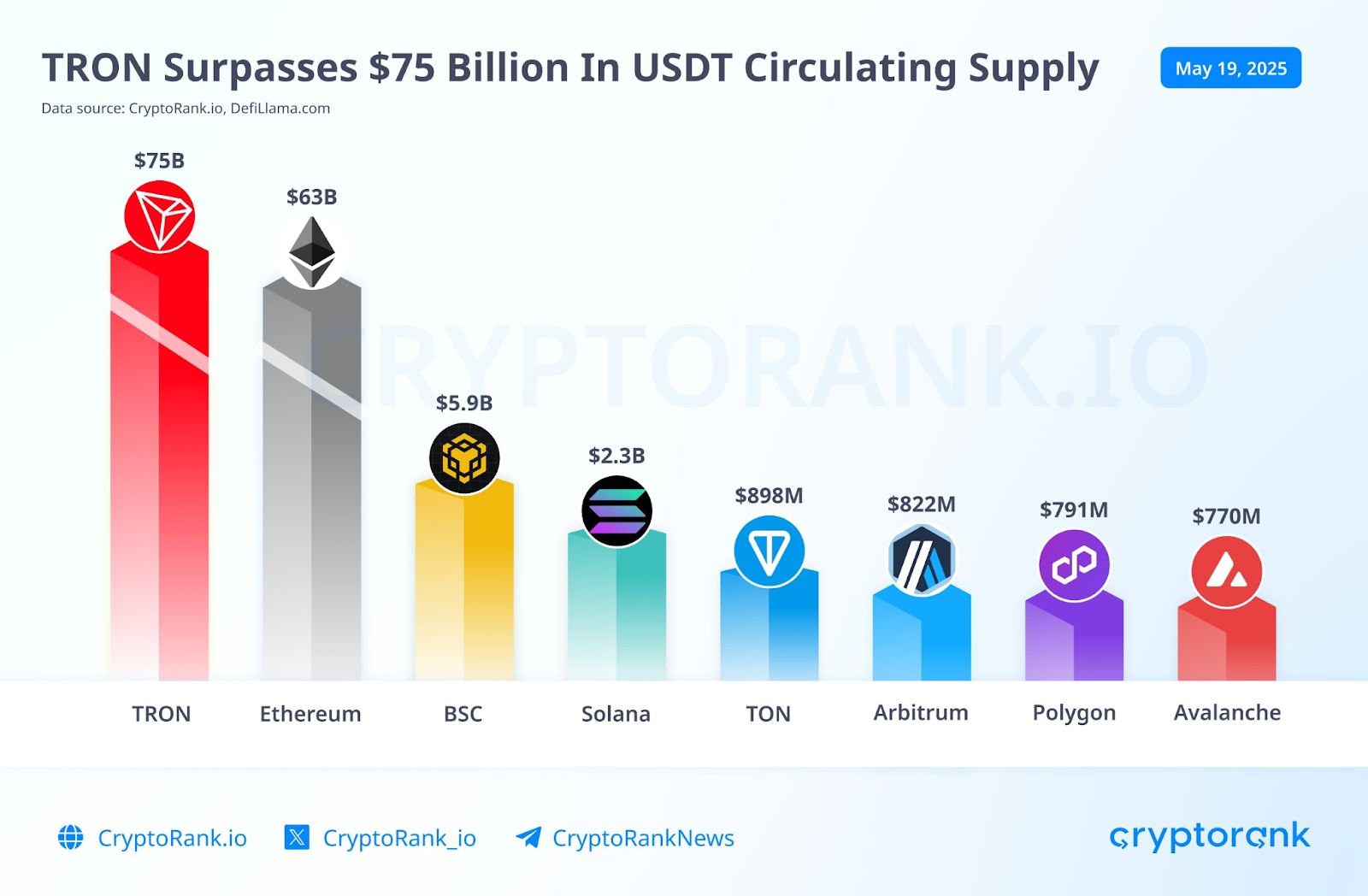
TRON has officially reached $75 billion in USDT circulating supply, surpassing all blockchain competitors. This milestone cements TRON’s position as the leading network for Tether transactions, outperforming Ethereum, Binance Smart Chain, and other chains in both volume and reliability. However, this development comes at a time when the stablecoin is facing a downturn, with USDT’s overall market dominance dropping to 4.41%. This decline raises questions about changing investor priorities in the crypto space.
 Source:
X
Source:
X
TRON Becomes the Primary Network for USDT Transfers
CryptoRank data shows TRON leading with $75 billion in USDT, while Ethereum trails at $63 billion. Binance Smart Chain holds $5.9 billion. Other networks like Solana ($2.3 billion), TON ($898 million), Arbitrum ($822 million), Polygon ($791 million), and Avalanche ($770 million) remain far behind. TRON’s surge is attributed to low transaction costs and reliable performance for high-volume transfers.
The network’s architecture supports fast, scalable transactions, which make it ideal for stablecoin users, especially in DeFi and cross-border settings. Users seeking speed and savings continue to favor TRON.
USDT Market Share Drops Amid Investor Rotation to Altcoins
As of May 23, 2025, USDT’s market dominance dropped to 4.41%, down from April’s high of 6.18%, showing a persistent decline. Chart data from TradingView indicates a downward channel with resistance at the 0.786 Fibonacci level of 4.82%. The Relative Strength Index sits at 31.22, near oversold levels, suggesting heavy selling pressure.
Related: Meta Plans Support for USDT and USDC in Platform Payments
Additionally, a fair value gap between 4.82% and 5.11% remains unfilled, limiting recovery prospects unless sentiment shifts. Market preference appears to be rotating toward higher-risk digital assets.
 Source:
TradingView
Source:
TradingView
Consequently, investors are reallocating capital from stablecoins like USDT to more volatile assets, including DeFi tokens. This shift aligns with rising attention toward high-growth ecosystems such as Hyperliquid, where recent gains have attracted considerable liquidity.
The post TRON Surpasses $75B in USDT, Cements Its Top Position appeared first on Cryptotale.
Disclaimer: The content of this article solely reflects the author's opinion and does not represent the platform in any capacity. This article is not intended to serve as a reference for making investment decisions.
You may also like
Gold price holds critical $4,100 support, but can it break $4,200 as inflation risks loom?
Hinkal joins Mastercard Crypto Partner Program for private stablecoin payments
Chipmaker earnings growth cools to 136% as AI boom lifts S&P 500
Updated: Delta Air Lines warns that as fuel prices hit profits, airline capacity will tighten further
Delta Airlines lowers its annual profit forecast due to an expected increase in fuel costs to $6 billion. The CEO stated that ticket prices have risen by about 20% this year, with limited passenger resistance. Analysts warn that maintaining high ticket prices in 2027 is critical for improving profitability. The article includes comments from the earnings call and analyst remarks. Rajesh Kumar Singh/Shivansh Tiwary, Reuters Chicago, October 9 - Delta Airlines (DAL.N) said on Friday that, despite strong travel demand and rising ticket prices, soaring fuel costs have forced it to cut its 2026 profit expectations by nearly a quarter. So, the airline industry may need to further limit flight growth next year to protect profitability. This warning highlights the increasingly tough challenges faced by U.S. airlines. While strong demand and restricted seat growth have allowed airlines to significantly raise ticket prices and offset higher fuel costs, aggressively increasing flights to capture more demand may intensify competition, making it harder to maintain high fares and protect profits. Based in Atlanta, Delta now expects its annual fuel expenditure to increase by about $6 billion compared to last year—about $2 billion higher than its July forecast—due to the Iran war (link) causing global jet fuel prices to spike. Airlines worldwide are preparing for a prolonged fuel shock. Michael O’Leary, CEO of Ryanair Group RYA.I, said Thursday that high jet fuel prices could persist for another 12-18 months (link), adding more pressure on airlines to raise fares and control costs. https://www.reuters.com/graphics/AUTOMATED-20261008/A4A-JET-FUEL-DAILY-1Y/xmpjwjnmbvr/chart.png “In a high-cost environment, you can’t simply grow your way out,” Delta CEO Ed Bastian said on the earnings call. He noted that the industry has already taken steps to restrict capacity, but more measures will be needed next year to improve profitability. Bastian said Delta raised ticket prices about 20% this year, and passenger resistance has been limited. He is confident that even if fuel costs eventually drop, the high fares can still be maintained. Delta lowered its adjusted annual earnings per share forecast from the July prediction of $6.50-$7.50 to $5.10-$5.60. According to LSEG data, the midpoint of the new range is below analysts’ average expectation of $5.46. Third-quarter adjusted earnings per share were $1.72, four cents below analysts’ average forecast. In midday trading, shares of Delta dropped 1.7%, United Airlines UAL.O fell 1.4%, and both American Airlines AAL.O and Southwest Airlines LUV.N were down about 1%. Delta partly shields itself from rising fuel costs by owning a refinery outside Philadelphia (link), which is expected to generate over $700 million in profits this year. Even with this buffer, the airline expects its fourth-quarter fuel price to rise from $3.61 per gallon in Q3 to $4.25 per gallon. Delta forecasts adjusted fourth-quarter earnings per share to be between $1.15-$1.65, with the $1.40 midpoint roughly matching analysts’ average expectation of $1.39. Fare increases Government data shows that in the first eight months of 2026, U.S. airlines spent $42.9 billion on fuel, an increase of $13.2 billion compared to the same period last year despite slightly reduced consumption. According to the U.S. Bureau of Labor Statistics, strong demand and limited seat growth pushed average U.S. airline ticket prices up by about 25% year-on-year between April and August. https://www.reuters.com/graphics/USA-AIRLINES/FUEL/lbpgdnbzwvq/chart.png Analysts at Melius Research said that despite surging fuel costs, Delta’s ability to raise fares helps keep second-half profits roughly stable. Still, they warn that the company’s profit margin has struggled to improve over the years. “It is critical for margin improvement to maintain or raise fares in 2027,” they wrote in their research report. With industry capacity growth expected to accelerate in Q4, this challenge will likely become even tougher. Deutsche Bank analysts expect the proportion of fuel costs recouped through revenue measures to fall in Q4 and predict full recovery won’t happen until early 2027. Bastian noted that low industry returns are another reason for limiting capacity growth. He said Delta will be cautious with its 2027 capacity plan until the fuel price outlook becomes clearer. He added that international routes may account for a larger share of Delta’s capacity expansion compared to domestic routes. Currently, Delta says its premium cabins and corporate travel business remain strong, and its economy cabin business is gradually improving. With Q4 ticket bookings already exceeding 60%, Delta expects revenue to increase about 20% year-on-year, despite limited capacity growth. Executives said early booking trends for Q1 2027 are also encouraging. (For the convenience of non-native English speakers, Reuters automatically translates its reports into several
Crypto prices
More


