Bitget App
Trade smarter
Buy cryptoMarketsTradeFuturesStocksEarnInstitutionAI & More
Can Pi Network Price Hit $1 Amid Massive Token Unlocks & Community Backlash?

Can Pi Network Price Hit $1 Amid Massive Token Unlocks & Community Backlash?

TheCoinRepublicTheCoinRepublic2025/05/22 22:55
By:By Kelvin Munene

PI coin price traded at $0.8, up 30% this month but still 72% below its February all-time high of $2.99. Over 1.47 billion PI tokens are set to unlock over the next year, raising concerns about potential selling pressure. The lack of major exchange listings and ecosystem utility continues to limit PI coin price growth and market confidence.

PI Network price is slowly recovering from its big drop earlier in May. After a drop of about 50% between May 12 and May 17, the token was back up over 20% in the last four days and valued at $0.83 before dropping slightly to $7904.

However, Pi coin price network is 72% lower than its highest recorded point of $2.99, which was reached in February 2025.

PI token investors watch to see if the price can reach $1 again, given concerns about token unlocks and open issues with the project.

Pi Network Price Prediction: Testing Key Resistance at $0.90

According to the latest Pi network price analysis, the short-term trend appears cautiously optimistic. The altcoin recently surpassed the $0.74 support level. That was a previous local high from April, which has turned into a key price floor.

The current PI coin price of $0.79 reflected an 8% drop in the last 24 hours and a 30% gain over the past month.
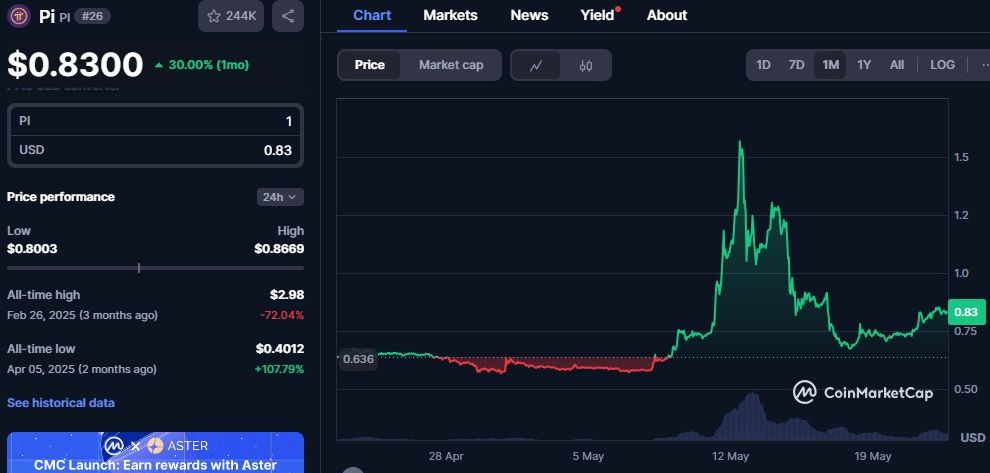
Can Pi Network Price Hit $1 Amid Massive Token Unlocks & Community Backlash? image 0 Source: CMC

From the daily chart, it seems that technical indicators are giving both positive and negative signals. Currently, RSI is at 54, making it fall within a neutral level. The weekly moving averages for 10, 20, 30, and 50 days are climbing, so momentum may continue in this direction.

The key resistance for Pi Network price remains at $0.90. It is a level that is marked by a bearish order block on the 4-hour chart. Breaking through this resistance is essential for the altcoin to move closer to the $1 threshold.

Pi Coin Unlocks Raise Concerns Over Selling Pressure

On May 22, 2025, PI tokens were released, with an estimated total of 5.78 million tokens unlocked, with daily unlocks expected to go on for at least two months.

Because of this, the number of tokens in circulation went up. It has led to talks aming the community about the market’s ability to process new tokens.
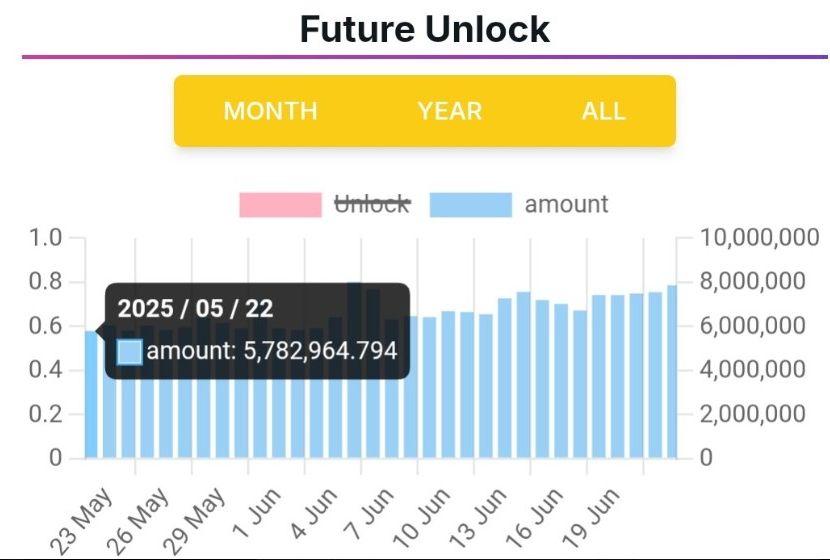
Can Pi Network Price Hit $1 Amid Massive Token Unlocks & Community Backlash? image 1 Source: X

By the following year, 1.47 billion PI tokens will be released for unlocking. These tokens will be issued by early backers, the project’s developers, and community members.

Experience from prior similar projects has proven that increases in the token supply, if not followed by ecosystem growth or more users, can cause Pi Network price to drop.

Exchange Listings and Utility Limit Pi Network Price Upside

Despite rising trading volume and user interest, PI coin is currently not listed on major cryptocurrency exchanges. Although voters in the Pi Network favored a Binance listing , the Pi token is still not listed on the platform.

Liquidity is still below expectations because OKX depth is merely under $100,000. This reduces the chance for the token to grow and makes its prices more easily affected by changes.

A further challenge is that there aren’t many valuable decentralized applications or DeFi projects built using the PI token. At the beginning of this month, Pi coin price surged to $1.35 after the news of a $100 million venture fund, but it soon dropped back down.

If Pi Network price is going to maintain or continue its bullish move, its user utility will be very important.

Community Frustration and Ecosystem Challenges

Ongoing delays in Pi Network’s mainnet migration and the slow rollout of KYC verification have generated frustration among users, particularly in regions such as China where transfer limitations are more strictly enforced. These delays affect user trust and limit the ability to transact freely with the token.

More so, analyst Dr Altcoin raised concern by sharing a post on X, specifically pointing to a wallet address allegedly linked to Pi Core Team activity. According to his analysis, the wallet in question recorded the sale of at least 19 million PI tokens over the past 20 to 30 days.

He emphasized that this is just one of several wallets under scrutiny.

Meanwhile, Dr Altcoin clarified that his intention was not to create fear, uncertainty, or doubt (FUD), but rather to call for accountability, transparency, and open communication from the Pi Core Team. His post has prompted further community interest in the Pi Network.

Can Pi Network Price Hit $1 Amid Massive Token Unlocks & Community Backlash? image 2 Source: X

Concerns about centralized control, limited transparency, and regulatory uncertainties continue to fuel debate in the community. Some users have also expressed doubts about the project’s ability to scale effectively, especially as unlocked tokens enter circulation.

The current recovery offers short-term optimism for PI token holders. However, the broader Pi Network price trajectory will depend on Pi Network’s ability to address ongoing challenges.

0
1

Disclaimer: The content of this article solely reflects the author's opinion and does not represent the platform in any capacity. This article is not intended to serve as a reference for making investment decisions.

Understand the market, then trade.
Bitget offers one-stop trading for cryptocurrencies, stocks, and gold.
Trade now!

You may also like

Updated: Delta Air Lines warns that as fuel prices hit profits, airline capacity will tighten further

Delta Airlines lowers its annual profit forecast due to an expected increase in fuel costs to $6 billion. The CEO stated that ticket prices have risen by about 20% this year, with limited passenger resistance. Analysts warn that maintaining high ticket prices in 2027 is critical for improving profitability. The article includes comments from the earnings call and analyst remarks. Rajesh Kumar Singh/Shivansh Tiwary, Reuters Chicago, October 9 - Delta Airlines (DAL.N) said on Friday that, despite strong travel demand and rising ticket prices, soaring fuel costs have forced it to cut its 2026 profit expectations by nearly a quarter. So, the airline industry may need to further limit flight growth next year to protect profitability. This warning highlights the increasingly tough challenges faced by U.S. airlines. While strong demand and restricted seat growth have allowed airlines to significantly raise ticket prices and offset higher fuel costs, aggressively increasing flights to capture more demand may intensify competition, making it harder to maintain high fares and protect profits. Based in Atlanta, Delta now expects its annual fuel expenditure to increase by about $6 billion compared to last year—about $2 billion higher than its July forecast—due to the Iran war (link) causing global jet fuel prices to spike. Airlines worldwide are preparing for a prolonged fuel shock. Michael O’Leary, CEO of Ryanair Group RYA.I, said Thursday that high jet fuel prices could persist for another 12-18 months (link), adding more pressure on airlines to raise fares and control costs. https://www.reuters.com/graphics/AUTOMATED-20261008/A4A-JET-FUEL-DAILY-1Y/xmpjwjnmbvr/chart.png “In a high-cost environment, you can’t simply grow your way out,” Delta CEO Ed Bastian said on the earnings call. He noted that the industry has already taken steps to restrict capacity, but more measures will be needed next year to improve profitability. Bastian said Delta raised ticket prices about 20% this year, and passenger resistance has been limited. He is confident that even if fuel costs eventually drop, the high fares can still be maintained. Delta lowered its adjusted annual earnings per share forecast from the July prediction of $6.50-$7.50 to $5.10-$5.60. According to LSEG data, the midpoint of the new range is below analysts’ average expectation of $5.46. Third-quarter adjusted earnings per share were $1.72, four cents below analysts’ average forecast. In midday trading, shares of Delta dropped 1.7%, United Airlines UAL.O fell 1.4%, and both American Airlines AAL.O and Southwest Airlines LUV.N were down about 1%. Delta partly shields itself from rising fuel costs by owning a refinery outside Philadelphia (link), which is expected to generate over $700 million in profits this year. Even with this buffer, the airline expects its fourth-quarter fuel price to rise from $3.61 per gallon in Q3 to $4.25 per gallon. Delta forecasts adjusted fourth-quarter earnings per share to be between $1.15-$1.65, with the $1.40 midpoint roughly matching analysts’ average expectation of $1.39. Fare increases Government data shows that in the first eight months of 2026, U.S. airlines spent $42.9 billion on fuel, an increase of $13.2 billion compared to the same period last year despite slightly reduced consumption. According to the U.S. Bureau of Labor Statistics, strong demand and limited seat growth pushed average U.S. airline ticket prices up by about 25% year-on-year between April and August. https://www.reuters.com/graphics/USA-AIRLINES/FUEL/lbpgdnbzwvq/chart.png Analysts at Melius Research said that despite surging fuel costs, Delta’s ability to raise fares helps keep second-half profits roughly stable. Still, they warn that the company’s profit margin has struggled to improve over the years. “It is critical for margin improvement to maintain or raise fares in 2027,” they wrote in their research report. With industry capacity growth expected to accelerate in Q4, this challenge will likely become even tougher. Deutsche Bank analysts expect the proportion of fuel costs recouped through revenue measures to fall in Q4 and predict full recovery won’t happen until early 2027. Bastian noted that low industry returns are another reason for limiting capacity growth. He said Delta will be cautious with its 2027 capacity plan until the fuel price outlook becomes clearer. He added that international routes may account for a larger share of Delta’s capacity expansion compared to domestic routes. Currently, Delta says its premium cabins and corporate travel business remain strong, and its economy cabin business is gradually improving. With Q4 ticket bookings already exceeding 60%, Delta expects revenue to increase about 20% year-on-year, despite limited capacity growth. Executives said early booking trends for Q1 2027 are also encouraging. (For the convenience of non-native English speakers, Reuters automatically translates its reports into several

路透社•2026/10/09 17:36